
Moon Phase Today Glastonbury
On Friday, October 9, 2026, the moon in Glastonbury is a New Moon with 0% illumination. Moon age: 28.9 days.
☽ Best Places to View the Moon in Glastonbury
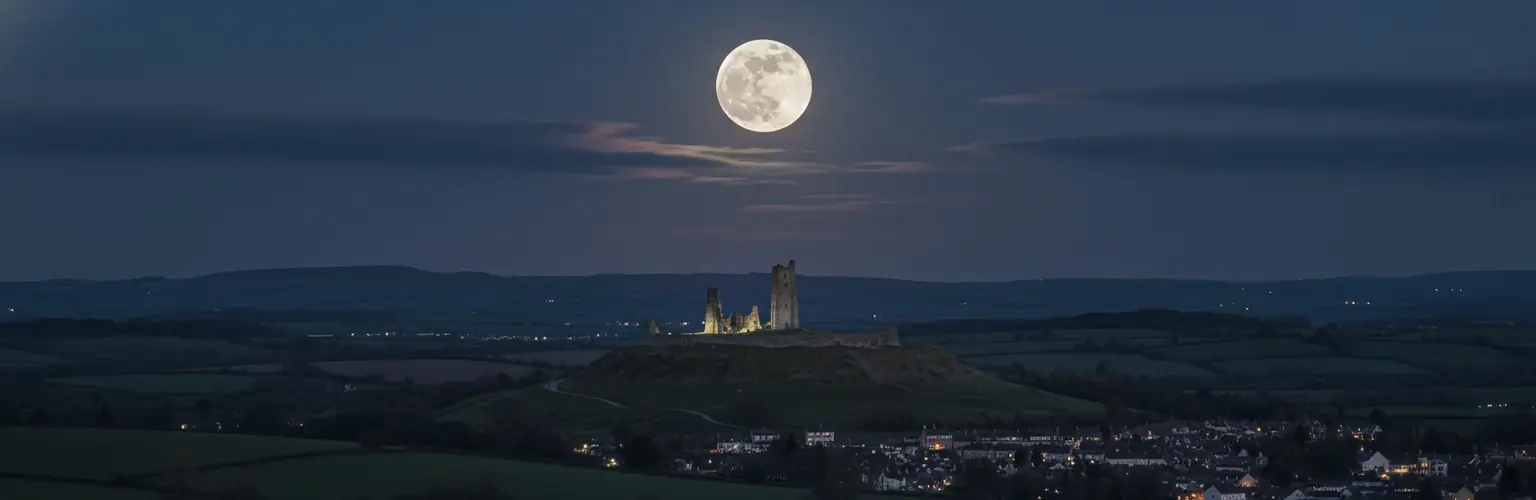
Glastonbury sits at 51° North, rising dramatically out of the Somerset Levels—a landscape that in ancient times was a true inland sea, leaving the Glastonbury Tor as the mythical "Isle of Avalon." Moon photography here is an exercise in capturing folklore; the moon rises over the Mendip Hills and illuminates the weathered medieval masonry of St. Michael's Tower. Whether you are seeking the "Avalon Mist" that makes the Tor appear to float or the precise alignment of the moon behind the beacon tower, Glastonbury offers a celestial experience where the veil between the modern world and ancient myth feels thin.
Glastonbury Tor – Summit
The absolute #1 viewpoint and a site of ancient power. Legend holds it as the gateway to the underworld (Annwn). The steep climb rewards you with a 360° panorama of the Vale of Avalon. The moon clears the Mendip Hills to the northeast and illuminates the tower. Extremely atmospheric and perfect for feeling the "veil is thin" energy. Free access 24/7; be prepared for high winds at the summit.
Wearyall Hill
Historically famous as the site of the Holy Thorn. Note for visitors: The original ancient tree was destroyed by vandals in 2010; currently, only a young replacement in a protective cage remains. However, the hill remains the premier spot for the classic profile shot of the Tor. From this ridge, you can align a telephoto lens to place the rising moon directly behind the Tor tower. Easy walk from the town centre.
Ham Wall / Avalon Marshes
To see why this was called the "Isle of Avalon," head to the Avalon Marshes at dusk. On misty moonlit nights, low-lying fog pools in the fields, and the Tor appears to float above a sea of white mist—a ghostly image. This is a premier spot for wildlife photographers. Note that car park fees apply (approx. £3) and the marshes are a short drive west of the town center.
Walton Hill (Polden Hills)
Located south/southwest of the town, this elevated ridge offers a stunning "compression" vantage point. From near the converted windmill (now a private residence), a telephoto lens (200mm+) makes the moon look massive as it hangs beside the Tor. It captures the rolling landscape of the Vale beautifully. The public car park nearby is a favored spot for local landscape professionals.
Windmill Hill
A modest residential hill on the eastern side of town providing a panoramic view of the Glastonbury skyline. The moon rises behind the Tor from this angle, often caught in the branches of trees along the ridge. It is a quiet, local alternative for those wanting to include the town's evening lights in their composition alongside the celestial arc.
Glastonbury Abbey Perimeter
The legendary burial place of King Arthur. Access Note: The Abbey grounds have strict closing hours (usually 6:00 PM or dusk, whichever is earlier) and do not stay open for nighttime viewing. However, the moon rising over the Gothic arches can be viewed and photographed from various points around the town escarpment and perimeter walls. Check the official site for specific closing times.
◉ Best Times for Moon Photography
📷 Quick Photography Tips
Glastonbury operates on GMT (UTC+0) in winter and BST (UTC+1) during summer. Clocks go forward the last Sunday in March and back the last Sunday in October. Because the Somerset horizon is dominated by the Mendip Hills to the northeast, the "actual" moonrise occurs slightly later than the mathematical horizon time.
The moon phase today in Glastonbury is shown in detail above. For the moon phase today in any other city or location worldwide, visit our Dynamic Moon Phase Calculator on the home page.
◐ What the Experience Actually Feels Like
There is a specific, heavy silence that falls over Glastonbury when the moon rises. Standing on the summit of the Tor, you aren't just on a hill; you are on the "Isle of Avalon." As the moon clears the Mendip Hills, it illuminates the surrounding Somerset Levels—flat, dark expanses that were once submerged under water. In the moonlight, the ancient geography of the Isle reappears, and the modern world of streetlights feels like a distant memory.
The experience is often communal. On a full moon night, you will likely hear the faint beat of drums or see the flickering of torches as people make the pilgrimage up the terraced slopes. The medieval tower catches the lunar light, its weathered stone glowing against the indigo sky. It is a place where the spiritual and the celestial meet; the wind howls through the roofless arches, and the entire landscape seems to hold its breath.
In the winter months, the real magic is the "Avalon Mist." From the lower vantage points of the marshes, you can watch the moonrise over a sea of white fog that pools in the valleys. Only the summit of the Tor and the ruins of the tower poke through the white blanket, illuminated from above by the moon. It is the quintessential image of Arthurian myth—a floating island in a sea of clouds.
"The medieval tower catches the lunar light, its weathered stone glowing against the indigo sky. It is a place where the spiritual and the celestial meet."
✓ Your Glastonbury Moon Chase Checklist
Before You Go
- Check the moonrise time on this page — remember that the hills to the northeast will delay the visual rise by several minutes
- Check the weather for "fog" or "mist" on the Somerset Levels; a clear sky with a mist warning is the best scenario
- Download PhotoPills or Stellarium to track the exact arc relative to St. Michael's Tower
- Check the ground conditions; if it has rained recently, Wearyall and Walton will be extremely muddy
- Verify Abbey hours: The grounds close at 6:00 PM or dusk (whichever is earlier) and do not allow night access
What to Bring
- Sturdy, waterproof boots — the climb up the Tor is steep and the clay soil stays slippery for days after rain
- A telephoto lens (200mm-400mm) for "compressing" the moon behind the medieval tower from Walton Hill
- Serious windproof layers — the summit of the Tor is completely exposed and can be significantly colder than the town
- A remote shutter release or use a 2-second timer to prevent tripod shake in the high winds
- Spare camera batteries — the cold Somerset air drains lithium power quickly during long night sessions
- A red-light headlamp to navigate the Tor paths without ruining your night vision
On the Night
- Arrive at your viewpoint 45 minutes early; the "Avalon Blue" hour before moonrise is often more ethereal than total darkness
- Focus manually on the moon’s edge; autofocus can often "hunt" in the dark Somerset countryside
- Bracket your exposures — take one for the moon's craters and one for the dark silhouette of the tower
- At the Marshes, stay low to the ground; the mist is most dramatic when viewed from a lower angle looking up
- Stay for 20 minutes after moonrise; the composition evolves as the moon clears the atmospheric haze
? Glastonbury Moon Phase — Frequently Asked Questions
Q. What is the moon phase today in Glastonbury?
The moon phase today in Glastonbury is a New Moon with 0% illumination. The next full moon is in 17 days, on Oct 26. Moonrise is at 6:03 AM and moonset at 5:55 PM.
Q. Where is the best place to view the moon in Glastonbury?
Glastonbury Tor's summit is the town's number one viewpoint, with the moon clearing the Mendip Hills to the northeast and illuminating St. Michael's Tower on a 360° panorama of the Vale of Avalon. Wearyall Hill gives the classic profile shot of the moon aligned directly behind the Tor tower, Walton Hill on the Polden Hills offers dramatic telephoto compression, and Ham Wall / Avalon Marshes is the place to catch the Tor appearing to float above low-lying mist.
Q. Are there access restrictions at any of Glastonbury's moon-viewing spots?
Yes. Glastonbury Abbey's grounds close at 6:00pm or dusk, whichever is earlier, and do not allow nighttime access, though the moon rising over its Gothic arches can still be viewed from the town escarpment and perimeter walls outside. The Tor itself is free and open 24/7, and Ham Wall's car park charges a fee of roughly £3.
Q. Does Glastonbury observe daylight saving time?
Yes. Glastonbury runs on GMT (UTC+0) in winter and switches to BST (UTC+1) in summer, with clocks going forward the last Sunday in March and back the last Sunday in October. The times shown on this page are already adjusted for whichever period applies today.
Q. What's the best time of year for moon photography in Glastonbury?
October through February is "Avalon Mist" season, the best window for low-lying fog inversions that make the Tor appear to float. November through January also brings the tightest tower alignments as the moon's path moves further south, while a full moon around May 1st (Beltane) draws drummers and celebrants to the summit for a shared moonrise.
Q. Does this page work for locations besides Glastonbury?
This page is set up specifically for Glastonbury, UK. For the moon phase in any other city or location worldwide, use the Dynamic Moon Phase Calculator on the moonphase.today home page.
✦ Explore Further
Moon Phase Today: Bath
Check tonight's moon phase in Bath, just down the road from Glastonbury in Somerset.
📷Moon Photography Guide
Camera settings, lenses, and techniques for shooting sharp, well-exposed moon shots.
📐Looney 11 Exposure Calculator
Dial in the exact f-stop, ISO, and shutter speed for a full moon — the same rule used in our Tor tower alignment tips.
🌆Blue Hour Calculator
Find tonight's exact "Avalon Blue" window to time your Tor moonrise shots.
NASA Moon Phase & Libration Gallery
NASA's Scientific Visualization Studio's daily renders of the moon's exact phase, libration, and orientation, straight from official mission data.