
Moon Phase Today Cardiff UK
On Friday, October 9, 2026, the moon in Cardiff is a New Moon with 0% illumination. Moon age: 28.9 days.
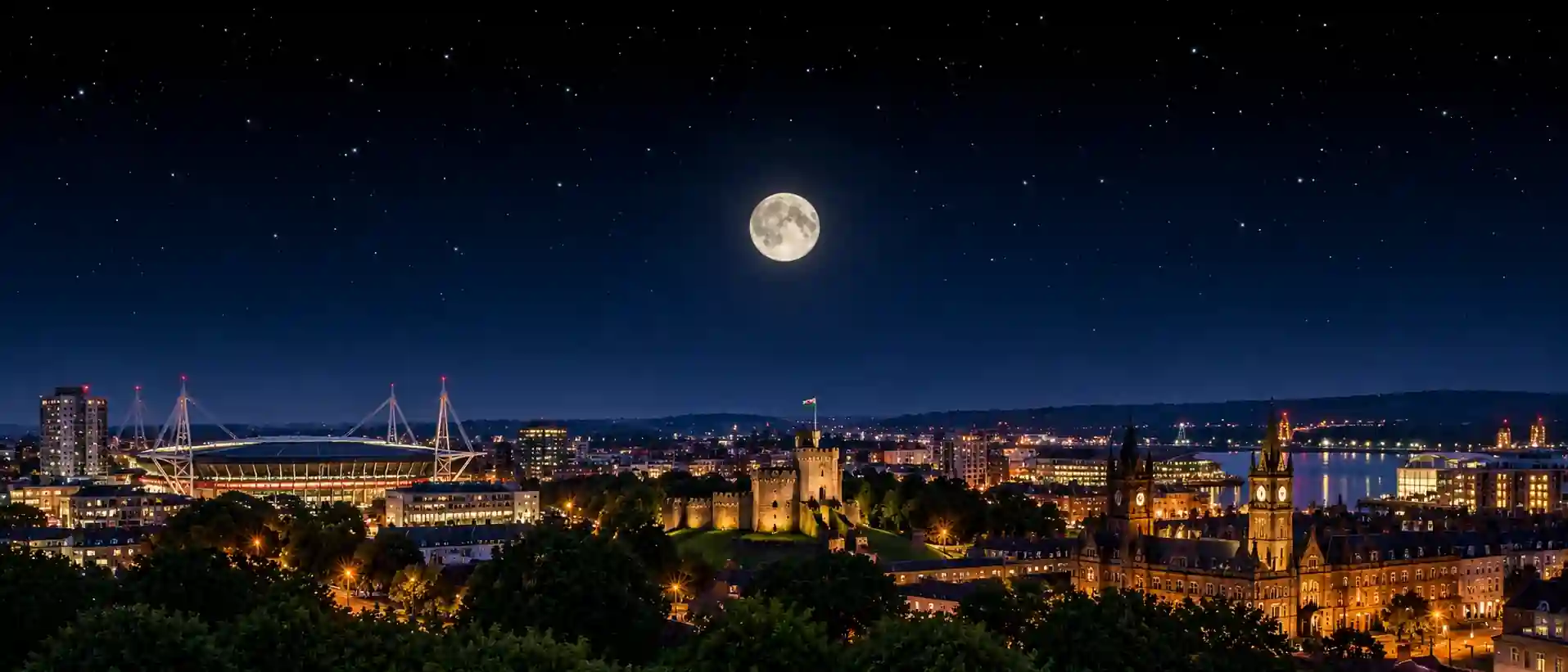
☽ Best Places to View the Moon in Cardiff, UK
Cardiff is a low-lying Welsh capital on the Severn Estuary, with a Victorian lake park, riverside castle grounds, a bay and barrage, and an astronomical society with its own observatory just outside the city. It also sits on one of the biggest tidal ranges in the world, which the moon drives. The city is bright, so the best moon-watching is over water and on organised telescope evenings.
Roath Park – Victorian Lake and Lighthouse
A Grade I registered Victorian park of about 130 acres, opened in 1894, with a 29-acre lake and the Scott Memorial Lighthouse. The lake can mirror the moon on a still night. The park and pleasure gardens are open from 7.30am to 30 minutes before sunset, but the recreation ground is open 24 hours a day.
Bute Park – Castle Grounds on the Taff
About 130 acres of gardens and parkland beside the River Taff, once part of the grounds of Cardiff Castle and presented to the people of Cardiff in 1947. The lawns give an open sky in the city centre. It is open daily from 7.30am to 30 minutes before sunset, and the council has locked its city-centre entrances at sunset, so plan a dusk visit.
Dyffryn Observatory – Cardiff Astronomical Society
The Society's observatory at Dyffryn Gardens, St Nicholas, just west of Cardiff, with an 11-inch telescope. It is away from the worst of the city's light pollution and opens to the public for star parties, and the National Trust holds stargazing events at the gardens. Check the Society's listings for dates and booking.
Techniquest – Planetarium in Cardiff Bay
The science centre on Stuart Street in Cardiff Bay has a planetarium and runs after-hours astronomy events, including eclipse evenings. It is a dependable indoor option when the Welsh weather turns cloudy. Check its event listings and booking.
Cardiff Bay Barrage – Open Water Horizon
The barrage gives a wide horizon over the bay and the Severn Estuary, where a low summer moon crosses the southern sky. It is listed as open daily from 7.30am to 30 minutes before sunset, so it suits a dusk moonrise rather than a late session. Check tide times, because the estuary's tides follow the moon.
Heath Park – Northern Parkland
A large northern park with sports and play facilities, woodland, ponds and wetland, one of the city's biggest green spaces. Its hours are given differently by different sources, with a 24-hour listing in some places and gates closed from 11pm to 6am in others, so check the council before a night visit.
◉ Best Times for Moon Photography in Cardiff
📷 Quick Photography Tips for Cardiff
🕐 Timezone: Cardiff runs on Greenwich Mean Time (GMT, UTC+0) in winter and British Summer Time (BST, UTC+1) in summer.
Horizons: Cardiff is low-lying, with buildings and trees hiding a low moon at street level. Open lawns, lakes and the waterfront over the Severn Estuary give the clearest sightlines.
Light: Cardiff is a large city with continuous street lighting. Darker skies lie north in Bannau Brycheiniog, Wales's first International Dark Sky Reserve, and the observatory at Dyffryn is away from the worst of the city's light.
Access: Bute Park, Victoria Park and Cefn Onn Park close 30 minutes before sunset, Roath Park's gardens too, with its recreation ground open 24 hours. Check the council for Heath Park.
The moon phase today in Cardiff is shown above. For the moon phase today anywhere else, visit the Dynamic Moon Phase Calculator.
◐ What the Experience Actually Feels Like
At Roath Park, Cardiff feels Victorian and still: the lake darkens, the lighthouse stands against the sky, and a rising moon lays a line of light across the water.
At Bute Park, it feels like green space in the middle of a capital. The lawns run down to the Taff, the castle sits just behind, and a pale early moon hangs over the trees before the gates close.
At Dyffryn and Cardiff Bay, it feels like a city that looks up: society telescopes pointed at the moon on a star party night, and the barrage and estuary opening out toward the south.
"A moon on the lake at Roath Park, a telescope at Dyffryn, and the Severn's biggest tides following the moon."
✓ Your Cardiff Moon Chase Checklist
Before You Go
- Check the moonrise time and azimuth for your date — a rising moon appears between north-east and south-east
- Check access — most parks close 30 minutes before sunset, Roath Park's recreation ground is open 24 hours, and Heath Park needs a council check
- Check tide times for the shoreline, and the Met Office for cloud, visibility, wind and rain
What to Bring
- A telephoto lens of 200mm or longer for a tight Moon, and a wide lens for the lake and the bay
- A tripod, and a remote shutter or 2-second timer
- A lens cloth for sea spray and damp air
- A warm, windproof layer and water-resistant footwear for wet paths
On the Night
- Focus manually on the Moon's edge
- Bracket exposures — one for the bright disc, one for the darker land or water
- Leave parks before their closing time, and keep to lit routes after dark
- A Green Flag award means well maintained, not open at night — check hours before you go
? Cardiff Moon Phase — Frequently Asked Questions
Q. What is the moon phase today in Cardiff?
The moon phase today in Cardiff is a New Moon with 0% illumination. The next full moon is in 17 days, on Oct 26. Moonrise is at 6:05 AM and moonset at 5:56 PM.
Q. Where is the best place to view the moon in Cardiff?
Roath Park, a Grade I registered Victorian park of about 130 acres opened in 1894, has a 29-acre lake with the Scott Memorial Lighthouse, which can mirror the moon on a still night. Bute Park, about 130 acres of landscaped gardens and parkland beside the River Taff that once formed the grounds of Cardiff Castle, has wide open lawns. Cardiff Bay Barrage gives a sea horizon over the Severn Estuary, Heath Park is a large northern park with woodland, ponds and wetland, and Cefn Onn Park is a woodland garden park on the northern edge.
Q. Can I look at the moon through a telescope near Cardiff?
Yes. Cardiff Astronomical Society, founded in 1975, has its observatory in the grounds of Dyffryn Gardens at St Nicholas, just west of the city, with an 11-inch telescope, and it opens it to the public for star parties, away from the worst of the city's light pollution. The National Trust also holds stargazing events at Dyffryn Gardens. Techniquest in Cardiff Bay has a planetarium and holds after-hours astronomy events. Check each organiser's listings for dates and booking, since observing depends on the weather, and a bright moon is the easiest first target.
Q. Where does the moon rise and set in Cardiff, and how high does it climb?
At about 51.5°N, Cardiff's moonrise and moonset points swing widely across the horizon each month, from roughly north-east to south-east for rising and north-west to south-west for setting, with an even wider swing in years near a major lunar standstill. A full moon near the winter solstice climbs to roughly 62° in the south, while a full moon near the summer solstice stays low, peaking near 15°, so it needs a clear view south, such as the open water of the Severn Estuary. Cardiff is low-lying, with buildings and trees hiding a low moon at street level, so open lawns, lakes and the waterfront give the clearest sightlines. Check the azimuth for your date and exact spot.
Q. Is light pollution a problem for moon observing in Cardiff?
The moon is bright enough to observe and photograph from almost anywhere in Cardiff, so light pollution rarely limits the lunar disc itself. It does wash out earthshine on a thin crescent and any faint sky detail. Cardiff is a large city with continuous street lighting, so stars will be faint across the city, including in its parks. For genuinely dark skies, Bannau Brycheiniog, the Brecon Beacons, to the north became Wales's first International Dark Sky Reserve in 2012, and Cardiff University's astronomy society makes observing trips there.
Q. What camera settings and phases work best for moon photography in Cardiff?
For a full moon, start with Looney 11 (f/11, ISO 100, 1/100 s) and refine using your histogram, since it is a baseline rather than a guarantee. The moon is much brighter than parkland, lakes and the city, so shoot RAW and bracket or blend exposures to keep both crater detail and the foreground. A waxing gibbous is useful for blue hour over the water while some daylight remains. For a moon-and-landmark shot, move farther back and use a longer focal length of 200 mm or more, with a sturdy tripod on windy waterfront ground and manual focus on the moon's edge using magnified live view. Roath Park's lake can give a reflection when the water is still.
Q. How do tides, cloud and mist affect moon viewing in Cardiff?
Cardiff sits on the Severn Estuary, which has one of the largest tidal ranges in the world, and the biggest spring tides come around the full and new moon, so check tide times before heading to the shoreline. Cardiff has a mild, wet maritime climate with frequent Atlantic cloud and rain, so clear lunar windows can be short, and mist can gather over the estuary, the bay and the lake on cool, still nights. Waterfront ground is windy and paths can be wet and muddy after rain. Check the Met Office forecast for cloud, visibility, wind and rain.
Q. What time zone are Cardiff's moonrise and moonset times shown in?
Cardiff runs on Greenwich Mean Time, UTC+0, in winter and British Summer Time, UTC+1, in summer. Clocks go forward on the last Sunday in March and back on the last Sunday in October, and moonrise and moonset times on this page follow the local clock in effect on each date. Cardiff lies at about 3.2°W, west of the Greenwich meridian on which GMT is based, so the sun and moon cross the sky roughly 13 minutes later on the clock than at Greenwich.
Q. Can I shoot the moon at Cardiff's viewpoints after dark?
Mostly not in the main parks. Bute Park is open daily from 7.30am to 30 minutes before sunset, and the council has locked its city-centre entrances at sunset, though a commuter route through it is open 24 hours and unlit. Roath Park's park and pleasure gardens keep the same hours, with its recreation ground open 24 hours a day, and Victoria Park and Cefn Onn Park also close before sunset. Heath Park's hours are given differently in different places, so check the council's current times. Cardiff Bay Barrage is listed with the same sunset closing, so an evening visit needs planning.
✦ Explore Further
Moon Phase Today: Glastonbury
Check tonight's moon phase in Glastonbury, roughly 49 km east-south-east of Cardiff across the Severn Estuary.
🛁Moon Phase Today: Bath
See the moon over Bath, roughly 58 km east of Cardiff on the River Avon.
🇬🇧Moon Phase in the UK
Browse moon phase pages for cities across the United Kingdom, from Edinburgh to Bath.
🌍World Moon Phase Directory
Find the moon phase, rise and set times for cities in every region of the world.
Blue Hour Calculator
Work out when blue hour falls, ideal for waxing gibbous shots over Roath Park Lake and Cardiff Bay.