
Moon Phase Today Sakarya
On Sunday, October 4, 2026, the moon in Sakarya is a Last Quarter with 45% illumination. Moon age: 22.6 days.
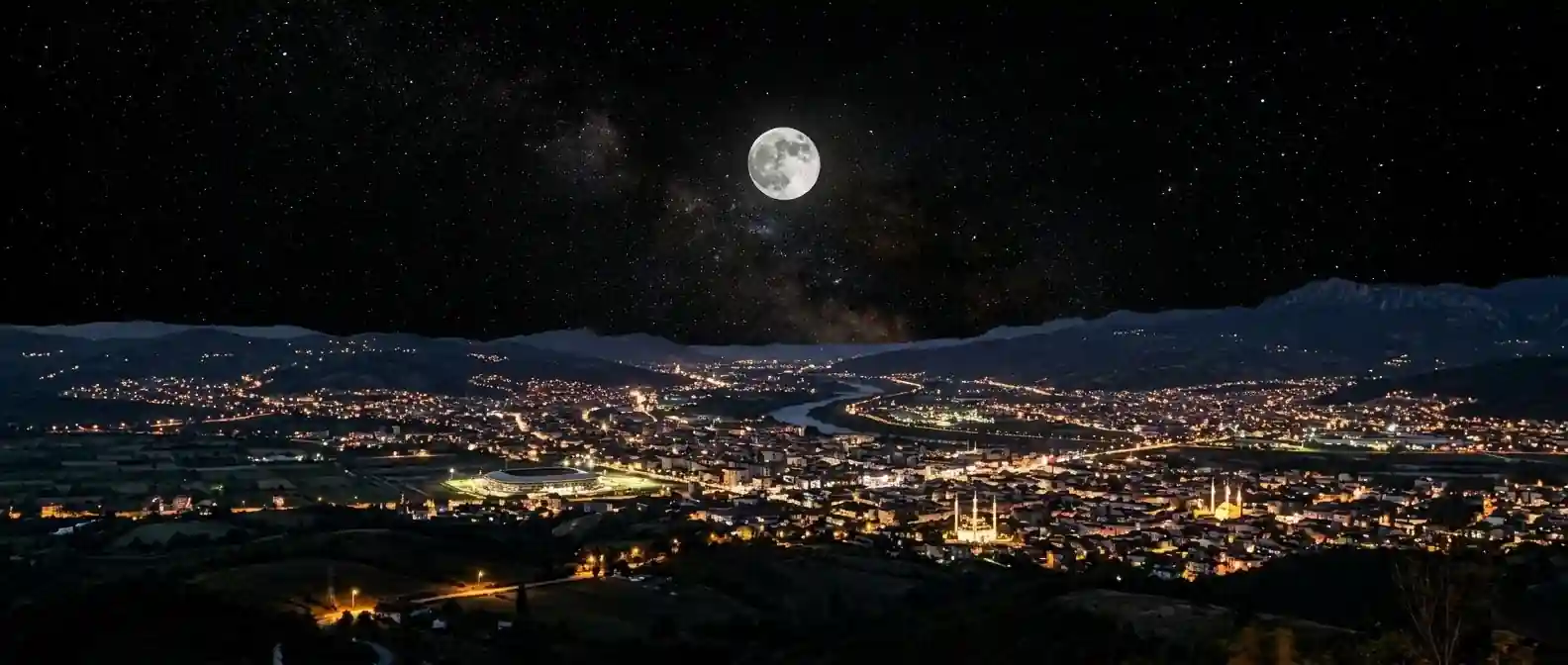
☽ Best Places to View the Moon in Sakarya, Turkey
Sakarya sits where the Marmara region meets the Black Sea, so one province gives you a low plain, a lake, a sandy coast and forested highlands. Sapanca Lake, between Adapazarı and İzmit, gives water for reflections. The Black Sea beaches at Karasu and Kocaali face roughly north, so the Moon rises over the water only when it rises north of due east, and sets over the water only when it sets north of due west. Higher ground at Keremali and the province's highest peak, Dikmen Tepesi, is colder and generally darker than the plain, though it is remote and mountain cloud and fog are common. Exact Moonrise and Moonset directions change with the date and your observing position, so check both before planning a specific composition.
Sapanca Lake – Water and Hills East of İzmit
Sapanca Lake lies east of the İzmit Gulf and spans the Sakarya–Kocaeli provincial boundary. It covers about 47 km², is about 17 km long and 5 km wide, and sits at roughly 31 m above sea level. The lake runs roughly east to west, so from its shores the Moon can rise or set along the water, and its surrounding hills can provide Moon-and-water compositions, although the exact foreground and horizon depend on your viewing location.
Karasu & Kocaali – Sandy Black Sea Beaches
Sandy beaches along the Black Sea at Karasu and Kocaali, part of a coastline of roughly 54 km of managed beaches in recent municipal material. The coast faces roughly north, so the open sea gives a broad horizon, and the Moon rises or sets over the water only when it is north of due east or due west. Landward horizons to the east and west can have obstructions. Dunes and forest are protected, so stay on paths.
Poyrazlar Lake – Sheltered Lake Near the City
Poyrazlar Lake lies about 8 km from the centre of Adapazarı, according to the Turkish Culture Portal, with an area of about 67 hectares and a shoreline of about 2.4 km. It is forest-fringed and sheltered, which makes it useful for stable tripod work close to the city, rather than for a wide horizon. Check the nature area's current rules before an evening visit.
Sakarya River Mouth – Black Sea Estuary
Near Karasu, the Sakarya River forms a web of estuary channels where it meets the Black Sea. The low, flat ground is open to the north, with sea-facing views, which suits wide-field Moon and estuary compositions. Conditions around the water can change, so stay on public paths.
Keremali – Major High Area
Keremali is listed at about 1,543 m and takes its name from a tomb near the summit. It is a major high-elevation area that is potentially darker than the city, but it is remote, reached by forest roads, with colder conditions in winter, and mountain cloud and fog can reduce visibility. Check road, snow and park conditions before going.
Dikmen Tepesi – Highest Peak in the Province
Dikmen Tepesi is the province's highest peak, listed at about 1,720 m by forestry information and 1,722 m by the Culture and Tourism portal, with wide horizons above the forest. It is colder than the plain in winter and subject to mountain cloud and fog, and it is reached by forest roads, so check access before an evening visit.
◉ Best Times for Moon Photography in Sakarya
📷 Quick Tips for Sakarya
🕐 Timezone: Sakarya uses Turkey Time (TRT), UTC+3, year-round. Turkey has used a single permanent time zone since September 2016 and does not observe daylight saving. Europe/Istanbul zone.
🔭 Telescope Option: There is no regular public telescope night widely advertised in Sakarya. Nearby, the Kocaeli Metropolitan Municipality's Science Center has held a two-day sky-observation festival at Kuzuyayla Tabiat Parkı in Kartepe, which looks toward Sapanca Lake. Check the municipalities' announcements for dates.
Access: Karasu and Kocaali are reached by the coastal road and Sapanca by the main road from İzmit. Poyrazlar Lake is about 8 km from Adapazarı. Keremali and Dikmen Tepesi are reached by forest roads, so check winter snow and park rules.
The moon phase today in Sakarya is shown above. For moon phase today anywhere else, visit the calculator on our home page.
◐ What It Feels Like
On the Karasu and Kocaali beaches, the open Black Sea gives a broad horizon that works well for a Moonrise or Moonset when the Moon's azimuth falls over the water, with the dunes and forest behind you.
At Sapanca Lake, the water is calm with hills around it, and orchards and the surrounding mountains frame Moon reflections depending on your viewing spot.
On Keremali and Dikmen Tepesi, the air is colder than on the plain and potentially darker than urban Sakarya, though mountain cloud and fog can reduce visibility.
"From a low plain and a calm lake to sandy Black Sea beaches and forested ridges — water, sea horizons and high forest clearings."
✓ Checklist for Lunar Observers
Before You Go
- Check moonrise and moonset azimuth for your date — it varies with the Moon's declination, and decides whether it rises over the sea or over land
- Check the MGM forecast — Black Sea mist and cloud over the hills
- Confirm access: the beaches at Karasu and Kocaali, Sapanca Lake, Poyrazlar Lake, and the forest roads to Keremali and Dikmen Tepesi
What to Bring
- Telephoto 200 mm or longer, and a wide lens for lake and beach foregrounds
- Tripod for landscapes and bracketing — a close-up Moon can be shot handheld with a fast shutter
- Lens cloth for sea spray and humidity
- A warm layer — the highlands are much colder than the plain
On the Night
- Manual focus on the lunar limb or a distant object
- Bracket for the disc and the lake, forest and beach
- Stay on paths — the dunes and forest are protected
- Move away from the city's light dome — higher ground is generally darker, but not a dark-sky site
? Sakarya Moon Phase — Frequently Asked Questions
Q. What is the moon phase today in Sakarya?
The moon phase today in Sakarya is a Last Quarter with 45% illumination. The next full moon is in 23 days, on 26 Oct. Moonrise is at — and moonset at 3:24 PM.
Q. Where is the best place to view the moon in Sakarya?
Sakarya combines a low plain, a lake, a Black Sea coast and mountains. Sapanca Lake, about 47 km² and 17 km long, lies between Adapazarı and İzmit and gives water for reflections, with hills around it. The sandy Black Sea beaches at Karasu and Kocaali face roughly north, with an open sea horizon. Poyrazlar Lake, about 8 km from the centre of Adapazarı, is a small forest-fringed lake close to the city. For height, the province's highest peak, Dikmen Tepesi, is listed at about 1,720 m, with Keremali at about 1,543 m, though both are remote and need forest roads.
Q. Can I look at the moon through a telescope in Sakarya?
A regular public telescope night is not widely advertised in Sakarya. Nearby, the Kocaeli Metropolitan Municipality's Science Center has held a two-day sky-observation festival at Kuzuyayla Tabiat Parkı in Kartepe, which looks toward Sapanca Lake, with telescopes and about 17,000 visitors. Check the municipalities' announcements for dates, since observing depends on the weather.
Q. Where does the moon rise and set in Sakarya, and how high does it climb?
At about 40.8°N, Sakarya's moonrise and moonset points swing widely across the horizon each month, from roughly east-north-east to east-south-east for rising and west-north-west to west-south-west for setting, with an even wider swing in years near a major lunar standstill. A full moon near the winter solstice climbs to roughly 73° in the south, while a full moon near the summer solstice stays lower, peaking near 26°. On the north-facing Black Sea coast, the moon rises over the water only when it rises north of due east, and sets over the water only when it sets north of due west, and otherwise it rises or sets over land. Check the azimuth for your date and exact spot.
Q. Is light pollution a problem for moon observing in Sakarya?
The moon is bright enough to observe and photograph from almost anywhere in Sakarya, so light pollution rarely limits the lunar disc itself. It does wash out earthshine on a thin crescent and any faint sky detail. Adapazarı and the industrial corridor toward İzmit are brightly lit, so stars are faint on the plain and around Sapanca. The forested highlands and the coast away from the towns are darker, though no measured dark-sky designation is listed for them, so treat them as better, not dark.
Q. What camera settings and phases work best for moon photography in Sakarya?
For a full moon, start with Looney 11 (f/11, ISO 100, 1/100 s) and refine using your histogram, since it is a baseline rather than a guarantee. The moon is much brighter than the lakes and forests, so shoot RAW and bracket or blend exposures to keep both crater detail and the foreground. A waxing gibbous suits blue hour at Sapanca Lake and Karasu while the foreground is still lit. For close-ups the moon is bright enough to shoot handheld with a fast shutter, while a tripod suits landscapes and bracketing, and humidity and haze can reduce sharpness, so focus manually on the moon's edge using magnified live view.
Q. How do Black Sea mist, humidity and cloud affect moon viewing in Sakarya?
Sakarya has a damp climate, with mist off the Black Sea and cloud over the hills that can move in quickly. Humidity and haze can lower contrast and reduce sharpness, so check the Turkish State Meteorological Service forecast for cloud, mist and visibility shortly before you go. The highlands are much colder than the 30 m plain and can have snow in winter, so bring a warm layer.
Q. What time zone are Sakarya's moonrise and moonset times shown in?
Sakarya runs on Turkey Time, UTC+3, all year. Turkey has used a single permanent time zone since September 2016 and does not change its clocks. Moonrise and moonset times on this page follow the local clock. Sakarya lies at about 30.4°E, west of the 45°E meridian on which UTC+3 is based, so the sun and moon cross the sky about 58 minutes later on the clock than they would on that meridian.
Q. Can I shoot the moon at Sakarya's viewpoints after dark?
Mostly, with care, but check each place. The beaches at Karasu and Kocaali and the shore of Sapanca Lake are public, though dunes and forest are protected, so stay on paths. Poyrazlar Lake is a nature area, so check its current rules. The highlands of Dikmen Tepesi and Keremali are reached by forest roads, which can have snow in winter, so check road and park conditions before an evening visit.
✦ Explore Further
Moon Phase Today: Kocaeli
Check tonight's moon phase in Kocaeli, roughly 40 km west of Sakarya around the İzmit Gulf.
🕌Moon Phase Today: Istanbul
See the moon over Istanbul, roughly 125 km west-north-west of Sakarya on the Bosphorus.
🌍World Moon Phase Directory
Find the moon phase, rise and set times for cities in every region of the world.
Blue Hour Calculator
Work out when blue hour falls, ideal for waxing gibbous shots over Sapanca Lake.