
Moon Phase Today Kocaeli
On Sunday, October 4, 2026, the moon in Kocaeli is a Last Quarter with 45% illumination. Moon age: 22.6 days.
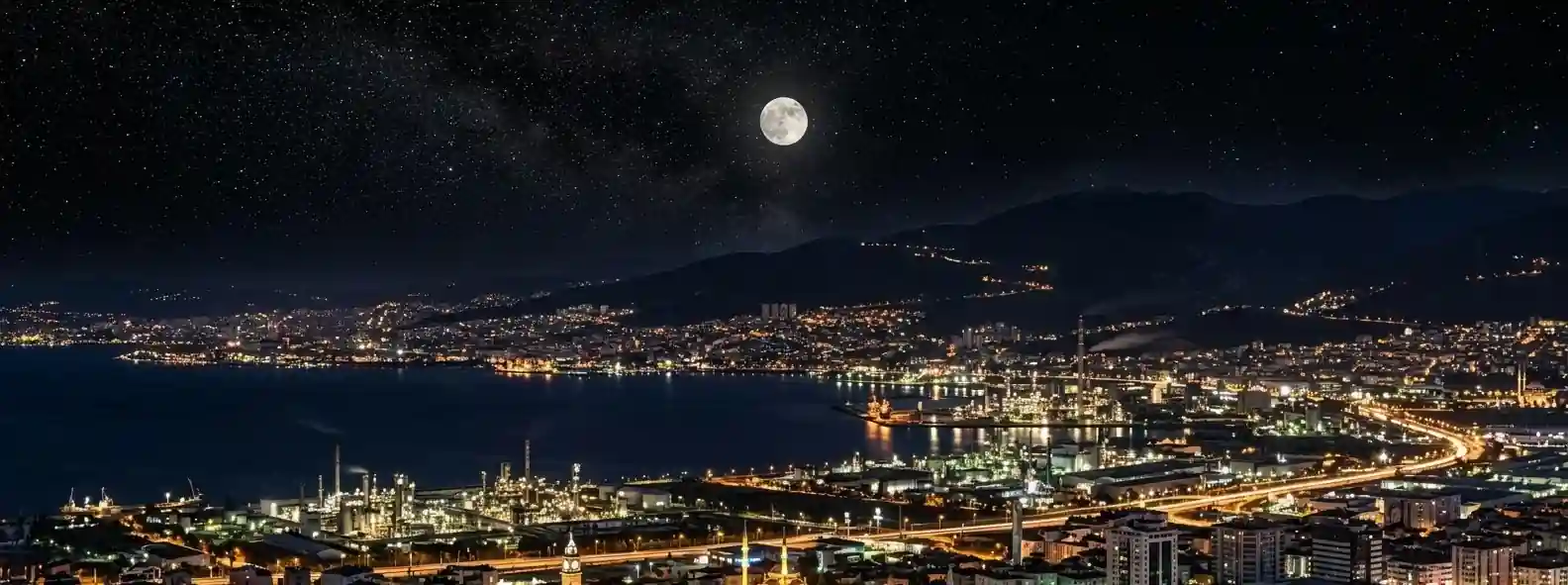
☽ Best Places to View the Moon in Kocaeli, Turkey
Kocaeli offers several very different settings for watching and photographing the Moon, from the İzmit Gulf waterfront to the forested slopes of Kartepe and the canyon landscape around Gebze. Sekapark provides a long waterfront setting with open views across the Gulf, while Başiskele Sahili offers another broad coastal foreground. Higher in Kartepe, Kuzuyayla Tabiat Parkı combines elevated terrain with views toward Sapanca Lake and a more natural landscape. Ormanya provides extensive woodland and open recreation areas, while Ballıkayalar Tabiat Parkı offers a very different canyon environment. The Kartepe Teleferik connects Derbent with Kuzuyayla and can be useful when planning a mountain viewing trip, subject to its operating schedule. The Moon rises in the east and sets in the west, and the İzmit Gulf stretches west from the city, so from the waterfront a setting Moon can drop over the water, while a rising Moon comes up over the land behind you. The Moon's exact rise time, altitude and direction still depend on the date and your observing location, so check those details before attempting a particular Moonrise composition.
Sekapark
A large waterfront park on the İzmit shoreline, created through the redevelopment of the former SEKA paper-factory site. The park includes a long walking and cycling route, waterfront areas, artificial hills, open recreation spaces and the distinctive Uçurtma Tepesi area. The Gulf lies to the west, the direction of Moonset, so a setting Moon, mostly a waning Moon in the morning or a crescent in the evening, can drop over the water. Its combination of water, open sky and city infrastructure makes it useful for Moon photography with an urban Kocaeli foreground. Park facilities and individual attractions can have their own operating arrangements, so check current local notices before a late visit.
Başiskele Sahili
The Başiskele waterfront follows the southern shore of İzmit Gulf and provides a broad coastal setting for observing the Moon. The promenade includes areas used for walking, running and cycling, with open views across the water. A low Moon over the Gulf can create a strong landscape composition, particularly when the Moon's azimuth places it over the water, and for a setting Moon that means looking west along the Gulf. Current shoreline works or individual facility access can change conditions, so check local notices before planning a specific setup.
Kuzuyayla Tabiat Parkı & Kartepe Teleferik
A protected nature area on Kartepe with elevated terrain and views toward Sapanca Lake, which lies to the east-north-east, near the direction where the Moon rises. Kocaeli Metropolitan Municipality identifies Kuzuyayla as suitable for day hiking, photography, wildlife observation and cycling. Current visitor hours are listed as Tuesday through Sunday, 09:00–19:00, with the park closed on Mondays. The Kartepe Teleferik links Derbent with Kuzuyayla over a 4.7-kilometre line in about 14 minutes, with a daytime timetable of 10:00–19:00. Listings differ on whether it runs on Mondays, so confirm before travelling. The cable car is an access option, not a late-night observing platform.
Ormanya Doğal Yaşam Parkı
A large natural-life park in Uzuntarla, Kartepe, reported at about 4,000 decares, including walking and cycling routes, wildlife areas, a bird-observation area, camping facilities and recreation spaces. Its extensive woodland gives Moon photographers plenty of natural foreground possibilities, although it is not a dark-sky site. Ormanya is closed on Mondays except when a Monday coincides with an official holiday. Visitor hours vary seasonally, so check the current schedule before planning a Moon session.
Ballıkayalar Tabiat Parkı
Near Tavşanlı in Gebze, Ballıkayalar is a protected natural area known for its limestone canyon landscape, walking routes and rock-climbing terrain. The natural rock walls and vegetation can provide striking foregrounds when the Moon is positioned above the canyon landscape. This is a nature area rather than a dedicated astronomical facility, so conditions underfoot, weather and current site arrangements should be considered before visiting, especially after dark.
Kocaeli Science Center Sky-Watching at Kuzuyayla
Kocaeli Metropolitan Municipality's Science Center has held a two-day sky-observation festival, Gökyüzü Gözlem Şenliği, at Kuzuyayla Tabiat Parkı, where about 17,000 visitors looked at stars and planets through telescopes and watched the Perseid meteor shower, with talks by astronomers. This is the best chance in the province to see the Moon through a telescope. It is a scheduled event, not a nightly service, so check the Science Center's announcements for dates.
◉ Best Times for Moon Photography
📷 Quick Photography Tips
🕐 Timezone: Kocaeli uses Turkey Time (TRT), UTC+3 year-round. Türkiye has used a single permanent time zone since September 2016 and does not observe seasonal daylight-saving clock changes. When planning a Moonrise or Moonset composition, use the local date and time shown for Kocaeli and verify the Moon's exact azimuth and altitude for the specific location you plan to photograph.
🔭 Telescope Option: There is no regular public telescope night widely advertised in Kocaeli. The Kocaeli Metropolitan Municipality's Science Center has held a two-day sky-observation festival at Kuzuyayla Tabiat Parkı in Kartepe, with telescopes for stars and planets. Check its announcements for dates.
The moon phase today in Kocaeli is shown in detail above — complete with exact illumination percentage, moonrise/set times, and the best local spots to see it. For the moon phase today in any other city worldwide, visit our Dynamic Moon Phase Calculator on the home page.
◐ What the Experience Actually Feels Like
Sekapark gives Moon watching a distinctly urban waterfront character. The park sits directly along the İzmit shoreline on the former SEKA industrial site and combines waterfront paths, open recreation areas, artificial hills and other facilities. For photographers, the important advantage is the combination of open sky and water, which can provide a natural foreground when the Moon is low enough over the Gulf, and with the Gulf to the west that usually means a setting Moon.
Başiskele provides another Gulf-side perspective, this time from the southern shoreline. The long coastal recreation area is designed around walking, running and cycling, with open views across the water. A low Moon here can feel much more expansive than one viewed among dense city buildings, although the exact composition depends on the Moon's azimuth on the chosen date.
Higher in Kartepe, the experience changes dramatically. Kuzuyayla Tabiat Parkı is a protected natural setting with a view toward Sapanca Lake and forested mountain scenery. Kocaeli Metropolitan Municipality specifically identifies photography and nature observation among the area's uses, and its Science Center has held a sky-watching festival here. Because current visitor hours end at 19:00 and Mondays are closed, it should not be treated as an unrestricted all-night observing site.
Ormanya offers a similarly natural setting but on a much larger scale. The park contains extensive walking and cycling routes, wildlife areas, bird observation facilities and recreation areas. Its visitor schedule changes with the season, and the park is closed on Mondays except when a Monday is an official holiday. That makes checking the current schedule particularly important when planning a lunar visit.
Ballıkayalar provides the most rugged landscape on this list. Its canyon, limestone walls and vegetation create a very different foreground from the Gulf or Kartepe. It is a protected natural environment rather than a dedicated astronomical facility, so visitors should plan around current site conditions and should not assume that every part of the park is suitable for nighttime access.
"Kocaeli's Moon-viewing experience ranges from Gulf waterfronts and city lights to forested mountain scenery, protected natural areas and the highland landscape of Kartepe."
✓ Your Kocaeli Moon Chase Checklist
Before You Go
- Check the Moon's rise time, altitude and azimuth for your date and exact Kocaeli observing location — the Moon's direction can change substantially from one date to another
- If you're planning a waterfront composition, use PhotoPills or Stellarium to determine whether the Moon will set over the İzmit Gulf or another useful part of the landscape
- Verify Site Access: Kuzuyayla currently lists Tuesday–Sunday visitor hours of 09:00–19:00 and is closed Mondays. Ormanya also closes Mondays and changes its opening hours seasonally.
- If using the Kartepe Teleferik, check its operating schedule before travelling. The municipal schedule is listed as 10:00–19:00 Tuesday–Sunday, but some listings show daily service, so confirm Monday operation.
- Check cloud cover and visibility before leaving, particularly if you're planning a precise Moonrise composition
- Allow extra time when travelling from the İzmit waterfront toward Kartepe or Gebze, as Kocaeli covers a large and geographically varied area
What to Bring
- A telephoto lens — 200mm or longer can be useful when you want the Moon to appear relatively large beside a distant Kocaeli landmark, depending on your shooting distance
- A warm layer for elevated Kartepe locations, particularly outside summer. Conditions can differ substantially between the Gulf shoreline and the mountain environment.
- A remote shutter release or a 2-second timer to reduce camera shake during tripod photography
- A small flashlight can be useful when walking natural-area paths, but avoid shining bright light toward other visitors or wildlife
- A backup viewing location in case cloud, crowds, access restrictions or changing conditions affect your original composition
On the Night
- Arrive early when photographing a planned Moonrise so you have time to establish your foreground, camera position and composition
- If autofocus struggles in low light, switch to manual focus and focus carefully on the Moon's edge or another distant subject
- Bracket your exposures when photographing both the bright lunar disc and a much darker waterfront, forest or skyline
- If the Moon looks soft or hazy near the horizon, consider waiting until it rises higher. The longer atmospheric path at low altitude can increase scattering and apparent distortion.
- At Kuzuyayla, Ormanya and Ballıkayalar, follow the site's current visitor rules rather than assuming that late-night access is permitted
Use the tools on this page, check the current site access information, pick your vantage point, and catch a Kocaeli moonrise for yourself.
? Kocaeli Moon Phase — Frequently Asked Questions
Q. What is the moon phase today in Kocaeli?
The moon phase today in Kocaeli is a Last Quarter with 45% illumination. The next full moon is in 23 days, on 26 Oct. Moonrise is at — and moonset at 3:26 PM.
Q. Where is the best place to view the moon in Kocaeli?
Kocaeli covers very different landscapes, so choose by the view you want. Sekapark, a large park on the İzmit shoreline built on the site of the former SEKA paper factory, has waterfront paths, artificial hills and a kite hill, and looks west down the İzmit Gulf, the direction the moon sets. The Başiskele waterfront follows the Gulf's southern shore. In the mountains of Kartepe, Kuzuyayla Tabiat Parkı has views toward Sapanca Lake and is reached by the Kartepe cable car from Derbent, and Ormanya is a large natural-life park in Uzuntarla. Ballıkayalar Tabiat Parkı, near Gebze, is a limestone canyon.
Q. Can I look at the moon through a telescope in Kocaeli?
Occasionally. The Kocaeli Metropolitan Municipality's Science Center has held a two-day sky-observation festival, Gökyüzü Gözlem Şenliği, at Kuzuyayla Tabiat Parkı in Kartepe, where about 17,000 visitors looked at stars and planets through telescopes and watched the Perseid meteor shower, with talks by astronomers. A regular public telescope night is not widely advertised, so check the Science Center's announcements for dates, since observing depends on the weather.
Q. Where does the moon rise and set in Kocaeli, and how high does it climb?
At about 40.8°N, Kocaeli's moonrise and moonset points swing widely across the horizon each month, from roughly east-north-east to east-south-east for rising and west-north-west to west-south-west for setting, with an even wider swing in years near a major lunar standstill. A full moon near the winter solstice climbs to roughly 73° in the south, while a full moon near the summer solstice stays lower, peaking near 26°. The İzmit Gulf stretches west from the city, so from Sekapark a setting moon, mostly a waning moon in the morning or a crescent in the evening, can drop over the water, while a rising moon comes up over the land behind you. Check the azimuth for your date and exact spot.
Q. Is light pollution a problem for moon observing in Kocaeli?
The moon is bright enough to observe and photograph from almost anywhere in Kocaeli, so light pollution rarely limits the lunar disc itself. It does wash out earthshine on a thin crescent and any faint sky detail. Kocaeli is a heavily industrial and densely populated province on the road between Istanbul and Ankara, so stars are faint along the Gulf and the lights of the waterfront add to the glow. The mountain areas of Kartepe are darker than the shoreline, but they are not dark-sky sites.
Q. What camera settings and phases work best for moon photography in Kocaeli?
For a full moon, start with Looney 11 (f/11, ISO 100, 1/100 s) and refine using your histogram, since it is a baseline rather than a guarantee. The moon is much brighter than the Gulf, the forests and the city lights, so shoot RAW and bracket or blend exposures to keep both crater detail and the foreground. A full moon is not always the best phase for showing surface relief. For a moon-and-landmark shot, move farther back and use a longer focal length of 200 mm or more, with a sturdy tripod where allowed and manual focus on the moon's edge using magnified live view. The moon illusion makes a low moon look huge, but it is perceptual, not a change in size.
Q. How do coastal and mountain weather differ for moon viewing in Kocaeli?
The İzmit Gulf shoreline and the Kartepe mountains can have noticeably different weather and visibility, so check cloud cover and visibility for the exact place you plan to shoot. Cloud and haze can sit over the Gulf while the heights are clear, or the other way round, and mountain viewpoints such as Kuzuyayla can be much colder and windier than the shoreline, especially outside summer, so bring a warm layer.
Q. What time zone are Kocaeli's moonrise and moonset times shown in?
Kocaeli runs on Turkey Time, UTC+3, all year. Turkey has used a single permanent time zone since September 2016 and does not change its clocks. Moonrise and moonset times on this page follow the local clock. Kocaeli lies at about 29.9°E, west of the 45°E meridian on which UTC+3 is based, so the sun and moon cross the sky about an hour later on the clock than they would on that meridian.
Q. Can I shoot the moon at Kocaeli's viewpoints after dark?
Not at all of them. Kuzuyayla Tabiat Parkı currently lists visitor hours of 09:00 to 19:00, Tuesday to Sunday, and is closed on Mondays, and the Kartepe cable car from Derbent runs on a daytime timetable, from 10:00 to 19:00, so the mountain is not an all-night site. Listings differ on whether the cable car runs on Mondays, so check before travelling. Ormanya is closed on Mondays and changes its hours with the season. The waterfront at Sekapark and Başiskele is public, but check local notices for any works or facility closures. Ballıkayalar is a protected natural area, so check conditions before visiting after dark.
✦ Explore Further
Moon Phase Today: Sakarya
Check tonight's moon phase in Sakarya, roughly 40 km east of Kocaeli beside Sapanca Lake.
🕌Moon Phase Today: Istanbul
See the moon over Istanbul, roughly 85 km west-north-west of Kocaeli on the Bosphorus.
🌍World Moon Phase Directory
Find the moon phase, rise and set times for cities in every region of the world.
Blue Hour Calculator
Work out when blue hour falls, ideal for waxing gibbous shots over the İzmit Gulf.