
Moon Phase Today Mersin
On Sunday, October 4, 2026, the moon in Mersin is a Last Quarter with 45% illumination. Moon age: 22.6 days.
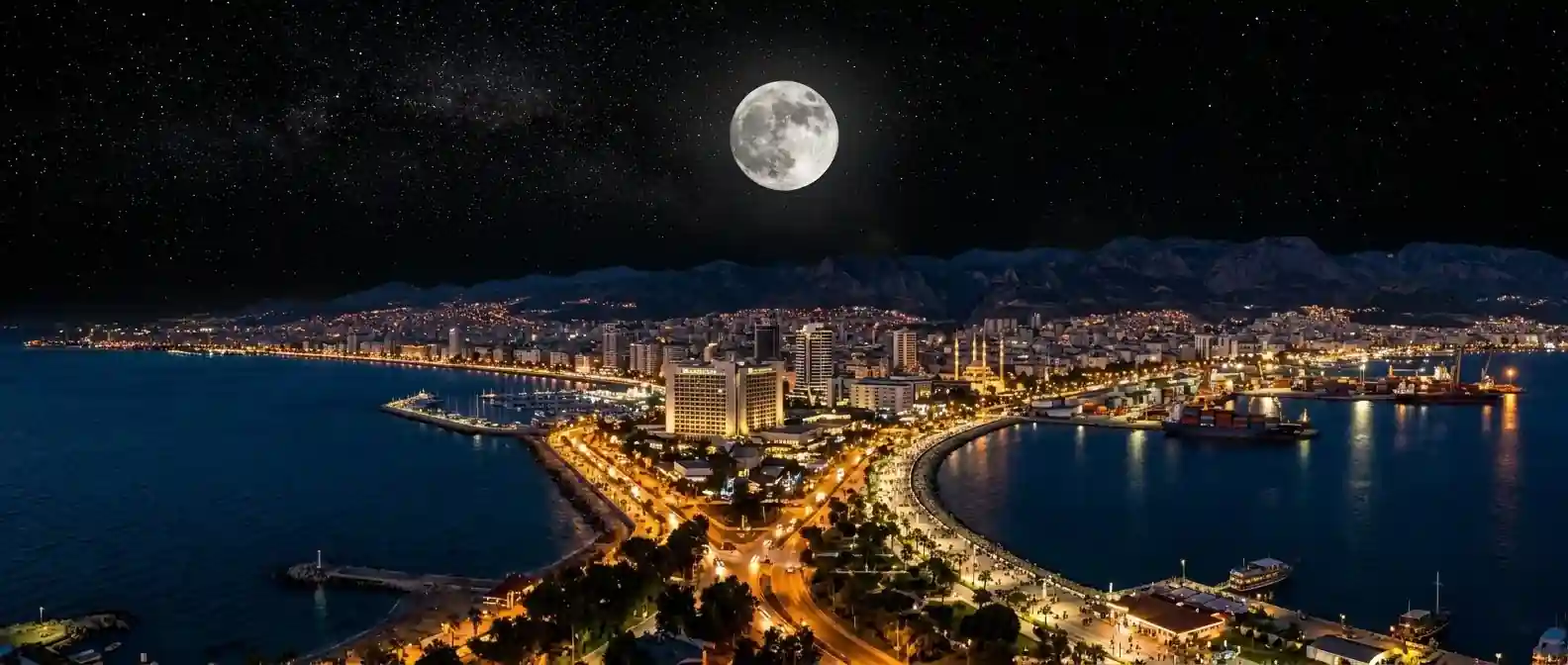
☽ Best Places to View the Moon in Mersin, Turkey
Mersin stretches along the south-eastern Mediterranean, with long beaches backed by the Bolkar section of the Central Taurus. The coast faces south, so the Moon, which rises in the east and sets in the west, crosses the sky above the sea in front of you, and the east-south-east and west-south-west ends of its range fall over the water, while the Taurus rises to the north, where the Moon never rises or sets. Low coastline and wide deltas give you broad sea horizons, while high peaks inland offer elevated viewpoints away from the coastal lights. Exact Moonrise and Moonset directions change with the date and your observing position, so check both before planning a specific composition.
Medetsiz Tepe – 3,524 m Bolkar Summit
Official Mersin tourism information identifies Medetsiz Tepesi, at 3,524 m, as the highest point of the Bolkar Mountains, in Çamlıyayla district. The Bolkar Mountains form part of the Taurus range along Mersin's northern interior and rise sharply behind the coastal and interior plains. It is a remote high-mountain summit, not an easy night viewpoint, so check access and weather before going.
Bolkar Passes & Çamlıyayla – Taurus Highlands
The Taurus Mountains occupy much of northern Mersin, with the Mersin section known as the Bolkar Mountains. Gülek Pass reaches about 1,050 m, and Sertavul Pass near Mut reaches about 1,610 m, giving elevated horizons well above the coast. Çamlıyayla, in the Bolkar foothills, was the first stop for the municipal science centre's mobile events. Mountain weather changes rapidly with elevation, so check conditions and road access.
Kızkalesi & the Erdemli Coast – Island Castle and Beaches
Maiden's Castle, also known as the Sea Castle, stands on a small island approximately 600 m from the shore, according to the Turkish Culture Portal, in Erdemli district. It is one of Mersin's best-known coastal landmarks, with open sea horizons and a historic stone foreground for lunar photography. The coast faces south, and the nearby Susanoğlu and Erdemli beaches give a long beach strip. Check opening hours for the castle and take care on the beaches after dark.
Göksu Delta – 15,000 ha Ramsar Wetland
The Göksu Delta lies south of Silifke, where the Göksu River reaches the Mediterranean. The Ramsar site covers 15,000 hectares and was designated in 1994, and the wider Göksu Delta Special Environmental Protection Area covers 22,844 hectares. The wetland includes lagoons, reedbeds, marshes, meadows and coastal dunes and is important for migratory and wintering birds, with watchtowers for bird watching. It is a protected area, so stay on paths.
Anamur & Mamure Castle – Coastal Fortress
A coastal district near the border with Antalya province, with long beaches and banana groves. Mamure Castle is a large seaside fortress set directly on the Mediterranean coast, according to official Mersin tourism material, with stone ramparts and towers overlooking the waves and open horizons. Check the castle's opening hours before an evening visit.
Mercan Science Center – Mersin's Sky and Science Programme
Mersin Metropolitan Municipality's Mercan 100th Year Climate and Environment Science Center runs mobile science events under the slogan 'Gökyüzü Hepimizin, Bilim Her Yerde' ('The Sky Is for Everyone, Science Is Everywhere'), starting in Çamlıyayla. It is a climate and environment centre, not a dedicated observatory, and no regular public telescope night is widely advertised, so check its announcements for any sky-watching events.
◉ Best Times for Moon Photography in Mersin
📷 Quick Tips for Mersin
🕐 Timezone: Mersin uses Turkey Time (TRT), UTC+3, year-round. Turkey has used a single permanent time zone since September 2016 and does not observe daylight saving. Europe/Istanbul zone.
🔭 Telescope Option: No regular public telescope night is widely advertised in Mersin. The Mercan Science Center's mobile events, under the slogan 'The Sky Is for Everyone', are the nearest equivalent. Check the municipality's and the universities' announcements.
Access: Kızkalesi is in Erdemli district and Mamure Castle is directly on the coast at Anamur. The Göksu Delta lies south of Silifke, about 17 km from Silifke and about 80 km from Mersin city centre. The Bolkar passes, Gülek at about 1,050 m and Sertavul near Mut at about 1,610 m, are inland.
The moon phase today in Mersin is shown above. For moon phase today anywhere else, visit the calculator on our home page.
◐ What It Feels Like
At Kızkalesi, Maiden's Castle stands on a small island about 600 metres from shore, one of Mersin's best-known coastal landmarks, with open sea horizons all around it.
At the Göksu Delta south of Silifke, a river delta meets the Mediterranean in lagoons, reedbeds, marshes, meadows and coastal dunes, important for migratory and wintering birds.
Up in the Bolkar Mountains, Medetsiz at 3,524 metres forms part of the Taurus range along the northern interior, rising sharply behind the plains, with passes reaching about a thousand metres and higher near Mut.
"An island castle a short distance offshore, a wide delta where the river meets the sea, and the high Bolkar ridge rising behind the plain."
✓ Checklist for Lunar Observers
Before You Go
- Check moonrise and moonset azimuth — it determines whether the Moon is over water
- Check MGM — coastal haze and weather can differ between the coast and the Bolkar
- Confirm access — Kızkalesi's island castle in Erdemli, the Göksu Delta south of Silifke, and Mamure Castle directly on the coast at Anamur
What to Bring
- Telephoto and wide for castle and delta foregrounds
- Tripod for landscape and bracketing — useful for multi-exposure, and a close Moon can be handheld
- Lens cloth for sea spray
- Warm layers — much colder at higher elevations in the Bolkar
On the Night
- Manual focus on the lunar limb
- Bracket for the disc and the foreground — it is difficult to retain both in a single exposure
- Stay on paths — the Ramsar wetlands and archaeological sites are protected
- Higher ground can offer cleaner horizons under some conditions, but darkness and clarity still depend on nearby artificial light and weather
? Mersin Moon Phase — Frequently Asked Questions
Q. What is the moon phase today in Mersin?
The moon phase today in Mersin is a Last Quarter with 45% illumination. The next full moon is in 23 days, on 26 Oct. Moonrise is at — and moonset at 2:54 PM.
Q. Where is the best place to view the moon in Mersin?
Mersin stretches along the south-eastern Mediterranean, with long beaches backed by the Bolkar section of the Central Taurus. Kızkalesi in Erdemli district, a castle on a small island about 600 m from shore, has open sea horizons and a historic stone foreground, and Mamure Castle is a seaside fortress at Anamur. The Göksu Delta, a Ramsar wetland south of Silifke, has lagoons, reedbeds and dunes. Inland, Medetsiz Tepe, at 3,524 m the highest point of the Bolkar Mountains, and the Taurus passes give elevated viewpoints.
Q. Can I look at the moon through a telescope in Mersin?
A regular public telescope night is not widely advertised in Mersin. The Mersin Metropolitan Municipality's Mercan 100th Year Climate and Environment Science Center runs mobile science events under the slogan 'Gökyüzü Hepimizin, Bilim Her Yerde' ('The Sky Is for Everyone, Science Is Everywhere'), starting in Çamlıyayla, but it is not a dedicated observatory. Check the municipality's and the universities' announcements for any sky-watching events, since observing depends on the weather.
Q. Where does the moon rise and set in Mersin, and how high does it climb?
At about 36.8°N, Mersin's moonrise and moonset points swing widely across the horizon each month, from roughly east-north-east to east-south-east for rising and west-north-west to west-south-west for setting, with an even wider swing in years near a major lunar standstill. A full moon near the winter solstice climbs to roughly 77° in the south, while a full moon near the summer solstice stays lower, peaking near 30°. The coast faces south, so the Moon crosses the sky above the sea in front of you, and the east-south-east and west-south-west ends of its range fall over the water, while the Taurus rises to the north, where the Moon never rises or sets. Check the azimuth for your date and exact spot.
Q. Is light pollution a problem for moon observing in Mersin?
The moon is bright enough to observe and photograph from almost anywhere in Mersin, so light pollution rarely limits the lunar disc itself. It does wash out earthshine on a thin crescent and any faint sky detail. Mersin is a large port city with a continuous strip of coastal towns and resorts, so stars are faint along the shore. The Bolkar highlands inland are darker, though darkness and clarity still depend on nearby artificial light and weather.
Q. What camera settings and phases work best for moon photography in Mersin?
For a full moon, start with Looney 11 (f/11, ISO 100, 1/100 s) and refine using your histogram, since it is a baseline rather than a guarantee. The moon is much brighter than the sea, the wetland and the mountains, so shoot RAW and bracket or blend exposures to keep both crater detail and the foreground, especially at twilight over the Mediterranean. A waxing gibbous suits blue hour at Kızkalesi, Anamur and the Göksu Delta while the foreground is still lit. A telephoto of about 200 to 400 mm can isolate the moon against Kızkalesi's island tower or Mamure's walls, with a tripod and manual focus on the moon's edge using magnified live view.
Q. How do coastal haze, heat and mountain weather affect moon viewing in Mersin?
Mersin's weather and cloud can differ substantially between the coast and the higher terrain. Coastal haze, atmospheric conditions and reflections from calm water can change the appearance of a low moon, and conditions change rapidly with elevation in the Bolkar Mountains. Check the Turkish State Meteorological Service forecast for coastal haze, wind and cloud before you go, and bring warm layers for the mountains, which are much colder than the coast.
Q. What time zone are Mersin's moonrise and moonset times shown in?
Mersin runs on Turkey Time, UTC+3, all year. Turkey has used a single permanent time zone since September 2016 and does not change its clocks. Moonrise and moonset times on this page follow the local clock. Mersin lies at about 34.6°E, west of the 45°E meridian on which UTC+3 is based, so the sun and moon cross the sky about 41 minutes later on the clock than they would on that meridian.
Q. Can I shoot the moon at Mersin's viewpoints after dark?
Mostly, with care, but check each place. The beaches along the coast are public, while Kızkalesi's island castle and Mamure Castle are archaeological sites with their own opening hours, so check them before an evening visit. The Göksu Delta is a Ramsar wetland, so stay on paths. The Bolkar passes and Medetsiz Tepe are remote, and roads can be difficult in bad weather.
✦ Explore Further
Moon Phase Today: Adana
Check tonight's moon phase in Adana, roughly 65 km east-north-east of Mersin on the Seyhan River.
🌅Moon Phase Today: Hatay
See the moon over Hatay, roughly 150 km east-south-east of Mersin near the Syrian border.
🌍World Moon Phase Directory
Find the moon phase, rise and set times for cities in every region of the world.
Blue Hour Calculator
Work out when blue hour falls, ideal for waxing gibbous shots over the Mediterranean.