
Moon Phase Today Adana
On Sunday, October 4, 2026, the moon in Adana is a Last Quarter with 45% illumination. Moon age: 22.6 days.
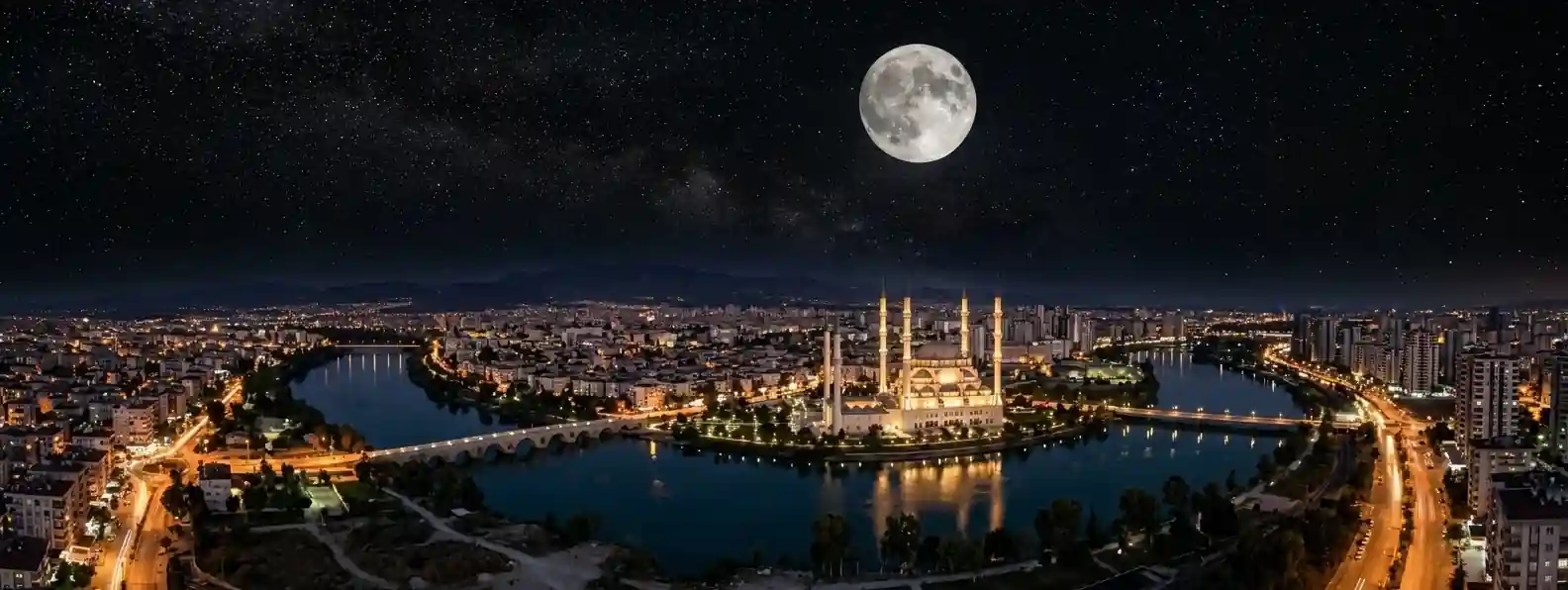
☽ Best Places to View the Moon in Adana, Turkey
Adana is particularly interesting for lunar viewing because the city is organized around the Seyhan River, with long riverside sightlines, bridges, parks and distinctive architectural landmarks providing natural foregrounds. The Merkez Park and Seyhan River corridor combines open space with views toward Sabancı Central Mosque and the city's bridges, while Dilberler Sekisi provides a long riverside walking and recreation corridor. Taşköprü adds one of Adana's most recognizable historic structures, while the Seyhan Dam and reservoir area provides a much more open landscape north of the city. Çoban Dede Park adds an elevated viewpoint over the reservoir, while 15 Temmuz Şehitler Parkı contains a planetarium and science-history-culture complex. The Seyhan runs north to south, so the Moon, which rises in the east and sets in the west, crosses the river rather than following it: the mosque stands on the river's west bank, so from the east bank it lies in the direction where the Moon sets. These are urban or suburban observing locations rather than dark-sky sites, so city light will remain part of most scenes. The Moon, however, is bright enough for successful photography from Adana. Exact Moonrise direction and altitude change with the date and observing position, so check both before planning a specific composition.
Merkez Park & Seyhan River
Merkez Park is a major riverside public park extending across both banks of the Seyhan River. Sources give it an area of roughly 30 to 33 hectares and note its walking and cycling routes, seating areas and open event spaces. The riverside route continues through Dilberler Sekisi and Yaşar Kemal Park toward Seyhan Dam. Sabancı Central Mosque stands beside the park on the river's west bank, so from the east bank it makes one of Adana's most recognizable Moon-and-city compositions, with a setting Moon in its direction. Check current local conditions before planning a late-night visit.
Dilberler Sekisi
Dilberler Sekisi is a riverside recreation and walking area along the Seyhan. Municipal sources identify it as part of the longer riverside walking and cycling corridor extending from Merkez Park toward Seyhan Dam. The waterfront gives photographers changing angles along the river, while the water, trees and surrounding city can provide useful foreground elements. Current municipal information also confirms that work has been carried out in this area, so check the latest local conditions before visiting.
Taşköprü & Seyhan River
Taşköprü is one of Adana's defining historic landmarks, a Roman-era stone bridge attributed to Hadrian, and it crosses the Seyhan River between the central Seyhan and Yüreğir districts. The official Rota Adana guide describes the historic bridge as approximately 300 metres long, with 14 visible arches and five smaller drainage arches. For Moon photography, the bridge and nearby riverbanks provide several possible compositions, including the Moon above the arches or reflected in the river. Treat the surrounding riverbanks as the more flexible option for a planned nighttime shoot.
Seyhan Dam & Reservoir
North of central Adana, Seyhan Dam and its reservoir create a much more open landscape than the dense city centre. The Turkish Ministry of Culture and Tourism specifically lists nature walking, cycling, water sports and recreation among activities around the Seyhan River and reservoir. The broad water surface can provide a strong foreground for Moonrise or Moonset photography, although individual access points around the reservoir should be checked before a nighttime visit.
Çoban Dede Park & Seyir Terası
Çoban Dede Park is located in the Karslılar area near Seyhan Dam Lake. The park's elevated viewing terrace provides broad views across the reservoir, the Adana plain and toward the surrounding landscape. This makes it particularly useful for landscape-style Moon photography, where the lunar disc is part of a wider scene rather than the only subject. Check current access conditions before planning an after-dark visit.
15 Temmuz Şehitler Parkı & Planetariums
This large public complex in Yüreğir includes the 15 Temmuz Şehitler Parkı, Science, History and Culture Complex. The Adana Governorate states that the 54,000-square-metre complex includes a planetarium, the 5 Ocak Adana Liberation Diorama, the 15 Temmuz Martyrs Monument and recreation areas. A Turkish news explainer also lists the Sabancı Uzay Evi, near Şakirpaşa Airport, as a planetarium. These are genuine astronomy-education locations, but a planetarium should not be confused with a continuously open nighttime observatory. Check the current program if you specifically want an astronomy presentation or scheduled visit.
◉ Best Times for Moon Photography in Adana
📷 Quick Photography Tips
🕐 Timezone: Adana uses Turkey Time — TRT (UTC+3) year-round. Türkiye has used a single permanent time zone since September 2016 and does not change between standard time and daylight-saving time seasonally. For an exact Moonrise composition, use PhotoPills, Stellarium or another astronomy planning tool with the precise Adana viewpoint selected.
🔭 Astronomy Facilities: The 15 Temmuz Şehitler Parkı Science, History and Culture Complex includes a planetarium, according to the Adana Governorate, and a Turkish news explainer lists the Sabancı Uzay Evi, near Şakirpaşa Airport, as a planetarium. Neither should be treated as a continuously open public telescope observatory; check the current program if you want a scheduled astronomy presentation or planetarium visit.
The moon phase today in Adana is shown in detail above — complete with exact illumination percentage, moonrise/set times, and useful local viewing information. For the moon phase today in any other city worldwide, visit our Dynamic Moon Phase Calculator on the home page.
◐ What the Experience Actually Feels Like
The Merkez Park and Seyhan River corridor gives Adana's Moon-viewing experience its strongest combination of water, architecture and open urban space. The official city tourism guide describes the park as extending across both banks of the river, with extensive walking and cycling infrastructure. Sabancı Central Mosque stands beside the park on the west bank, creating a recognizable foreground for lunar photography, and the river gives photographers a way to incorporate reflections and broad stretches of sky into the composition.
Dilberler Sekisi feels more like a riverside promenade than a conventional viewpoint. The route forms part of the longer Seyhan waterfront walking and cycling corridor, so photographers can change position as the Moon moves rather than being restricted to a single overlook. Trees, water, bridges and the surrounding city can all become foreground elements.
Taşköprü changes the character again. The historic bridge provides a strong geometric foreground while the Seyhan below gives the scene depth. Depending on the Moon's azimuth, photographers can work from the bridge area or nearby riverbanks to place the lunar disc above the arches, water or surrounding city. The bridge is a public landmark, but the nearby riverbanks provide more freedom for setting up a planned camera position.
The Seyhan reservoir and Çoban Dede Park provide a more open landscape experience. The reservoir is officially recognized as a recreation area where activities include walking and cycling, while Çoban Dede's elevated viewing terrace provides broader views across the lake and surrounding landscape. These locations are particularly useful when the Moon is low enough to become part of a wide landscape composition.
"Adana's Moon-viewing experience ranges from the illuminated Seyhan waterfront and historic Taşköprü to open reservoir landscapes, elevated viewpoints and astronomy-focused educational facilities."
✓ Your Adana Moon Chase Checklist
Before You Go
- Check the Moon's rise time, altitude and azimuth for your exact date and viewpoint — even small changes in position can alter which bridges, buildings or sections of the river are available as foreground
- If you're planning a composition involving the Seyhan River, Taşköprü or Sabancı Central Mosque, use PhotoPills or Stellarium to check the Moon's predicted position relative to the landmark you want in frame
- Verify Site Access: do not assume that parks, waterfront facilities, event spaces or managed attractions remain accessible throughout the night
- If you want to visit a planetarium, such as the one at 15 Temmuz Şehitler Parkı, check the current program rather than assuming that an astronomy presentation or planetarium session is taking place
- Check cloud cover, visibility and transparency before leaving, particularly when attempting a precise Moonrise composition over the river or reservoir
- Allow extra time at your chosen viewpoint to identify a foreground that works with the Moon's actual position
What to Bring
- A telephoto lens — 200mm or longer can be useful when you want a relatively large Moon beside a distant Adana landmark, depending on shooting distance
- Water and suitable clothing for the season — especially useful during warmer months when spending extended periods beside the river or reservoir
- A remote shutter release or a 2-second timer to reduce camera shake during tripod exposures
- A small flashlight with a red-light mode can be useful when walking darker paths without unnecessarily brightening your surroundings
- A backup viewpoint in case cloud, access restrictions, crowds or an obstructed horizon interfere with your planned composition
On the Night
- Arrive 30–45 minutes early for a planned Moonrise composition so you can establish your camera position before the Moon reaches the horizon
- If autofocus struggles in low light, switch to manual focus and carefully focus on the Moon or another distant subject
- Bracket your exposures — one for the bright lunar disc and another for the darker Adana skyline, river, mosque, bridge or surrounding landscape
- If the Moon appears soft or strongly coloured immediately after rising, consider waiting as it climbs higher; the longer atmospheric path near the horizon can increase scattering and distortion
- Respect posted opening and closing times and any temporary restrictions at parks, waterfront areas and astronomy-related facilities
Use the tools on this page, check access conditions, choose your vantage point, and catch an Adana moonrise for yourself.
? Adana Moon Phase — Frequently Asked Questions
Q. What is the moon phase today in Adana?
The moon phase today in Adana is a Last Quarter with 45% illumination. The next full moon is in 23 days, on 26 Oct. Moonrise is at — and moonset at 2:52 PM.
Q. Where is the best place to view the moon in Adana?
Adana is organised around the Seyhan River, which runs north to south through the city, so most viewpoints are on its banks. Merkez Park, a riverside park of roughly 30 to 33 hectares on both banks, has walking and cycling routes, and Sabancı Central Mosque stands beside it. Dilberler Sekisi is a riverside promenade, and the historic Taşköprü, a Roman-era stone bridge, crosses the river in the centre. North of the city, Seyhan Dam and its reservoir give an open landscape, and Çoban Dede Park has a viewing terrace over the lake.
Q. Can I look at the moon through a telescope in Adana?
A regular public telescope night is not widely advertised in Adana. The nearest equivalents are planetariums. The Adana Governorate says the 15 Temmuz Şehitler Parkı Science, History and Culture Complex in Yüreğir includes a planetarium, and a Turkish news explainer lists the Sabancı Uzay Evi, near Şakirpaşa Airport, as a planetarium. Neither is a continuously open observatory, so check the current programme for planetarium shows and any observing events, since observing depends on the weather.
Q. Where does the moon rise and set in Adana, and how high does it climb?
At about 37.0°N, Adana's moonrise and moonset points swing widely across the horizon each month, from roughly east-north-east to east-south-east for rising and west-north-west to west-south-west for setting, with an even wider swing in years near a major lunar standstill. A full moon near the winter solstice climbs to roughly 76° in the south, while a full moon near the summer solstice stays lower, peaking near 30°. The Seyhan runs north to south, so the Moon rises and sets across the river rather than along it. Sabancı Central Mosque stands on the river's west bank, so from the east bank it lies in the direction where the Moon sets. Check the azimuth for your date and exact spot.
Q. Is light pollution a problem for moon observing in Adana?
The moon is bright enough to observe and photograph from almost anywhere in Adana, so light pollution rarely limits the lunar disc itself. It does wash out earthshine on a thin crescent and any faint sky detail. Adana is one of Turkey's largest cities, so stars are faint along the river and in the centre, and the lit bridges and mosque add to the glow. The reservoir north of the city is more open but is still not a dark-sky site.
Q. What camera settings and phases work best for moon photography in Adana?
For a full moon, start with Looney 11 (f/11, ISO 100, 1/100 s) and refine using your histogram, since it is a baseline rather than a guarantee. The moon is much brighter than the river and the city lights, so shoot RAW and bracket or blend exposures to keep both crater detail and the foreground. A full moon is not always the best phase for showing surface relief. For a moon-and-landmark shot, move farther back and use a longer focal length of 200 mm or more, with a sturdy tripod where allowed and manual focus on the moon's edge using magnified live view. The moon illusion makes a low moon look huge, but it is perceptual, not a change in size.
Q. How do heat, humidity and haze affect moon viewing in Adana?
Adana has a Mediterranean climate and is known for its hot summers, with humid, hazy air that can lower contrast and soften distant landmarks and a low moon. Check cloud cover, visibility and transparency, not just the general forecast, and haze or moisture over the river and the reservoir can build up in the evening. Summer evenings stay warm, so bring water, and dress for the season beside the river.
Q. What time zone are Adana's moonrise and moonset times shown in?
Adana runs on Turkey Time, UTC+3, all year. Turkey has used a single permanent time zone since September 2016 and does not change its clocks. Moonrise and moonset times on this page follow the local clock. Adana lies at about 35.3°E, west of the 45°E meridian on which UTC+3 is based, so the sun and moon cross the sky about 39 minutes later on the clock than they would on that meridian.
Q. Can I shoot the moon at Adana's viewpoints after dark?
Mostly yes, with care, but check each site. Merkez Park, Dilberler Sekisi and the riverbanks around Taşköprü are public spaces, though work has been carried out along parts of the riverside, so check current local conditions. Taşköprü is a public landmark, and the riverbanks give more freedom for a planned camera position. Access points around Seyhan Dam and the reservoir, and Çoban Dede Park's terrace, should be checked before an evening visit, and the planetarium keeps scheduled hours.
✦ Explore Further
Moon Phase Today: Mersin
Check tonight's moon phase in Mersin, roughly 65 km west-south-west of Adana on the Mediterranean coast.
🌅Moon Phase Today: Hatay
See the moon over Hatay, roughly 115 km south-east of Adana near the Syrian border.
🌍World Moon Phase Directory
Find the moon phase, rise and set times for cities in every region of the world.
Blue Hour Calculator
Work out when blue hour falls, ideal for waxing gibbous shots over the Seyhan River.