
Moon Phase Today İzmir
On Sunday, October 4, 2026, the moon in Izmir is a Last Quarter with 45% illumination. Moon age: 22.6 days.
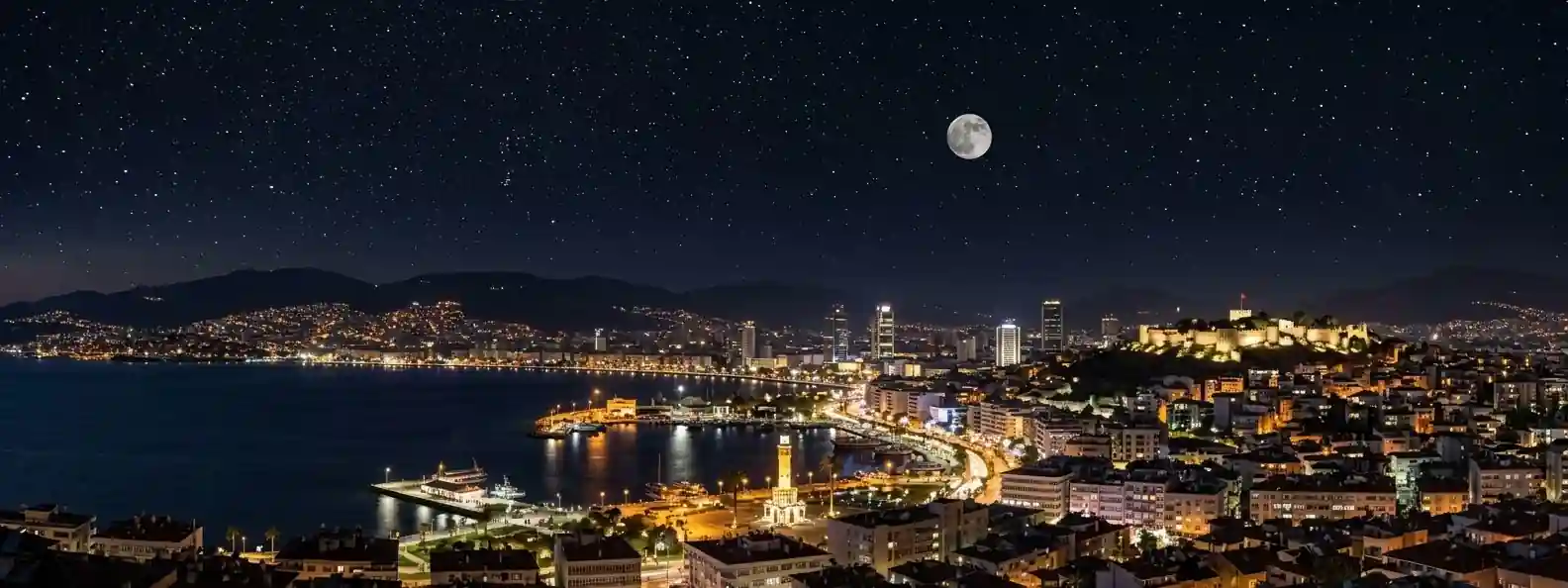
☽ Best Places to View the Moon in Izmir, Turkey
Izmir sits at the inner end of the Gulf of Izmir on the Aegean coast, with the sea opening to the west and mountains rising quickly behind the city. That gives you open water for Moonset, hilltop viewpoints over the Gulf, and high ridges just inland with less city glow. The Moon rises in the east and sets in the west, so from the Kordon waterfront a setting Moon can drop over the water, while a rising Moon comes up over the city and the hills behind you. The city also has an unusually good set of telescope options, including Ege University's observatory and Bornova Municipality's sky-watching programme. Exact Moonrise and Moonset directions change with the date and your observing position, so check both before planning a specific composition.
Kordon & Gulf Waterfront – Alsancak, Karşıyaka and İnciraltı
The Kordon in Alsancak is the classic spot for a view down the Gulf, with wide walking promenades along the water, and İnciraltı beach in Balçova has seating areas and bicycle paths on the shore. The Gulf opens to the west, so these waterfronts face the direction where the Moon sets, and a setting Moon can drop over the water. They are public promenades in a big city, so city light will remain part of most scenes.
Kadifekale & the Historical Elevator – Gulf Overlooks
Kadifekale, the castle hill on Mount Pagos, is worth the climb for what is described as the best view of the Gulf of Izmir, and it is an open-air archaeological site with Byzantine cisterns, a gate, a watchtower and castle walls. The Historical Elevator is another high viewpoint over the Gulf. Check opening hours for the archaeological site before an evening visit.
Balçova Cable Car – Viewing Terraces Above the City
The Balçova cable car has been serving the public for more than 30 years, and at the top there are viewing terraces, picnic tables and binoculars. It gives a high, open overlook of the city and the Gulf for an evening Moon, but it runs on set hours, so check them before planning a late visit.
Mount Nif & Kurudağ – Ege University Observatory
The Kemalpaşa mountains, with Mount Nif above the district centre east of Izmir, reach about 1,500 m, with elevated views over the plain. Ege University's Observatory, on Kurudağ, holds public days and observing camps with telescopes, workshops and talks with scientists. These are scheduled events, so check the university's announcements for dates.
Yamanlar, Karagöl & the Bozdağlar – Highlands
Karagöl Nature Park lies at about 850 m in the Yamanlar mountains in Menemen district, roughly 35 km from the city centre, with views of the Gulf from the slopes. The Bozdağlar reach 2,159 m north of Birgi, according to Izmir's official tourism page, giving high, potentially darker skies than the urban plain, though local cloud varies. Check protected-area rules and road and weather conditions before going.
West Coast – Karaburun, Foça, Çeşme and Alaçatı
The Karaburun Peninsula forms the western side of the Gulf, with bays and coves such as Mimoza and Hamzabükü, and Foça lies on the northern side. Both are generally less urbanised than central Izmir, though lighting varies by site. Çeşme and Alaçatı, known for windmills, beaches and steady winds, have open sea views at Ilıca and Çark beaches. West-facing coasts can work for Moonset when the Moon's azimuth falls over water, but that depends on the date.
◉ Best Times for Moon Photography in Izmir
📷 Quick Tips for Izmir
🕐 Timezone: Izmir uses Turkey Time (TRT), UTC+3, year-round. Turkey has used a single permanent time zone since September 2016 and does not observe daylight saving. Europe/Istanbul zone.
🔭 Telescope Options: Ege University's Observatory, on Kurudağ, holds public days and observing camps. Bornova Municipality's Mevlana Toplum ve Bilim Merkezi runs a sky-watching programme with telescopes, which in August 2026 included a night at the Yeşilova Höyüğü site and another at the Aşık Veysel Recreation Area. Check each organiser's announcements for dates.
Access: The Kordon and the waterfront promenades are public. Kadifekale is an open-air archaeological site, and the Balçova cable car runs on set hours. Karagöl Nature Park and the coastal and forest protected areas have their own rules.
The moon phase today in Izmir is shown above. For moon phase today anywhere else, visit the calculator on our home page.
◐ What It Feels Like
On the Kordon, the Gulf opens to the west, and as the Moon sets, the water and the city's promenade lights share the scene, with ferries and boats crossing.
From Kadifekale and the cable car, the city spreads out below and the Gulf shines beyond it, an old fortress hill and a modern overlook with the Moon above.
On Karaburun and in Foça, the Gulf opens west into coves and bays that are generally less urbanised, and at Çeşme and Alaçatı, windmills and beaches face open sea, with wide sky when the Moon's azimuth falls over the water.
On Yamanlar and Mount Nif, the Gulf and the plain lie below, with the city in the middle and the Aegean visible beyond.
"A Moonset over the Gulf from the Kordon, an old fortress hill above the city, and inland ridges rising to 2,159 m — the Aegean at your feet and telescopes within reach."
✓ Checklist for Lunar Observers
Before You Go
- Check moonrise and moonset azimuth for your date — the Moon's direction changes with its declination, and decides whether it sets over the Gulf
- Check the MGM forecast for coastal haze, wind, cloud and mountain weather
- Confirm access: Kadifekale, the Balçova cable car, Karagöl Nature Park, the Karaburun and Foça coast and the Çeşme beaches
- Check the Ege University and Bornova sky-watching dates if you want a telescope
What to Bring
- Telephoto 200 mm or longer, and a wide lens for Gulf and peninsula foregrounds
- Tripod for landscapes and bracketing — a close-up Moon can be shot handheld with a fast shutter
- Lens cloth for sea spray
- A warm layer — temperatures can be much lower at elevation
On the Night
- Manual focus on the lunar limb or a distant light
- Bracket for the disc and the sea, coves and mountain foreground
- Stay on paths — the coastal and forest protected areas
- Treat the higher ground as better skies, not dark-sky sites
? Izmir Moon Phase — Frequently Asked Questions
Q. What is the moon phase today in Izmir?
The moon phase today in Izmir is a Last Quarter with 45% illumination. The next full moon is in 23 days, on 26 Oct. Moonrise is at — and moonset at 3:30 PM.
Q. Where is the best place to view the moon in Izmir?
Izmir sits at the inner end of the Gulf of Izmir, with the sea to the west and mountains rising behind the city. The Kordon waterfront in Alsancak is the classic spot for a view down the Gulf, and Kadifekale, the castle hill on Mount Pagos, and the Historical Elevator both give wide views over it. The Balçova cable car has viewing terraces at the top, and higher up, Mount Nif, the Yamanlar mountains with Karagöl Nature Park, and the Bozdağlar are darker. Karaburun, Foça, Çeşme and Alaçatı on the western coast have open sea horizons.
Q. Can I look at the moon through a telescope in Izmir?
Yes, at scheduled events. Ege University's Observatory, on Kurudağ, holds public days and observing camps with telescopes and workshops. Bornova Municipality's Mevlana Toplum ve Bilim Merkezi runs a Gökyüzü Gözlem programme, with experts and telescopes, in which in August 2026 children studied the surface and craters of the moon at the Yeşilova Höyüğü site, with a further night at the Aşık Veysel Recreation Area. Check each organiser's announcements for current dates, since observing depends on the weather.
Q. Where does the moon rise and set in Izmir, and how high does it climb?
At about 38.4°N, Izmir's moonrise and moonset points swing widely across the horizon each month, from roughly east-north-east to east-south-east for rising and west-north-west to west-south-west for setting, with an even wider swing in years near a major lunar standstill. A full moon near the winter solstice climbs to roughly 75° in the south, while a full moon near the summer solstice stays lower, peaking near 28°. The Gulf opens to the west of the city, the direction the moon sets, so from the Kordon a setting moon, mostly a waning moon in the morning or a crescent in the evening, can drop over the water, while a rising moon comes up over the city and the hills behind you. Check the azimuth for your date and exact spot.
Q. Is light pollution a problem for moon observing in Izmir?
The moon is bright enough to observe and photograph from almost anywhere in Izmir, so light pollution rarely limits the lunar disc itself. It does wash out earthshine on a thin crescent and any faint sky detail. Izmir is Turkey's third-largest city, so stars are faint around the Gulf. The Karaburun and Foça coasts are generally less urbanised, and the mountains inland, such as Mount Nif and the Bozdağlar, are darker, though no measured dark-sky designation is listed for them.
Q. What camera settings and phases work best for moon photography in Izmir?
For a full moon, start with Looney 11 (f/11, ISO 100, 1/100 s) and refine using your histogram, since it is a baseline rather than a guarantee. The moon is much brighter than the sea and the mountains, so shoot RAW and bracket or blend exposures to keep both crater detail and the foreground, and adjust for haze and sea reflection. A waxing gibbous suits blue hour at Foça and Karaburun while the foreground is still lit. For close-ups the moon is bright enough to shoot handheld with a fast shutter, while a tripod suits landscapes, and a longer lens can isolate islands, boats or the moon against the Gulf. Focus manually on the moon's edge or a distant light.
Q. How do coastal haze, wind and mountain weather affect moon viewing in Izmir?
Izmir has a Mediterranean climate, and coastal haze can lower contrast and soften a low moon over the Gulf. The Çeşme and Alaçatı coast is known for steady winds, so a sturdy tripod matters there, and mountain weather inland can change quickly. Check the Turkish State Meteorological Service forecast for haze, wind, cloud and mountain conditions, and bring a warm layer for the high ground, which is much colder than the coast.
Q. What time zone are Izmir's moonrise and moonset times shown in?
Izmir runs on Turkey Time, UTC+3, all year. Turkey has used a single permanent time zone since September 2016 and does not change its clocks. Moonrise and moonset times on this page follow the local clock. Izmir lies at about 27.1°E, well west of the 45°E meridian on which UTC+3 is based, so the sun and moon cross the sky about 71 minutes later on the clock than they would on that meridian.
Q. Can I shoot the moon at Izmir's viewpoints after dark?
Mostly, with care, but check each place. The Kordon and the other waterfront promenades are public. Kadifekale is an open-air archaeological site and the Balçova cable car runs on set hours, so check their hours before an evening visit. Karagöl Nature Park and the forest and coastal protected areas have their own rules, so stay on paths, and check road and weather conditions before going up to the Bozdağlar.
✦ Explore Further
Moon Phase Today: Manisa
Check tonight's moon phase in Manisa, roughly 35 km north-east of Izmir at the foot of Mount Spil.
🏛Moon Phase Today: Aydın
See the moon over Aydın, roughly 90 km south-east of Izmir in the Büyük Menderes valley.
🌍World Moon Phase Directory
Find the moon phase, rise and set times for cities in every region of the world.
Blue Hour Calculator
Work out when blue hour falls, ideal for waxing gibbous shots over the Gulf of Izmir.