
Moon Phase Today Ankara
On Sunday, October 4, 2026, the moon in Ankara is a Last Quarter with 45% illumination. Moon age: 22.6 days.
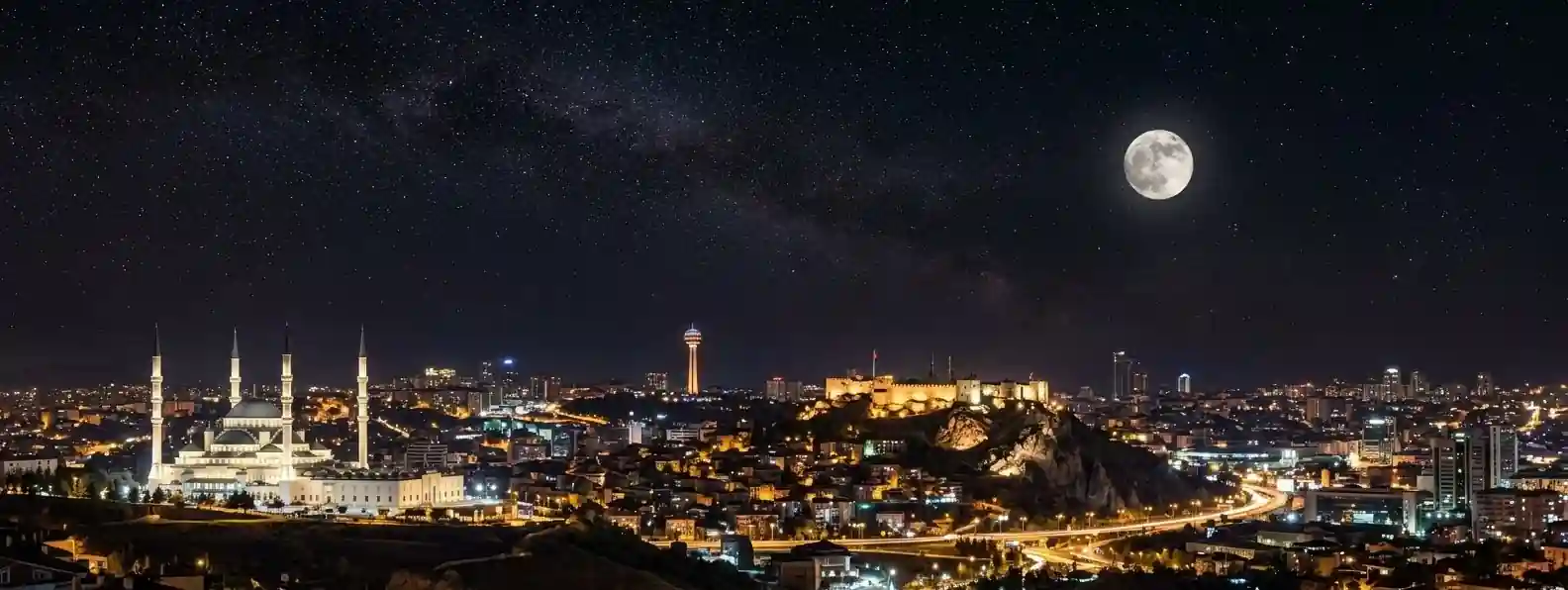
☽ Best Places to View the Moon in Ankara, Turkey
Ankara sits on the large plains of central Anatolia, with mountain forests to the north and open plains and rolling terrain to the south. Wide steppe horizons and hilltop parks in the city give way to quiet lakes and forested highlands just outside town. The city also has one of the best public telescope programmes in Turkey, at Ankara University's Kreiken Observatory. The Moon rises in the east and sets in the west, and on the open plateau a rising or setting Moon meets a long horizon. Exact Moonrise and Moonset directions change with the date and your observing position, so check both before planning a specific composition.
Kreiken Observatory – Ankara University's Public Telescopes
Ankara University's Kreiken Observatory stands on the university's Ahlatlıbel campus, outside the city centre. It has run monthly public-day (Halk Günü) evenings through the observing season, with telescopes and a naked-eye tour of the constellations, and special events for eclipses and the Perseid meteor shower, which have drawn thousands of people. At the August and October 2024 events the Moon and Saturn were the targets. The observatory is colder than the centre, and under cloud the telescopes cannot be used and presentations replace them, so check the current schedule and dress warmly.
Mogan & Eymir Lakes – About 20 km South
Mogan and Eymir lakes lie in Gölbaşı district, about 20 km south of central Ankara, and are important recreation areas and aquatic ecosystems. Mogan feeds Eymir within the same drainage system. The northern part of the district is nestled by Eymir Lake amid forest, while the southern part extends along Mogan Lake, giving open lake horizons and broad sky. The lakes lie south of the city, so from the northern shores the Moon crosses the sky above the water in front of you. The lakes can freeze in very cold winters.
Işık Dağı & Soğuksu National Park – Northern Forests
Işık Dağı, in Kızılcahamam in northern Ankara, is reported at roughly 1,940 to 2,015 m, depending on the source. Soğuksu National Park, in Kızılcahamam about 80 km from Ankara, lies between the Central Anatolian steppe and the northern forest, with an elevation range of 1,030 to 1,776 m according to an official source, and 1,776 m at Tolubelen Tepesi. Forested ridges and a generally less urbanised setting, although local lighting varies. Check park access and weather before going.
İdris Dağı – About 1,995 m Southeast
İdris Dağı rises to about 1,995 m in the Elmadağ area south-east of Ankara, according to the Ankara Provincial Directorate of National Education. The high ground gives elevated views over the Ankara plain, a different perspective from the city and the lakes. Weather can change quickly with elevation, so check conditions before going.
Atatürk Forest Farm & Anıtkabir – Urban Green Space and Hilltops
The Atatürk Forest Farm was founded by Mustafa Kemal Atatürk on 5 May 1925 as a model farm on the outskirts of Ankara and remains a large public institution with agricultural, cultural and recreational functions. Its open areas give broad sky views, although nearby urban lighting makes it less suitable for dark-sky observing. Anıtkabir, Atatürk's mausoleum, stands on a hilltop and is a managed memorial site with its own visiting hours, so check them before an evening visit.
◉ Best Times for Moon Photography in Ankara
📷 Quick Tips for Ankara
🕐 Timezone: Ankara uses Turkey Time (TRT), UTC+3, year-round. Turkey has used a single permanent time zone since September 2016 and does not observe daylight saving. Europe/Istanbul zone.
🔭 Telescope Option: Ankara University's Kreiken Observatory, on the Ahlatlıbel campus, holds public-day evenings and special events with telescopes. In 2024 these ran at 20:00 to midnight for a modest fee paid in cash on the door. Check the observatory's current schedule, since the series is seasonal.
Access: Mogan and Eymir lakes are in Gölbaşı district about 20 km south of the city, connected by a canal under the Ankara–Konya highway. Soğuksu National Park in Kızılcahamam is about 80 km from Ankara. The Atatürk Forest Farm is a public institution on the city's outskirts, and Anıtkabir keeps its own visiting hours.
The moon phase today in Ankara is shown above. For moon phase today anywhere else, visit the calculator on our home page.
◐ What It Feels Like
At Mogan and Eymir, about 20 km south, shallow lakes within the same drainage system lie with forest on one side and open plain on the other, and they freeze on very cold winter days.
On İdris Dağı in the Elmadağ area south-east of the city, the surrounding high ground holds cooler air above the steppe, with city lights below.
In the northern forests around Kızılcahamam and Soğuksu, mountain forests cover the slopes above the plateau, generally less urbanised and darker away from the city's lights.
At the Kreiken Observatory, on a public-day evening, visitors queue in the cold for a look at the Moon and Saturn through the telescopes, then warm up inside over tea and coffee.
"Wide steppe and hilltop light in the city, quiet lakes to the south, forested ridges rising above the plain, and telescopes open to the public."
✓ Checklist for Lunar Observers
Before You Go
- Check moonrise and moonset azimuth — it determines orientation over the lakes
- Check MGM — weather can change quickly with elevation
- Confirm access — the Gölbaşı lakes, Soğuksu National Park, the Atatürk Forest Farm, and the Kreiken Observatory's schedule
What to Bring
- Telephoto and wide for lake and steppe foregrounds
- Tripod for landscape and bracketing — useful for multi-exposure, and a close Moon can be handheld
- Lens cloth for dust on the plateau
- Warm layers — colder at higher elevations and at the observatory
On the Night
- Manual focus on the lunar limb
- Bracket for the disc and the foreground — it is difficult to retain both in a single exposure
- Stay on paths — the parks and lake reserves
- Higher ground can offer cleaner horizons and less haze, but darkness still depends on nearby artificial light
? Ankara Moon Phase — Frequently Asked Questions
Q. What is the moon phase today in Ankara?
The moon phase today in Ankara is a Last Quarter with 45% illumination. The next full moon is in 23 days, on 26 Oct. Moonrise is at — and moonset at 3:11 PM.
Q. Where is the best place to view the moon in Ankara?
Ankara sits on the high plains of central Anatolia, with forested mountains to the north and rolling steppe to the south. Ankara University's Kreiken Observatory, on the university's Ahlatlıbel campus, is the best place to see the moon through a telescope. Mogan and Eymir lakes in Gölbaşı district, about 20 km south of the city, give open lake horizons, and İdris Dağı in the Elmadağ area is higher ground to the south-east. Işık Dağı and Soğuksu National Park in Kızılcahamam, to the north, have forested ridges, and Anıtkabir and other hilltops give city views.
Q. Can I look at the moon through a telescope in Ankara?
Yes. Ankara University's Kreiken Observatory, on the Ahlatlıbel campus, has run monthly Halk Günü (public day) evenings through the observing season, with telescopes and a naked-eye tour of the constellations, and special events for rarer sky events such as eclipses and the Perseid meteor shower. At the August and October 2024 events, the moon and Saturn were the targets. Visits were charged a modest entrance fee, paid in cash on the door in 2024, and the telescopes cannot be used under cloud, when presentations replace them. Check the observatory's current schedule, since the series is seasonal.
Q. Where does the moon rise and set in Ankara, and how high does it climb?
At about 39.9°N, Ankara's moonrise and moonset points swing widely across the horizon each month, from roughly east-north-east to east-south-east for rising and west-north-west to west-south-west for setting, with an even wider swing in years near a major lunar standstill. A full moon near the winter solstice climbs to roughly 74° in the south, while a full moon near the summer solstice stays lower, peaking near 27°. The plateau gives wide open horizons, and Mogan and Eymir lie south of the city, so from the northern shores the moon crosses the sky above the water in front of you. Check the azimuth for your date and exact spot.
Q. Is light pollution a problem for moon observing in Ankara?
The moon is bright enough to observe and photograph from almost anywhere in Ankara, so light pollution rarely limits the lunar disc itself. It does wash out earthshine on a thin crescent and any faint sky detail. Ankara is a very large city, so stars are faint in the centre, and the Atatürk Forest Farm and the hilltop parks are less suitable for dark-sky observing because of nearby urban lighting. The Kreiken Observatory is outside the centre and colder, and the forested highlands in the north are darker, though darkness still depends on nearby lighting.
Q. What camera settings and phases work best for moon photography in Ankara?
For a full moon, start with Looney 11 (f/11, ISO 100, 1/100 s) and refine using your histogram, since it is a baseline rather than a guarantee. The moon is much brighter than the lakes, the steppe and the forest, so shoot RAW and bracket or blend exposures to keep both crater detail and the foreground, especially at twilight, when the plateau light fades quickly. A waxing gibbous suits blue hour at Mogan, Eymir and Anıtkabir while the foreground is still lit. A telephoto of about 200 to 400 mm can isolate the moon against Eymir's forest edge, boats on Mogan or Anıtkabir on its hilltop, with a tripod and manual focus on the moon's edge using magnified live view.
Q. How do dry air, haze and cold affect moon viewing in Ankara?
Ankara sits on a high, dry plateau, and its urban haze and dry plateau air can change exposure, so refine with your histogram. Weather can change quickly with elevation, and places outside the centre, such as the Kreiken Observatory, the lakes and the forested highlands, are colder than the city, so bring warm clothes. Check the Turkish State Meteorological Service forecast for haze, wind and cloud before you go, particularly for the high ground of İdris Dağı and Soğuksu, where conditions vary. Lakes can freeze in very cold winters.
Q. What time zone are Ankara's moonrise and moonset times shown in?
Ankara runs on Turkey Time, UTC+3, all year. Turkey has used a single permanent time zone since September 2016 and does not change its clocks. Moonrise and moonset times on this page follow the local clock. Ankara lies at about 32.9°E, west of the 45°E meridian on which UTC+3 is based, so the sun and moon cross the sky about 49 minutes later on the clock than they would on that meridian.
Q. Can I shoot the moon at Ankara's viewpoints after dark?
Mostly, with care, but check each place. The lake shores at Mogan and Eymir are recreation areas with their own rules, and the Atatürk Forest Farm, Soğuksu National Park and other parks have set hours, so stay on paths and check them before an evening visit. Anıtkabir is a managed memorial site with its own visiting hours. The Kreiken Observatory is open to the public only at its scheduled events.
✦ Explore Further
Moon Phase Today: Konya
Check tonight's moon phase in Konya, roughly 230 km south of Ankara on the Central Anatolian plain.
🌊Moon Phase Today: Sakarya
See the moon over Sakarya, roughly 230 km west-north-west of Ankara beside Sapanca Lake.
🌍World Moon Phase Directory
Find the moon phase, rise and set times for cities in every region of the world.
Blue Hour Calculator
Work out when blue hour falls, ideal for waxing gibbous shots over Mogan Lake.