
Moon Phase Wroclaw
On Sunday, October 4, 2026, the moon in Wroclaw is a Last Quarter with 45% illumination. Moon age: 22.6 days.
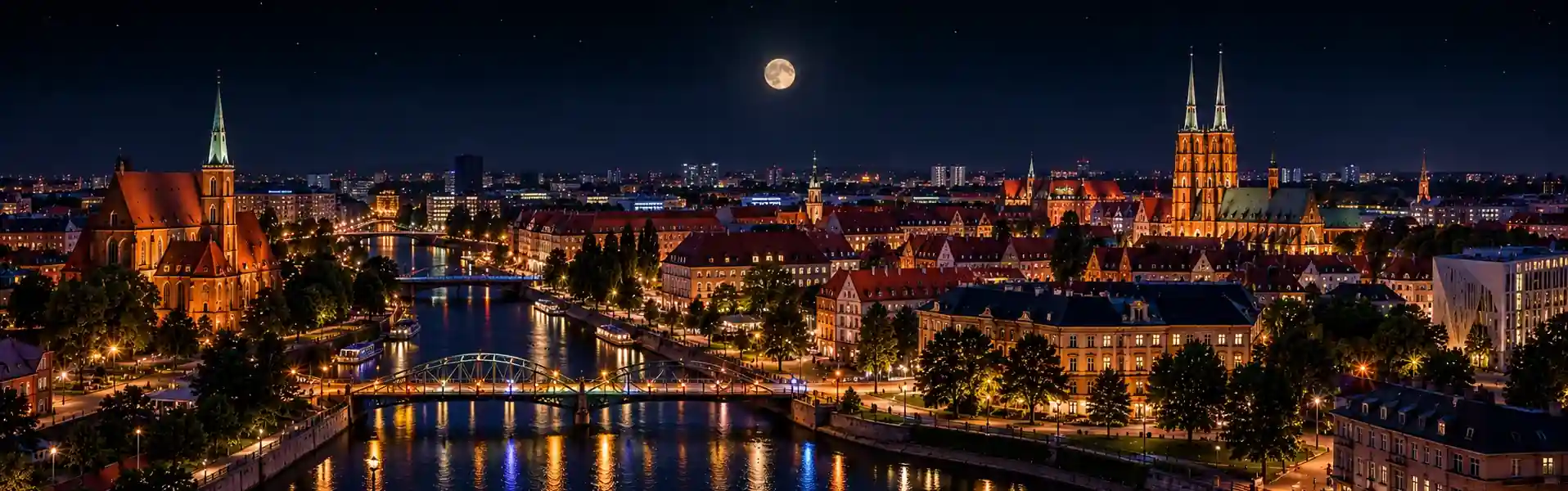
☽ Best Places to View the Moon in Wrocław, Poland
Wrocław sits at roughly 51.1°N on the Odra (Oder) River in south-western Poland, the historical capital of Silesia. Nicknamed the "City of a Hundred Bridges," it is spread across around a dozen river islands linked by more than a hundred crossings, so the river puts the Moon over the water in more places than in most cities this far from the coast. At this latitude the Moon rises between north-east and south-east, and a summer full Moon stays low, near 16°, while a winter one climbs to about 62°. The city also has a university observatory with a historic refractor. Exact rise and set times and azimuth depend on the date and your observing position, so check both before planning a specific composition.
Ostrów Tumski & the Botanical Garden
The city's oldest historic district, settled since at least the 10th century and home to the Gothic Cathedral of St. John the Baptist. Once an island, its surrounding waterways were filled in during the early 19th century. Its cobbled streets are still lit each evening by a lamplighter who lights and extinguishes the gas lamps by hand, and the quiet, gas-lit atmosphere makes this one of the more atmospheric places on the river to watch the Moon rise over the water. The University Botanical Garden, with ponds and greenery beside the cathedral, keeps seasonal opening hours rather than staying open after dark.
St. Elizabeth's Tower & the Mathematical Tower – City Viewpoints
St. Elizabeth's is a Gothic church near the Market Square with a 91.46-metre tower and a viewing terrace around 75 metres up, one of the best-known panoramic viewpoints over the city centre. The Mathematical Tower of the University of Wrocław, in the main building on Plac Uniwersytecki, was the city's first observatory, set up at the end of the 18th century, and is now part of the University Museum, with astronomical exhibits and a viewing terrace that opens weather permitting. Both keep seasonal hours, so check current opening times before planning a visit around either.
Institute of Astronomy – University of Wrocław Observatory
The Institute of Astronomy, at ul. Kopernika 11 in the Sępolno district on the edge of Szczytnicki Park, has an observatory with a 203 mm Clark–Repsold refractor under a dome and a small planetarium. The city says only occasional observations for enthusiasts and students are held there, and the institute has run night observations of the sky at the Lower Silesian Science Festival in September, with popular-science lectures the same evenings. Check its announcements for dates, since observing depends on the weather.
Szczytnicki Park & Japanese Garden
A large park east of the centre, next to the UNESCO-listed Centennial Hall, with a Japanese Garden first laid out for the 1913 Centennial Exhibition. It is Wrocław's biggest stretch of green space within easy reach of downtown, and a quieter option than the river islands closer to the Old Town. Check the opening hours of the garden before an evening visit.
Wyspa Słodowa & the Odra Boulevards – Moon Over the Water
Wyspa Słodowa (Malt Island) is one of Wrocław's liveliest river islands, popular with students for its bars, food trucks and open-air events, with direct water views back toward the Old Town. It has previously been fenced and gated overnight, so check current access before a late-night visit, and expect it to be a social spot rather than a quiet one. The riverside promenades through the city centre, past the islands, bridges and historic buildings that give Wrocław its "Venice of the North" reputation, are the easiest option for an ordinary evening and put the Moon directly over the water among the city's best-known landmarks.
Rędzin & Beyond – Darker Skies Outside the Centre
Like other large cities, Wrocław is brightly lit at night, which makes astronomical observing hard. An astronomer at the Institute of Astronomy has named Rędzin, a district on the edge of the city, as a reasonable place, though about a quarter of the sky is still lost to the glow there, and there are no designated observing points, so scout it by day before returning at night. For truly dark skies, the university uses Białków, about 70 km from the city, and the Izera Dark-Sky Park in the Sudetes, designated in 2009, is the nearest certified dark-sky place.
◉ Best Times for Moon Photography in Wrocław
📷 Quick Photography Tips for Wrocław
🕐 Timezone: Wrocław runs on CET (UTC+1), shifting to CEST (UTC+2) for daylight saving time, from the last Sunday in March to the last Sunday in October.
🔭 Telescope Option: The Institute of Astronomy of the University of Wrocław, at ul. Kopernika 11, has a 203 mm refractor and a small planetarium, with only occasional public observations. Check its announcements for dates. For the moon phase in any other city, use the calculator on our home page.
The moon phase today in Wrocław, Poland is shown in detail above — complete with exact illumination percentage, moonrise/set times, and the best viewpoints to see it. For the moon phase today in any other city or location worldwide, visit our Dynamic Moon Phase Calculator on the home page.
◐ What the Experience Actually Feels Like
Wrocław's relationship with the Moon is really a relationship with light of all kinds. This is a city that still employs someone to light its lamps by hand every evening, in its oldest district, in a country where that job has otherwise disappeared. Watching the Moon come up over Ostrów Tumski while the gas lamps are still being lit one by one is a specific, slightly anachronistic pleasure that few other cities can offer.
Everywhere else, the river does the work. A dozen islands and more than a hundred bridges mean Wrocław has an unusual number of places where you're standing directly over or beside water in the middle of a large city, whether that's the quiet cobbles of the cathedral district or the noisier, younger crowd on Wyspa Słodowa a short walk away.
At about 51°N, the Moon over Wrocław behaves in a typically central European way: high in the winter sky, low and often hazy in summer. What's unusual here isn't the sky. It's the city built to be looked at from the water, lit in one small corner of it in the style it was lit generations ago, and with a university observatory of its own, on the edge of Szczytnicki Park, for the nights when you want to look closer.
"Wrocław still lights its oldest district by hand, lamp by lamp, every evening — the Moon just happens to be the one light in the sky nobody has to climb a ladder for."
✓ Your Wrocław Moon Chase Checklist
Before You Go
- Check the moonrise time and phase on this page for each night of your stay
- If you want to climb St. Elizabeth's tower or the Mathematical Tower, check their current seasonal hours — they can extend into the evening in summer
- Check Wyspa Słodowa's current access hours if you're planning to visit late
- Between late March and late October, remember Poland shifts to CEST — re-verify your moonrise app's offset
- Check the Botanical Garden's current opening hours if you want to combine it with an Ostrów Tumski visit
- Check the Institute of Astronomy's announcements if you want a look through a telescope
What to Bring
- A warm layer for winter evenings — nights hover near freezing on average, colder on a bad night
- A tripod, useful on the open river islands and bridges
- Comfortable shoes for cobblestones on Ostrów Tumski and around the Old Town
- A small umbrella or light rain jacket — Wrocław sees frequent light rain rather than heavy downpours
- Spare camera batteries if you're out for an extended session in the cold
On the Night
- Time an Ostrów Tumski visit around dusk to catch the lamplighter lighting the gas lamps by hand
- Arrive 20–30 minutes before moonrise at open river spots for the best reflection on the water
- Expect crowds and noise on Wyspa Słodowa in summer — it's a social spot rather than a quiet one
- Shoot RAW and bracket exposures, especially where street lighting and moonlight mix along the river
- Mind slippery cobbles and bridge surfaces in wet or icy weather
? Wrocław Moon Phase — Frequently Asked Questions
Q. What is the moon phase today in Wrocław?
The moon phase today in Wrocław is a Last Quarter with 45% illumination. The next full moon is in 23 days, on 26 Oct. Moonrise is at 11:59 PM and moonset at 4:06 PM.
Q. Where is the best place to view the moon in Wrocław?
Wrocław is the historic capital of Silesia, on the Odra (Oder) River, spread across around a dozen river islands joined by more than a hundred bridges, so the river is the main draw. Ostrów Tumski, the oldest district, is lit by gas lamps lit by hand each evening, and the Odra boulevards and Wyspa Słodowa put the moon over the water. St. Elizabeth's Church tower has a viewing terrace about 75 m up, the Mathematical Tower of the University is a former observatory with a terrace, and Szczytnicki Park, beside the Centennial Hall, is a quieter green space east of the centre.
Q. Can I look at the moon through a telescope in Wrocław?
Occasionally. The Institute of Astronomy of the University of Wrocław, at ul. Kopernika 11 on the edge of Szczytnicki Park, has an observatory with a 203 mm Clark–Repsold refractor under a dome, and a small planetarium. The city says only occasional observations for enthusiasts and students are held there, and the institute has run night observations of the sky at the Lower Silesian Science Festival in September. The Mathematical Tower of the University, a former observatory now part of the University Museum, has astronomical exhibits and a meridian line, and a viewing terrace that opens on a seasonal schedule, weather permitting. Check the Institute of Astronomy's announcements for current dates, since observing depends on the weather.
Q. Where does the moon rise and set in Wrocław, and how high does it climb?
At about 51.1°N, Wrocław's moonrise and moonset points swing widely across the horizon each month, from roughly north-east to south-east for rising and north-west to south-west for setting, with an even wider swing in years near a major lunar standstill. A full moon near the winter solstice climbs to roughly 62° in the south, while a full moon near the summer solstice stays low, peaking near 16°, and is often hazy. The land around the city is flat, so the view of a rising or setting moon is limited mainly by buildings and trees, and the towers give the clearest horizon. Check the azimuth for your date and exact spot.
Q. Is light pollution a problem for moon observing in Wrocław?
The moon is bright enough to observe and photograph from almost anywhere in Wrocław, so light pollution rarely limits the lunar disc itself. It does wash out earthshine on a thin crescent and any faint sky detail. The city itself says that Wrocław, like other large cities, is brightly lit at night, which makes astronomical observing hard. An astronomer at the Institute of Astronomy has named Rędzin, a district on the edge of the city, as a reasonable place, though even there about a quarter of the sky is lost to the glow, and there are no designated observing points, so scout it by day. The university itself uses Białków, about 70 km away, and the Izera Dark-Sky Park, designated in 2009 in the Sudetes, is the nearest certified dark-sky place.
Q. What camera settings and phases work best for moon photography in Wrocław?
For a full moon, start with Looney 11 (f/11, ISO 100, 1/100 s) and refine using your histogram, since it is a baseline rather than a guarantee. The moon is much brighter than the river and the lamp-lit streets, so shoot RAW and bracket exposures, especially where street lighting and moonlight mix along the river. Arrive 20 to 30 minutes before moonrise at an open river spot to catch its reflection on calm water, and use a tripod, which helps on the open islands where wind off the water is more noticeable. Ostrów Tumski's gas lamps make a distinctive foreground for a moonrise shot.
Q. How do river mist, cloud and rain affect moon viewing in Wrocław?
Wrocław sees frequent light rain rather than heavy downpours, and the Odra valley can bring mist and humidity that reduce contrast. Check the forecast from IMGW, Poland's meteorological institute, for cloud, visibility and fog before you go. Bring a small umbrella or light rain jacket, a warm layer for winter evenings, when nights hover near freezing on average, and spare camera batteries for an extended session in the cold. Mind slippery cobbles and bridge surfaces in wet or icy weather.
Q. What time zone are Wrocław's moonrise and moonset times shown in?
Wrocław runs on Central European Time, CET, UTC+1, in winter and Central European Summer Time, CEST, UTC+2, in summer. Clocks go forward on the last Sunday in March and back on the last Sunday in October, and moonrise and moonset times on this page follow the local clock in effect on each date, so re-check any moonrise app's offset when the clocks change. Wrocław lies at about 17.0°E, just east of the 15°E meridian on which Central European Time is based, so the sun and moon cross the sky about 8 minutes earlier on the clock than they would on that meridian.
Q. Can I shoot the moon at Wrocław's viewpoints after dark?
Mostly, with care, but check each place. St. Elizabeth's tower keeps seasonal hours, which can extend into the evening in summer, and the Mathematical Tower is open on a seasonal schedule, with its terrace weather permitting. Wyspa Słodowa has been fenced and gated overnight in the past, so check current access, and it is a social spot rather than a quiet one in summer. The University Botanical Garden keeps seasonal opening hours rather than staying open after dark. The river boulevards are the easiest option for an ordinary evening.
✦ Explore Further
Moon Phase Today: Poznań
Check tonight's moon phase in Poznań, roughly 145 km north of Wrocław in Greater Poland.
🏙Moon Phase Today: Łódź
See the moon over Łódź, roughly 185 km east-north-east of Wrocław in central Poland.
🌍World Moon Phase Directory
Find the moon phase, rise and set times for cities in every region of the world.
Blue Hour Calculator
Work out when blue hour falls, ideal for waxing gibbous shots over the Odra.