
Moon Phase Poznan
On Sunday, October 4, 2026, the moon in Poznan is a Last Quarter with 45% illumination. Moon age: 22.6 days.
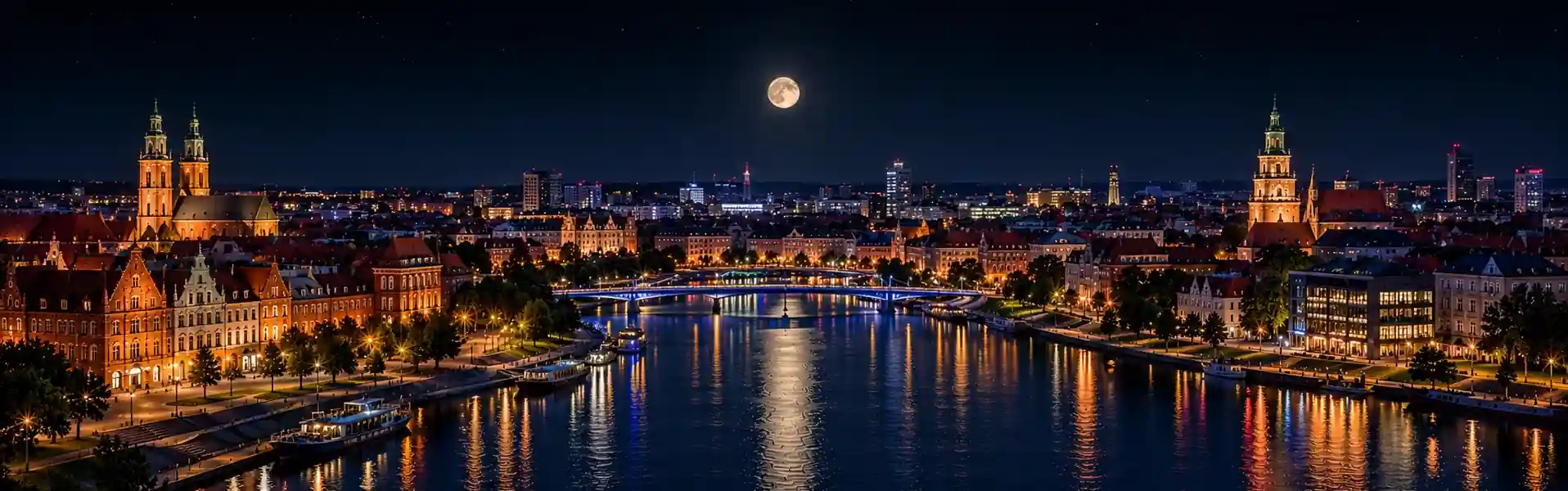
☽ Best Places to View the Moon in Poznań, Poland
Poznań sits at roughly 52.4°N on the Warta river in west-central Poland, one of Poland's oldest cities and the historic capital of Wielkopolska. It is also a real centre of astronomical research: the Astronomical Observatory Institute of Adam Mickiewicz University organizes public sky shows and works on asteroids and other small bodies of the Solar System. Poznań's most remarkable feature, though, sits on the ground rather than in a telescope: a field of meteorite impact craters within the city's own borders, at Morasko, on a hill on its northern edge. At this latitude the Moon rises between north-east and south-east, and a summer full Moon stays low, near 14°, while a winter one climbs to about 61°. Exact rise and set times and azimuth depend on the date and your observing position, so check both before planning a specific composition.
Morasko Meteorite Nature Reserve
On the southern slope of Góra Moraska, the highest hill in the area at about 154 metres, seven impact craters mark where fragments of a large iron meteorite struck the ground roughly 5,000 years ago, within the city's own borders. The largest crater is about 100 metres across. Meteorite fragments were first found in 1914, by soldiers digging trenches, and are still occasionally found. The reserve, protected since 1976, has an educational trail prepared with the university's Astronomical Observatory. It lies about 10 km north of the city centre, so plan your route and return transport in advance, and do not remove rocks or meteorite material.
Astronomical Observatory Institute – Adam Mickiewicz University
The Astronomical Observatory Institute, at ul. Słoneczna 36, organizes public sky shows on the occasion of astronomical phenomena, with dates announced in the media and on its website. Recent ones have included a partial solar eclipse in March 2025 and a Perseids' Night in August 2022, and a Mercury transit in 2019, and it also runs open lectures and a Researchers' Night. No regular weekly viewing night is advertised, so check its announcements, since observing depends on the weather.
Ostrów Tumski
Poznań's oldest district, on what was once an island in the Warta, and one of the principal early centres of the emerging Polish state; Mieszko I's baptism in 966 may have taken place here. The Gothic cathedral and quiet riverside streets give a calmer, more historic setting than the Old Town proper, with the river providing an open view over the water. The cathedral keeps its own opening hours, so check them before a visit.
Citadel Park (Park Cytadela)
Poznań's largest park at around 100 hectares, built on the site of the former Fort Winiary, once the heart of the Poznań Fortress. Today it's open green space with museums, war cemeteries, and sculpture installations spread across shaded walking routes, giving a wider, more open sky than the streets of the city centre. Check the museums' opening hours if you want to visit them, not just the grounds.
Rusałka & Malta Lakes
Rusałka is a large artificial reservoir on the city's north-western edge, ringed by forest and hiking trails and used for swimming and boating in summer, and its forested shoreline gives some of the more open sky in the city, away from the centre's lighting. Malta Lake, an artificial rowing lake created in 1952 by damming the Cybina river, is Poznań's best-known recreational lake, with a summer toboggan run, walking trails and open water. It is more developed and lit than Rusałka, so it suits an easy evening moonrise over the water rather than a search for darkness, and its attractions run on seasonal hours.
Old Market Square (Stary Rynek)
The historic heart of the city, ringed by colourful Renaissance townhouses and the Town Hall, home to the daily noon appearance of the mechanical goats. It's Poznań's easiest option for an ordinary evening: no dark sky, but a Moon over some of the city's most photographed architecture.
◉ Best Times for Moon Photography in Poznań
📷 Quick Photography Tips for Poznań
🕐 Timezone: Poznań runs on CET (UTC+1), shifting to CEST (UTC+2) for daylight saving time, from the last Sunday in March to the last Sunday in October.
🔭 Telescope Option: The Astronomical Observatory Institute of Adam Mickiewicz University, at ul. Słoneczna 36, organizes public sky shows for astronomical events and runs open lectures and a Researchers' Night. Check its announcements for dates. For the moon phase in any other city, use the calculator on our home page.
The moon phase today in Poznań, Poland is shown in detail above — complete with exact illumination percentage, moonrise/set times, and the best viewpoints to see it. For the moon phase today in any other city or location worldwide, visit our Dynamic Moon Phase Calculator on the home page.
◐ What the Experience Actually Feels Like
Poznań has a river, lakes, and a fortress turned into parkland, as many cities do, and then it has something few can offer: a real impact site, seven craters wide, on a hill at the edge of the city, left behind when a large iron meteoroid broke apart and came down as scattered iron. It's easy to walk past Morasko's craters and see only shallow depressions in a quiet forest, since the ground has had thousands of years to soften the evidence, but the informational panels the university's astronomers helped install make the scale of what happened there hard to ignore.
Everywhere else in the city, the more familiar rhythms take over. Ostrów Tumski carries the weight of being one of the places where the Polish state itself first took shape, and the Citadel's fortress-turned-parkland gives the sense of a city that has spent centuries repurposing what it was given rather than starting fresh. Between Rusałka's forest shoreline and Malta's more social, developed one, there's a real choice between a quiet lake and a lively one, depending on what kind of evening you're after.
None of this needs special planning. Morasko is about 10 km north of the city centre, and everything else on this list is a normal evening's outing in an ordinary Polish city, one that just happens to have a piece of the Solar System sitting in its own backyard.
"Poznań has a river, lakes, and a fortress turned into parkland — and then it has a hillside where fragments of the sky itself once came down and stayed."
✓ Your Poznań Moon Chase Checklist
Before You Go
- Check the moonrise time and phase on this page for each night of your stay
- Plan your route to Morasko in advance — it's about 10 km north of the city centre, reached by public transport and a walk
- Check current opening hours for Ostrów Tumski's cathedral and any museums at Citadel Park if you want to visit them, not just the grounds
- Between late March and late October, remember Poland shifts to CEST — re-verify your moonrise app's offset
- Check seasonal hours for Malta Lake's attractions if visiting outside summer
- Check the Astronomical Observatory Institute's announcements if you want a public sky show
What to Bring
- A warm layer for winter evenings — nights are typically around or below freezing in January, colder on a bad night
- A tripod, useful at Rusałka's open shoreline and on the exposed hilltop at Morasko
- Sturdy, grippy footwear for the marked forest trails at Morasko, which can be uneven or muddy
- A headlamp for unlit stretches around Rusałka's forest paths
- Spare camera batteries for extended cold-weather sessions
On the Night
- Arrive 20–30 minutes before moonrise at open spots like Rusałka's shoreline or Citadel Park
- At Morasko, stay on designated paths and do not remove rocks or meteorite material from the protected reserve
- Shoot RAW and bracket exposures, especially where floodlit landmarks like the cathedral mix with moonlight
- Confirm return transport options if you're heading out to Morasko or Rusałka without a car
? Poznań Moon Phase — Frequently Asked Questions
Q. What is the moon phase today in Poznań?
The moon phase today in Poznań is a Last Quarter with 45% illumination. The next full moon is in 23 days, on 26 Oct. Moonrise is at 11:52 PM and moonset at 4:13 PM.
Q. Where is the best place to view the moon in Poznań?
Poznań sits on the Warta in west-central Poland, the historic capital of Wielkopolska. Morasko, a hill on the city's northern edge and home to a meteorite reserve with seven impact craters, gives open ground away from the centre's lighting. Ostrów Tumski, the oldest district and the site of the Gothic cathedral, puts the moon over the river, and Citadel Park, at around 100 hectares the city's largest park, has a wider sky than the streets. Rusałka Lake has a forested shoreline, Malta Lake is a lively rowing lake, and the Old Market Square gives an architectural foreground.
Q. Can I look at the moon through a telescope in Poznań?
At events. The Astronomical Observatory Institute of Adam Mickiewicz University, at ul. Słoneczna 36, organizes public sky shows on the occasion of astronomical phenomena, with dates announced in the media and on its website. Recent ones have included a partial solar eclipse in March 2025 and a Perseids' Night in August 2022, and it also runs open lectures and a Researchers' Night. No regular weekly viewing night is advertised, so check its announcements for current dates, since observing depends on the weather.
Q. Where does the moon rise and set in Poznań, and how high does it climb?
At about 52.4°N, Poznań's moonrise and moonset points swing widely across the horizon each month, from roughly north-east to south-east for rising and north-west to south-west for setting, with an even wider swing in years near a major lunar standstill. A full moon near the winter solstice climbs to roughly 61° in the south, while a full moon near the summer solstice stays low, peaking near 14°, and is often hazy. The land around the city is flat, so the view of a rising or setting moon is limited mainly by buildings and trees, and the hilltop at Morasko is more open than the streets. Check the azimuth for your date and exact spot.
Q. Is light pollution a problem for moon observing in Poznań?
The moon is bright enough to observe and photograph from almost anywhere in Poznań, so light pollution rarely limits the lunar disc itself. It does wash out earthshine on a thin crescent and any faint sky detail. Poznań is a large city, so stars are faint in the centre. Rusałka's forested shoreline, on the city's north-western edge, and the hilltop at Morasko give more open sky, away from the centre's lighting, while Malta Lake is more developed and lit, so it suits an easy evening moonrise over the water rather than a search for darkness.
Q. What camera settings and phases work best for moon photography in Poznań?
For a full moon, start with Looney 11 (f/11, ISO 100, 1/100 s) and refine using your histogram, since it is a baseline rather than a guarantee. Shoot RAW and bracket exposures, especially where floodlit landmarks such as the cathedral mix with moonlight. Ostrów Tumski's cathedral, floodlit at night, makes a striking historic foreground against a rising moon over the Warta. Arrive 20 to 30 minutes before moonrise at an open spot such as Rusałka's shoreline or Citadel Park, and use a tripod at Rusałka's open shoreline and on the hilltop at Morasko, both more exposed than the streets of the centre.
Q. How do cold and cloud affect moon viewing in Poznań?
January nights in Poznań are typically around or below freezing, with colder spells possible, so check the forecast and dress warmly. Cold drains camera batteries fast, so carry spares in an inner pocket and swap them rather than waiting for one to die. Check IMGW, Poland's meteorological institute, for cloud, visibility and fog before you go, and wear sturdy, grippy footwear for the marked forest trails at Morasko, which can be uneven or muddy.
Q. What time zone are Poznań's moonrise and moonset times shown in?
Poznań runs on Central European Time, CET, UTC+1, in winter and Central European Summer Time, CEST, UTC+2, in summer. Clocks go forward on the last Sunday in March and back on the last Sunday in October, and moonrise and moonset times on this page follow the local clock in effect on each date, so re-check any moonrise app's offset when the clocks change. Poznań lies at about 16.9°E, just east of the 15°E meridian on which Central European Time is based, so the sun and moon cross the sky about 8 minutes earlier on the clock than they would on that meridian.
Q. Can I shoot the moon at Poznań's viewpoints after dark?
Mostly, with care, but check each place. Morasko is about 10 km north of the city centre, reached by public transport and a walk, so confirm return transport if you are heading out without a car. At Morasko, stay on the designated paths and do not remove rocks or meteorite material from the protected reserve. Rusałka's forest paths can be unlit, so a headlamp helps. The cathedral on Ostrów Tumski and any museums at Citadel Park keep their own opening hours, and Malta Lake's attractions run on seasonal hours.
✦ Explore Further
Moon Phase Today: Bydgoszcz
Check tonight's moon phase in Bydgoszcz, roughly 105 km north-east of Poznań on the Brda.
🌉Moon Phase Today: Wrocław
See the moon over Wrocław, roughly 145 km south of Poznań on the Odra.
🌍World Moon Phase Directory
Find the moon phase, rise and set times for cities in every region of the world.
Blue Hour Calculator
Work out when blue hour falls, ideal for waxing gibbous shots over the Warta.