
Moon Phase Krakow
On Sunday, October 4, 2026, the moon in Krakow is a Last Quarter with 45% illumination. Moon age: 22.6 days.
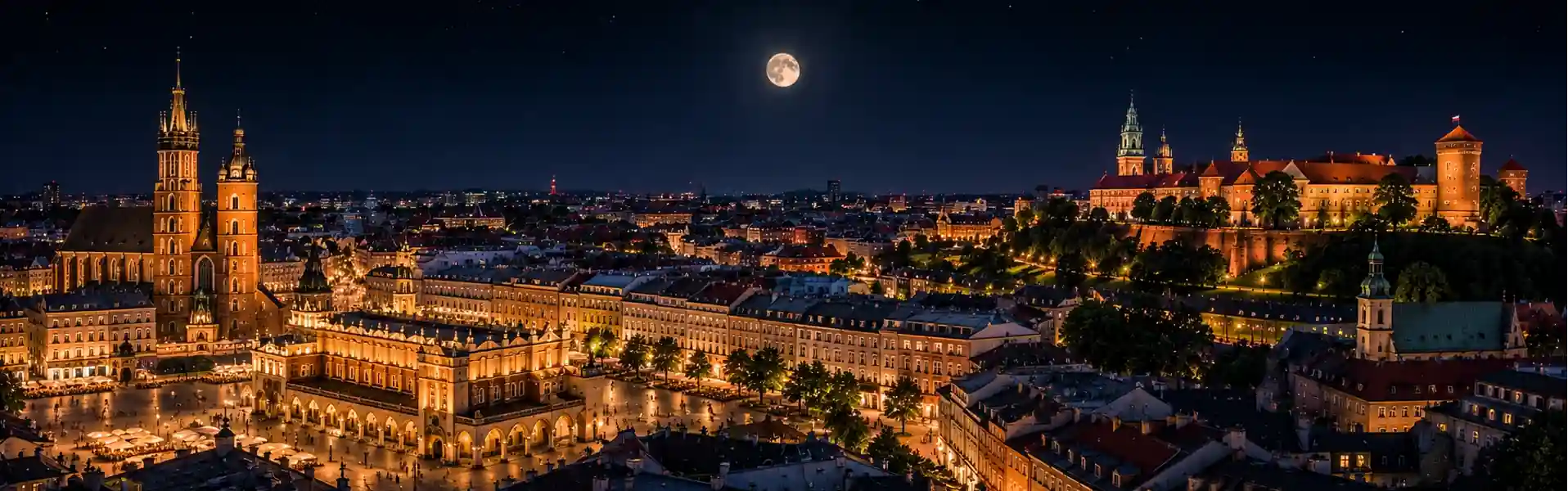
☽ Best Places to View the Moon in Kraków, Poland
Kraków sits at roughly 50.06°N on the Vistula River in southern Poland, the country's former capital until 1596. Its Old Town and Wawel Hill were among the original sites inscribed on the UNESCO World Heritage list in 1978. Few cities have as direct a historical claim to astronomy: Nicolaus Copernicus studied here in the 1490s, and the hills around the city carry a scatter of ancient and modern earthwork mounds that have long doubled as vantage points. At this latitude the Moon rises between north-east and south-east, and a summer full Moon stays low, near 16°, while a winter one climbs to about 63°. Between the river, the mounds, and the university's own observatory, Kraków has an unusually layered set of places to watch the Moon from. Exact rise and set times and azimuth depend on the date and your observing position, so check both before planning a specific composition.
Wawel Hill & the Vistula Boulevards
A limestone hill above the Vistula, roughly 228 metres above sea level, settled since before recorded history and topped by the Royal Castle and Cathedral. As the traditional seat of Polish kings, it gives an elevated view straight down the river, in contrast to the flatter streets of the Old Town just to the north. The riverside paths below the hill and along both banks of the Vistula, the Bulwary Wiślane, are the easiest option for an ordinary evening. The river runs broadly west to east through the centre, so a Moonrise or Moonset can follow the water, and the Moon sits directly over the river beneath the castle, one of the most photographed views in the city.
Krakus Mound & Wanda Mound
Two of Kraków's oldest prehistoric earthworks, associated in legend with the city's founder, Krakus, and his daughter, Wanda. Krakus Mound, an artificial earthwork about 16 metres high on Lasota Hill, gives sweeping views in every direction, and Wanda Mound lies to the east-north-east, in the direction the Moon rises. Some published research has explored a possible astronomical or calendar relationship between the two mounds' alignment, but this remains a research hypothesis rather than settled archaeology.
Piłsudski Mound & Kościuszko Mound
In the same western part of the city, in and around the Las Wolski forest, Piłsudski Mound, built in the 1930s atop Sowiniec Hill, is the largest of Kraków's mounds at 35 metres and its highest artificial viewpoint, with views toward the Tatra Mountains on a clear day. The older Kościuszko Mound, built in the 1820s, adds a second, more historic vantage point in the same general area. Check each mound's opening hours before a visit after dark.
Jagiellonian University Astronomical Observatory – Fort Skała
The Astronomical Observatory of the Jagiellonian University, named after Copernicus and founded in 1792, is based at Fort Skała, ul. Orla 171, some 10 km west of the centre. It holds free public evenings called "Night under the Stars," starting at 7 p.m., for which you must register in advance, with room for up to 40 people at each. It has very little parking, so the "Obserwatorium" public-transport stop near the entrance is the better option, and you should dress warmly. It is first of all a research institution, so check its schedule for upcoming dates rather than turning up unannounced.
Collegium Maius & the Old Observatory – Copernicus Heritage
Nicolaus Copernicus studied at the Jagiellonian University from 1491 to 1495, one of Europe's oldest centres of astronomical and mathematical teaching. Collegium Maius, the University Museum, preserves the university's Copernican heritage, including astronomical instruments. The university's former observatory building in its Botanical Garden, where the city's first observatory was set up in the 18th century, has a historic telescope nicknamed "Amerykanka" and has hosted visits, so check whether it is open to visitors. Confirm current Collegium Maius opening hours before planning a visit.
Zakrzówek
A flooded former limestone quarry turned recreational lake, ringed by dramatic rock cliffs, a short distance south-west of the centre. The open water and surrounding rock give a wider, more open sky than the streets of the Old Town, in a setting that looks nothing like the rest of the city. The bathing area and its platforms run on seasonal hours, so check current access before planning a visit, and stay well back from the cliff edges.
◉ Best Times for Moon Photography in Kraków
📷 Quick Photography Tips for Kraków
🕐 Timezone: Kraków runs on CET (UTC+1), shifting to CEST (UTC+2) for daylight saving time, from the last Sunday in March to the last Sunday in October.
🔭 Telescope Option: The Jagiellonian University Astronomical Observatory at Fort Skała, ul. Orla 171, runs free "Night under the Stars" evenings at 7 p.m., with registration required and room for up to 40 people. Lesser Poland's Lubomir observatory in the Beskid Wyspowy is also reported to hold night shows of deep-sky objects. Check both for dates. For the moon phase in any other city, use the calculator on our home page.
The moon phase today in Kraków, Poland is shown in detail above — complete with exact illumination percentage, moonrise/set times, and the best viewpoints to see it. For the moon phase today in any other city or location worldwide, visit our Dynamic Moon Phase Calculator on the home page.
◐ What the Experience Actually Feels Like
Kraków has a strong claim on the history of astronomy. Copernicus attended lectures here in the 1490s, decades before he wrote the book that moved the Earth around the Sun, at a university that had already been teaching astronomy and mathematics for generations. Collegium Maius still holds astronomical instruments, a small, easy-to-miss detail in a city full of grander monuments.
Outside the university, the hills carry their own older relationship with the sky. Krakus and Wanda mounds predate the city's written history, and published research has explored whether the two were positioned with the sunrise on specific dates in mind — a hypothesis nobody has proven, but one that fits a landscape people have clearly been drawn to for a very long time.
None of this requires any special effort to reach. A walk up Krakus Mound, an evening on the Vistula boulevards beneath a floodlit Wawel, or a free evening at the university observatory on Fort Skała are all within an ordinary visit to the city — layered, if you want them to be, with a very long history of people watching the sky from this landscape.
"Kraków taught Copernicus before he taught the world — and the hills around it may have been watched for the sunrise long before that."
✓ Your Kraków Moon Chase Checklist
Before You Go
- Check the moonrise time and phase on this page for each night of your stay
- Check the Jagiellonian University Observatory's "Night under the Stars" dates and register in advance — they're not a daily, walk-in option, and each is limited to 40 people
- Confirm current Collegium Maius opening hours if you want to see the Copernicus-related exhibits
- Between late March and late October, remember Poland shifts to CEST — re-verify your moonrise app's offset
- Check current seasonal access and hours at Zakrzówek before heading out
What to Bring
- A warm layer for winter evenings — nights are typically around or below freezing in January, colder on a bad night
- A tripod, useful at the exposed mound summits and around Zakrzówek's open water
- Sturdy shoes for the dirt paths up Krakus, Wanda, and Piłsudski mounds, which can be muddy or icy depending on season
- A headlamp for the walk through Las Wolski to Piłsudski and Kościuszko mounds after dark
- Spare camera batteries for extended cold-weather sessions
On the Night
- Arrive 20–30 minutes before moonrise at open spots like Krakus Mound or the Vistula boulevards
- Mind uneven, sometimes steep paths on the mound trails, especially after rain or frost
- At Zakrzówek, stay well back from the cliff edges, particularly in low light
- Shoot RAW and bracket exposures, especially where floodlighting on Wawel Castle mixes with moonlight
- For the observatory, arrive by public transport to the "Obserwatorium" stop, since parking is very limited
? Kraków Moon Phase — Frequently Asked Questions
Q. What is the moon phase today in Kraków?
The moon phase today in Kraków is a Last Quarter with 45% illumination. The next full moon is in 23 days, on 26 Oct. Moonrise is at 11:52 PM and moonset at 3:48 PM.
Q. Where is the best place to view the moon in Kraków?
Kraków sits on the Vistula in southern Poland, the country's former capital until 1596, with an Old Town and Wawel Hill that were among the original UNESCO World Heritage sites in 1978. Wawel Hill, a limestone hill of roughly 228 m crowned by the Royal Castle, and the Vistula boulevards below it put the moon over the river. The earthwork mounds give open horizons: Krakus Mound, about 16 m high, and Piłsudski Mound, 35 m, with views toward the Tatra Mountains on a clear day. Zakrzówek, a flooded limestone quarry southwest of the centre, has open water and cliffs.
Q. Can I look at the moon through a telescope in Kraków?
Yes, at events. The Astronomical Observatory of the Jagiellonian University, named after Copernicus, is at Fort Skała, ul. Orla 171, about 10 km west of the centre. It holds free public evenings called "Night under the Stars", starting at 7 p.m., for which you register in advance, with room for up to 40 people at each, so dress warmly. An earlier evening tour also showed the Sun through a filter, Venus and Mars, with a presentation if the sky was cloudy. The Observatory is first of all a research institution, so check its schedule for upcoming dates rather than turning up unannounced.
Q. Where does the moon rise and set in Kraków, and how high does it climb?
At about 50.1°N, Kraków's moonrise and moonset points swing widely across the horizon each month, from roughly north-east to south-east for rising and north-west to south-west for setting, with an even wider swing in years near a major lunar standstill. A full moon near the winter solstice climbs to roughly 63° in the south, while a full moon near the summer solstice stays low, peaking near 16°, and is often hazy. The Vistula runs broadly west to east through the centre, so from the boulevards a rising or setting moon can follow the river, and Wanda Mound lies east-north-east of Krakus Mound, in the direction the moon rises. Check the azimuth for your date and exact spot.
Q. Is light pollution a problem for moon observing in Kraków?
The moon is bright enough to observe and photograph from almost anywhere in Kraków, so light pollution rarely limits the lunar disc itself. It does wash out earthshine on a thin crescent and any faint sky detail. Kraków is a large, brightly lit city, so stars are faint in the centre, and the university's Fort Skała observatory sits on the western outskirts rather than in a dark-sky area. Lesser Poland has darker places outside the city, such as the Lubomir observatory in the Beskid Wyspowy, which is reported to hold night shows of deep-sky objects, so check ahead for its dates.
Q. What camera settings and phases work best for moon photography in Kraków?
For a full moon, start with Looney 11 (f/11, ISO 100, 1/100 s) and refine using your histogram, since it is a baseline rather than a guarantee. Shoot RAW and bracket exposures, especially where the floodlighting on Wawel Castle mixes with moonlight. Arrive 20 to 30 minutes before moonrise at an open spot such as Krakus Mound or the Vistula boulevards, and use a tripod at the exposed mound summits, which are more open to wind than the streets. Wawel Castle floodlit against the night sky, shot from across the river, works well with a rising moon, and Zakrzówek's still water can give a clean reflection on a calm night.
Q. How do cold, smog and mist affect moon viewing in Kraków?
January nights in Kraków are typically around or below freezing, with colder spells possible, so check the forecast and dress warmly, and keep spare camera batteries, which drain faster in the cold. Haze, mist and winter smog can reduce contrast, so check IMGW, Poland's meteorological institute, for cloud, visibility and fog. Paths up the mounds can be muddy or icy depending on the season, and a headlamp helps on the walk through Las Wolski to the Piłsudski and Kościuszko mounds after dark.
Q. What time zone are Kraków's moonrise and moonset times shown in?
Kraków runs on Central European Time, CET, UTC+1, in winter and Central European Summer Time, CEST, UTC+2, in summer. Clocks go forward on the last Sunday in March and back on the last Sunday in October, and moonrise and moonset times on this page follow the local clock in effect on each date, so re-check any moonrise app's offset when the clocks change. Kraków lies at about 19.9°E, east of the 15°E meridian on which Central European Time is based, so the sun and moon cross the sky about 20 minutes earlier on the clock than they would on that meridian.
Q. Can I shoot the moon at Kraków's viewpoints after dark?
Mostly, with care, but check each place. The Vistula boulevards are the easiest option for an ordinary evening. The mounds are reached by dirt paths that can be steep, uneven, muddy or icy, so go carefully in low light, and check each mound's opening hours before a night visit. At Zakrzówek the bathing area and its platforms run on seasonal hours, and you should stay well back from the cliff edges, particularly in low light. The observatory is open only on its scheduled evenings.
✦ Explore Further
Moon Phase Today: Łódź
Check tonight's moon phase in Łódź, roughly 190 km north of Kraków in central Poland.
🏙Moon Phase Today: Lublin
See the moon over Lublin, roughly 225 km north-east of Kraków in eastern Poland.
🌍World Moon Phase Directory
Find the moon phase, rise and set times for cities in every region of the world.
Blue Hour Calculator
Work out when blue hour falls, ideal for waxing gibbous shots over the Vistula.