
Moon Phase Lublin
On Sunday, October 4, 2026, the moon in Lublin is a Last Quarter with 45% illumination. Moon age: 22.6 days.
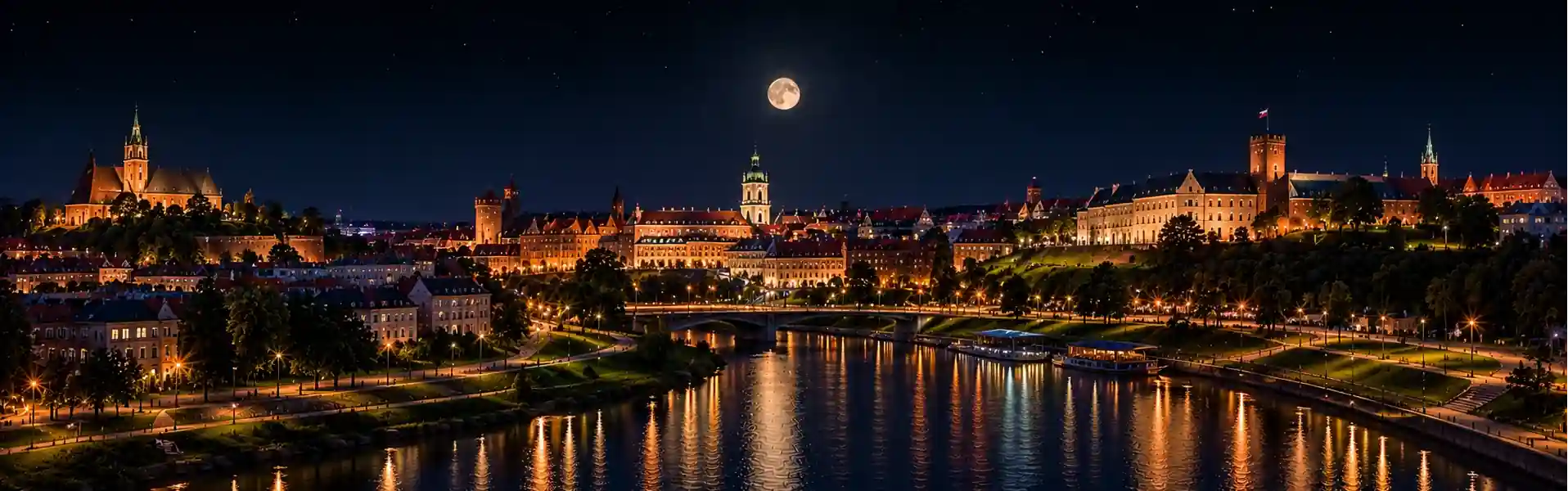
☽ Best Places to View the Moon in Lublin, Poland
Lublin sits at roughly 51.25°N in eastern Poland, the largest Polish city east of the Vistula. Built atop the loess hills of the Lublin Upland, the city is split by the Bystrzyca river valley, with deep gorges on one side and a flatter plateau on the other. Between a medieval castle hill, a bell tower with one of the city's principal panoramic views, and an artificial lake south of the centre, Lublin gives plenty of ways to get above or beside the streets for a clear view of the Moon. At this latitude the Moon rises between north-east and south-east, and a summer full Moon stays low, near 15°, while a winter one climbs to about 62°. Lublin lies far enough east that the Sun and Moon cross its sky about 30 minutes earlier on the clock than on the 15°E meridian. Exact rise and set times and azimuth depend on the date and your observing position, so check both before planning a specific composition.
Lublin Castle & the Keep
A hilltop stronghold established here in the 12th century; its surviving 13th-century Romanesque Keep is one of Lublin's oldest structures and the oldest fully preserved monument of brick architecture in the city. It has been open to visitors since 2012, with a viewing area at the top reached by an irregular staircase climbing about 30 metres. The site's Chapel of the Holy Trinity, with its Byzantine-Ruthenian frescoes, has received a European Heritage Label. It closes on a schedule, so check hours before an evening visit.
Trinity Tower
The bell tower of Lublin Cathedral, rebuilt in its current neo-Gothic form in the 1820s and one of the city's principal panoramic viewpoints. Around 200 steps lead up past the Archdiocesan Museum of Religious Art to a viewing platform over the Old Town, though reported heights and step counts vary between sources. Like the Keep, it runs on a schedule rather than staying open at night.
Old Town & Cracow Gate
Lublin's historic core, one of Poland's best-preserved medieval old towns, centred on the Market Square and the 14th-century Cracow Gate. It's the city's easiest option for an ordinary evening: no dark sky, but a Moon rising over some of the oldest streets in the country, and the floodlit Old Town gives a striking historic foreground without leaving the centre.
Zalew Zemborzycki
An artificial reservoir of about 282 hectares in the Bystrzyca valley on the city's southern edge, created in 1974 by damming the river and now Lublin's largest water body and recreation area, with beaches, watersports, and a cycling path around the shore. Its open water gives a wider horizon than anywhere in the centre, and its shoreline is more exposed to wind than the streets of the Old Town, so confirm your return transport in the evening.
Bystrzyca Valley & the University Botanical Garden
The river valley that splits Lublin runs through the city as a green corridor, with paths and recreational areas alongside the water and the surrounding loess landscape, a quieter, more natural stretch than the Old Town, with unlit stretches after dark. The 21-hectare Botanical Garden of Maria Curie-Skłodowska University, with around 7,500 plant taxa across river valley, slope, loess ravines and plateau, is a scenic daytime and early-evening destination, but its visitor season and opening hours fall well short of full darkness for much of the year.
Astronomy in Lublin – Societies and Events
Lublin has no permanent public observatory or planetarium with a regular viewing night that is advertised. The Lublin branch of the Polish Amateur Astronomers' Society (PTMA) and astronomy groups at Maria Curie-Skłodowska University have co-organised astronomy days with talks and, weather permitting, evening sky observations, and the Copernicus Science Centre's mobile planetarium, the Planetobus, visits schools around the Lublin region. Watch for announcements rather than turning up unannounced.
◉ Best Times for Moon Photography in Lublin
📷 Quick Photography Tips for Lublin
🕐 Timezone: Lublin runs on CET (UTC+1), shifting to CEST (UTC+2) for daylight saving time, from the last Sunday in March to the last Sunday in October.
🔭 Telescope Option: No regular public telescope night is advertised in Lublin. The Lublin branch of PTMA and Maria Curie-Skłodowska University's astronomy groups have co-organised astronomy days with evening sky observations, weather permitting, so watch for announcements. For the moon phase in any other city, use the calculator on our home page.
The moon phase today in Lublin, Poland is shown in detail above — complete with exact illumination percentage, moonrise/set times, and the best viewpoints to see it. For the moon phase today in any other city or location worldwide, visit our Dynamic Moon Phase Calculator on the home page.
◐ What the Experience Actually Feels Like
Lublin's shape does a lot of the work for you. The city sits on hills cut through by the Bystrzyca valley, so the hills and river valley create plenty of natural changes in elevation and viewpoint across the city — climbing toward the castle, dropping into a loess gorge, or opening out at the reservoir to the south. That's unusual among cities this size, and it means a decent view of the Moon rarely requires much of a special trip.
The castle keep and the Trinity Tower are the two most distinctive elevated viewpoints, both literally built to be climbed and looked out from, centuries apart from each other but serving the same purpose today. Between them, and further out past Zalew Zemborzycki, the city gives you a genuine range: a medieval Romanesque tower, a neo-Gothic bell tower, and an artificial lake ringed with beaches and cycling paths.
None of it requires special timing beyond checking when the towers close. A walk through the Old Town, a climb up to either viewpoint, or an evening out at the reservoir are all well within an ordinary visit to the city.
"Lublin doesn't need to send you looking far for a viewpoint — the hills and the river valley put changes in elevation within reach almost everywhere you stand."
✓ Your Lublin Moon Chase Checklist
Before You Go
- Check the moonrise time and phase on this page for each night of your stay
- Check current opening hours for the Castle Keep and Trinity Tower, since both run on a schedule rather than staying open at night
- Plan transport in advance for Zalew Zemborzycki if travelling without a car
- Between late March and late October, remember Poland shifts to CEST — re-verify your moonrise app's offset
- Check the Botanical Garden's current seasonal hours if you want to visit — it's a daytime and early-evening destination, not a late-night one
What to Bring
- A warm layer for winter evenings — nights are typically around or below freezing in January, colder on a bad night
- A tripod, useful at Zalew Zemborzycki's open shoreline
- Sturdy footwear for the uneven stairs in the Castle Keep and the steps up the Trinity Tower
- A headlamp for unlit stretches along the Bystrzyca valley after dark
- Spare camera batteries for extended cold-weather sessions
On the Night
- Arrive 20–30 minutes before moonrise at open spots like Zalew Zemborzycki
- Mind the uneven stairs in the Castle Keep and the roughly 200 steps up the Trinity Tower
- Shoot RAW and bracket exposures, especially where floodlit Old Town landmarks mix with moonlight
- Confirm your return transport if heading out to the reservoir in the evening
? Lublin Moon Phase — Frequently Asked Questions
Q. What is the moon phase today in Lublin?
The moon phase today in Lublin is a Last Quarter with 45% illumination. The next full moon is in 23 days, on 26 Oct. Moonrise is at 11:35 PM and moonset at 3:44 PM.
Q. Where is the best place to view the moon in Lublin?
Lublin, the largest Polish city east of the Vistula, is built on the loess hills of the Lublin Upland and split by the Bystrzyca valley, so elevation is easy to find. Lublin Castle's 13th-century Romanesque Keep has a viewing area at the top, and the Trinity Tower, the bell tower of the cathedral, is one of the city's principal panoramic viewpoints, with around 200 steps. The Old Town and the 14th-century Cracow Gate give a historic foreground, and Zalew Zemborzycki, an artificial reservoir of about 282 hectares on the city's southern edge, has the widest open horizon.
Q. Can I look at the moon through a telescope in Lublin?
Not at a regular public night that is advertised. The Lublin branch of the Polish Amateur Astronomers' Society (PTMA) and astronomy groups at Maria Curie-Skłodowska University have co-organised astronomy days with talks and, weather permitting, evening sky observations, so watch for announcements. The Copernicus Science Centre's mobile planetarium, the Planetobus, also visits schools around the Lublin region. Observing depends on the weather.
Q. Where does the moon rise and set in Lublin, and how high does it climb?
At about 51.2°N, Lublin's moonrise and moonset points swing widely across the horizon each month, from roughly north-east to south-east for rising and north-west to south-west for setting, with an even wider swing in years near a major lunar standstill. A full moon near the winter solstice climbs to roughly 62° in the south, while a full moon near the summer solstice stays low, peaking near 15°, and is often hazy. The hills and the river valley change the horizon from place to place, so a spot on the castle hill or the Trinity Tower is more open than the streets of the Old Town. Check the azimuth for your date and exact spot.
Q. Is light pollution a problem for moon observing in Lublin?
The moon is bright enough to observe and photograph from almost anywhere in Lublin, so light pollution rarely limits the lunar disc itself. It does wash out earthshine on a thin crescent and any faint sky detail. Lublin is a large city, so stars are faint in the Old Town and around the castle, which are floodlit. The open shoreline of Zalew Zemborzycki and the Bystrzyca valley are quieter, though still inside the city's glow.
Q. What camera settings and phases work best for moon photography in Lublin?
For a full moon, start with Looney 11 (f/11, ISO 100, 1/100 s) and refine using your histogram, since it is a baseline rather than a guarantee. Shoot RAW and bracket exposures, especially where floodlit Old Town landmarks mix with moonlight. The floodlit Old Town and Cracow Gate give a striking historic foreground for a moonrise shot without leaving the centre. Arrive 20 to 30 minutes before moonrise at an open spot such as Zalew Zemborzycki, and use a tripod at its shoreline, which is more exposed to wind than the streets of the Old Town.
Q. How do cold and temperature swings affect moon viewing in Lublin?
Lublin has a continental climate typical of the Lublin Upland, with large temperature swings and long, cool winters. January nights are typically around or below freezing, with colder spells possible, so check the forecast and dress warmly. Cold drains camera batteries fast, so carry spares in an inner pocket and swap them rather than waiting for one to die. Check IMGW, Poland's meteorological institute, for cloud, visibility and wind.
Q. What time zone are Lublin's moonrise and moonset times shown in?
Lublin runs on Central European Time, CET, UTC+1, in winter and Central European Summer Time, CEST, UTC+2, in summer. Clocks go forward on the last Sunday in March and back on the last Sunday in October, and moonrise and moonset times on this page follow the local clock in effect on each date, so re-check any moonrise app's offset when the clocks change. Lublin lies at about 22.6°E, well east of the 15°E meridian on which Central European Time is based, so the sun and moon cross the sky about 30 minutes earlier on the clock than they would on that meridian.
Q. Can I shoot the moon at Lublin's viewpoints after dark?
Mostly, with care, but check each place. The Castle Keep and the Trinity Tower both run on a schedule and do not stay open at night, so an evening visit timed around moonrise needs checking against current opening hours. The stairs in the Keep are uneven, and the Trinity Tower has roughly 200 steps, though reported step counts and heights vary between sources. The University Botanical Garden has seasonal hours that stop well short of full darkness. Confirm return transport if heading out to the reservoir in the evening, and bring a headlamp for unlit stretches along the Bystrzyca valley.
✦ Explore Further
Moon Phase Today: Warsaw
Check tonight's moon phase in Warsaw, roughly 155 km north-west of Lublin on the Vistula.
🏙Moon Phase Today: Łódź
See the moon over Łódź, roughly 220 km west-north-west of Lublin in central Poland.
🌍World Moon Phase Directory
Find the moon phase, rise and set times for cities in every region of the world.
Blue Hour Calculator
Work out when blue hour falls, ideal for waxing gibbous shots over Zalew Zemborzycki.