
Moon Phase Gdansk
On Sunday, October 4, 2026, the moon in Gdansk is a Last Quarter with 45% illumination. Moon age: 22.6 days.
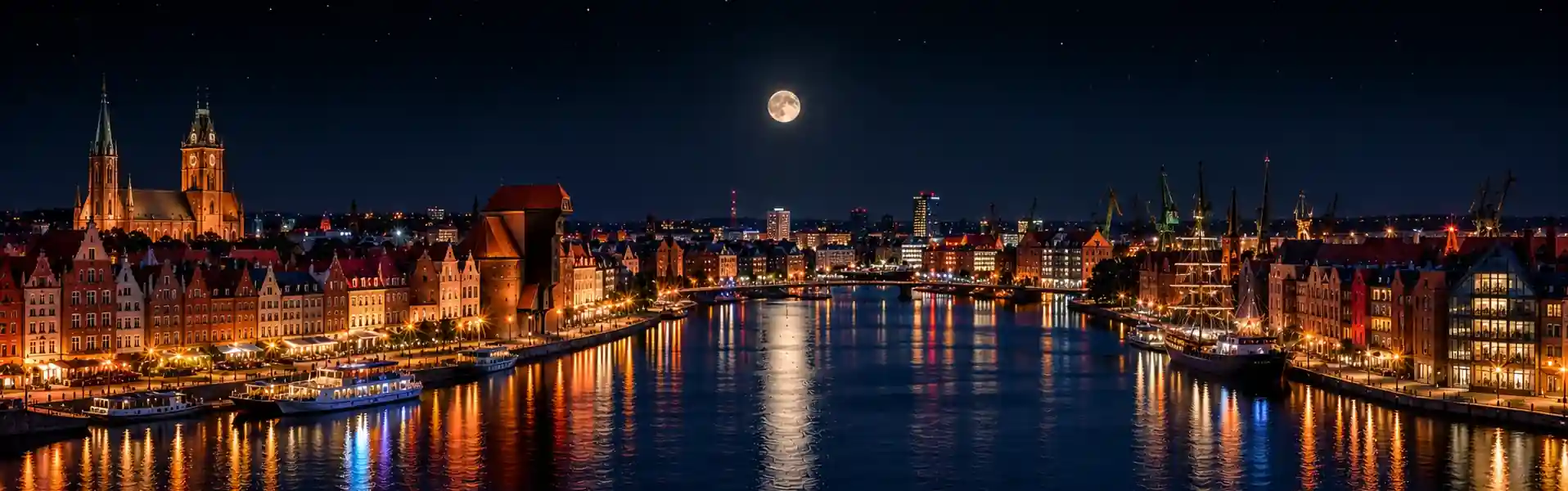
☽ Best Places to View the Moon in Gdańsk, Poland
Gdańsk sits at roughly 54.35°N on the Baltic coast of northern Poland, at the mouth of the Motława river, and anchors the Tricity (Trójmiasto) it forms with Gdynia and Sopot. Few cities have a stronger personal claim to lunar history: Gdańsk was the home of Johannes Hevelius, the 17th-century astronomer widely regarded as the founder of lunar topography, who spent years systematically observing and drawing the lunar surface from his own rooftop observatory here, publishing the results in 1647. At this latitude the Moon rises between north-east and south-east, a summer full Moon stays very low, near 12°, and a winter one climbs to about 59°. The bay faces roughly north, so the Moon is over the sea only when it rises north of due east or sets north of due west, and otherwise it rises or sets over land. Exact rise and set times and azimuth depend on the date and your observing position, so check both before planning a specific composition.
Hevelianum, Gradowa Hill
A science centre and museum at ul. Gradowa 6, built inside a 19th-century fortress on Góra Gradowa, a fortified hill about 50 metres above sea level, and named after Johannes Hevelius. Alongside its exhibits, Hevelianum runs public astronomy events, such as a free Perseids night with sky observations from 21:30 to 1:00, astronomers' stories and a replica of the telescope Hevelius used. The hilltop is also one of the better panoramic viewpoints over the Old Town. Opening hours change regularly and the night events are scheduled, so check its calendar.
Hevelius Monuments & St. Catherine's Church
Several monuments to Hevelius stand around Gdańsk's Old Town, and St. Catherine's Church holds his tomb. His original observatory, on the roofs of his houses in the Old Town, was destroyed by fire in 1679 and rebuilt, and the rebuilt structure was later lost when the Old Town was destroyed in the Second World War, so it is not there to visit today. Together the monuments and the tomb make a small, walkable trail through the city's own astronomical history. Check the church's visiting hours.
Motława Riverfront & Long Market
The historic waterfront running past the Gdańsk Crane, the Green Gate, and the Long Market's merchant houses is the city's most-used public space and its easiest option for an ordinary evening. It won't give you a dark sky, but it puts the Moon directly over the water among some of the city's best-known landmarks, and the floodlit waterfront makes a striking historic foreground.
Westerplatte
A peninsula at the mouth of the Dead Vistula, the site of the opening fighting of the German invasion of Poland in September 1939. Its position at the harbour entrance gives an open view out over Gdańsk Bay, distinct from the more enclosed streets of the Old Town, and it is exposed to wind off the Baltic, so bring a windproof layer and confirm your return transport.
Sobieszewo Island
A quieter, more rural island within the city limits, on the Vistula delta east of the centre, home to the Ptasi Raj and Mewia Łacha nature reserves along with extensive beaches and coastal areas. It's the strongest choice on this list for getting away from dense urban lighting without leaving the city. It has unlit stretches after dark, so bring a headlamp and confirm return transport in advance.
Brzeźno Beach
A sandy beach and pier on Gdańsk Bay, reached from the city centre by public transport, with open sea views to the north. Brzeźno's seaside Dom Zdrojowy is a branch of Hevelianum. It's a straightforward option for watching the Moon rise over open water without travelling as far as Sobieszewo or Westerplatte, and like Westerplatte it is exposed to wind off the Baltic.
◉ Best Times for Moon Photography in Gdańsk
📷 Quick Photography Tips for Gdańsk
🕐 Timezone: Gdańsk runs on CET (UTC+1), shifting to CEST (UTC+2) for daylight saving time, from the last Sunday in March to the last Sunday in October.
🔭 Telescope Option: Hevelianum on Gradowa Hill, at ul. Gradowa 6, runs public astronomy events such as its Perseids night, with sky observations and a replica of Hevelius's telescope. These are scheduled rather than nightly, so check its calendar. For the moon phase in any other city, use the calculator on our home page.
The moon phase today in Gdańsk, Poland is shown in detail above — complete with exact illumination percentage, moonrise/set times, and the best viewpoints to see it. For the moon phase today in any other city or location worldwide, visit our Dynamic Moon Phase Calculator on the home page.
◐ What the Experience Actually Feels Like
Gdańsk has the most personal relationship with the Moon of almost any city. Johannes Hevelius spent years, from the 1640s onward, systematically observing and drawing the lunar surface from a telescope he built himself on the roof of his own house, publishing the results as Selenographia in 1647. Earlier astronomers, including Galileo and Thomas Harriot, had already drawn the Moon, but Hevelius's map was more ambitious and precise than anything before it, precise enough that he's generally credited with discovering the Moon's libration in longitude, the slight wobble that lets an observer glimpse a little further around its edge over time.
His original observatory didn't even survive his own lifetime intact — it burned down in 1679, and he rebuilt it. That rebuilt structure was lost for good when the Old Town was destroyed in the Second World War. The city has rebuilt its relationship with him in other ways instead: monuments, a tomb at St. Catherine's, and Hevelianum, a science centre on a hill above the city that runs public astronomy events, including a replica of his telescope, where you can look at the sky much as he once did, just with better equipment.
Beyond that, Gdańsk works the way any Baltic port city does: a historic river frontage for an easy evening, an island and a beach or two for something quieter, and a peninsula at the harbour mouth where the sea opens right up. It's an ordinary northern European city with one very unusual claim to fame sitting quietly in the middle of it.
"Gdańsk is a place where someone made detailed maps of the Moon by hand, from a rooftop a few streets from where you'd be standing to look at it now."
✓ Your Gdańsk Moon Chase Checklist
Before You Go
- Check the moonrise time and phase on this page for each night of your stay
- Check Hevelianum's current event calendar if you want to catch one of its public astronomy nights — they're not a nightly, walk-in option
- Check current opening hours for St. Catherine's Church if you want to visit Hevelius's tomb
- Between late March and late October, remember Poland shifts to CEST — re-verify your moonrise app's offset
- Check current transport options to Sobieszewo Island or Westerplatte in advance if travelling without a car
What to Bring
- A warm, windproof layer — Gdańsk's coastal position means wind off the Baltic is a regular factor, even in mild weather
- A tripod, useful at open spots like Westerplatte, Brzeźno, and Gradowa Hill
- Sturdy footwear for Sobieszewo's beaches and nature trails
- A headlamp for unlit stretches on Sobieszewo Island after dark
- Spare camera batteries for extended cold-weather sessions
On the Night
- Arrive 20–30 minutes before moonrise at open spots like Westerplatte or Brzeźno for the clearest sea horizon
- Mind wind and cold at exposed coastal and hilltop spots — conditions can turn quickly near the water
- Shoot RAW and bracket exposures, especially where floodlit landmarks along the Motława mix with moonlight
- Confirm your return transport if heading out to Sobieszewo or Westerplatte in the evening
? Gdańsk Moon Phase — Frequently Asked Questions
Q. What is the moon phase today in Gdańsk?
The moon phase today in Gdańsk is a Last Quarter with 45% illumination. The next full moon is in 23 days, on 26 Oct. Moonrise is at 11:33 PM and moonset at 4:19 PM.
Q. Where is the best place to view the moon in Gdańsk?
Gdańsk sits on the Baltic coast at the mouth of the Motława river, the home of the 17th-century astronomer Johannes Hevelius, who published a detailed map of the Moon in 1647. Hevelianum, a science centre inside a 19th-century fortress on Gradowa Hill, about 50 m above sea level, is the main astronomy venue and a panoramic viewpoint over the Old Town. The floodlit Motława riverfront puts the moon over the water, Westerplatte and Brzeźno Beach have open sea horizons over Gdańsk Bay, and Sobieszewo Island, on the Vistula delta, is the quietest, darkest choice.
Q. Can I look at the moon through a telescope in Gdańsk?
At events. Hevelianum, at ul. Gradowa 6, runs public astronomy events, such as its free Perseids night, an astronomical science picnic with sky observations from 21:30 to 1:00 accompanied by astronomers' stories, and a replica of the telescope Hevelius used. It also marks Hevelius's birthday on 28 January with astronomers' talks and the replica telescope. These are not nightly, walk-in sessions, so check Hevelianum's event calendar for current dates, since observing depends on the weather.
Q. Where does the moon rise and set in Gdańsk, and how high does it climb?
At about 54.4°N, Gdańsk's moonrise and moonset points swing widely across the horizon each month, from roughly north-east to south-east for rising and north-west to south-west for setting, with an even wider swing in years near a major lunar standstill. A full moon near the winter solstice climbs to roughly 59° in the south, while a full moon near the summer solstice stays very low, peaking near 12°, and is often hazy. Gdańsk Bay faces roughly north, so the moon is over the sea only when it rises north of due east or sets north of due west, and otherwise it rises or sets over land. Check the azimuth for your date and exact spot.
Q. Is light pollution a problem for moon observing in Gdańsk?
The moon is bright enough to observe and photograph from almost anywhere in Gdańsk, so light pollution rarely limits the lunar disc itself. It does wash out earthshine on a thin crescent and any faint sky detail. Gdańsk is the anchor of the Tricity with Gdynia and Sopot, a large, continuously lit urban area, so stars are faint along the waterfront and the Old Town. Sobieszewo Island, with its beaches and nature reserves on the Vistula delta east of the centre, is the strongest choice within the city limits for getting away from dense urban lighting.
Q. What camera settings and phases work best for moon photography in Gdańsk?
For a full moon, start with Looney 11 (f/11, ISO 100, 1/100 s) and refine using your histogram, since it is a baseline rather than a guarantee. Shoot RAW and bracket exposures, especially where floodlit landmarks along the Motława mix with moonlight, and the floodlit waterfront gives a striking historic foreground for a moonrise shot over the water. Arrive 20 to 30 minutes before moonrise at an open spot such as Westerplatte or Brzeźno for the clearest sea horizon, and use a tripod there, since both are more exposed to wind off the Baltic than the streets of the Old Town.
Q. How do wind, cold and long summer twilight affect moon viewing in Gdańsk?
Gdańsk's coastal position means wind off the Baltic is a regular factor, even in mild weather, so bring a warm, windproof layer, and conditions can turn quickly near the water. January nights are typically around or below freezing, with colder spells possible, and cold drains camera batteries fast, so carry spares. At this latitude the sun stays within about 12° of the horizon at midsummer, so from roughly early May to early August the sky never gets fully dark. Check IMGW, Poland's meteorological institute, for cloud, visibility and wind.
Q. What time zone are Gdańsk's moonrise and moonset times shown in?
Gdańsk runs on Central European Time, CET, UTC+1, in winter and Central European Summer Time, CEST, UTC+2, in summer. Clocks go forward on the last Sunday in March and back on the last Sunday in October, and moonrise and moonset times on this page follow the local clock in effect on each date, so re-check any moonrise app's offset when the clocks change. Gdańsk lies at about 18.6°E, east of the 15°E meridian on which Central European Time is based, so the sun and moon cross the sky about 15 minutes earlier on the clock than they would on that meridian.
Q. Can I shoot the moon at Gdańsk's viewpoints after dark?
Mostly, with care, but check each place. Hevelianum keeps its own opening hours, which change regularly, and its night events are scheduled. St. Catherine's Church, which holds Hevelius's tomb, keeps its own visiting hours. Westerplatte, Brzeźno and the Motława riverfront are public. Sobieszewo Island has unlit stretches after dark, so a headlamp helps, and you should confirm return transport if heading out to Sobieszewo or Westerplatte in the evening.
✦ Explore Further
Moon Phase Today: Bydgoszcz
Check tonight's moon phase in Bydgoszcz, roughly 145 km south-south-west of Gdańsk on the Brda.
☄️Moon Phase Today: Poznań
See the moon over Poznań, roughly 245 km south-south-west of Gdańsk, home to the Morasko meteorite craters.
🌍World Moon Phase Directory
Find the moon phase, rise and set times for cities in every region of the world.
Blue Hour Calculator
Work out when blue hour falls, ideal for waxing gibbous shots over Gdańsk Bay.