
Moon Phase Today Quezon City
On Monday, October 5, 2026, the moon in Quezon City is a Waning Crescent with 34% illumination. Moon age: 23.7 days.
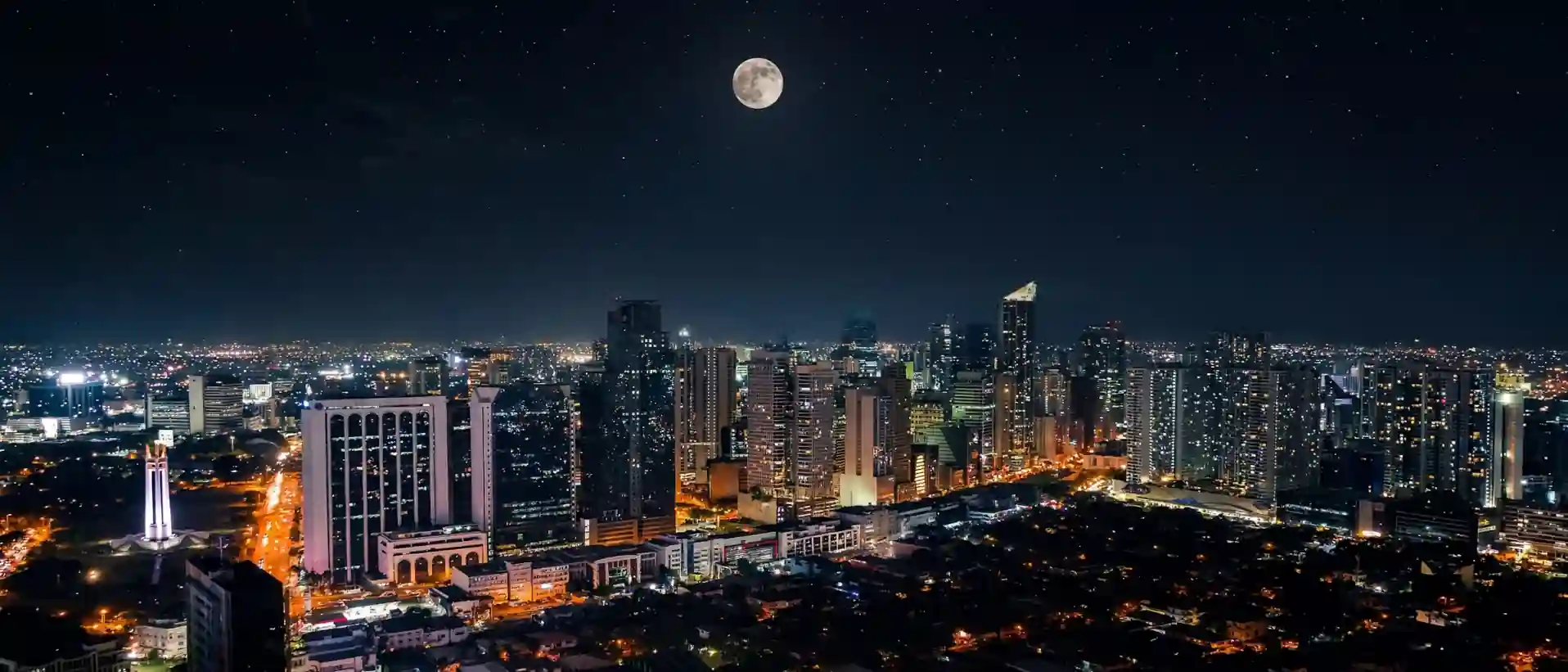
☽ Best Places to View the Moon in Quezon City, Philippines
Quezon City sits at roughly 14.7°N in the north-east of Metro Manila, on the Guadalupe Plateau, a relatively high plateau of rolling terrain between the Manila lowlands to the south-west and the Marikina River valley to the east. It is the largest city in Metro Manila by area, and it was the country's official capital from 1948 to 1976. It is also where the Philippines' government astronomy happens: the PAGASA Astronomical Observatory sits on the UP Diliman campus, and the PAGASA Planetarium is in the Science Garden nearby. At this latitude the Moon rises between roughly east-north-east and east-south-east and climbs high: a full Moon near the December solstice passes within about 15° of the zenith, while one near the June solstice crosses the southern sky at roughly 47° to 57°. Quezon City is heavily built up and brightly lit, so open ground with a clear horizon matters more here than darkness. Exact rise and set times and azimuth depend on the date and your observing position, so check both before planning a specific composition.
Quezon Memorial Circle & Shrine
A national park of about 25 to 27 hectares at the heart of the city, inside the large oval of Elliptical Road, in front of Quezon City Hall. At its centre stands the 66-metre art-deco Quezon Memorial Shrine, a monument of three vertical pylons that houses a museum and the mausoleum of President Manuel L. Quezon. The park is free to enter and open daily from 5 a.m. to 10 p.m., so it is the city's most practical evening spot, and its open lawns give wide horizons. The administration requires a permit for organised photo or film shoots, commercial or non-commercial, so check with the Quezon Memorial Circle Administration Office before bringing a crew. Private vehicles pay a small parking fee at the entrance.
PAGASA Astronomical Observatory – UP Diliman
The government's astronomical observatory has stood on the University of the Philippines Diliman campus since 1954, and is run by PAGASA. Its 45-cm telescope, donated by Japan in 2001 and open for public use since 2003, can show the Moon and planets. Stargazing and telescoping sessions are held on request, with a letter to PAGASA at least two weeks ahead, and free walk-in sessions are held during events such as Philippine Space Week, for example 6 to 9 p.m. on 13 August 2026, weather permitting and first come, first served. It is not a nightly drop-in, so check PAGASA's current schedule.
PAGASA Planetarium – Science Garden
PAGASA's planetarium in the Science Garden Complex off Agham Road, in Barangay Central, was built in 1977 and seats about 100 people. During Space Week it has run free shows several times a day, and it has been described as open to the public for a minimal fee. It shows a projected sky, not the real Moon, so treat it as an astronomy stop rather than a viewing spot, and check current showtimes and fees before visiting.
UP Diliman Campus – Academic Oval
UP Diliman has open lawns and tree-lined avenues around its Academic Oval, on the same plateau, and the PAGASA observatory is on the campus. The grounds give broad horizons over open space when the Moon's azimuth for your date lines up with them. As a university campus, evening access varies with university policy, so use public areas only and check the current rules before a late visit.
Ninoy Aquino Parks & Wildlife Center and the Elevated Promenade
An urban forest park of about 22.7 hectares across Elliptical Road from Quezon Memorial Circle, with a wildlife rescue center. It is open from 7 a.m. to 5 p.m., so it closes before the Moon is up and is a daytime visit. The Elevated Landscape Promenade, a walkway over Elliptical Road between North Avenue and Quezon Avenue that opened in late 2025, links the two parks, and its ramp is inside Quezon Memorial Circle. Check access after hours.
La Mesa Eco Park & Watershed – Daytime Only
The 33-hectare La Mesa Eco Park sits inside the La Mesa Watershed in Barangay Greater Lagro, a vital water source for the metropolis around a reservoir, described by the city as the last remaining forest of its size in Metro Manila. It is open Tuesday to Sunday from 7 a.m. to 4 p.m., with advance reservations through the Manila Water Foundation, so it is not a night-time Moon location. Use designated public areas only.
◉ Best Times for Moon Photography in Quezon City
📷 Quick Photography Tips for Quezon City
🕐 Timezone: Quezon City runs on Philippine Standard Time (UTC+8) year-round; the Philippines does not observe daylight saving time. Photo-planning apps such as PhotoPills or Stellarium will work out the Moon's exact rise azimuth for any of these spots.
🔭 Telescope Option: The PAGASA Astronomical Observatory at UP Diliman holds stargazing and telescoping sessions on request, with a letter to PAGASA at least two weeks ahead, and free walk-in sessions during Space Week events. Check PAGASA for current dates. For the moon phase in any other city, use the calculator on our home page.
The moon phase today in Quezon City is shown in detail above — complete with exact illumination percentage, moonrise/set times, and the best local spots to see it. For the moon phase today in any other city worldwide, visit our Dynamic Moon Phase Calculator on the home page.
◐ What the Experience Actually Feels Like
At Quezon Memorial Circle, the Moon shares the evening with the city's centre. The park is a national landmark with a 66-metre art-deco shrine at its middle, ringed by the traffic of Elliptical Road, and it stays open until 10 p.m., so a moonrise over its lawns is an ordinary after-work outing rather than an expedition. The sky is bright with city glow, but the Moon itself cuts through it easily, and at this latitude it climbs high rather than hugging the horizon.
A few kilometres away, the University of the Philippines Diliman campus carries the government's observatory, which has been there since 1954. Its telescope is not a nightly drop-in, but when PAGASA opens it to walk-in visitors during Space Week, the Moon and planets are on the programme, and the queue is first come, first served. The planetarium in the Science Garden is the other half of the story, with a projected sky rather than a real one.
The green spaces fill in the rest of the picture, mostly by daylight. Ninoy Aquino Parks and Wildlife Center and La Mesa Eco Park both close well before moonrise, so they are places to visit in the day and then move on to the Circle or the campus for the evening. The rainy season, roughly June to November, can cover the Moon for days, and the drier months from December make the better bet.
"Quezon City is a place where you can watch the Moon from a national park in the evening and look at it through the government's own telescope when the observatory opens its doors."
✓ Your Quezon City Moon Chase Checklist
Before You Go
- Check the moonrise time and phase on this page for your date — some days have no moonrise at all
- Check PAGASA's schedule if you want a telescope or planetarium session, and send a request letter at least two weeks ahead for an on-request session
- Quezon Memorial Circle is open 5 a.m. to 10 p.m., Ninoy Aquino Parks and Wildlife Center 7 a.m. to 5 p.m., and La Mesa Eco Park Tuesday to Sunday 7 a.m. to 4 p.m. with advance reservations — confirm hours before a late setup
- Arrange a permit with the Quezon Memorial Circle Administration Office if you plan an organised photo or film shoot
- Check the current PAGASA forecast, tropical-cyclone advisories and Quezon City flood advisories, especially from June to November
What to Bring
- A telephoto lens, often 200 mm or longer, to frame the Moon tightly against the Quezon Memorial Shrine
- A sturdy tripod and a remote shutter release or 2-second timer to avoid shake
- A lens cloth for humidity and haze, which are common in the evening
- A light rain layer and water-resistant footwear during the rainy season, June to November
- Some Philippine pesos for parking, which private vehicles pay at the Quezon Memorial Circle entrance
On the Night
- Arrive early at Quezon Memorial Circle — it can become busier after sunset, and the park closes at 10 p.m.
- Focus manually on the Moon's edge, since park and campus lighting can confuse autofocus at dusk
- Bracket exposures: one for the bright lunar disc and another for the darker lawns or shrine below
- Stay in designated public areas, park paths or public campus viewpoints, and avoid private university buildings and restricted watershed areas without permission
? Quezon City Moon Phase — Frequently Asked Questions
Q. What is the moon phase today in Quezon City?
The moon phase today in Quezon City is a Waning Crescent with 34% illumination. The next full moon is in 22 days, on Oct 26. Moonrise is at 12:31 AM and moonset at 1:55 PM.
Q. Where is the best place to view the moon in Quezon City?
Quezon City sits in the north-east of Metro Manila on the Guadalupe Plateau, and the easiest spot is Quezon Memorial Circle, a national park of about 25 to 27 hectares around the 66 m Quezon Memorial Shrine, open daily from 5 a.m. to 10 p.m. The grounds of UP Diliman, home of the PAGASA Astronomical Observatory, have open lawns and tree-lined avenues, though evening access varies. Ninoy Aquino Parks and Wildlife Center, across Elliptical Road, closes in the late afternoon, and La Mesa Eco Park keeps daytime hours, so both are daytime visits.
Q. Can I look at the moon through a telescope in Quezon City?
Yes, though not every night. The PAGASA Astronomical Observatory at UP Diliman, the government's observatory, has a 45 cm telescope that the public can use, and the Moon and planets can be observed. It holds stargazing and telescoping sessions on request, with a letter to PAGASA sent at least two weeks ahead, and it opens free, walk-in telescope viewing during events such as Philippine Space Week, for example 6 to 9 p.m. on 13 August 2026, weather permitting and first come, first served. The PAGASA Planetarium in the Science Garden shows a projected sky rather than the real moon, so check PAGASA's current schedule.
Q. Where does the moon rise and set in Quezon City, and how high does it climb?
At about 14.7°N, the Moon in Quezon City rises and sets fairly close to due east and west, between roughly east-north-east and east-south-east for moonrise. A full moon near the December solstice passes high overhead, typically within about 15° of the zenith, while a full moon near the June solstice crosses the southern sky at roughly 47° to 57°. Crescent moons often look tilted, lying on their back like a bowl or a boat. Some calendar days have no moonrise at all, and the moon times above show a dash on those days. Check the azimuth for your date and exact spot.
Q. Is light pollution a problem for moon observing in Quezon City?
The moon is bright enough to observe and photograph from almost anywhere in Quezon City, so light pollution rarely limits the lunar disc itself. It does wash out earthshine on a thin crescent and any faint sky detail. Quezon City is the largest city in Metro Manila by area and is heavily built up, so stars are faint across the city, and no part of it is a genuine dark-sky site. Open ground with a clear horizon, such as the lawns of Quezon Memorial Circle, matters more than darkness.
Q. What camera settings and phases work best for moon photography in Quezon City?
For a full moon, start with Looney 11 (f/11, ISO 100, 1/100 s) and refine using your histogram, since it is a baseline rather than a guarantee. Shoot RAW and expose for the lunar disc, because the foreground will be much darker. To make the moon look large against the Quezon Memorial Shrine, shoot from a substantial distance with a long telephoto lens, often 200 mm or longer. Waxing gibbous moons rise before sunset, which gives a useful blue-hour window with some colour left in the sky, and a hazy sky can reduce lunar contrast.
Q. How do the rainy season and typhoons affect moon viewing in Quezon City?
The Philippines has a rainy season from about June to November and a drier season from about December to May, with typhoon activity typically peaking from July to October. This is national climatological guidance, not a Quezon City prediction. Cloud and humidity are the main obstacles, and haze can soften the moon, so check the current PAGASA forecast, any tropical-cyclone advisories and Quezon City flood advisories before going out. A lens cloth helps with humidity, and a light rain layer is useful from June to November.
Q. What time zone are Quezon City's moonrise and moonset times shown in?
Quezon City uses Philippine Standard Time, UTC+8, all year, and the Philippines does not observe daylight saving time, so there is no clock change to account for. Quezon City lies at about 121.0°E, just east of the 120°E meridian on which UTC+8 is based, so the sun and moon cross the sky about 4 minutes earlier on the clock than they would on that meridian.
Q. Can I shoot the moon at Quezon City's viewpoints after dark?
Only some. Quezon Memorial Circle is open from 5 a.m. to 10 p.m. daily, and its administration requires a permit for organised photo or film shoots, commercial or non-commercial, so check before bringing a crew. Ninoy Aquino Parks and Wildlife Center is open from 7 a.m. to 5 p.m., and La Mesa Eco Park is open Tuesday to Sunday from 7 a.m. to 4 p.m. with advance reservations, so neither is an evening moon spot. UP Diliman's evening access varies with university policy, so use public areas only and check the current rules.
✦ Explore Further
Moon Phase Today: Valenzuela
Check tonight's moon phase in Valenzuela, roughly 7 km west of Quezon City in northern Metro Manila.
🏙️Moon Phase Today: Caloocan City
See the moon over Caloocan City, roughly 9 km west-south-west of Quezon City.
🌍World Moon Phase Directory
Find the moon phase, rise and set times for cities in every region of the world.
Blue Hour Calculator
Work out when blue hour falls, ideal for waxing gibbous shots over Quezon Memorial Circle.