
Moon Phase Today Caloocan City
On Monday, October 5, 2026, the moon in Caloocan City is a Waning Crescent with 34% illumination. Moon age: 23.7 days.
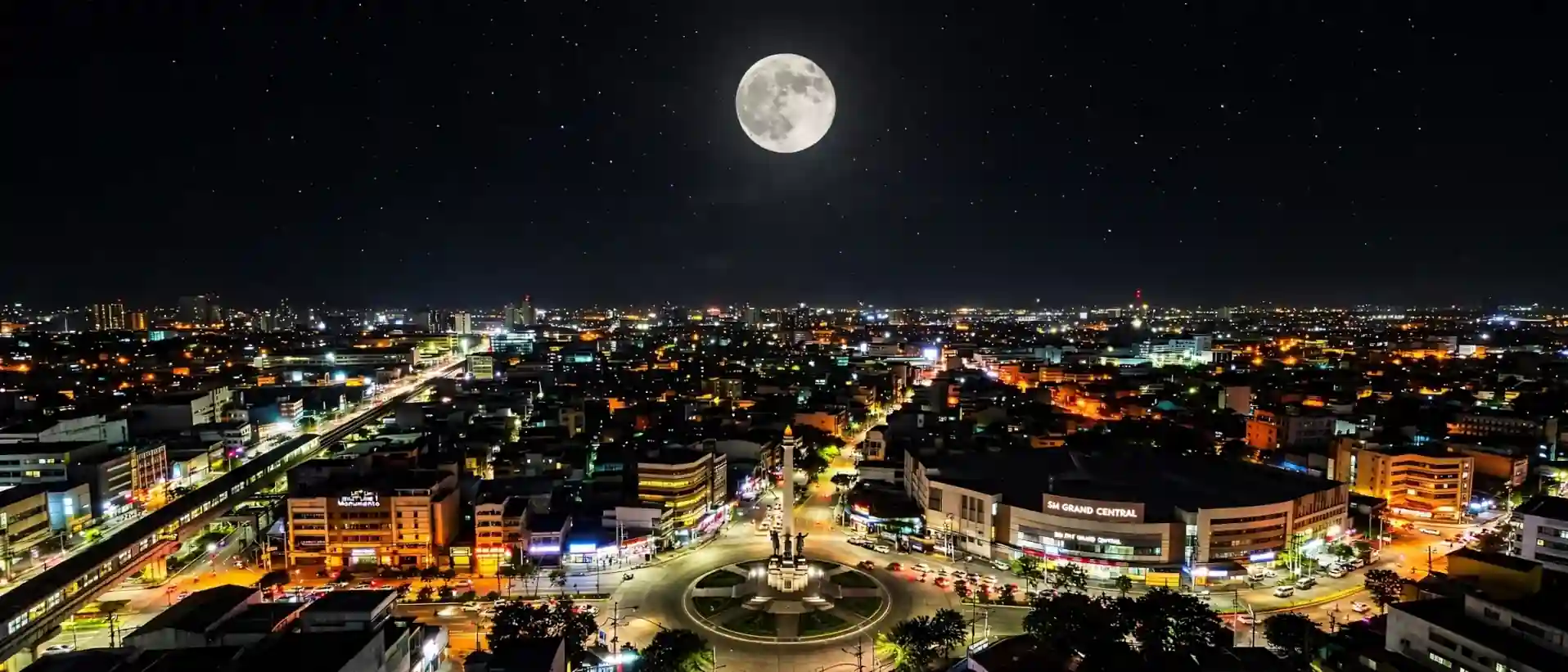
☽ Best Places to View the Moon in Caloocan City, Philippines
Caloocan is entirely landlocked — unlike Metro Manila cities such as Pasay along Manila Bay, Caloocan has no coastline or gulf of its own, and no hills either, since it sits on the same flat plain as the rest of the National Capital Region. So there's no dramatic bay-facing or hilltop vantage here. What the city does offer is a split personality: a dense, historic southern half (South Caloocan) built around the Monumento traffic circle and the old Grace Park district, and a much larger, lower-density northern half (North Caloocan) of subdivisions and resettlement areas that back onto Bulacan, with more open sky and less light and traffic than the south. Wherever you go, the date and your observing location together determine the moon's exact rise time and azimuth, and heavy Metro Manila light pollution will wash out fainter stars — though the moon itself is bright enough to stay clearly visible regardless. Here are six locations that offer different ways to experience or photograph the moon.
Bonifacio Monument (Monumento)
The city's most famous landmark: a 45-foot bronze-and-granite obelisk by National Artist Guillermo Tolentino, dedicated in 1933 to Andrés Bonifacio and the 1896 Cry of Balintawak. It stands at the center of a busy traffic rotunda where EDSA, Rizal Avenue, MacArthur Highway, and Samson Road all meet, so it's best viewed and photographed from a sidewalk or a safe distance rather than lingered around — access to the monument itself is limited by the traffic. Monumento Circle, South Caloocan.
Caloocan City People's Park
A recently redeveloped public park in Grace Park East, funded by the Melco Resorts Philippines Foundation and inaugurated in early 2026, with landscaped grounds, a children's playground, fitness equipment, a jogging lane, a pickleball court, and food kiosks. It's open 6 a.m. to 10 p.m. daily, making it one of the more reliably open-air evening spots in South Caloocan — check current hours before a night visit, since posted hours can change. 8th Avenue, Grace Park East, South Caloocan.
La Loma Catholic Cemetery
One of Metro Manila's oldest cemeteries, opened in 1884 and spanning nearly 54 hectares mostly within South Caloocan (a smaller southern portion sits across the boundary in Manila). Its older sections have mature trees and open sky above the tombs and mausoleums. Like most Philippine cemeteries, it operates on daytime-to-dusk hours rather than staying open into the evening — check current hours, which can extend around All Souls' Day but are otherwise limited. C-3 Highway (Samson Road) at 7th Avenue, South Caloocan.
Thai To Taoist Temple
A century-old Taoist temple built by Caloocan's Chinese-Filipino community, known for its tiered pagoda and red-and-gold architecture, near the 5th Avenue LRT-1 station in Grace Park. Reported hours vary by source but generally run from around 8 a.m. into the afternoon, so this is a daytime cultural stop rather than a nighttime viewing spot — though the exterior pagoda remains visible from the street after closing. M. H. Del Pilar St. corner 6th Avenue East, Grace Park, South Caloocan.
Caloocan (Amparo) Nature Park
A small, city-run green space in North Caloocan's Amparo Subdivision, built around several old heritage trees and used mainly for local government seminars and family outings, with two swimming pools open on weekends. Reported hours run roughly 8 a.m. to 5 p.m., so it's a daytime destination rather than an evening one — check current hours and whether public entry is allowed on a given day, since parts of the schedule are reserved for barangay functions. Barangay 179, Amparo Subdivision, North Caloocan.
Caloocan Sports Complex
A city-owned sports complex in Bagumbong, North Caloocan, opened in 2017, combining a 3,000-seat indoor arena with an outdoor leisure park, jogging path, and gazebos, and sitting right in front of the newer SM City Caloocan mall. The open-air leisure park and jogging path offer a bit of sky away from South Caloocan's density, though the complex's main schedule follows its indoor sporting events — check current hours for the outdoor areas specifically. Malapitan Road, Bagumbong, North Caloocan.
◉ Best Times for Moon Photography
📷 Quick Photography Tips
Caloocan runs on Philippine Standard Time (PhST, UTC+8) year-round — the Philippines does not observe daylight saving time. (PAGASA uses "PhST" rather than "PST" to avoid confusion with Pacific Standard Time.) PhotoPills or Stellarium will handle the moon's exact rise azimuth for any of these spots automatically.
The moon phase today in Caloocan is shown in detail above — complete with exact illumination percentage, moonrise/set times, and the best local spots to see it. For the moon phase today in any other city worldwide, visit our Dynamic Moon Phase Calculator on the home page.
◐ What the Experience Actually Feels Like
At Monumento, the moon competes with jeepneys, buses, and the LRT-1 line for attention — this is a landmark you photograph in passing, from a sidewalk or the pedestrian overpass, rather than a place to set up a tripod and wait. The obelisk itself, lit up at night against the traffic below, makes its own kind of foreground.
Caloocan City People's Park, by contrast, is built for lingering — families on the jogging lane, a pickleball game finishing up, food kiosks doing steady business into the evening. It's new enough that its trees haven't grown in yet, so the sky above it is genuinely open rather than filtered through a canopy.
Out at the Amparo Nature Park or the Caloocan Sports Complex in the north, the feeling changes again — fewer people, more space, and a sense that you've left the dense, historic core of the city behind, even though you're still well within Metro Manila.
"At Monumento, the moon competes with jeepneys and the LRT-1 line for attention — a landmark you photograph in passing rather than a place to linger."
✓ Your Caloocan Moon Chase Checklist
Before You Go
- Check the moonrise time and rise azimuth for your date — the date and your observing location together determine the moon's rise time and direction, while your viewpoint determines how much of that horizon is unobstructed
- Remember Caloocan is flat and landlocked, so there's no bay, gulf, or hilltop to frame the moon against here — plan around buildings and street orientation instead
- Verify Site Hours: La Loma Cemetery, the Thai To Taoist Temple, and the Amparo Nature Park all keep daytime-to-early-evening hours rather than staying open at night — confirm current hours before building a plan around them
- Check current hours at Caloocan City People's Park and the Caloocan Sports Complex's outdoor areas, since both are relatively new and hours can still shift
- Use PhotoPills or Stellarium to check whether the moon will align with a specific landmark on your date
- Check the forecast and any typhoon advisories, especially from June through November
What to Bring
- A telephoto lens, often 200mm or longer, to frame the moon tightly against the Monumento obelisk or a temple rooftop
- Cash (Philippine pesos) for food at People's Park's kiosks or around Monumento, since the parks themselves are free to enter
- A remote shutter release or a 2-second timer to avoid shake on tripod shots
- Insect repellent for the greener spots in North Caloocan, especially around Amparo Nature Park's older trees
- A light rain layer during the wet season (roughly June to November)
On the Night
- As a general recommendation, arrive at your viewpoint at least 30–45 minutes early, especially at People's Park on weekend evenings
- Focus manually on the moon's edge — streetlights, mall signage, and traffic can confuse autofocus at dusk
- Bracket your exposures — one for the bright lunar disc, one for the darker street, park, or skyline below
- At Monumento specifically, stay on a sidewalk or overpass rather than approaching the rotunda directly
- Confirm current closing times before you go, and plan to be back with time to spare rather than counting on staying past posted hours
? Caloocan City Moon Phase — Frequently Asked Questions
Q. What is the moon phase today in Caloocan City?
The moon phase today in Caloocan City is a Waning Crescent with 34% illumination. The next full moon is in 22 days, on Oct 26. Moonrise is at 12:32 AM and moonset at 1:55 PM.
Q. Where is the best place to view the moon in Caloocan City?
Caloocan City is landlocked and flat, on the same plain as the rest of Metro Manila, so there is no bay or hilltop to frame the Moon and the best spots are open parks. Caloocan City People's Park in Grace Park East, redeveloped and inaugurated in early 2026, is listed as open from 6 a.m. to 10 p.m. daily, which makes it the most reliable evening spot in the south. The Bonifacio Monument at Monumento is the city's landmark, best photographed from a sidewalk across the traffic, and the Caloocan Sports Complex in Bagumbong gives a jogging path and some sky in the north.
Q. Can I look at the moon through a telescope in Caloocan City?
Not in Caloocan at a regular public night that is advertised. The nearest regular option is the PAGASA Astronomical Observatory at UP Diliman in Quezon City, about 11 km east, which has a 45 cm telescope open for public use. PAGASA holds stargazing sessions on request, with a letter at least two weeks ahead, and free walk-in sessions during events such as Philippine Space Week. The Astronomical League of the Philippines has also held free telescope viewing at SM By the Bay in Pasay each February, about 13 km south.
Q. Where does the moon rise and set in Caloocan City, and how high does it climb?
At about 14.7°N, the Moon in Caloocan City rises and sets fairly close to due east and west, between roughly east-north-east and east-south-east for moonrise. A full moon near the December solstice passes high overhead, within about 14° of the zenith, while a full moon near the June solstice crosses the southern sky at roughly 47° to 57°. The city is flat, so the view of a rising or setting moon is limited mainly by buildings, and the rising azimuth shifts a lot with the date, so check it before planning a shot against Monumento. Crescent moons often look tilted, lying on their back like a bowl or a boat.
Q. Is light pollution a problem for moon observing in Caloocan City?
The moon is bright enough to observe and photograph from almost anywhere in Caloocan City, so light pollution rarely limits the lunar disc itself. It does wash out earthshine on a thin crescent and any faint sky detail. Metro Manila's light pollution washes out faint stars almost everywhere in the city, with the dense south around Monumento the brightest and the larger, lower-density north having somewhat more open sky and less light and traffic.
Q. What camera settings and phases work best for moon photography in Caloocan City?
For a full moon, start with Looney 11 (f/11, ISO 100, 1/100 s) and refine using your histogram, since it is a baseline rather than a guarantee. Shoot RAW and expose for the lunar disc, because streetlights, mall signage and park lighting are far dimmer than the moon. A telephoto lens does not enlarge the moon relative to the foreground on its own, but shooting from farther away from a landmark such as the Monumento obelisk and using a longer focal length lets you frame a distant composition tightly, often at 200 mm or longer. A waxing gibbous moon rises before sunset, giving a useful blue-hour window.
Q. How do the rainy season and typhoons affect moon viewing in Caloocan City?
The Philippines has a rainy season from about June to November and a drier season from about December to May, with typhoon activity typically peaking from July to October. This is national climatological guidance, not a Caloocan prediction. Cloud and humidity are the main obstacles, and urban haze can soften the moon. Check the current PAGASA forecast and typhoon advisories before going out, especially in the wet months, and bring a light rain layer.
Q. What time zone are Caloocan City's moonrise and moonset times shown in?
Caloocan City uses Philippine Standard Time, UTC+8, all year, and the Philippines does not observe daylight saving time, so there is no clock change to account for. PAGASA uses the abbreviation PhST for it to avoid confusion with Pacific Standard Time. Caloocan City lies at about 121.0°E, just east of the 120°E meridian on which UTC+8 is based, so the sun and moon cross the sky about 4 minutes earlier on the clock than they would on that meridian.
Q. Can I shoot the moon at Caloocan City's viewpoints after dark?
Only some. Caloocan City People's Park is listed as open until 10 p.m., but posted hours can change. La Loma Cemetery, the Thai To Taoist Temple and the Amparo Nature Park keep daytime-to-early-evening hours and are not night spots. At Monumento, stay on a sidewalk or overpass and not near the rotunda, since it is a busy traffic circle. The outdoor areas of the Caloocan Sports Complex follow the complex's own schedule, so check hours before a late visit.
✦ Explore Further
Moon Phase Today: Valenzuela
Check tonight's moon phase in Valenzuela, roughly 6 km north of Caloocan City, where the library runs free telescope viewing.
🏙️Moon Phase Today: Quezon City
See the moon over Quezon City, roughly 9 km east-north-east of Caloocan City, home of the PAGASA observatory.
🌍World Moon Phase Directory
Find the moon phase, rise and set times for cities in every region of the world.
Blue Hour Calculator
Work out when blue hour falls, ideal for waxing gibbous shots over the Bonifacio Monument.