
Moon Phase Turin
On Saturday, October 10, 2026, the moon in Turin is a New Moon with 0% illumination. Moon age: 29.1 days.
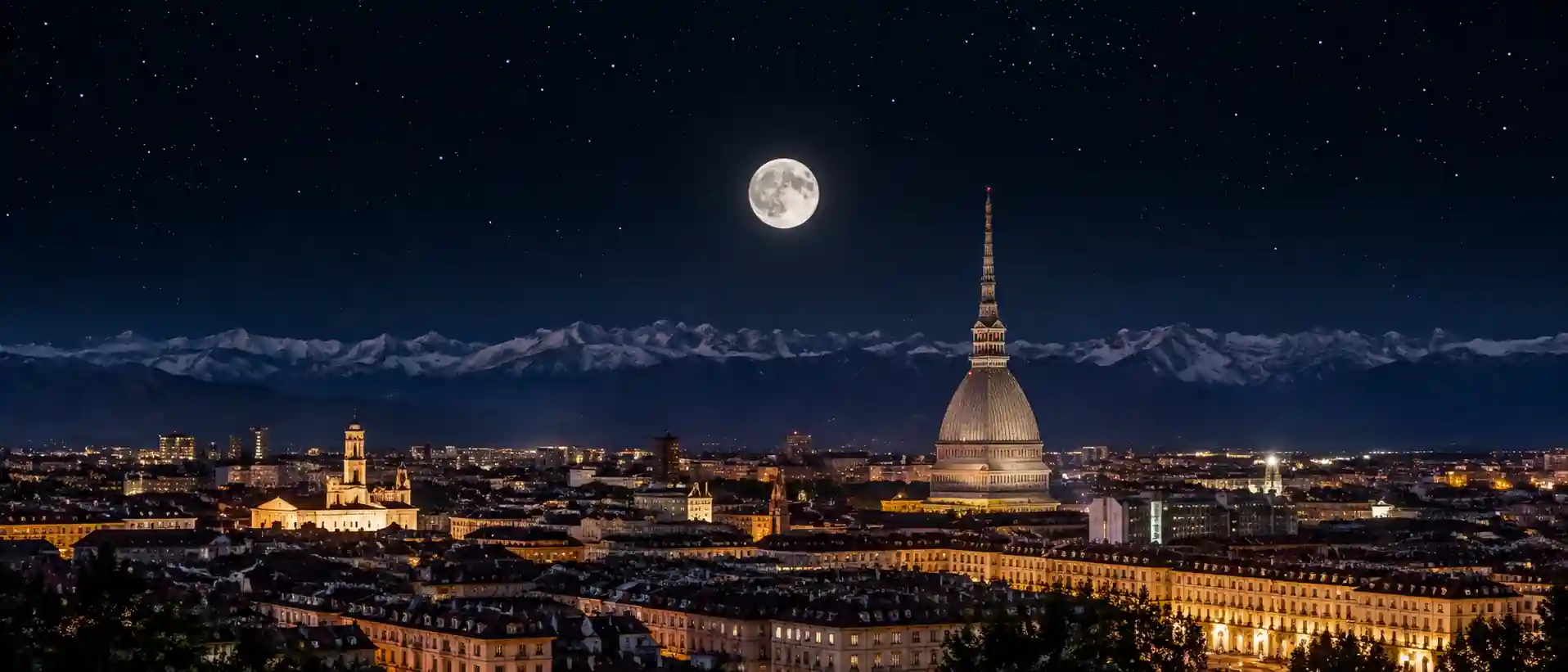
☽ Best Places to View the Moon in Turin, Italy
Turin sits at roughly 45.07°N on the Po River in northwestern Italy, the capital of Piedmont with around 860,000 residents. Ringed by the western Alpine arc and topped by the hill of Superga, the city was the first capital of a unified Italy, and its skyline is still dominated by a single, unmistakable tower originally commissioned as a synagogue and repurposed almost by accident into the city's defining landmark. Between that tower, a hilltop basilica with sweeping Alpine views, and a riverside park with a long architectural history of its own, Turin gives a genuinely dramatic set of places to watch the moon.
Mole Antonelliana
Turin's most recognizable landmark and symbolic centrepiece, now home to the National Cinema Museum, with a glass lift that carries visitors up to a panoramic observation deck. Its distinctive silhouette remains the clearest visual symbol of the city from almost anywhere you stand — check current opening hours and any reservation requirements before your visit.
Basilica di Superga
A Baroque basilica designed by Filippo Juvarra, begun in 1717 atop a hill about 660 metres above sea level east of the city, built after Duke Vittorio Amedeo II's vow during the 1706 siege of Turin. Its terrace gives what many consider the single best panorama over Turin and the Alps, and visitors can climb 131 steps up to the dome for an even higher vantage point; the House of Savoy's royal tombs are housed within.
Monte dei Cappuccini
A hill on the right bank of the Po, much closer to the historic centre than Superga, crowned by a church begun in 1584 and consecrated in 1656. It houses the National Mountain Museum and offers a much closer panorama of the Mole Antonelliana and the Alps behind it than the more distant view from Superga.
Parco del Valentino
Turin's oldest and best-known public park, running along the Po's west bank, home to the Castello del Valentino and the historic Borgo Medievale, an open-air reconstruction of a fortified medieval village built for an 1884 exhibition. The Borgo and its Rocca are currently closed for restoration until 2027, but the park's riverside paths and gardens remain an easy, green option for an evening walk.
Piazza Castello & the Royal Palace
The historic heart of the city, surrounded by the Royal Palace of Turin and other buildings recognized by UNESCO as part of the Residences of the Royal House of Savoy. It's Turin's most central option for an ordinary evening, framed by some of the city's grandest architecture.
Po River & Gran Madre Church
The riverside promenades tracing the Po past the neoclassical Gran Madre di Dio church, whose steps and colonnade look directly back across the water toward the city centre. It's a quieter alternative to the busier plazas, with an open sightline along the river.
◉ Best Times for Moon Photography
📷 Quick Photography Tips
Turin runs on Central European Time (UTC+1), shifting to Central European Summer Time (UTC+2) for daylight saving time, from the last Sunday in March to the last Sunday in October.
For the moon phase in any other city worldwide, visit our Dynamic Moon Phase Calculator for instant lunar data tailored to wherever you are.
The moon phase today in Turin, Italy is shown in detail above — complete with exact illumination percentage, moonrise/set times, and the best viewpoints to see it. For the moon phase today in any other city or location worldwide, visit our Dynamic Moon Phase Calculator on the home page.
◐ While Actually There
Turin's two great hills tell different versions of the same story. Superga, higher and further out, was Filippo Juvarra's grand Baroque statement — a votive basilica built after Duke Vittorio Amedeo II vowed to honour the Virgin Mary if Turin survived a French siege, and it's still where the House of Savoy buried its dead. Monte dei Cappuccini, closer and more modest, does the same essential job for anyone who doesn't have time for the rack railway: a quick walk up from the river gets you a much closer view of the Mole Antonelliana and the mountains behind it.
Down at street level, the city keeps rewriting its own history. The Mole Antonelliana was originally commissioned as a synagogue in the 1860s and grew far beyond its original budget before eventually becoming a cinema museum — a landmark that ended up meaning something quite different from what it was built for. Parco del Valentino does something similar with its Borgo Medievale, a "medieval village" that's actually a 19th-century reconstruction built for an 1884 exhibition, though it's currently closed for restoration until 2027 and can only be admired from outside for now.
None of it requires much beyond checking Superga's rack railway timetable if you want to make the trip out there. Monte dei Cappuccini, Parco del Valentino's grounds, and the river paths are all straightforward for an ordinary evening without much advance planning.
"Turin's tallest landmark started life as a synagogue and became a cinema museum — a city that keeps finding new uses for its grandest gestures."
✓ Your Turin Moon Chase Checklist
Before You Go
- Check the moonrise time and phase on this page for each night of your stay
- Check the current Superga rack railway timetable before planning a visit around moonrise
- Check current opening hours and reservation requirements for the Mole Antonelliana's observation deck
- Check current opening hours for the Royal Palace if you want to go inside, not just view the piazza
- Note that Parco del Valentino's Borgo Medievale is closed for restoration until 2027
What to Bring
- Warm clothing for December–February — Po Valley winters can bring cold spells and freezing nights
- A tripod, useful at open, elevated spots like Monte dei Cappuccini and Superga
- Comfortable shoes for the climb up Monte dei Cappuccini and the walk through Parco del Valentino
- A light rain layer, since weather can change quickly, particularly around the hills
- Spare camera batteries kept warm in an inner pocket during cold-weather sessions
On the Night
- Arrive 20–30 minutes before moonrise at open spots like the Po riverside or Monte dei Cappuccini
- Confirm last departure times if traveling to or from Superga by rack railway
- Shoot RAW and bracket exposures, especially where the illuminated Mole Antonelliana mixes with moonlight
- Mind wind and cold at every exposed hilltop spot, particularly in winter
- Watch for fog, which can obscure the sky with little warning in the Po Valley
? Turin Moon Phase — Frequently Asked Questions
Q. What is the moon phase today in Turin?
The moon phase today in Turin is a New Moon with 0% illumination. The next full moon is in 17 days, on Oct 26. Moonrise is at 7:30 AM and moonset at 6:35 PM.
Q. Where is the best place to view the moon in Turin?
Basilica di Superga, on a hill about 660 metres above sea level east of the city, offers the widest panorama over Turin and the Alps. Monte dei Cappuccini is much closer to the centre and looks west across the Mole Antonelliana toward the mountains, which suits a setting moon. The Po riverside near the Gran Madre church gives an open sightline along the water, Parco del Valentino is an easy green option on the river's west bank, and the Mole's own panoramic observation deck offers a central elevated view if you check current hours and reservations.
Q. Where does the moon rise and set in Turin, and how high does it climb?
At Turin's latitude of about 45°N, the moon's rising and setting points swing between roughly northeast and southeast (and northwest to southwest for moonset) over each month, depending on its declination. A full moon near the winter solstice rises far to the northeast and culminates high, roughly 65–70° above the southern horizon, while a summer full moon rises far to the southeast and stays low, peaking near 20°. The rise and set times listed on this page assume a flat horizon, so hills east of the city, including the Superga ridge, can delay when the moon first appears from street level.
Q. Which moon phase is best for seeing crater detail from Turin?
Surface relief is sharpest along the terminator, the line between lunar day and night, where low sun angles throw long shadows across craters, rilles and mountain ridges. Waxing crescent through waxing gibbous, especially around first quarter, are the classic evening targets, while the waning phases favour pre-dawn sessions. A full moon has almost no shadows, so it flattens topography, though it is the best time to study bright ray systems such as those around Tycho and Copernicus and subtle differences in surface brightness.
Q. What camera settings work for photographing the moon over Turin?
For a full moon, the Looney 11 rule is a reliable starting point: f/11, ISO 100 and a shutter speed near 1/100 s, opening up roughly one stop for gibbous and two for a quarter moon. Use a tripod and a timer or remote release, and shoot RAW so highlights can be recovered. A full moon rises close to sunset, so shooting within the blue-hour window just after moonrise lets you balance the sky and the illuminated skyline in one frame, whereas a tight lunar close-up needs a long telephoto lens and a much faster shutter.
Q. How do Po Valley conditions affect moon observing and photography in Turin?
Turin sits in the Po Valley, where humidity, haze and winter fog can reduce sky transparency with little warning, and city lights raise the background glow enough to wash out earthshine on a thin crescent. The moon itself is bright enough to observe from almost anywhere in town, but elevated spots such as Superga or Monte dei Cappuccini can sometimes sit above a shallow valley fog layer. Because conditions shift quickly, treat any clear-sky plan as provisional and check a current forecast before you commit to a hill.
Q. Does this page work for cities besides Turin?
This page is set up specifically for Turin, Italy. For the moon phase in any other city or location worldwide, use the Dynamic Moon Phase Calculator on the moonphase.today home page.
✦ Explore Further
Moon Phase Today: Milan
Check tonight's moon phase in Milan, a short trip east of Turin across the Po Valley.
⚓Moon Phase Today: Genoa
See the moon over the Ligurian coast, just across the Apennines from Turin.
🇮🇹Moon Phase in Italy
Browse moon phase pages for cities across Italy, from Venice to Palermo.
🌍World Moon Phase Directory
Find the moon phase, rise and set times for cities in every region of the world.
NASA Moon Phase & Libration Gallery
NASA's Scientific Visualization Studio's daily renders of the moon's exact phase, libration, and orientation, straight from official mission data.