
Moon Phase Milan
On Saturday, October 10, 2026, the moon in Milan is a New Moon with 0% illumination. Moon age: 29.0 days.
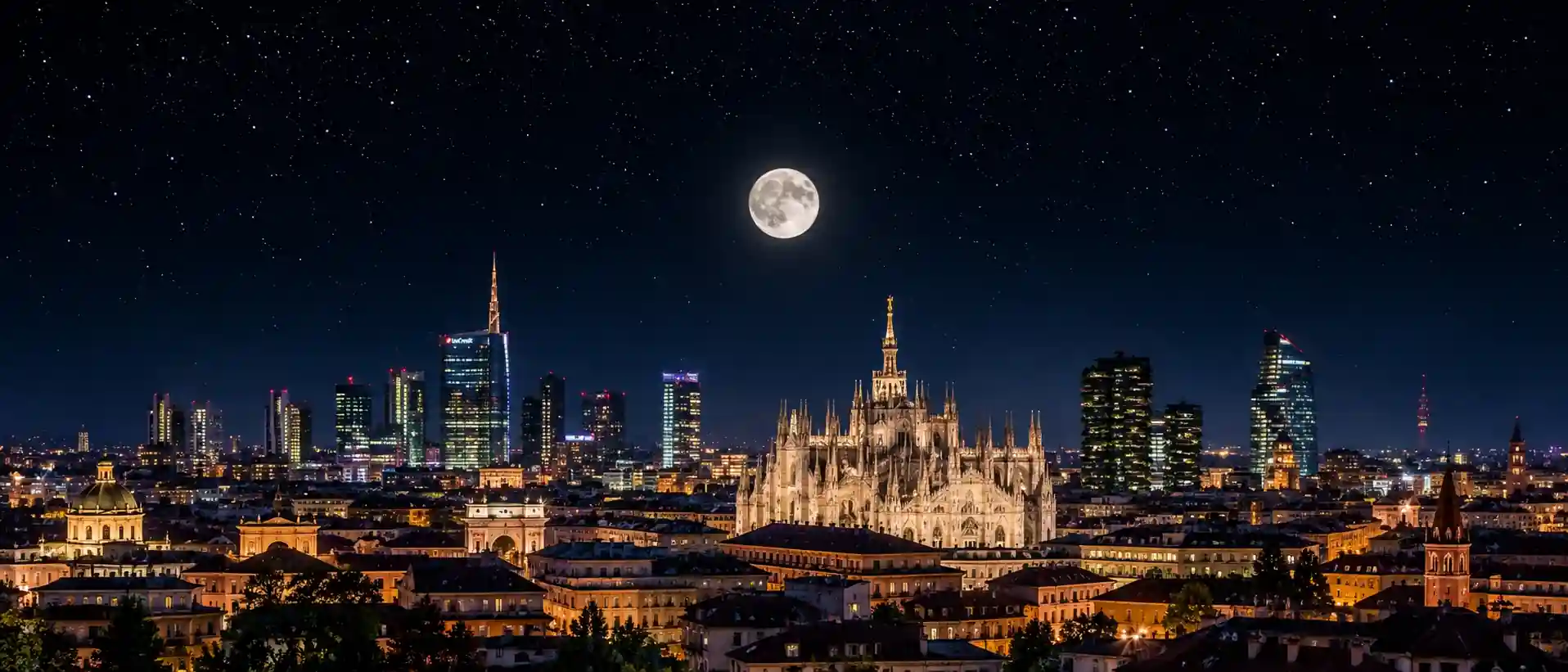
☽ Best Places to View the Moon in Milan, Italy
Milan lies in Lombardy on the Po plain. The municipality covers about 181.67 km², with a reference elevation of about 122 m a.s.l. per Comune di Milano technical documentation. The city is generally low-lying, with higher ground largely formed by artificial hills in parks, surrounded by large parks to the north, east and west.
Monte Stella – Montagnetta di Milano – QT8 Hill
Artificial hill in QT8 / Municipio 8, 45 m above the surrounding QT8 area and about 185 m a.s.l., supported by Comune di Milano documentation. Parco Monte Stella is about 311,000 m² per current municipal figure, with the city's dedicated Monte Stella document giving 311,200 m². The summit provides broad panoramic views over Milan and, in good visibility, the Alps and Apennines. Check current park notices for evening access.
Parco Sempione – 386,000 m² Central Park
Central park that contains Sforza Castle and is associated with the Arch of Peace and Torre Branca. Municipal figure gives 386,000 m². Current municipal access is 06:00–24:00 April–September and 06:00–22:00 October–March. Open parkland suitable for Moon-over-park compositions, with substantial artificial lighting.
Torre Branca – Evening Sessions to Midnight
Iconic tower within Parco Sempione offering a perspective over the park and the city. Controlled access and ticketed, but can be available specifically during evening and night hours. Official information currently lists evening sessions extending to midnight on several days during its 2026 summer schedule, and states that the tower closes in bad weather or strong wind. Check current schedule and weather before planning a session.
Parco Nord Milano – Multi-Municipality Regional Park
Metropolitan and regional park extending across Milan, Sesto San Giovanni, Cinisello Balsamo, Bresso, Cormano, Cusano Milanino and Novate Milanese, not entirely within Milan municipality. Large park north of the city with open lawns and lakes. Provides broader sky pockets away from densest central lighting. Institutional sources give differing area figures depending on measurement, currently about 950 hectares in one description and about 790 hectares in another ecological description; no single area is given here to avoid mixing definitions.
Parco Lambro – 773,000 m² Eastern Park
Large eastern park along the Lambro River, confirmed as 773,000 m² with free access according to the municipality. Provides open parkland and river corridor suitable for Moon-over-park compositions.
Boscoincittà, Parco delle Cave & Darsena – West & South
Western parks with distinct characteristics: Boscoincittà in Municipio 7 is 1,100,000 m² with seasonal hours published by the municipality; Parco delle Cave in Municipio 7 has 1,350,000 m², four artificial lake basins and currently lists free access. Darsena is the historic dock where Naviglio Grande and Naviglio Pavese meet, and is a pedestrian waterfront area. Useful for woodland, lake and waterfront foregrounds.
◉ Best Times for Moon Photography in Milan
📷 Quick Tips for Milan
🕐 Timezone
Central European Time (CET) — UTC+1, Central European Summer Time (CEST) — UTC+2 during daylight-saving. Europe/Rome zone.
📍 Geography Note
Horizons: Milan lies on the Po plain. Parco Sempione contains Sforza Castle and is associated with Arch of Peace and Torre Branca. Torre Branca evening sessions extending to midnight on several days during 2026 summer schedule, closes in bad weather or strong wind. Darsena is historic dock where Naviglio Grande and Naviglio Pavese meet, pedestrian waterfront area.
Elevation & Area: Municipality 181.67 km² supported by Comune di Milano material. Milan reference elevation about 122 m a.s.l. per Comune di Milano technical document, not 120, 130 mixed figures. Monte Stella 45 m above surrounding QT8 area about 185 m a.s.l., park about 311,000 m² current municipal figure, dedicated document 311,200 m², summit provides broad panoramic views over Milan and in good visibility Alps and Apennines. Parco Sempione 386,000 m² access 06:00–24:00 April–September 06:00–22:00 October–March. Parco Lambro along Lambro River 773,000 m² free access. Boscoincittà Municipio 7 1,100,000 m² seasonal hours, Parco delle Cave Municipio 7 1,350,000 m² four artificial lake basins free access.
Access: Parco Sempione 06:00–24:00 April–September 06:00–22:00 October–March, Torre Branca controlled access ticketed with evening sessions to midnight 2026 summer subject to weather, Parco Nord metropolitan park across Milan, Sesto San Giovanni, Cinisello Balsamo, Bresso, Cormano, Cusano Milanino and Novate Milanese, Parco Lambro free access, Boscoincittà seasonal hours, Parco delle Cave free access, Darsena pedestrian waterfront. Check current notices.
The moon phase today in Milan is shown above. For moon phase today anywhere else, visit the calculator on the home page.
◐ What It Feels Like
At Monte Stella, artificial hill in QT8 45 m above the surrounding area and about 185 m a.s.l. within a park about 311,000 m² provides broad panoramic views over Milan and in good visibility the Alps and Apennines.
In Parco Sempione, 386,000 m² central park containing Sforza Castle and associated with Arch of Peace offers open parkland with access 06:00–24:00 April–September and 06:00–22:00 October–March, while Torre Branca within the park can have evening sessions extending to midnight in summer, closing in bad weather or strong wind.
At Parco Nord Milano extending across seven municipalities and at Darsena historic dock where Naviglio Grande and Naviglio Pavese meet, larger northern park horizons and southern waterfront provide open views within a municipality of about 181.67 km².
"Artificial hill 45 m above QT8 at about 185 m a.s.l. in 311,000 m² park, 386,000 m² central park open to midnight in summer, and tower with evening sessions to midnight."
✓ Checklist for Lunar Observers
Before You Go
- Check moonrise/moonset azimuth — use exact observing location to determine whether Moon will align with park, city or hill foregrounds on the Po plain
- Check forecasts for cloud, haze, humidity and visibility; Monte Stella about 311,000 m² with summit at about 185 m a.s.l.
- Confirm access — Monte Stella 45 m above QT8 about 185 m a.s.l. about 311,000 m² summit broad panoramic views Alps and Apennines in good visibility, Sempione 386,000 m² 06:00–24:00 April–September 06:00–22:00 October–March, Torre Branca evening to midnight 2026 summer weather dependent, municipality about 181.67 km² reference elevation about 122 m a.s.l.
What to Bring
- Telephoto and wide for hill and park foregrounds
- Tripod for landscape and bracketing — useful for multi-exposure, close Moon can be handheld
- Lens cloth for dust, dew or condensation
- Light jacket for changing evening temperatures
On the Night
- Manual focus considerations — for lunar detail focus on Moon preferable; for composed landscape containing Moon appropriate focus depends on composition and depth of field
- Bracket for disc vs. foreground — difficult to retain both in single exposure
- Stay on designated paths and observe posted access rules — Sempione seasonal hours, Torre Branca evening sessions to midnight subject to weather, Boscoincittà seasonal hours, Parco delle Cave free access
- Urban parks provide open horizons as light-polluted locations useful for Moon-over-city rather than dark-sky observing, with Alps and Apennines visible from Monte Stella in good visibility
? Milan Moon Phase — Frequently Asked Questions
Q. What is the moon phase today in Milan?
The moon phase today in Milan is a New Moon with 0% illumination. The next full moon is in 17 days, on Oct 26. Moonrise is at 7:24 AM and moonset at 6:28 PM.
Q. Where is the best place to view the moon in Milan?
Monte Stella, an artificial hill about 185 m above sea level and 45 m above the surrounding QT8 area, gives broad views over Milan and, in good visibility, toward the Alps and Apennines. Parco Sempione, with Sforza Castle and Torre Branca, is the central option, while Parco Nord Milano to the north offers broader sky pockets away from the densest lighting. Parco Lambro along the Lambro River lies to the east, and Boscoincittà, Parco delle Cave and the Darsena waterfront to the west and south add woodland, lake and canal foregrounds.
Q. Where does the moon rise and set in Milan, and how high does it climb?
At about 45°N, Milan's moonrise and moonset points swing across the horizon over each month, from roughly northeast to southeast for rising and northwest to southwest for setting. A winter full moon culminates high, at roughly 70° above the southern horizon, while a summer full moon stays low, peaking near 20°. Milan sits on the flat Po plain, so buildings are the main horizon obstruction at street level, and elevated spots such as Monte Stella give a cleaner view of the horizon, with the Alps and Apennines sometimes visible in good conditions.
Q. Is light pollution a problem for moon observing in Milan?
The moon is bright enough to observe and photograph from almost anywhere in the city, so light pollution rarely limits the lunar disc itself. It does wash out earthshine on a thin crescent and any faint sky detail, and urban parks and squares carry substantial artificial lighting. Larger green spaces such as Parco Nord Milano offer broader sky pockets away from the densest central lighting, though Milan is still a light-polluted location rather than a dark-sky site.
Q. What camera settings and phases work best for moon photography in Milan?
For a full moon, start with Looney 11 (f/11, ISO 100, 1/100 s) and refine using your histogram, since it is a baseline rather than a guarantee. The moon is much brighter than a typical night-time foreground, so shoot RAW and bracket or blend exposures to keep both crater detail and the park or city lights. A waxing gibbous is useful for blue hour at Parco Sempione and Monte Stella while the foreground is still lit, and a full moon rises around sunset. A 200–400 mm lens helps isolate the moon against distant foregrounds, with a tripod for bracketing and manual focus on the moon using magnified live view.
Q. How do haze and fog on the Po plain affect moon viewing in Milan?
Milan lies on the Po plain, where humidity, haze and fog can reduce sky transparency and soften lunar contrast, and conditions can shift quickly. Views of the Alps and Apennines from Monte Stella depend on good visibility. Check local forecasts for cloud, haze and visibility before heading out, and carry a lens cloth for dust, dew or condensation.
Q. Can I shoot the moon in Milan's parks after dark?
Access varies by site. Parco Sempione is open 06:00–24:00 from April to September and 06:00–22:00 from October to March. Torre Branca has controlled, ticketed access, and official information listed evening sessions running to midnight on several days during the 2026 summer schedule, with closures in bad weather or strong wind, so check the current schedule. Parco Lambro and Parco delle Cave list free access, Boscoincittà publishes seasonal hours, and Monte Stella evening access is worth confirming against current park notices.
Q. Does this page work for cities besides Milan?
This page is set up specifically for Milan, Italy. For the moon phase in any other city or location worldwide, use the Dynamic Moon Phase Calculator on the moonphase.today home page.
✦ Explore Further
Moon Phase Today: Turin
Check tonight's moon phase in Turin, west of Milan at the foot of the Alps.
⚓Moon Phase Today: Genoa
See the moon over the Ligurian coast, just south of Milan across the Apennines.
🇮🇹Moon Phase in Italy
Browse moon phase pages for cities across Italy, from Venice to Palermo.
🌍World Moon Phase Directory
Find the moon phase, rise and set times for cities in every region of the world.
NASA Moon Phase & Libration Gallery
NASA's Scientific Visualization Studio's daily renders of the moon's exact phase, libration, and orientation, straight from official mission data.