
Moon Phase Today St. Paul
On Friday, October 9, 2026, the moon in St. Paul is a New Moon with 0% illumination. Moon age: 29.0 days.
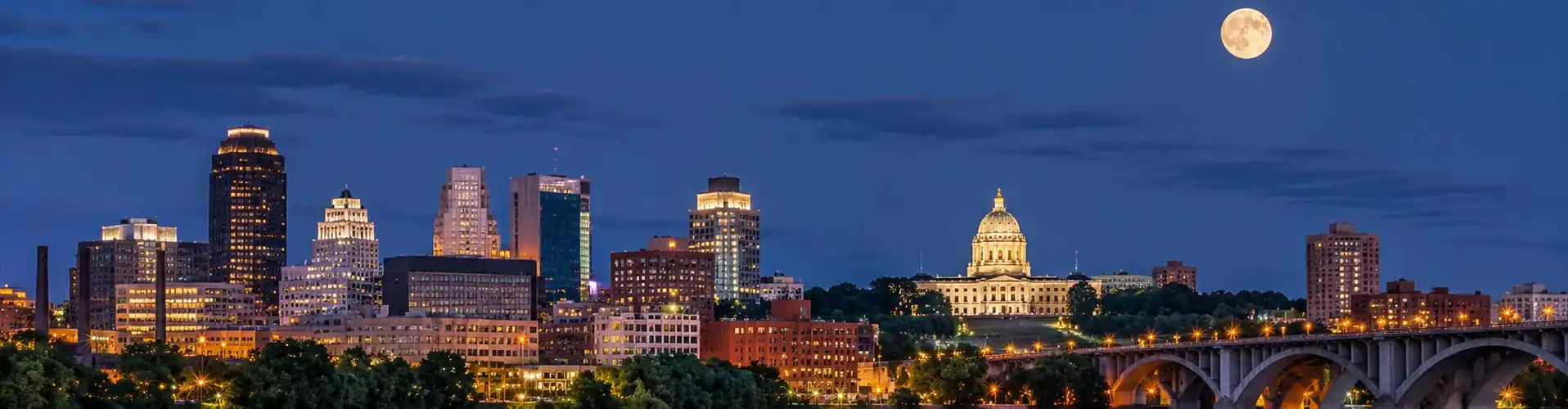
☽ Best Places to View the Moon in St. Paul, MN
St. Paul sits in a bend of the Mississippi River, and its best moon-viewing spots often take advantage of the city's river bluffs, which give several parks a genuine elevated view over the river and skyline rather than a flat street-level one. Away from the river, the city's neighborhood lakes offer a quieter, more open alternative. One of the bluff parks on this list, Wic̣aḥapi (formerly known as Indian Mounds Regional Park), is a sacred Dakota burial site as well as a scenic overlook — well worth a respectful visit, not just a photo stop. As always, the moon's exact rise direction shifts through its cycle, so it's worth checking that against whichever bluff or shoreline you're planning around. Here are six of the area's strongest viewpoints.
Louis Ristorante & Bar Rooftop (Downtown)
A rooftop restaurant above Cossetta's on West 7th Street, with views toward downtown and the Cathedral. Hours vary by day and can change, so check the restaurant's current schedule before planning a moonrise visit. Address: 211 W 7th St.
Harriet Island Regional Park (Downtown)
A riverfront park directly across the Mississippi from downtown St. Paul, with walking paths that keep the skyline in view the whole way and a classic reflection shot on a calm evening. Free to visit. Check current park hours before planning a late-evening visit. Address: 49 Harriet Island Rd.
Wic̣aḥapi / Indian Mounds Regional Park (East Side)
A bluff-top park 200 feet above the river, a sacred Dakota burial place as well as one of the most-cited skyline views in the city, looking west over downtown and the Mississippi. Free, no reservation needed. Open sunrise to 11 p.m. Please visit with respect for the site's significance. Address: 10 Mounds Blvd.
Cherokee Regional Park (West Side)
100 acres of forested Mississippi bluff on the opposite side of downtown from Wic̣aḥapi, with the Vento View Overlook giving a wide panorama of the river valley below. Free, no reservation needed. Open sunrise to 11 p.m. Address: 700 Cherokee Heights Blvd.
Como Park (Como Lake)
A lake at the center of 450-acre Como Regional Park, with 2.3 miles of paved trail around the shoreline and the Como Lakeside Pavilion (home to the Dock & Paddle restaurant) on the west side. Free to visit the park. Open sunrise to 11 p.m. Address: 1199 Midway Pkwy.
Phalen Regional Park (Lake Phalen)
One of the largest lakes in St. Paul, with a 3-mile paved walking and biking loop around the water — genuinely further from downtown's glow than anywhere else on this list. Free, no reservation needed. Open sunrise to 11 p.m. Address: 1600 Phalen Dr.
◉ Best Times for Moon Photography
📷 Quick Photography Tips
St. Paul runs on Central Time — CST (UTC−6) in winter and CDT (UTC−5) in summer, since Minnesota observes daylight saving time. PhotoPills or Stellarium will handle the moon's exact rise azimuth for any of these spots automatically.
The moon phase today in St. Paul is shown in detail above — complete with exact illumination percentage, moonrise/set times, and the best local spots to see it. For the moon phase today in any other city worldwide, visit our Dynamic Moon Phase Calculator on the home page.
◐ What the Experience Actually Feels Like
Up on the Louis rooftop, on busy weekends you may encounter a wait for a table, with the cathedral lit up in one direction and the downtown skyline in another. The moon tends to clear the low St. Paul skyline quickly from up here, sharing the sky for a while with string lights and the murmur of the dining room below before it climbs high enough to stand on its own.
Out at Wic̣aḥapi, the mood is entirely different, and it's worth remembering why: this bluff is a Dakota burial ground as well as a lookout. Visitors tend to come and go quietly, and the view west over downtown and the river is the kind that draws people to linger a while rather than snap a photo and move on.
Out at Lake Phalen, it's a different city altogether. The shoreline loop circles the lake well away from downtown's glow, and outside the busiest daytime periods, it can offer a quieter place to watch the sky change — one of the closer things to open water and open sky that the city itself offers.
"Out at Wic̣aḥapi, it's worth remembering this bluff is a Dakota burial ground as well as a lookout, and visiting with that in mind."
✓ Your St. Paul Moon Chase Checklist
Before You Go
- Check the moonrise time and rise azimuth for your date — alignment with a specific bluff view or lakeshore depends on the date, not just the location
- Check both the moon's rise time and each site's current closing time — the rooftop restaurant has shorter hours than the parks, while individual park facilities and events can have separate schedules
- Verify Site Access: Louis Ristorante & Bar's hours shift by day of the week — check current hours before heading over
- Use PhotoPills or Stellarium to check whether the moon will align with a specific bluff or shoreline on your date
- In winter, check the wind chill forecast, not just the temperature — exposed bluff-top spots get noticeably colder than sheltered lake paths
- Confirm whether your chosen venue allows tripods, particularly on a rooftop bar patio where space and seating rules vary
What to Bring
- A telephoto lens — 200mm or longer is a useful starting point; shooting from farther away makes the moon appear larger relative to the skyline or a distant bluff
- Warm layers well beyond what feels necessary at sunset, especially on the exposed bluffs at Wic̣aḥapi and Cherokee Park — Minnesota evenings cool off fast
- A remote shutter release or a 2-second timer to avoid shake on tripod shots, where tripods are permitted
- A small flashlight or headlamp for the walk back to your car in early-evening dusk, while still planning to leave before each park's posted closing
- A backup viewing location in case your first choice is crowded or hosting an event
On the Night
- Arrive at your viewpoint at least 30–45 minutes early, especially downtown around full moons and weekend events
- Focus manually on the moon's edge — rooftop lighting and downtown glow can confuse autofocus at dusk
- Bracket your exposures — one for the bright lunar disc, one for the darker river or lake below
- If the moon looks soft or hazy right at moonrise, consider waiting until it climbs higher above the horizon, when atmospheric effects are often less pronounced
- Never walk out onto Como Lake or Lake Phalen ice for a better angle in winter — ice conditions are unpredictable even when a lake looks solidly frozen
? St. Paul Moon Phase — Frequently Asked Questions
Q. What is the moon phase today in St. Paul?
The moon phase today in St. Paul is a New Moon with 0% illumination. The next full moon is in 17 days, on Oct 25. Moonrise is at 6:22 AM and moonset at 6:05 PM.
Q. Where is the best place to view the moon in St. Paul?
Wic̣aḥapi (formerly Indian Mounds Regional Park) is one of the most-cited spots, a bluff-top park 200 feet above the river looking west over downtown — and also a sacred Dakota burial site, so it's worth visiting with the same respect you'd bring to any such place, not just as a photo stop. Cherokee Regional Park's Vento View Overlook gives a wide river-valley panorama from the opposite bluff, Harriet Island Regional Park offers a classic reflection shot from directly across the Mississippi, and Louis Ristorante's rooftop, Como Park, or Phalen Regional Park add further downtown-dining, lakeside, or farther-from-downtown alternatives.
Q. Do these viewing spots stay open after dark?
Most of them do — Wic̣aḥapi, Cherokee Regional Park, Como Park, and Phalen Regional Park are all open sunrise to 11 p.m. Harriet Island Regional Park's specific hours weren't confirmed, so it's worth checking current park signage before a late-evening visit, and Louis Ristorante's rooftop hours vary by day, so checking the restaurant's current schedule matters there too.
Q. Does St. Paul observe daylight saving time?
Yes. St. Paul runs on Central Time — CST (UTC−6) in winter and CDT (UTC−5) in summer, since Minnesota observes daylight saving time on the standard U.S. schedule.
Q. What's the best time of year for moon photography in St. Paul?
The moon's exact rise direction shifts through its cycle rather than following a fixed seasonal pattern, so it's worth checking that against whichever bluff or shoreline you're planning around. St. Paul's river bluffs give several parks a genuine elevated view over the river and skyline, while the city's neighborhood lakes offer a quieter, more open alternative away from downtown's glow.
Q. Does this page work for cities besides St. Paul?
This page is set up specifically for St. Paul, Minnesota. For the moon phase in any other city or location worldwide, use the Dynamic Moon Phase Calculator on the moonphase.today home page.
✦ Explore Further
Moon Phase Today: Minneapolis
Check tonight's moon phase in Minneapolis, right next door in the Twin Cities.
📷Moon Photography Guide
Camera settings, lenses, and techniques for shooting sharp, well-exposed moon shots.
📐Looney 11 Exposure Calculator
Dial in the exact f-stop, ISO, and shutter speed for a full moon over the bluffs.
🌙Why Does the Moon Rise and Set?
The simple science behind why the rising direction shifts night to night.
NASA Moon Phase & Libration Gallery
NASA's Scientific Visualization Studio's daily renders of the moon's exact phase, libration, and orientation, straight from official mission data.