
Moon Phase Today San Antonio
On Friday, October 9, 2026, the moon in San Antonio is a New Moon with 0% illumination. Moon age: 29.0 days.
☽ Best Places to View the Moon in San Antonio, TX
San Antonio's moon-viewing options split cleanly into two groups: the historic, lit-up core around downtown and the River Walk, and the Hill Country terrain on the city's edges, where a state natural area offers real distance from downtown light. Several downtown sites have two different sets of hours worth knowing — a public plaza or park that stays open late, and a specific building or attraction within it that closes much earlier — so it's worth checking which one applies to your plan. As always, the moon's exact rise time and direction shift with the date and your observing location, so it's worth checking both against whichever spot you're planning around. Here are six of the area's strongest viewpoints.
Tower of the Americas
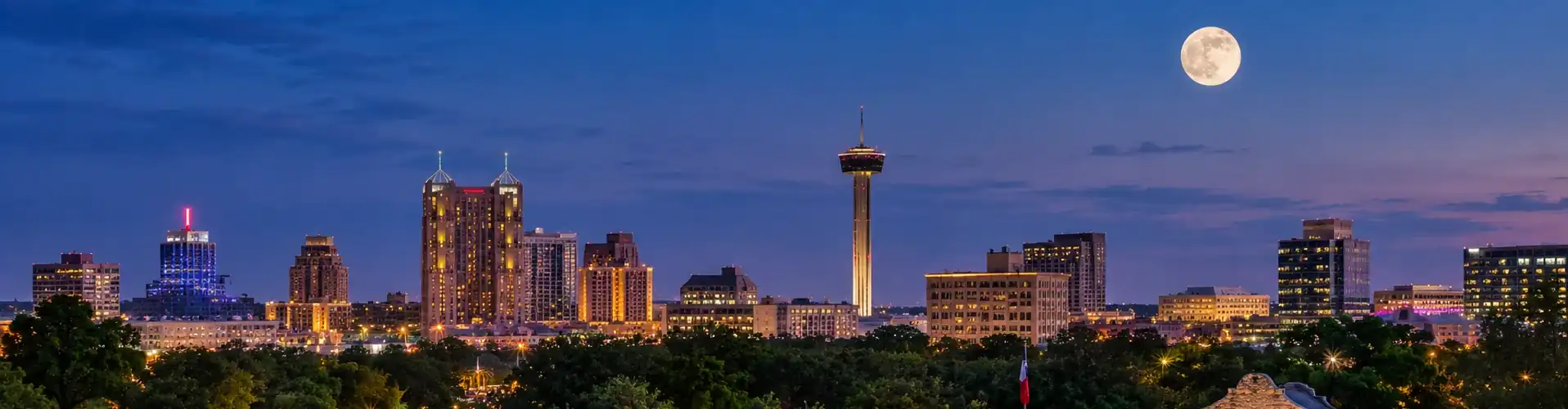
A 750-foot tower in Hemisfair, built for the 1968 World's Fair, with a 360-degree Observation Deck, the revolving Chart House restaurant, and Bar 601. Observation Deck hours: Sun–Thu 10 a.m.–10 p.m., Fri–Sat 10 a.m.–11 p.m. Admission fee applies. Address: 739 E Cesar Chavez Blvd.
San Antonio River Walk
The city's signature waterway, running from the Pearl District through downtown to the historic missions. The City confirms the Downtown and Museum Reach sections are open 24 hours a day (individual businesses keep their own hours), while the Mission Reach section to the south is open during daylight hours only. Free to walk. Address: downtown along the river, off Commerce St.
Alamo Plaza
The public plaza in front of the Alamo, distinct from the historic site itself: the City lists Alamo Plaza's park hours as 5 a.m.–11 p.m. daily, while the Alamo Church and grounds close earlier (currently 9 a.m.–5:30 p.m., with last entry 30 minutes before close). The plaza itself is free and open into the evening. Address: 300 Alamo Plaza.
Brackenridge Park
A large historic park just north of downtown along the San Antonio River, with the Japanese Tea Garden, walking trails, and the San Antonio Zoo. Free to visit the park grounds. The City lists park hours as 5 a.m.–11 p.m. daily. Address: 3700 N St Mary's St.
San Antonio Botanical Garden
A 38-acre garden with the Lucile Halsell Conservatory and views back toward downtown from its higher paths. Admission fee applies; check the garden's current official hours before visiting, since they vary by season. Its operating hours make it primarily a daytime, late-afternoon, or early-evening option rather than a dependable late-night moon-viewing location. Address: 555 Funston Pl.
Government Canyon State Natural Area
About 13,000 acres of Hill Country on the city's northwest edge, protecting the Edwards Aquifer recharge zone, with over 40 miles of trails — a substantially darker setting than downtown, particularly useful for early-evening moonrise and twilight photography rather than late-night viewing. Day-use fee $6 for ages 13+ (12 and under free); reservations are recommended, since the park often reaches capacity. Gate hours: Fri–Mon 7 a.m.–10 p.m., Tue–Thu 7 a.m.–8 p.m. Address: 12861 Galm Rd.
◉ Best Times for Moon Photography
📷 Quick Photography Tips
San Antonio runs on Central Time — CST (UTC−6) in winter and CDT (UTC−5) in summer, since Texas observes daylight saving time. PhotoPills or Stellarium will handle the moon's exact rise azimuth for any of these spots automatically.
The moon phase today in San Antonio is shown in detail above — complete with exact illumination percentage, moonrise/set times, and the best local spots to see it. For the moon phase today in any other city worldwide, visit our Dynamic Moon Phase Calculator on the home page.
◐ What the Experience Actually Feels Like
The Tower of the Americas Observation Deck provides panoramic views from the tower's upper levels, with binoculars installed for a closer look and a 360-degree view in every direction. It's a ticketed attraction rather than a public park, with its own admission fee and operating hours.
Alamo Plaza is a public, multi-use space even after the Alamo itself closes for the day: the City's park hours run until 11 p.m., well past the historic site's 5:30 p.m. closing, so the plaza itself remains a legitimate evening option even when the building isn't.
Government Canyon is a genuinely different environment from downtown — Hill Country terrain protecting the Edwards Aquifer, with gate hours that extend into the evening on Friday through Monday. Because the park limits capacity, a reservation is the more reliable way to guarantee entry rather than arriving without one.
"Alamo Plaza is a public, multi-use space even after the Alamo itself closes for the day — the City's park hours run until 11 p.m., well past the historic site's 5:30 p.m. closing."
✓ Your San Antonio Moon Chase Checklist
Before You Go
- Check the moon's rise time and azimuth for your date and observing location — alignment with the Tower, the river, or a specific landmark depends on both
- Check both the moon's rise time and each site's current hours — Alamo Plaza and the River Walk's Downtown/Museum Reach sections stay open late, while the Alamo itself, Mission Reach, and the Botanical Garden close much earlier
- Verify Site Access: Government Canyon limits capacity and is best visited with a reservation; check current gate hours, since they differ Friday–Monday versus Tuesday–Thursday
- Use PhotoPills or Stellarium to check whether the moon will align with a specific landmark on your date
- Check the radar for flash-flood risk during heavy storms, particularly near the River Walk and any low-water crossings
- Confirm whether your chosen venue allows tripods, particularly on the Tower's Observation Deck where space and event schedules vary
What to Bring
- A telephoto lens — 200mm or longer can be useful when you want a relatively large moon beside a distant landmark, depending on your shooting distance
- Water and sun protection for Government Canyon or the Botanical Garden's higher trails, where portions are exposed
- A remote shutter release or a 2-second timer to avoid shake on tripod shots, where tripods are permitted
- A payment card for Government Canyon's day-use fee and Tower admission — the Tower's ticket booth is currently card-only. The River Walk, Alamo Plaza, and Brackenridge Park grounds are generally free to access, while Government Canyon and the Tower charge admission
- A backup viewing location in case your first choice is crowded, closed, or hosting an event
On the Night
- Arrive at your viewpoint at least 30–45 minutes early, especially downtown around full moons and weekend events
- Focus manually on the moon's edge — downtown lighting and river glow can confuse autofocus at dusk
- Bracket your exposures — one for the bright lunar disc, one for the darker river or hillside below
- If the moon looks soft or hazy right at moonrise, consider waiting until it climbs higher above the horizon, when atmospheric effects are often less pronounced
- At Brackenridge Park, the Botanical Garden, or Government Canyon, plan around each site's current posted hours rather than assuming late-night access
? San Antonio Moon Phase — Frequently Asked Questions
Q. What is the moon phase today in San Antonio?
The moon phase today in San Antonio is a New Moon with 0% illumination. The next full moon is in 17 days, on Oct 25. Moonrise is at 6:38 AM and moonset at 6:38 PM.
Q. Where is the best place to view the moon in San Antonio?
The Tower of the Americas is the standout spot, a 750-foot tower with a 360-degree Observation Deck over the whole city. The San Antonio River Walk gives a lit-up downtown waterway view, Alamo Plaza offers a public evening space right in the historic core, and Brackenridge Park, the San Antonio Botanical Garden, or Government Canyon State Natural Area add further parkland, garden, or genuinely dark Hill Country alternatives.
Q. Do these viewing spots stay open after dark?
It depends on which part of the site you mean — several downtown spots have two sets of hours worth knowing. Alamo Plaza stays open until 11 p.m. even though the Alamo building itself closes at 5:30 p.m., and the River Walk's Downtown and Museum Reach sections run 24 hours while the Mission Reach section is daylight-only. The Botanical Garden and Government Canyon both close at set hours, so check current times before planning a late visit.
Q. Does San Antonio observe daylight saving time?
Yes. San Antonio runs on Central Time — CST (UTC−6) in winter and CDT (UTC−5) in summer, since Texas observes daylight saving time on the standard U.S. schedule.
Q. What's the best time of year for moon photography in San Antonio?
The moon's rising azimuth changes with the date and your observing location rather than following a fixed seasonal pattern, so alignment with the Tower or a specific landmark depends on the exact night. Whatever the date, it's worth checking the radar for flash-flood risk near the River Walk and any low-water crossings during heavy storms, and planning around summer heat at exposed sites like Government Canyon.
Q. Does this page work for cities besides San Antonio?
This page is set up specifically for San Antonio, Texas. For the moon phase in any other city or location worldwide, use the Dynamic Moon Phase Calculator on the moonphase.today home page.
✦ Explore Further
Moon Phase Today: Austin
Check tonight's moon phase in Austin, about 80 miles north-east.
📷Moon Photography Guide
Camera settings, lenses, and techniques for shooting sharp, well-exposed moon shots.
📐Looney 11 Exposure Calculator
Dial in the exact f-stop, ISO, and shutter speed for a full moon over the Tower.
🌙Why Does the Moon Rise and Set?
The simple science behind why the rising azimuth shifts night to night.
NASA Moon Phase & Libration Gallery
NASA's Scientific Visualization Studio's daily renders of the moon's exact phase, libration, and orientation, straight from official mission data.