
Moon Phase Today Saltillo
On Sunday, October 4, 2026, the moon in Saltillo is a Waning Crescent with 34% illumination. Moon age: 23.7 days.
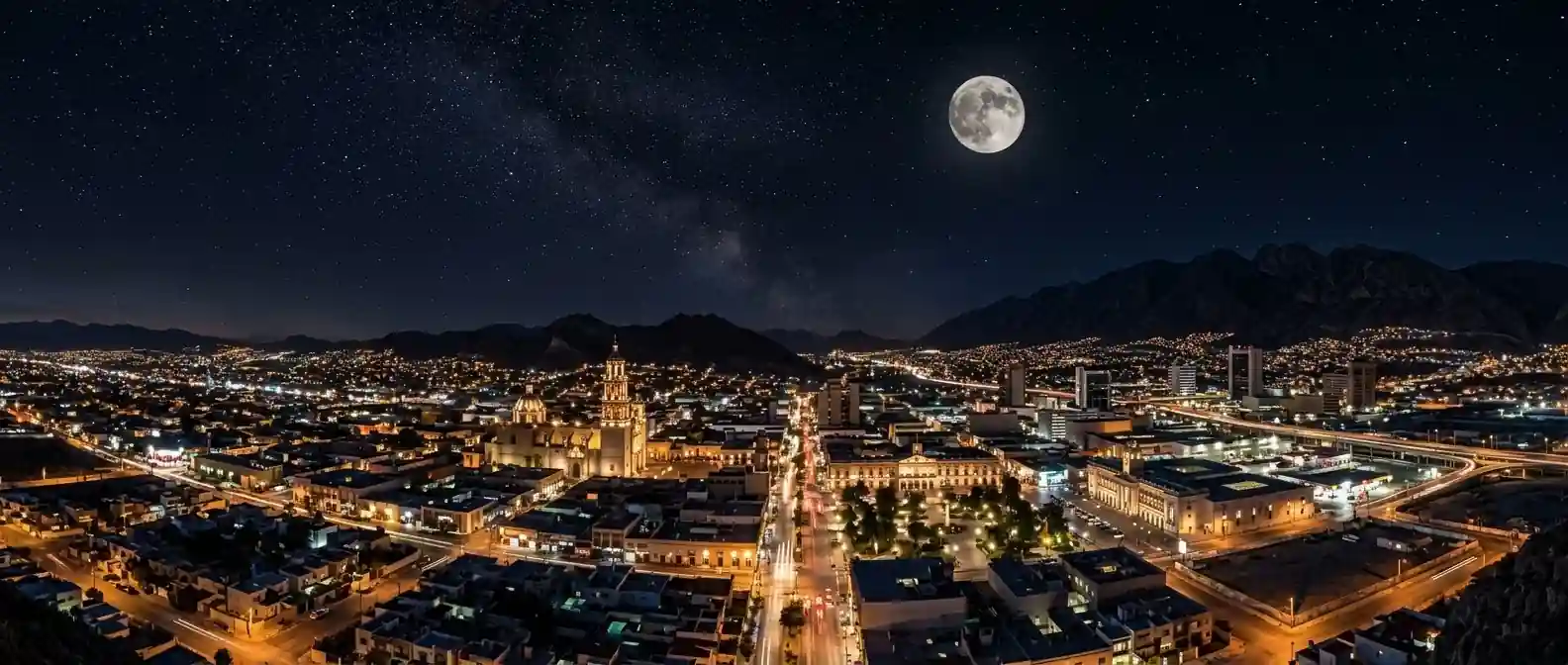
☽ Best Places to View the Moon in Saltillo, Mexico
Saltillo sits at roughly 25.42°N at an elevation of about 1,600 metres in northeastern Mexico, the capital and largest city of Coahuila with more than 800,000 residents. Founded in 1577, it's one of the oldest settlements in northern Mexico, nicknamed both "the Athens of Mexico" for its cultural institutions and "the Detroit of Mexico" for its major automotive manufacturing industry — an unusually wide range for one city to hold. Between a cathedral begun in 1745, a desert museum built around dinosaur fossils, and mountains flanking the city on nearly every side, Saltillo gives a genuinely varied set of places to watch the moon.
Catedral de Santiago Apóstol
An imposing cathedral begun in 1745 and completed in 1800, blending Baroque and Churrigueresque architecture, with a tower finished in the 1890s and a bell tower that has watched over the city's historic centre for generations. Local legends have long told of underground tunnels beneath the historic centre, including stories of passages associated with the cathedral, adding an extra layer of mystery to its illuminated evening exterior.
Alameda Zaragoza
The city's historic central park, with an artificial lake built in 1918 shaped like the outline of the Mexican Republic, shaded pathways, gardens, and sculptures throughout. Its open lawns give a straightforward, green option for an ordinary evening away from the busier downtown streets — check current hours, since the park is undergoing revitalization work.
Museo del Desierto
A museum devoted to the geology, paleontology, and biodiversity of the Chihuahuan Desert, including dinosaur fossils and other specimens from the region, plus a cactus greenhouse. Check current opening hours if you want to combine an exhibition with your evening, since it keeps daytime hours.
El Mirador & Cerro del Pueblo
A hill overlooking the city, topped by a large cross, with a lookout point giving a panoramic view over Saltillo and the surrounding valley. Its elevation provides a broad view over the city, making it useful for moonrise photography.
Historic Downtown & Plaza de Armas
The colonial heart of the city, home to the Coahuila State Government Palace and its murals, along with cafés and shops along narrow historic streets. It's an easy, central option for an ordinary evening near the cathedral.
Sierra de Zapalinamé
The mountain range flanking the city's southern edge, part of the Sierra Madre Oriental and open to ecotourism, including areas like San Lorenzo Canyon. Local legend says the ridgeline traces the silhouette of an indigenous Guachichil chieftain, and its foothills offer a quieter, more rural option for those willing to travel a short distance from the centre.
◉ Best Times for Moon Photography
📷 Quick Photography Tips
Saltillo runs on Central Standard Time (UTC-6) year-round. Unlike a handful of Coahuila's own border municipalities near the Texas line, Saltillo does not observe seasonal clock changes.
For the moon phase in any other city worldwide, visit our Dynamic Moon Phase Calculator for instant lunar data tailored to wherever you are.
The moon phase today in Saltillo, Mexico is shown in detail above — complete with exact illumination percentage, moonrise/set times, and the best viewpoints to see it. For the moon phase today in any other city or location worldwide, visit our Dynamic Moon Phase Calculator on the home page.
◐ While Actually There
Saltillo's two nicknames tell you almost everything about how the city sees itself. "The Athens of Mexico" points to a long tradition of education, arts, theatres, and cultural institutions; "the Detroit of Mexico" points to the modern automotive plants that now employ much of the region. Few cities carry both a colonial cathedral and a major manufacturing identity quite so comfortably.
The desert has its own say in the city's character too. The Museo del Desierto turns Saltillo's setting on the edge of the Chihuahuan Desert into an actual attraction, with dinosaur fossils and other specimens from the region, while the Sierra de Zapalinamé's ridgeline gives the surrounding mountains their own local legend, a chieftain's silhouette said to be visible in the rock itself.
None of it requires much beyond checking the Museo del Desierto's hours if you want to combine it with your visit, and current Alameda Zaragoza access given its ongoing revitalization work. The historic downtown and El Mirador are both straightforward for an ordinary evening without much advance planning.
"Saltillo is the Athens of Mexico and the Detroit of Mexico at once — a colonial cathedral and a modern car plant, both equally at home in the same city."
✓ Your Saltillo Moon Chase Checklist
Before You Go
- Check the moonrise time and phase on this page for each night of your stay
- Check current opening hours for the Catedral de Santiago Apóstol if you want to go inside, not just view the illuminated exterior
- Check current opening hours for the Museo del Desierto if you want to combine it with your visit
- Check current access and any revitalization-related restrictions at Alameda Zaragoza before an evening visit
- Check the forecast for the summer rainy season if visiting between June and August
What to Bring
- A warm layer for evenings year-round — Saltillo's elevation can make evenings noticeably cooler than in lower-lying Monterrey
- A tripod, useful at open, elevated spots like El Mirador
- Comfortable shoes for walking the historic downtown's streets
- A light rain layer during the summer rainy season
- Spare camera batteries kept warm in an inner pocket during cool evenings
On the Night
- Arrive 20–30 minutes before moonrise at open spots like El Mirador or Alameda Zaragoza
- Shoot RAW and bracket exposures, especially where the illuminated cathedral mixes with moonlight
- Mind wind at exposed elevated spots, particularly at El Mirador
- Confirm current transport options if visiting the Sierra de Zapalinamé in the evening
- Watch for sudden summer thunderstorms during the rainy season
? Saltillo Moon Phase — Frequently Asked Questions
Q. What is the moon phase today in Saltillo?
The moon phase today in Saltillo is a Waning Crescent with 34% illumination. The next full moon is in 22 days, on Oct 25. Moonrise is at 12:30 AM and moonset at 2:45 PM.
Q. Where is the best place to view the moon in Saltillo?
El Mirador on Cerro del Pueblo, a hill topped by a large cross, gives a panoramic view over Saltillo and the surrounding valley, making it the strongest choice for watching a moonrise. Alameda Zaragoza, the city's historic central park, offers open lawns and a lower, easier sightline, though it is undergoing revitalization work, so check current access. The illuminated Catedral de Santiago Apóstol in the historic downtown gives a historic foreground for a moon-over-architecture shot. The foothills of the Sierra de Zapalinamé, including areas such as San Lorenzo Canyon, offer a quieter option a short distance from the centre.
Q. Where does the moon rise and set in Saltillo, and how high does it climb?
At about 25.4°N, the Moon's rising point swings between roughly east-northeast (azimuth near 58°) and east-southeast (near 122°) over a month at the widest point of its 18.6-year declination cycle, with the setting point mirrored in the west. That cycle peaked with the major lunar standstill of 2024–2025, so the monthly swing is still near its widest. At culmination the Moon ranges from about 36° above the southern horizon at its southern extreme to about 87° above the northern horizon at its northern extreme. Saltillo lies north of the Tropic of Cancer, so the Sun never reaches the zenith here, but the Moon can pass nearly overhead. A December full moon typically culminates within about 7° of the zenith, while a June full moon peaks near 41° in the south.
Q. How do the surrounding mountains affect moonrise and moonset in Saltillo?
Saltillo sits at about 1,600 m immediately north of the Sierra de Zapalinamé, part of the Sierra Madre Oriental, whose ridgelines reach roughly 2,000–2,400 m with a highest peak of 3,140 m. That raises the southern horizon noticeably above a flat one, so the Moon's most southerly risings and settings, near azimuths 122° and 238°, may be delayed or hidden by the range depending on where you stand. Moonrises toward the east-northeast face a more open horizon. Because these times are usually calculated for a flat horizon, expect actual moonrise behind a ridge to come later than listed. An elevated position such as El Mirador improves the view of the horizon.
Q. Is light pollution a problem for moon observing in Saltillo?
The Moon is bright enough to observe and photograph from almost anywhere in the city, so light pollution rarely limits the lunar disc itself. With more than 800,000 residents in the city and its industrial zones, Saltillo does wash out earthshine on a thin crescent and faint stars or planets near the Moon. Larger open spaces such as Alameda Zaragoza and elevated El Mirador keep nearby buildings out of your foreground, while the foothills of the Sierra de Zapalinamé may offer a quieter setting away from the densest lighting. Saltillo remains a light-polluted urban location rather than a dark-sky site.
Q. How do altitude and the rainy season affect moon viewing in Saltillo?
At about 1,600 m, surface pressure is roughly 82% of the sea-level value, so there is less air between you and the Moon, which slightly reduces dimming and reddening near the horizon. The city's elevation also makes it cooler than nearby Monterrey, and nights can turn cool year-round. Saltillo has a summer rainy season from roughly June to August, with sudden thunderstorms and cloud as the main obstacle to lunar observing. Check the cloud forecast before heading out, and pack a warm layer for longer sessions.
Q. What camera settings work best for moon photography in Saltillo, and how does wind affect them?
For a full moon, start with Looney 11 (f/11, ISO 100, 1/100 s) and refine using your histogram, since it is a baseline rather than a guarantee. Saltillo is windier than Monterrey, particularly at exposed spots like El Mirador, and wind shake can blur even a bright Moon at 200–400 mm. Lower the tripod, hang weight from it, use a remote or timer, and trade ISO for shutter speed in equal steps, for example ISO 400 at 1/400 s with f/11. Shoot RAW, bracket, and use manual focus on the Moon with magnified live view.
Q. Does this page work for cities besides Saltillo?
This page is set up specifically for Saltillo, Mexico. For the moon phase in any other city or location worldwide, use the Dynamic Moon Phase Calculator on the moonphase.today home page.
✦ Explore Further
Moon Phase Today: Monterrey
Check tonight's moon phase in Monterrey, roughly 90 km east of Saltillo.
🏙️Moon Phase Today: San Luis Potosí
See the moon over San Luis Potosí, a highland city roughly 360 km south of Saltillo.
🇲🇽Moon Phase in Mexico
Browse moon phase pages for cities across Mexico, from Tijuana to Cancún.
🌍World Moon Phase Directory
Find the moon phase, rise and set times for cities in every region of the world.
Moon Compass
Follow the Moon's compass direction to line up rises and sets with your horizon.