
Moon Phase Today Madison
On Friday, October 9, 2026, the moon in Madison is a New Moon with 0% illumination. Moon age: 29.1 days.
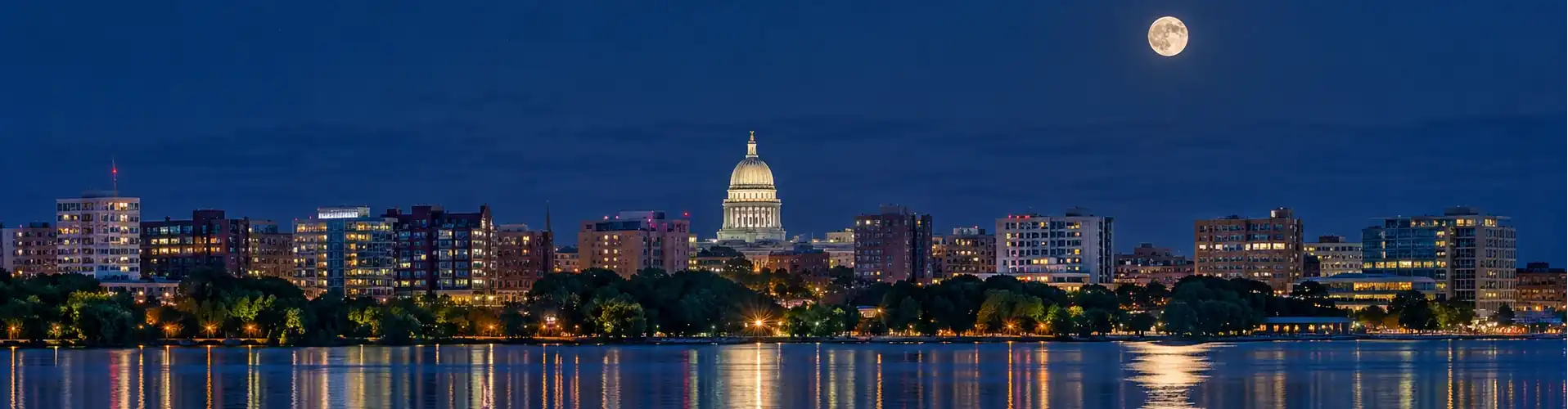
☽ Best Places to View the Moon in Madison, WI
Madison sits on a narrow isthmus between two lakes — Mendota to the north, Monona to the south — so nearly every good moon-viewing spot in the city comes down to a choice of which lake, and which shoreline, you want the moon rising over. The State Capitol's dome, visible from both lakes, gives most of these spots a shared landmark to frame against, while a couple of options further from downtown trade that skyline view for a darker, quieter sky. As always, the moon's exact rise direction shifts through its cycle rather than staying fixed, so it's worth checking that against whichever lake and shoreline you're planning around. Here are six of the area's strongest viewpoints.
Memorial Union Terrace (Campus)
The city's most iconic lakefront gathering spot — the University of Wisconsin's lakeside terrace on Lake Mendota, filled with the famous sunburst chairs and usually alive with live music on summer evenings. Open to the public (a day membership may apply outside campus hours), generally into the evening, though hours shift with the season and the terrace chairs come out only spring through fall. Address: 800 Langdon St.
Monona Terrace Rooftop Gardens (Downtown)
The William T. Evjue Rooftop Gardens atop the Frank Lloyd Wright-designed convention center, with a sweeping view across Lake Monona to the Capitol and downtown skyline. Free and open to the public. Rooftop hours: Sunday–Thursday 8 a.m.–10 p.m., Friday–Saturday 8 a.m.–midnight, weather permitting. Address: 1 John Nolen Dr.
Picnic Point (Lakeshore Nature Preserve)
A nearly mile-long wooded peninsula reaching into Lake Mendota, part of UW's 300-acre Lakeshore Nature Preserve, ending at an open overlook with views back toward the campus and downtown skyline. Free, no reservation needed. Open 4 a.m.–10 p.m. daily. Address: 2000 University Bay Dr.
Olbrich Botanical Gardens (East Side)
16 free acres of outdoor gardens on Lake Monona's northern shore, including the only Thai Pavilion in the continental U.S. and a viewing tower overlooking the gardens and lake beyond. Closes early — 6 p.m. April through September, 4 p.m. October through March — so it's a daytime or golden-hour visit rather than a nighttime one. Address: 3330 Atwood Ave.
Capitol Square (Downtown)
The grounds and sidewalks surrounding the Wisconsin State Capitol — the tallest structure in Madison and visible from both lakes — sit in a public square that's accessible any time of day. The building's own hours (and the seasonal observation deck) are limited, so this is about the exterior view of the dome against the sky, not going inside. Address: 2 E Main St.
Governor Nelson State Park (Waunakee)
Just across Lake Mendota from downtown, on the lake's quieter north shore — a 422-acre day-use state park with a beach and a clear sightline back toward the Capitol, well away from the city's own light. A Wisconsin vehicle admission sticker is required ($13/day for Wisconsin-plated vehicles $16/day for out-of-state plates). Open 6 a.m.–11 p.m. daily. Address: 5140 County Highway M, Waunakee.
◉ Best Times for Moon Photography
📷 Quick Photography Tips
Madison runs on Central Time — CST (UTC−6) in winter and CDT (UTC−5) in summer, since Wisconsin observes daylight saving time. PhotoPills or Stellarium will handle the moon's exact rise azimuth for any of these spots automatically.
The moon phase today in Madison is shown in detail above — complete with exact illumination percentage, moonrise/set times, and the best local spots to see it. For the moon phase today in any other city worldwide, visit our Dynamic Moon Phase Calculator on the home page.
◐ What the Experience Actually Feels Like
Out on the Memorial Union Terrace, the evening usually starts with a band tuning up near the water and every sunburst chair within view of the lake already claimed. The moon tends to rise somewhere out over Lake Mendota's open water, and for a while it competes with the terrace's string lights and the low hum of conversation before it clears the treeline and starts to stand on its own.
Out on Picnic Point, the mood shifts fast. The crowds thin within the first quarter mile, the path narrows into trees, and by the time you reach the tip of the peninsula it's usually just a handful of other walkers and whatever waterfowl are settling in for the night. From the overlook, the campus and downtown skyline sit low across the water, small and distant in a way they never feel from the terrace.
Across the lake at Governor Nelson State Park, it's a different city altogether. The beach empties out well before the 11 p.m. closing, the north shore goes properly dark, and the Capitol dome — the same one you might have been standing under an hour earlier — becomes a small lit point across several miles of open water. There's no music, no terrace chairs, just the lake and whatever's rising over it.
"Across the lake at Governor Nelson State Park, the north shore goes properly dark, and the Capitol dome becomes a small lit point across several miles of open water — no music, no terrace chairs, just the lake and whatever's rising over it."
✓ Your Madison Moon Chase Checklist
Before You Go
- Check the moonrise time and rise azimuth for your date — alignment with the Capitol dome or a specific shoreline depends on the date, not just the location
- Check both the moon's rise time and the venue's closing time — Olbrich Botanical Gardens closes as early as 4 p.m. in winter, and Governor Nelson State Park closes at 11 p.m. year-round
- Verify Site Access: Memorial Union Terrace hours and chair availability shift seasonally, and a Wisconsin Union day pass may be required outside normal visiting hours — check current status before heading over
- Use PhotoPills or Stellarium to check whether the moon will align with the Capitol or a specific shoreline on your date
- In winter, check the forecast for wind chill and road conditions, not just precipitation — cold is the bigger hazard most nights
- Confirm whether your chosen venue allows tripods, particularly at Monona Terrace's rooftop where space and event schedules vary
What to Bring
- A telephoto lens — 200mm or longer helps compress the moon behind the Capitol dome or the downtown skyline from across a lake
- Warm layers well beyond what feels necessary at sunset — lakefront wind cuts through fast once the sun's down, especially in fall and winter
- A remote shutter release or a 2-second timer to avoid shake on tripod shots, where tripods are permitted
- A flashlight or headlamp for the walk back from Picnic Point or Governor Nelson's trails after dark
- A payment method for Governor Nelson's vehicle admission sticker, since the rest of the spots on this list are free
On the Night
- Arrive at your viewpoint at least 30–45 minutes early, especially at the Terrace or Monona Terrace around full moons and weekend events
- Focus manually on the moon's edge — terrace string lights and downtown glow can confuse autofocus at dusk
- Bracket your exposures — one for the bright lunar disc, one for the darker lake or skyline below
- If the moon looks soft or hazy right at moonrise, consider waiting until it climbs higher above the horizon, when atmospheric effects are often less pronounced
- At Governor Nelson State Park, plan to be back at the gate before the 11 p.m. closing, and never walk out onto the lake ice in winter for a better view — it's not a reliable surface even when it looks frozen solid
? Madison Moon Phase — Frequently Asked Questions
Q. What is the moon phase today in Madison?
The moon phase today in Madison is a New Moon with 0% illumination. The next full moon is in 17 days, on Oct 25. Moonrise is at 6:05 AM and moonset at 5:52 PM.
Q. Where is the best place to view the moon in Madison?
Memorial Union Terrace is the city's most iconic lakefront spot, the University of Wisconsin's lakeside terrace on Lake Mendota with its famous sunburst chairs. Monona Terrace's rooftop gardens give a sweeping view across Lake Monona to the Capitol and skyline, Picnic Point offers a quieter, nearly mile-long peninsula walk out into Lake Mendota, and Olbrich Botanical Gardens, Capitol Square, or Governor Nelson State Park add further garden, downtown-exterior, or genuinely-darker-shoreline alternatives.
Q. Do these viewing spots stay open after dark?
Most do, with variation — Picnic Point is open 4 a.m. to 10 p.m. daily, and Monona Terrace's rooftop gardens run Sunday through Thursday 8 a.m. to 10 p.m. and Friday and Saturday 8 a.m. to midnight. Memorial Union Terrace's hours shift with the season, and its sunburst chairs come out only spring through fall. Olbrich Botanical Gardens closes early — 6 p.m. April through September, 4 p.m. the rest of the year — making it a daytime or golden-hour visit rather than a nighttime one, while Capitol Square's grounds and sidewalks are accessible any time of day, and Governor Nelson State Park runs 6 a.m. to 11 p.m. with a vehicle admission sticker required.
Q. Does Madison observe daylight saving time?
Yes. Madison runs on Central Time — CST (UTC−6) in winter and CDT (UTC−5) in summer, since Wisconsin observes daylight saving time on the standard U.S. schedule.
Q. What's the best time of year for moon photography in Madison?
The moon's exact rise direction shifts through its cycle rather than staying fixed, so it's worth checking that against whichever lake and shoreline you're planning around. The State Capitol's dome, visible from both Lake Mendota and Lake Monona, gives most of these spots a shared landmark to frame against, while a couple of options further from downtown trade that skyline view for a darker, quieter sky.
Q. Does this page work for cities besides Madison?
This page is set up specifically for Madison, Wisconsin. For the moon phase in any other city or location worldwide, use the Dynamic Moon Phase Calculator on the moonphase.today home page.
✦ Explore Further
Moon Phase Today: Milwaukee
Check tonight's moon phase in Milwaukee, about 75 miles east.
📷Moon Photography Guide
Camera settings, lenses, and techniques for shooting sharp, well-exposed moon shots.
📐Looney 11 Exposure Calculator
Dial in the exact f-stop, ISO, and shutter speed for a full moon over the Capitol.
🌙Why Does the Moon Rise and Set?
The simple science behind why the rising direction shifts night to night.
NASA Moon Phase & Libration Gallery
NASA's Scientific Visualization Studio's daily renders of the moon's exact phase, libration, and orientation, straight from official mission data.