
Moon Phase Today Doha
On Saturday, October 10, 2026, the moon in Doha is a New Moon with 0% illumination. Moon age: 28.9 days.
☽ Best Places to View the Moon in Doha
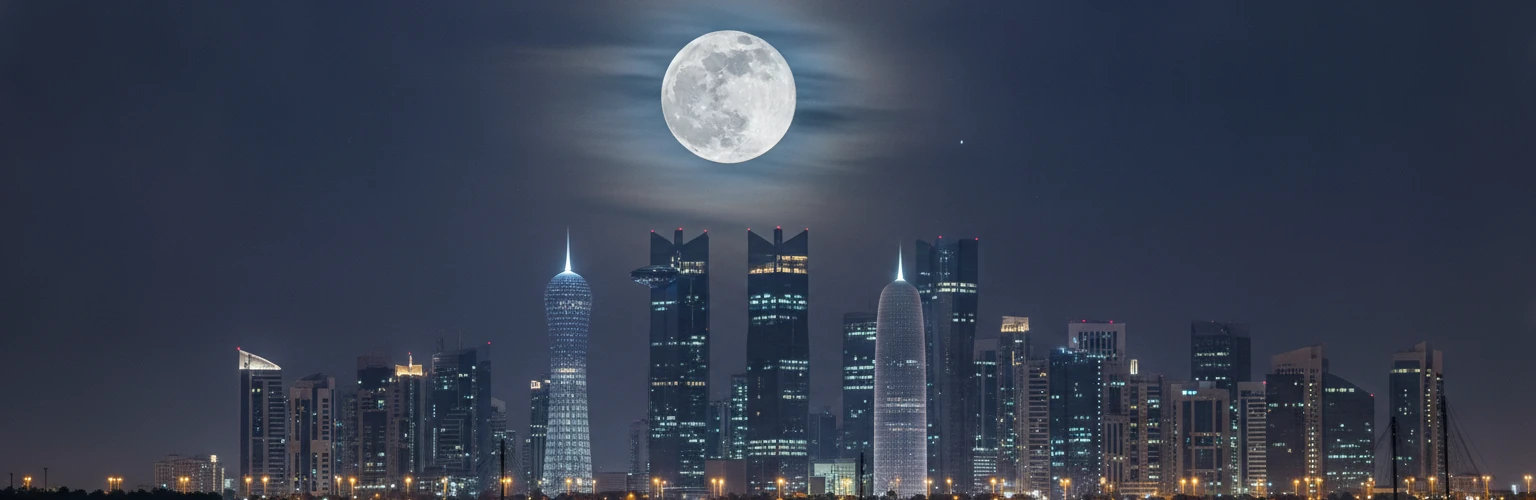
Doha sits at 25.2° North on the flat desert coast of the Persian Gulf, a city where the sky acts as a humid, electric stage for the lunar cycle. The geography of the city is defined by its deep crescent-shaped bay, providing a wide-open eastern horizon where the moon rises directly out of the sea. At night, the futuristic West Bay skyline and the geometric precision of the Museum of Islamic Art meet the warm, silver glow of the moon. Doha rewards the observer who utilizes its long seafront promenades to capture the moon as it reflects in the calm waters of the Corniche and silhouettes the traditional dhow boats.
The Doha Corniche
The absolute #1 viewpoint. This 7km waterfront promenade offers an unobstructed eastern horizon. The moon rises over the bay, silhouetting the iconic "fan" of skyscrapers in West Bay. The hundreds of traditional wooden dhow boats anchored along the shore provide a classic Qatari foreground, while the stone sea-wall acts as a steady platform for tripods. Free and open 24/7.
MIA Park (Museum of Islamic Art)
Situated on an elevated pier at the end of the Corniche. The MIA Park provides a unique perspective looking back at the skyline. The moon rises behind the geometric, monolithic architecture of I.M. Pei’s masterpiece. The Richard Serra "7" sculpture on the far tip of the park offers a minimalist architectural frame for wide-angle lunar shots. The park's open lawns are exceptionally safe for night photography.
Katara Cultural Village
The city's cultural hub, located between West Bay and The Pearl. From the southern beaches or the Roman-style amphitheater, the moon rises over the open Gulf. The ornate mosques of Katara, clad in Persian-style tiles, reflect the lunar glow with unique textures. It is significantly quieter than the Corniche, offering a more tranquil environment for tracking the moon as it climbs into the zenith.
Aspire Park – The Torch
The city's largest green lung. From the eastern shore of the park's lake, you can capture the moon as it tracks beside The Torch Doha (300m). The still waters of the lake create a perfect mirror reflection of the lunar disc and the tower's colorful LED lights. It is the premier inland spot for those wanting to escape the coastal humidity while keeping an iconic skyscraper in frame.
The Pearl-Qatar – Qanat Quartier
For a unique Venetian-inspired composition, head to the canals of The Pearl. The moon rises over the luxury towers of Porto Arabia and reflects in the narrow waterways. The pastel-colored bridges and the lack of heavy traffic provide an intimate, "European-middle-east" hybrid foreground that is distinct from the high-tech steel of the city center.
Al Safliya Island
Accessible via a short traditional boat ride from the Corniche. This island provides the darkest skies in the capital area. From the sandy shores, you look back at the entire Doha skyline silhouetted against the night sky, with the moon rising behind you over the open sea. It offers a "Big Sky" experience where the city’s light dome is a secondary element to the celestial arc.
◉ Best Times for Moon Photography
📷 Quick Photography Tips
Doha operates on AST (Arabia Standard Time, UTC+3) year-round. Qatar does not observe daylight saving time. Because Doha sits on a flat coastal plain, the "actual" moonrise is extremely close to mathematical calculations, though the skyscraper skyline will delay the first sighting at street level.
◐ What the Experience Actually Feels Like
There is a specific, quiet majesty to a moonrise in Doha. Standing on the stone walkway of the Corniche as the sun dips behind the high-rises of West Bay, you watch the city transition from a dusty desert amber to a deep, velvety indigo. The first hint of the moon appearing over the Persian Gulf feels like a clockwork event—ordered, precise, and profoundly beautiful. The air often carries the faint scent of sea salt and the oud from nearby cafes.
In winter, the experience is crystalline. When the Shamal winds clear the air, the sky is so transparent that the moon appears to have a physical texture, its craters silhouetting the Islamic Art Museum with surgical precision. It is a moment of profound contrast, where the city's high-tech energy is replaced by a celestial stillness. You can see the dark ribbons of the water weaving between the dhows, the white lights of yachts moving like slow-motion stars.
Summer nights are softer and more social. On the sands of Katara or the piers of The Pearl, the moonrise is often shared with thousands of locals enjoying the evening walk. The water remains still, creating a perfect glitter path that stretches toward the shore. From the heights of Al Safliya, the city feels like a living map, with the moon guiding the eye along the wide, dark curve of the coast.
"The moon creates a shimmering silver path across the dark water, pointing directly to the dhow moorings. In Doha, the futuristic skyline meets the ancient silence of the Gulf."
✓ Your Doha Moon Chase Checklist
Before You Go
- Check the moonrise time on this page — the Gulf horizon is flat, making the data highly accurate for the seafront
- Verify Site Access: Parks and cultural villages have specific seasonal closing hours; plan for early moonrises
- Download PhotoPills or Stellarium to track the exact arc relative to the Torch Doha or the West Bay towers
- Check the wind forecast; strong winds can create sea-spray that will blur long exposures near the Corniche wall
- Ensure your camera sensor is clean; long exposures against the dark Gulf will show every speck of dust
What to Bring
- A telephoto lens (200mm+) to "compress" the moon behind the city’s landmark towers from the Corniche
- Humidity protection — a small lens cleaning cloth is essential as the damp salt air can create a film on your glass
- A remote shutter release or use a 2-second timer to avoid "finger-tap" shake on your tripod during long exposures
- Spare camera batteries — the coastal heat and high-ISO night shooting can drain power faster than usual
- Comfortable walking shoes for the 7km stretch of the Doha Corniche or the marble paths of Katara
- A small flashlight for navigating the darker areas of Al Safliya Island or unlit sections of parks
On the Night
- Arrive at your viewpoint 45 minutes early; the Blue Hour transition over the Gulf is a peak moment for skyline shots
- Focus manually on the moon’s edge; the flickering neon lights of the skyscrapers can often confuse autofocus systems
- Bracket your exposures — take one for the bright lunar disc and one for the darker urban shadows and water reflections
- At the Corniche, move away from the main street lamps to minimize lens flare in your lunar compositions
- Stay for 20 minutes after moonrise; the composition sharpens as the moon clears the maritime horizon haze
? Doha Moon Phase — Frequently Asked Questions
Q. What is the moon phase today in Doha?
The moon phase today in Doha is a New Moon with 0% illumination. The next full moon is in 17 days, on Oct 26. Moonrise is at 5:09 AM and moonset at 5:00 PM.
Q. Where is the best place to view the moon in Doha?
The Doha Corniche, a 7km waterfront promenade, is the absolute #1 viewpoint, with the moon rising over the bay and silhouetting the West Bay skyline and rows of traditional dhow boats. MIA Park at the end of the Corniche looks back at the skyline behind I.M. Pei's Museum of Islamic Art, Katara Cultural Village's beaches offer a quieter Gulf moonrise beside Persian-tiled mosques, and Aspire Park's lake beside The Torch, The Pearl-Qatar's Venetian-style canals, or Al Safliya Island add further inland-mirror, canal, or genuinely dark-sky alternatives.
Q. How do I get to Al Safliya Island, and what makes it special?
Al Safliya Island is reached via a short traditional boat ride from the Corniche and offers the darkest skies in the capital area — from its sandy shores, you look back at the entire Doha skyline silhouetted against the night, with the moon rising behind you over open sea.
Q. Does Doha observe daylight saving time?
No. Doha operates on AST (Arabia Standard Time, UTC+3) year-round — Qatar does not observe daylight saving time. The times shown on this page never need a seasonal adjustment.
Q. What's the best time of year for moon photography in Doha?
November through February brings the lowest humidity, clearest air, and sharpest tower silhouettes, and evenings right after the Shamal winds often wash away the city's dust haze for exceptional clarity. Whatever the season, Gulf breezes along the Corniche can be strong, so a weighted tripod helps keep long exposures sharp.
Q. Does this page work for cities besides Doha?
This page is set up specifically for Doha, Qatar. For the moon phase in any other city or location worldwide, use the Dynamic Moon Phase Calculator on the moonphase.today home page.
✦ Explore Further
Moon Phase Today: Dubai
Check tonight's moon phase in Dubai, about 380 miles down the Gulf coast.
📷Moon Photography Guide
Camera settings, lenses, and techniques for shooting sharp, well-exposed moon shots.
📐Looney 11 Exposure Calculator
Dial in the exact f-stop, ISO, and shutter speed for a full moon — the same rule used in our Corniche tips.
🌆Blue Hour Calculator
Find tonight's exact blue hour window to time your West Bay moonrise shots.
NASA Moon Phase & Libration Gallery
NASA's Scientific Visualization Studio's daily renders of the moon's exact phase, libration, and orientation, straight from official mission data.