
Moon Phase Today Dubai
On Saturday, October 10, 2026, the moon in Dubai is a New Moon with 0% illumination. Moon age: 28.9 days.
☽ Best Places to View the Moon in Dubai
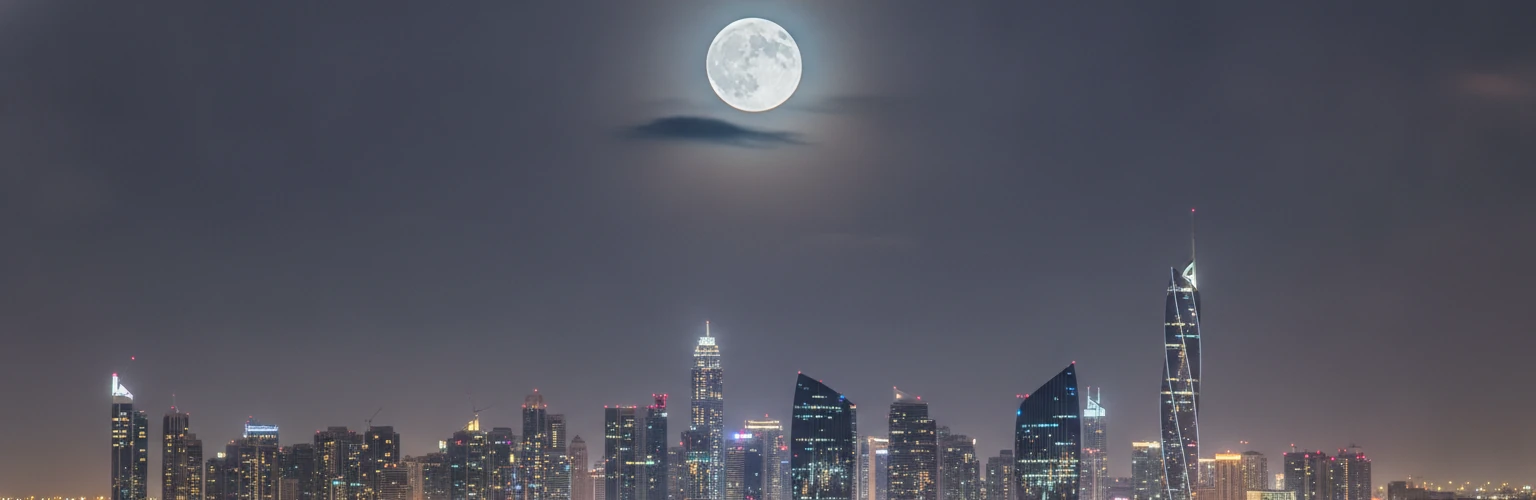
Dubai sits at 25.2° North on the flat desert coast of the Arabian Peninsula, a city defined by hyper-modern glass and the vast, open horizon of the Arabian Gulf. At night, the "City of Gold" undergoes a spectral shift: the cool silver of the moon meets the intense, high-tech glow of the Burj Khalifa. The moon rises over the eastern Hajar Mountains and desert dunes, tracks across a skyline of record-breaking towers, and sets into the sea to the west. Dubai rewards the observer who moves between the salt-sprayed boardwalks of the Palm and the silent, heart-shaped lakes of the deep desert to capture the moon as it interacts with the most futuristic urban landscape on Earth.
The Palm Jumeirah Boardwalk
The ultimate postcard vantage. From the outer crescent, looking west provides a premier view of the moon setting into the Arabian Gulf. The Atlantis hotel stands at the northern apex of the crescent, while looking East allows you to capture the moon rising behind the high-rises of the Dubai Marina skyline. The boardwalk is open 24/7 and is ideal for expansive sea reflections.
Al Qudra – Love Lake
A desert escape 45 minutes from downtown. With significantly lower light pollution, Al Qudra offers Bortle Class 2–3 skies. The moon rises over rolling red dunes and reflects in the heart-shaped Love Lake. On clear winter nights, the Burj Khalifa is faintly visible on the distant horizon, providing a surreal sense of scale against the absolute desert silence. Safe for overnight camping.
JBR Beach & The Walk
A wide seafront promenade in the Marina district. The moon sets over the sea, silhouetting the Ain Dubai wheel and the twisted Cayan Tower. The wet sand at low tide provides a vast reflective canvas for long-exposure photography. It is one of the most vibrant spots in the city, where the moon interacts with the neon energy of the local nightlife. Accessible 24/7.
Burj Park – Downtown Dubai
The definitive urban frame. From the promenade, the moon can be aligned to rise directly behind or beside the Burj Khalifa (828m). The nearby Dubai Fountain light shows and the Burj Lake provide a high-contrast architectural foreground. This is a premier spot for telephoto shots that emphasize the "vertical" scale of the city against the celestial disc. Best on clear winter nights when the air is sharp.
Kite Beach – Jumeirah
A clean, expansive western horizon. From the sands near the "Salt" stand, the moon occasionally sets behind or next to the Burj Al Arab sail. Because the beach is miles long, you can fine-tune your position along the shore to catch specific alignments. Note: Precise alignment with the hotel architecture varies significantly by date; use PhotoPills to plan your exact tripod placement.
Dubai Frame – Zabeel Park
The Dubai Frame acts as a literal picture window for the moon. From the gardens of Zabeel Park, you can capture the moon as it tracks through or beside the 150-meter-high structure. It provides a unique "frame-within-a-frame" composition, bridging the gap between Old Dubai to the North and the modern skyline to the South. The park grounds offer ample space for tripod setups.
◉ Best Times for Moon Photography
📷 Quick Photography Tips
Dubai operates on GST (Gulf Standard Time, UTC+4) year-round. The UAE does not observe daylight saving time. Because Dubai sits on a flat coastal plain, the "actual" moonset is extremely close to the mathematical horizon time, though the skyscraper skyline to the East will delay the visual moonrise for those at beach level.
The moon phase today in Dubai is shown in detail above — complete with exact illumination percentage, moonrise/set times, and the best local spots to see it. For the moon phase today in any other city worldwide, visit our Dynamic Moon Phase Calculator on the home page.
◐ What the Experience Actually Feels Like
There is a specific, high-energy majesty to a moonrise in Dubai. Standing in the middle of Downtown as the sun dips behind the Jumeirah coastline, you watch the city transition from a dusty desert amber to a neon-infused, velvety indigo. The air often carries a hint of frankincense and the warmth of the sand. When the moon finally breaks the horizon over the eastern desert, the Burj Khalifa begins to sparkle, its 1.2 million LED lights providing a high-tech counterpoint to the silver lunar light.
In winter, the experience is crystalline. When the Shamal winds clear the air, the sky is so transparent that the moon appears to have a physical texture, its craters silhouetting the Burj Al Arab sail with surgical precision. It is a moment of profound contrast, where the city's frantic energy is replaced by a celestial stillness. You can see the dark ribbons of the Gulf water weaving between the Palm fronds, the white lights of yachts moving like slow-motion stars.
Out at Al Qudra, the mood is elemental. The silence is absolute, and the moon rise over the red dunes is a prehistoric event—the sand turns from copper to silver, and for a few hours, the modern towers of the city feel like a distant dream. It is a cinematic experience where the natural geometry of the desert meets the math of the solar system—a reminder that in Dubai, the future and the ancient heavens are separated by only a short drive into the dunes.
"The Burj Khalifa begins to sparkle, its LED lights providing a high-tech counterpoint to the silver lunar light. It is a moment where the future and the ancient heavens meet."
✓ Your Dubai Moon Chase Checklist
Before You Go
- Check the moonrise time on this page — the skyscraper skyline will delay the visual rise for those in the Jumeirah area
- Verify Site Access: The Dubai Frame typically closes by 21:00; ensure you arrive early to catch moonrises that align with the structure
- Download PhotoPills or Stellarium to track the exact arc relative to the Burj Khalifa pinnacle or the Ain Dubai
- Check the wind forecast; winds over 25km/h in the desert can create dust haze that obscures the moon
- Ensure your camera sensor is clean; long exposures against the dark Gulf will show every speck of dust
What to Bring
- A telephoto lens (200mm+) to "compress" the moon behind the city’s landmark towers from the desert edge
- Serious humidity protection — a small lens cleaning cloth is essential as the salt air can create a film on your glass
- A remote shutter release or use a 2-second timer to avoid "finger-tap" shake on your tripod
- Spare camera batteries — long night sessions and the desert heat/cold can drain power faster than usual
- Comfortable sandals for the beach, but closed shoes if venturing into the dunes at Al Qudra
- Insect repellent — especially if shooting from the lake shore at Al Qudra where mosquitoes are active after dark
On the Night
- Arrive at your viewpoint 45 minutes early; the "Blue Hour" transition over the city is a peak moment
- Focus manually on the moon’s edge; the flickering neon lights of the skyscrapers can often confuse autofocus systems
- Bracket your exposures — take one for the bright lunar disc and one for the darker urban shadows
- At the Burj Park, move away from the main fountain floodlights to minimize lens flare in your lunar compositions
- Stay for 20 minutes after moonrise; the composition sharpens as the moon clears the lower horizon "city soup" haze
? Dubai Moon Phase — Frequently Asked Questions
Q. What is the moon phase today in Dubai?
The moon phase today in Dubai is a New Moon with 0% illumination. The next full moon is in 17 days, on Oct 26. Moonrise is at 5:54 AM and moonset at 5:44 PM.
Q. Where is the best place to view the moon in Dubai?
The Palm Jumeirah Boardwalk gives the ultimate postcard vantage, with the moon setting into the Arabian Gulf to the west or rising behind the Dubai Marina skyline to the east. Burj Park in Downtown Dubai lets the moon align directly beside the Burj Khalifa, JBR Beach and The Walk offer a lively seafront with Ain Dubai in silhouette, and Al Qudra's Love Lake or the Dubai Frame in Zabeel Park add further dark-sky desert or architectural-frame alternatives.
Q. Is Al Qudra really that much darker than the city?
Yes — Al Qudra sits about 45 minutes from downtown and offers Bortle Class 2–3 skies, a dramatic step down in light pollution from the city center. On clear winter nights the Burj Khalifa is still faintly visible on the distant horizon, giving a striking sense of scale against the desert silence.
Q. Does Dubai observe daylight saving time?
No. Dubai operates on GST (Gulf Standard Time, UTC+4) year-round — the UAE does not observe daylight saving time. The times shown on this page never need a seasonal adjustment.
Q. What's the best time of year for moon photography in Dubai?
November through March brings the lowest humidity, clearest air, and sharpest tower silhouettes of the year. In summer, desert dust often acts like a natural ND filter, producing deep red moonrises rather than the sharp silver disc typical of winter.
Q. Does this page work for cities besides Dubai?
This page is set up specifically for Dubai, United Arab Emirates. For the moon phase in any other city or location worldwide, use the Dynamic Moon Phase Calculator on the moonphase.today home page.
✦ Explore Further
Moon Phase Today: Doha
Check tonight's moon phase in Doha, about 380 miles up the Gulf coast.
📷Moon Photography Guide
Camera settings, lenses, and techniques for shooting sharp, well-exposed moon shots.
📐Looney 11 Exposure Calculator
Dial in the exact f-stop, ISO, and shutter speed for a full moon over the Burj Khalifa.
🌆Blue Hour Calculator
Find tonight's exact blue hour window to time your Palm Jumeirah moonset shots.
NASA Moon Phase & Libration Gallery
NASA's Scientific Visualization Studio's daily renders of the moon's exact phase, libration, and orientation, straight from official mission data.