
Moon Phase Today Dhaka
On Saturday, October 10, 2026, the moon in Dhaka is a New Moon with 0% illumination. Moon age: 28.9 days.
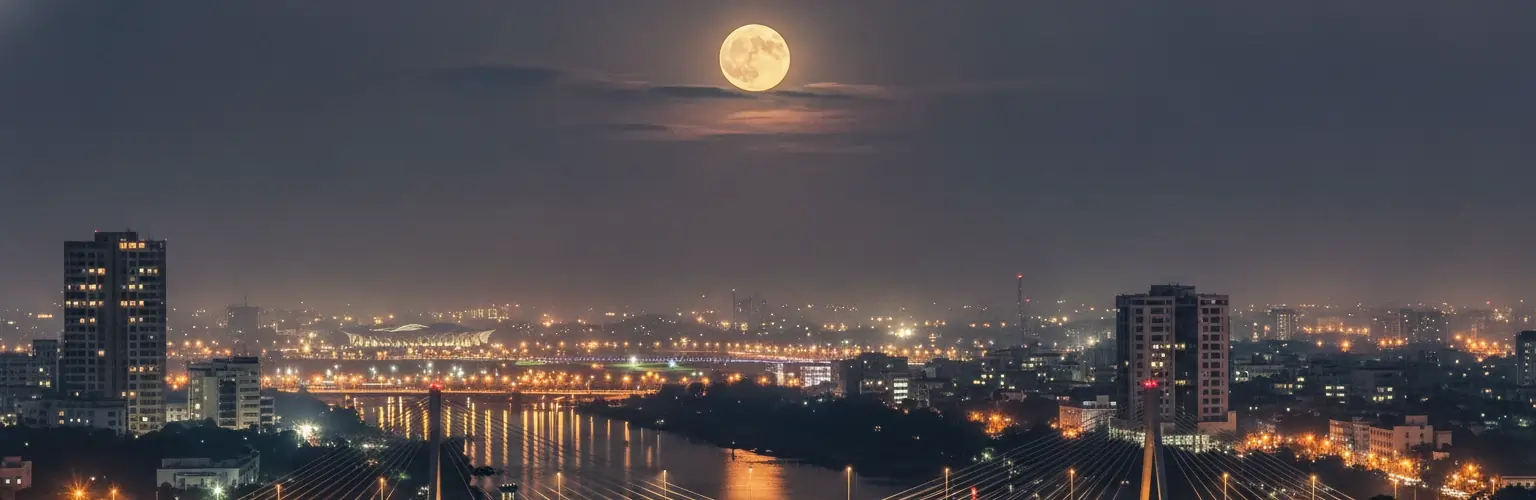
☽ Best Places to View the Moon in Dhaka
Dhaka sits at 23.7° North on the lush Ganges Delta, a massive megacity where the horizon is defined by urban lakes, the winding Buriganga river, and a dense, rapidly rising vertical skyline. At night, the "City of Mosques" undergoes a spectral shift: the high-contrast lights of the **Hatirjheel bridges** and the modern towers of Gulshan meet the soft, silver glow of the moon. The moon rises over the eastern plains and tracks across a sky that is often atmospheric with tropical humidity or seasonal haze. Near the horizon, the moon's well-known perceptual "Moon Illusion" — looking larger than it does higher in the sky, even though its actual size hasn't changed — is especially striking against Dhaka's low, open eastern edges. Dhaka rewards the observer who utilizes its expansive waterfronts and rooftop terraces to frame the moon against the most vibrant urban energy in South Asia.
Hatirjheel – The Amphitheatre
A standout viewpoint. This 302-acre reclaimed lake acts as one of the city's "lungs," with roughly 9km of footpath and 10km of lakeside walkway around the water. The moon can rise over the lake at certain times of year, silhouetting the illuminated bridges and the surrounding skyline — though the exact angle shifts with the season, so it won't always sit directly over the water. On still nights the lake can give a strong mirror reflection. The walkways allow for multiple tripod angles without the city's usual traffic congestion.
Gulshan Lake Park
Located in the heart of the diplomatic zone, this park offers a refined urban foreground. Depending on the season, the moon can rise behind the high-rises of Gulshan-2, casting silver light across the well-maintained lake. It tends to be quieter than the central city parks, providing a calmer environment for capturing the moon alongside Dhaka's modern architectural evolution.
Dhanmondi Lake – Bridge View
The city's historic central oasis. From the bridge near Rabindra Sarobar, the moon can rise over the water at points in its monthly cycle, silhouetting the iconic tree canopy and the residential towers of Dhanmondi. The area is a cultural hub, where moonrise evenings are often shared with musicians and poets. Generally well-lit, it is a strong spot for "contextual" shots that capture the city's social heart.
Sadarghat – Buriganga Riverbank
For high-drama cultural photography, nothing beats the Old Dhaka riverbank. When the moon rises over the Buriganga, it can silhouette the giant passenger launches (ferries) and the frantic activity of the historic port. The mix of river mist, ship lights, and the silver lunar glow creates a gritty, cinematic foreground that represents the raw soul of Dhaka.
Ramna Park – Main Lake Shore
A historic park in an area whose roots date back to the Mughal era, though the park itself was developed during the British colonial period and formally inaugurated in 1949. It's also the traditional home of Dhaka University's Pahela Baishakh festivities each April. From the eastern shore of the main lake, you have an unobstructed view of the moon clearing the city bowl. The park's old banyan trees provide unique silhouettes against the lunar disc, and the tree cover helps cut down on immediate street-level glare.
Purbachal – 300 Feet Road
For a "big sky" experience, head to the city's eastern edge. The wide-open floodplains and flat horizons around Purbachal's 300 Feet Road (the 12.5-km expressway also signed as July 36 Expressway) offer some of the more open sightlines in the Dhaka metropolitan area, with the eastern horizon noticeably flatter and clearer than central Dhaka's. This makes it a good spot for noticing the "Moon Illusion" — the well-known perceptual effect where the moon looks unusually large near the horizon, even though its actual angular size barely changes. There have been periodic news reports and public discussion of safety concerns along quieter, unlit stretches of this road after dark, so it's worth going with a group and sticking to busier sections in the evening.
◉ Best Times for Moon Photography
📷 Quick Photography Tips
Dhaka operates on BST (Bangladesh Standard Time, UTC+6) year-round. Bangladesh does not observe daylight saving time. Because Dhaka sits on a flat delta, the "actual" moonrise is close to mathematical calculations, though the dense urban skyline will delay the first sighting at street level.
◐ What the Experience Actually Feels Like
A mood piece, not a factual rundown — conditions and atmosphere vary night to night.
There is a specific, heavy warmth to a moonrise in Dhaka. Standing on a lakeside terrace in Dhanmondi as the sun dips behind the city, you hear the distant chorus of the metropolis—the rhythmic hum of rickshaw bells, the overlapping prayers from nearby mosques, and the vibrant social energy of the crowds. The air often smells of street-side spices and woodsmoke. When the moon finally breaks the horizon over the eastern delta, the city's modern towers begin to glow with a cool, silver counterpoint.
In winter, the experience is defined by tropical contrast. The sky often stays a deep, indigo blue, and the moon appears so bright it casts hard shadows on the white-washed walls of old city buildings. From the height of a Bashundhara rooftop, the city feels like a living, liquid map, with the moon guiding the eye along the dark ribbons of the jheels. It is a moment of relative stillness that makes the city's frantic daytime energy feel like a distant memory.
But the real magic happens at Sadarghat. As the full moon climbs above the river, the massive launches are bathed in silver light, their reflections dancing on the dark, churning water of the Buriganga. You are standing in the middle of a historic trade route where the moon has been a witness for centuries. It is a cinematic experience where the old delta meets the newer sprawl, unified for a few hours under a silver tropical light.
"The city's frantic energy gives way to something quieter. It is a scene where the old delta and the newer skyline meet, briefly unified under a silver tropical light."
✓ Your Dhaka Moon Chase Checklist
Before You Go
- Check the moonrise time on this page — visual rise will be delayed somewhat by the dense skyscraper skyline
- Verify Site Access: public parks in Dhaka often have evening closing hours; check current timings before planning a late rise
- Download PhotoPills or Stellarium to track the moon's arc relative to your chosen skyline or bridge
- Check the haze forecast; high pollution levels in Dec–Feb can dim and redden the moon near the horizon
- Arrange reliable transport; traffic near Hatirjheel and Dhanmondi can be heavy, especially around full moon evenings
What to Bring
- A telephoto lens (200mm-400mm) to "compress" the moon behind the city's landmark towers from the lake shores
- Humidity Protection: A small lens cleaning cloth is essential as the damp air can create condensation on your glass
- A remote shutter release or use a 2-second timer to avoid "finger-tap" shake on your tripod
- Insect repellent — useful if shooting from the lake shores at Dhanmondi or Ramna Park
- Light, breathable clothing — during the hottest months, midnight temperatures often stay above 28°C (82°F)
- A companion or group for late-night shoots, especially in quieter or unlit areas
On the Night
- Arrive at your viewpoint 30–45 minutes early; the blue hour transition over the urban lakes is a strong photographic window
- Focus manually on the moon's edge; the city's high light intensity can often confuse autofocus systems
- Bracket your exposures — take one for the bright lunar disc and one for the darker shadows of the water and buildings
- At Hatirjheel, move away from the main bridge floodlights to minimize lens flare in your lunar compositions
- Stay for 20 minutes after moonrise; the composition often sharpens as the moon clears the lower horizon haze
? Dhaka Moon Phase — Frequently Asked Questions
Q. What is the moon phase today in Dhaka?
The moon phase today in Dhaka is a New Moon with 0% illumination. The next full moon is in 17 days, on Oct 26. Moonrise is at 5:27 AM and moonset at 5:21 PM.
Q. Where is the best place to view the moon in Dhaka?
Hatirjheel, a 302-acre reclaimed lake with roughly 9km of footpath, is a standout viewpoint, with the moon able to silhouette the illuminated bridges and reflect on the water on calm nights. Gulshan Lake Park gives a refined, quieter urban foreground in the diplomatic zone, Sadarghat's Buriganga riverbank offers high-drama shots silhouetting the giant passenger launches, and Dhanmondi Lake, Ramna Park, or Purbachal's 300 Feet Road add further social, historic, or open-horizon alternatives.
Q. Is it safe to shoot at Purbachal's 300 Feet Road after dark?
There have been periodic news reports and public discussion of safety concerns along quieter, unlit stretches of this road, so it's worth going with a group and sticking to busier sections in the evening rather than isolated stretches.
Q. Does Dhaka observe daylight saving time?
No. Dhaka operates on Bangladesh Standard Time (BST, UTC+6) year-round — Bangladesh does not observe daylight saving time. The times shown on this page never need a seasonal adjustment.
Q. What's the best time of year for moon photography in Dhaka?
November through February brings the lowest humidity and best atmospheric transparency of the year. Whatever the season, high pollution levels in December through February can dim and redden the moon near the horizon, so checking the haze forecast beforehand is worth it.
Q. Does this page work for cities besides Dhaka?
This page is set up specifically for Dhaka, Bangladesh. For the moon phase in any other city or location worldwide, use the Dynamic Moon Phase Calculator on the moonphase.today home page.
✦ Explore Further
Moon Phase Today: Kolkata
Check tonight's moon phase in Kolkata, just across the border about 150 miles west.
📷Moon Photography Guide
Camera settings, lenses, and techniques for shooting sharp, well-exposed moon shots.
📐Looney 11 Exposure Calculator
Dial in the exact f-stop, ISO, and shutter speed for a full moon over Hatirjheel.
🌍World Moon Phase Directory
Browse the moon phase today in hundreds of other cities and locations around the world.
NASA Moon Phase & Libration Gallery
NASA's Scientific Visualization Studio's daily renders of the moon's exact phase, libration, and orientation, straight from official mission data.