
Moon Phase Strasbourg
On Saturday, October 10, 2026, the moon in Strasbourg is a New Moon with 0% illumination. Moon age: 29.0 days.
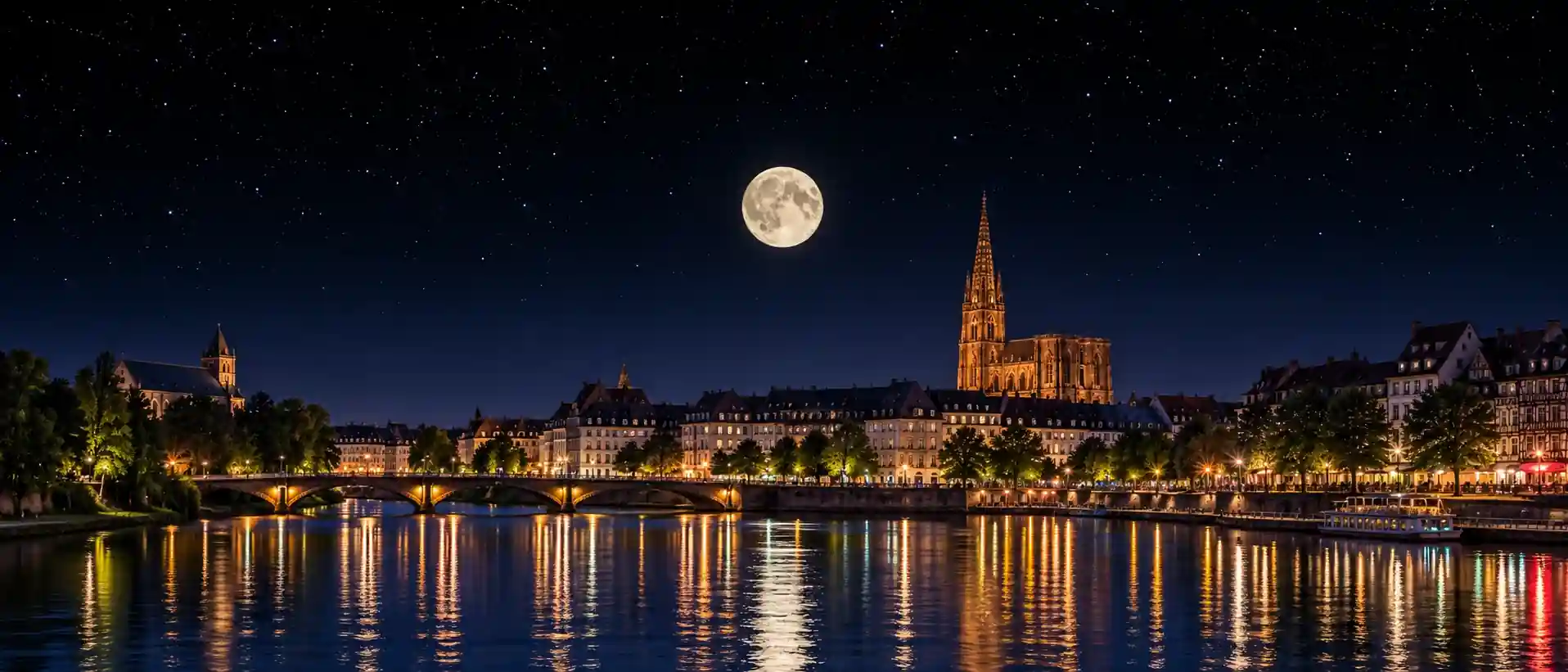
☽ Best Places to View the Moon in Strasbourg, France
Strasbourg sits at roughly 48.58°N on the Ill River near the German border in Alsace, the eighth-largest city in France with around 294,000 residents. Its historic centre, the Grande Île, was one of the first entire city centres to be inscribed as a UNESCO World Heritage Site, and the city doubles as one of the European Union's political capitals, hosting the European Parliament. Between a Gothic cathedral that was once the highest building in the Christian world, a canal-laced medieval quarter, and a 17th-century dam with one of the city's best free views, Strasbourg gives an unusually layered set of places to watch the moon.
Strasbourg Cathedral (Notre-Dame)
A Gothic cathedral of pink Vosges sandstone, its single 142-metre spire completed in 1439 and remaining the highest building in the Christian world for more than four centuries. Inside, the famous astronomical clock, rebuilt in the 19th century, draws crowds each day for its 12:30 procession of the apostles, and a platform 66 metres up, reached by 330 steps, gives a panoramic view over the city's rooftops.
Barrage Vauban & Ponts Couverts
A 17th-century dam designed under the military engineer Vauban with Jacques Tarade, its rooftop terrace open to the public free of charge since 1996 and considered one of the city's best free viewpoints. From the top, the canal-woven Petite France district, the medieval towers of the Ponts Couverts, and the cathedral spire beyond all line up in a single, often-photographed view, especially striking once the lights come on at night — check current seasonal hours before an evening visit.
Petite France
Strasbourg's most picturesque historic quarter, its half-timbered houses and small canals once home to tanners, millers, and fishermen. It's a good option for an evening walk with plenty of architectural texture close to the Barrage Vauban.
Grande Île (Old Town)
The historic centre formed by the main channel of the Ill River and its branches, recognized by UNESCO as a World Heritage Site in 1988, one of the first entire city centres to receive that designation. It's an easy, walkable base for an evening out.
Parc de l'Orangerie
Strasbourg's largest park, popular for picnics and quiet walks, and home to a small population of storks, a traditional symbol of good luck in Alsace. Its open lawns give a calmer, greener option than the busier historic centre.
European Parliament & the European Quarter
The seat of the European Parliament, along with the separate institutions of the Council of Europe and the European Court of Human Rights, all located in Strasbourg's European Quarter on the Ill's bank. The Parliament is open to visitors free of charge six days a week throughout the year; outside the 12 annual plenary sessions, individual self-guided visits need no reservation, while attending a session from the gallery requires advance registration and is subject to limited capacity.
◉ Best Times for Moon Photography
📷 Quick Photography Tips
Strasbourg runs on Central European Time (UTC+1), shifting to Central European Summer Time (UTC+2) for daylight saving time, from the last Sunday in March to the last Sunday in October.
For the moon phase in any other city worldwide, visit our Dynamic Moon Phase Calculator for instant lunar data tailored to wherever you are.
The moon phase today in Strasbourg, France is shown in detail above — complete with exact illumination percentage, moonrise/set times, and the best viewpoints to see it. For the moon phase today in any other city or location worldwide, visit our Dynamic Moon Phase Calculator on the home page.
◐ While Actually There
Strasbourg's cathedral spent more than four centuries as the highest building in the Christian world, and standing beneath it today, that history still feels plausible — a single spire rising 142 metres above a city that otherwise keeps a modest, human scale. Climb the 330 steps to its platform and the whole logic of the Grande Île becomes clear: a compact historic island, easy to cross on foot, built around the Ill's main channel.
The Barrage Vauban does something similar from ground level. A 17th-century military engineer's dam, its terrace opened to the public in 1996, gives one of the best photographs in the city for free — Petite France's canals, the medieval Ponts Couverts, and the cathedral spire all lined up in one frame, lit up after dark. It's a fitting complement to the European Quarter across town, where an entirely different, much more modern kind of institution now shapes the continent's politics twelve weeks a year.
None of it requires much beyond checking the plenary calendar if you specifically want to attend a session. The cathedral, Petite France, the Barrage Vauban, and Parc de l'Orangerie are all straightforward for an ordinary evening without much advance planning.
"Strasbourg's cathedral spire was the highest building in the Christian world for four centuries — and its best view today still comes free, from the roof of a 17th-century dam."
✓ Your Strasbourg Moon Chase Checklist
Before You Go
- Check the moonrise time and phase on this page for each night of your stay
- Check current opening hours for the cathedral's observation platform if you want to climb it, not just view it from outside
- Check the current plenary session calendar and registration requirements if you want to attend a session at the European Parliament
- Check current seasonal opening hours for the Barrage Vauban's rooftop terrace before an evening visit
- Check the forecast for winter cold and rain depending on your travel dates
What to Bring
- Warm winter clothing for December–February — Strasbourg's inland position brings colder nights than much of France
- A tripod, useful at open spots like the Barrage Vauban's terrace and Parc de l'Orangerie
- Comfortable shoes for walking Petite France's cobblestones and climbing the cathedral's 330 steps
- A light layer for summer evenings, which stay pleasant well after sunset
- Spare camera batteries kept warm in an inner pocket during cold-weather sessions
On the Night
- Arrive 20–30 minutes before moonrise at open spots like the Barrage Vauban's terrace or Parc de l'Orangerie
- Shoot RAW and bracket exposures, especially where the illuminated cathedral spire mixes with moonlight
- Mind cobblestones and canal edges in Petite France after dark
- Confirm current transport options if visiting the European Quarter in the evening, since it sits outside the historic centre
- Watch for winter fog, which can reduce visibility in the colder months
? Strasbourg Moon Phase — Frequently Asked Questions
Q. What is the moon phase today in Strasbourg?
The moon phase today in Strasbourg is a New Moon with 0% illumination. The next full moon is in 17 days, on Oct 26. Moonrise is at 7:34 AM and moonset at 6:29 PM.
Q. Where is the best place to view the moon in Strasbourg?
The rooftop terrace of the Barrage Vauban, a 17th-century dam open to the public free of charge since 1996, is one of the best free viewpoints, with Petite France, the medieval Ponts Couverts and the cathedral spire in a single view. The cathedral's own platform, 66 metres up and reached by 330 steps, gives a panorama over the city's rooftops, and Parc de l'Orangerie, the city's largest park, offers open lawns away from the narrowest streets. Petite France and the Grande Île suit an evening walk but give little open horizon at street level.
Q. Where does the moon rise and set in Strasbourg, and how high does it climb?
At about 48.6°N, Strasbourg's moonrise and moonset points swing across the horizon each month, from roughly northeast to southeast for rising and northwest to southwest for setting, a wider swing than in southern France. A winter full moon culminates high in the south, at roughly 65° above the horizon, while a summer full moon stays low, peaking near 18°. The city sits in the flat Rhine plain, so buildings are the main horizon obstruction at street level, and elevated spots such as the cathedral platform and the Barrage Vauban terrace give cleaner sightlines. From the Barrage Vauban the cathedral spire lies roughly to the east-northeast, so on some dates a rising moon can appear beside it. Check the azimuth for your date and exact spot.
Q. Is light pollution a problem for moon observing in Strasbourg?
The moon is bright enough to observe and photograph from almost anywhere in Strasbourg, so light pollution rarely limits the lunar disc itself. It does wash out earthshine on a thin crescent and any faint sky detail. The illuminated cathedral, the Grande Île, Petite France and the Barrage Vauban all carry substantial artificial lighting, so Strasbourg is a light-polluted site rather than a dark-sky one. In December the Christmas markets add extra lighting and crowds through the historic centre.
Q. What camera settings and phases work best for moon photography in Strasbourg?
For a full moon, start with Looney 11 (f/11, ISO 100, 1/100 s) and refine using your histogram, since it is a baseline rather than a guarantee. The moon is much brighter than the illuminated cathedral and canals, so shoot RAW and bracket or blend exposures to keep both crater detail and the lit foreground. A waxing gibbous is useful for blue hour from the Barrage Vauban while the foreground is still lit, and a full moon rises around sunset. A 200–400 mm lens helps isolate the moon against the cathedral spire, with a tripod for bracketing and manual focus on the moon using magnified live view.
Q. How do cold winter nights and fog affect moon viewing in Strasbourg?
Strasbourg's inland continental position brings colder nights than much of France, and winter nights can fall below freezing, which drains camera batteries quickly. Carry spares in an inner pocket and swap them rather than waiting for one to die. Winter fog can also reduce visibility and soften lunar contrast, and damp air near the Ill can leave dew on lenses. Check local forecasts for cloud, fog and visibility before heading out, and carry a lens cloth.
Q. Can I shoot the moon at Strasbourg's viewpoints after dark?
Access varies by site. The Barrage Vauban's rooftop terrace keeps seasonal opening hours, so check current times before an evening visit. The cathedral's observation platform also has its own hours, so confirm them if you plan to climb rather than view the spire from outside. Petite France, the Grande Île and Parc de l'Orangerie are open urban spaces, though cobblestones and canal edges can be hazardous after dark. The European Quarter sits outside the historic centre, so confirm transport options for evening visits.
Q. Does this page work for cities besides Strasbourg?
This page is set up specifically for Strasbourg, France. For the moon phase in any other city or location worldwide, use the Dynamic Moon Phase Calculator on the moonphase.today home page.
✦ Explore Further
Moon Phase Today: Stuttgart
Check tonight's moon phase in Stuttgart, east of Strasbourg across the Rhine and the Black Forest.
🏔️Moon Phase Today: Zurich
See the moon over Zurich, southeast of Strasbourg across the Swiss border.
🇫🇷Moon Phase in France
Browse moon phase pages for cities across France, from Paris to Strasbourg.
🌍World Moon Phase Directory
Find the moon phase, rise and set times for cities in every region of the world.
Planetary Positions
See where the planets sit relative to the moon on the night you plan to shoot over the Grande Île.