
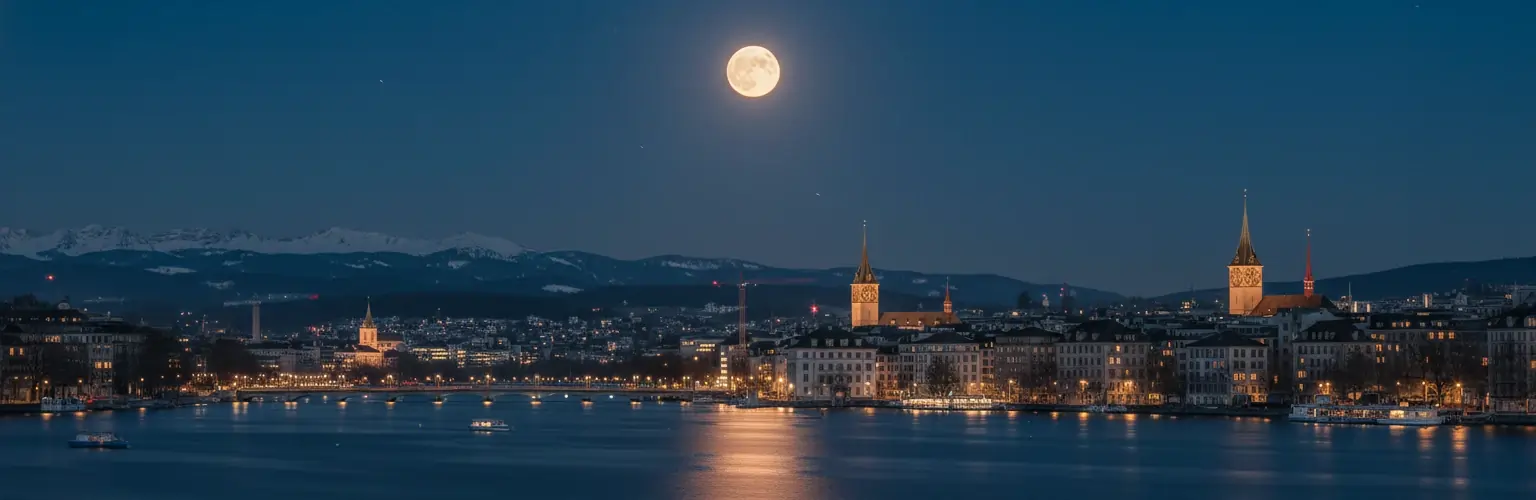
☽ Best Places to View the Moon in Zurich
Zurich is a city defined by precision and alpine drama: situated at the northern tip of Lake Zurich and split by the Limmat River. At 47° North latitude, moon photography here is an exercise in elegant composition, where the celestial body interacts with Romanesque towers, medieval rooftops, and the snow-capped Glarus Alps. Whether the moon is reflecting in the pristine lake or rising behind the iconic twin towers of the Grossmünster, Zurich offers a crispness of light that is uniquely Swiss.
Uetliberg Summit Lookout
The absolute #1 viewpoint at 871m elevation. From here, the moon rises over the entire city bowl and the Alps beyond. The 72-meter lookout tower at Uto Kulm provides a true 360° view; access requires a 2 CHF coin for the turnstile (card readers are often unreliable). Take the S10 train from Zurich HB for a 20-minute ride to the top.
Lindenhof Hill
A historic elevated park in the Old Town. This is the premier spot for framing the moon against the Romanesque twin towers of the Grossmünster. The elevation allows you to look across the Limmat River while keeping a clean horizon. It is free, open 24/7, and offers the most romantic "Old World" moonrise in the city.
Polyterrasse (ETH Zurich)
The massive university terrace acts as a rooftop platform overlooking the city center. The moon rises over the terracotta rooftops of the Niederdorf district, allowing for deep-focus shots that include both urban life and the lunar disc. Take the Polybahn funicular up for a classic experience, or walk the steep steps for a higher vantage point near the ETH main building.
Quaibrücke & Bürkliplatz
The point where the Limmat River meets Lake Zurich. This is the best spot for "horizon moonrises" where the moon appears to emerge directly from the water or the distant mountains. The wide-open southern horizon allows for stunning long-exposure reflection shots. It is highly accessible and particularly vibrant during the "blue hour."
Die Waid (Käferberg)
Located on a hill on the northern side of the city, Die Waid offers perhaps the most comprehensive panorama of the city and lake. The moon rises over the entire city bowl with the Alps as a backdrop. It is slightly farther from the center, resulting in less immediate light pollution and a more expansive, "big sky" feel—ideal for wide-angle landscape photography.
Rigiblick Terrace
Located high above the city on the Zürichberg side, the Rigiblick terrace is accessible via the Seilbahn Rigiblick (funicular). Unlike the Urania Observatory, this is an open-air public terrace that is perfect for tripods. It offers a unique angle looking southwest, catching the moon as it tracks across the lake towards the Albis mountain range.
◉ Best Times for Moon Photography
📷 Quick Photography Tips
Zurich operates on CET (UTC+1) in winter and CEST (UTC+2) during summer. Clocks shift forward the last Sunday in March and back the last Sunday in October. Because Zurich is at 47°N, the moon's path varies significantly by season—apps like Stellarium are essential for catching the moon at its peak elevation.
The moon phase today in Zurich is shown in detail above. For the moon phase today in any other city worldwide, visit our Dynamic Moon Phase Calculator on the home page.
◐ What the Experience Actually Feels Like
There is a quiet, clockwork precision to a moonrise in Zurich. Standing on the Lindenhof terrace as the sky transitions from deep Swiss blue to velvet black, you watch the moon crest the ridgeline of the Zürichberg. It is a moment of architectural alignment. The moon hangs momentarily between the twin towers of the Grossmünster—the city’s great Romanesque cathedral—its light catching the ripples of the Limmat River below.
Higher up, on the summit of Uetliberg, the experience is more expansive. In the winter, the air is so sharp it feels like glass, and the moon illuminates the entire lake basin like a floodlight. You can see the dark shapes of the Alps in the distance, their glaciers reflecting the lunar light. It is a stark contrast to the summer, where the moonrise is a softer affair, often shared with locals enjoying a late glass of wine on the terrace as the twilight lingers long past 10:00 PM.
What makes Zurich truly unique is the water. Whether you are at Bürkliplatz or the Quaibrücke, the lake acts as a massive mirror. When the moon is full, the "silver path" stretches across the water toward the mountains, creating a scene that feels almost too perfectly composed to be real. It rewards the patient observer who waits for that specific minute when the architecture and the Alpine backdrop align into a single, perfect frame of Swiss elegance.
"The moon hangs momentarily between the Romanesque twin towers of the Grossmünster, its light catching the ripples of the Limmat River below. It feels like a moment of perfect Swiss alignment."
✓ Your Zurich Moon Chase Checklist
Before You Go
- Check the moonrise time and phase on this page — timing is critical for spire alignments
- Carry a 2 CHF coin if you plan to climb the Uetliberg tower; the turnstile does not always accept cards
- Verify the S10 train schedule; the last train down is late, but missing it means a long walk
- Look at the cloud forecast for the Glarus Alps; clear mountain horizons make for the best background shots
- Download PhotoPills or Stellarium to track the exact lunar arc across the Romanesque skyline
What to Bring
- A telephoto lens (200mm+) for "compressing" the moon against the Romanesque church towers
- Extra layers — even in summer, the breeze off Lake Zurich or the elevation at Uetliberg can be chilly
- A remote shutter release or use your camera's internal timer to prevent shake during long exposures
- Spare battery — long exposures and cold Swiss nights drain power faster than standard shooting
- Sturdy shoes for the cobblestones of the Old Town or the gravel paths at the top of Uetliberg
On the Night
- Arrive at Lindenhof or Polyterrasse 30 minutes early to secure a prime spot at the stone railing
- Focus manually on the moon’s edge; autofocus often fails in high-contrast night conditions
- Bracket your exposures — take one for the bright moon and one for the darker stone architecture
- Watch for boat traffic on the lake at Bürkliplatz; their lights create beautiful trails in long exposures
- Stay for the "Blue Hour"—the 20 minutes after sunset when the sky is indigo but the moon is already bright
Moon Phase Today Zurich

Weather in Zurich
Loading Zurich conditions...