
Moon Phase Palermo
On Saturday, October 10, 2026, the moon in Palermo is a New Moon with 0% illumination. Moon age: 0.4 days.
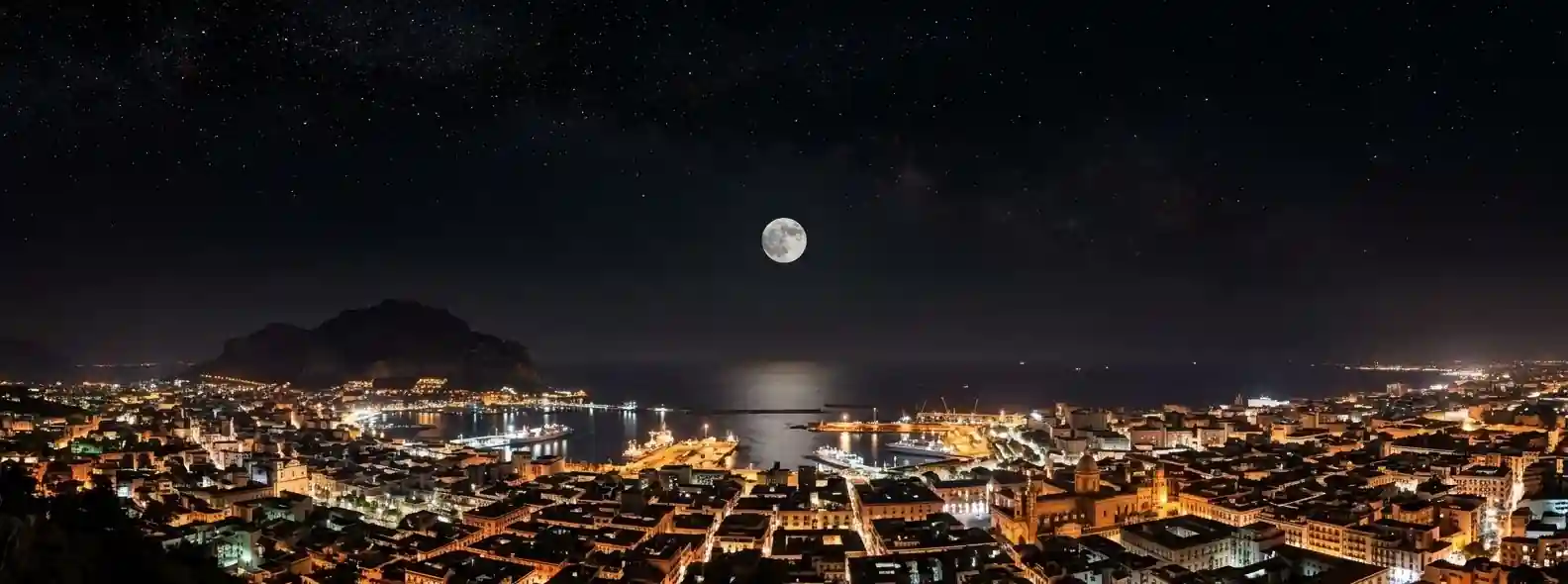
☽ Best Places to View the Moon in Palermo, Italy
Palermo lies on the Tyrrhenian Sea in the Conca d'Oro plain. The municipality covers about 160.59 km² and includes coastal lowlands and mountainous terrain to the north, with higher ground rising toward Monte Pellegrino and the surrounding reserves.
Monte Pellegrino – 609 m Summit within 1,050 ha Reserve
The regional source confirms the reserve and Monte Pellegrino's 609 m summit. The protected area is the 1,050-hectare Riserva Naturale Orientata Monte Pellegrino, which includes Monte Pellegrino and the Real Tenuta della Favorita. At Monte Pellegrino, the 609 m summit lies within the 1,050-hectare reserve and provides panoramic views over Palermo and the Tyrrhenian coastline. Access is toward Monte Pellegrino and the Santuario, but not every viewpoint is conveniently reached by public transport. Check trail, road and reserve conditions for evening visits.
Parco della Favorita – 400 ha Park at Foot of Monte Pellegrino
Large park at the foot of Monte Pellegrino, listed as 400 hectares according to the Palermo municipality tourism page. The 400-hectare park is distinct from the 1,050-hectare reserve that includes the Real Tenuta della Favorita. Municipal page confirms free admission but does not provide regular opening hours. Check current notices for temporary restrictions or closures, as the city periodically issues event-specific notices.
Foro Italico – Seafront from Cala to Villa Giulia, Always Open
Seafront promenade on Palermo's seafront, extending from Cala to Villa Giulia according to the city's tourism portal. Provides open views of the Mediterranean Sea along the waterfront. Currently listed as always open per municipal tourism page, making it a reliable option for Moon-over-water compositions.
Mondello & Capo Gallo – Northwest Coast
Official tourism material places Mondello northwest of central Palermo between Monte Pellegrino and Monte Gallo. Capo Gallo lies to the north and northwest of Mondello and the reserve occupies the Monte Gallo and Capo Gallo headland. Coastal area with open Tyrrhenian Sea horizons suitable for Moonrise photography.
Villa Giulia & Orto Botanico – Gardens Near Seafront
Historic gardens near the seafront. The Orto Botanico borders Villa Giulia and is near the seafront per official sources. Provides green space with sky pockets within the central coastal area. Check current garden hours; not an unrestricted nighttime site.
La Cala & Foro Umberto – Harbour Waterfront
Harbour area at La Cala with waterfront promenade toward Foro Umberto. Provides views of the port and bay suitable for Moon-over-harbour compositions with city lights as foreground. Urban waterfront location with artificial lighting.
◉ Best Times for Moon Photography in Palermo
📷 Quick Tips for Palermo
🕐 Timezone
Central European Time (CET) — UTC+1, Central European Summer Time (CEST) — UTC+2 during daylight-saving. Europe/Rome zone.
📍 Geography Note
Horizons: Coastal city in Conca d'Oro plain on Tyrrhenian Sea. Higher terrain rises toward Monte Pellegrino. Foro Italico extends from Cala to Villa Giulia on the seafront and is listed as always open. Mondello lies northwest of central Palermo between Monte Pellegrino and Monte Gallo; Capo Gallo lies to the north and northwest of Mondello and the reserve occupies the Monte Gallo and Capo Gallo headland.
Elevation & Area: Municipality about 160.59 km² per Palermo's 2024 statistical page. The 1,050-hectare figure refers to Riserva Naturale Orientata Monte Pellegrino, which includes Monte Pellegrino and the Real Tenuta della Favorita, with Monte Pellegrino summit at 609 m. The 400-hectare figure refers to Parco della Favorita at the foot of Monte Pellegrino per municipality tourism page. Villa Giulia and Orto Botanico near seafront, Orto Botanico borders Villa Giulia.
Access: Foro Italico always open per municipal tourism page. Parco della Favorita 400 ha free admission but check current notices for temporary restrictions or closures; municipal page does not list regular opening hours. Monte Pellegrino 609 m summit lies within 1,050-hectare reserve; access toward Santuario exists but does not imply every viewpoint is conveniently reached by bus; not an unrestricted nighttime location. Check current notices.
The moon phase today in Palermo is shown above. For moon phase today anywhere else, visit the calculator on the home page.
◐ What It Feels Like
At Monte Pellegrino, the 609 m summit lies within the 1,050-hectare Riserva Naturale Orientata Monte Pellegrino that includes Monte Pellegrino and the Real Tenuta della Favorita and provides panoramic views over Palermo and the Tyrrhenian coastline.
In Parco della Favorita, 400 hectares at the foot of Monte Pellegrino provides large parkland with free admission, with current notices to be checked for temporary restrictions or closures rather than a standing holiday rule.
At Foro Italico, the seafront promenade extending from Cala to Villa Giulia is listed as always open and provides open views of the Mediterranean Sea suitable for Moon-over-water compositions.
"609-metre summit within 1,050-hectare reserve that includes Real Tenuta della Favorita, 400-hectare park at its foot, and seafront from Cala to Villa Giulia always open."
✓ Checklist for Lunar Observers
Before You Go
- Check moonrise/moonset azimuth — use exact observing location to determine whether Moon will align with sea, city or hill foregrounds around Conca d'Oro
- Check forecasts for cloud, haze, humidity and visibility; Monte Pellegrino summit is 609 m
- Confirm access — Monte Pellegrino 609 m summit lies within 1,050-hectare Riserva Naturale Orientata including Real Tenuta della Favorita, Favorita 400 ha free admission check notices for temporary restrictions, Foro Italico from Cala to Villa Giulia always open, municipality about 160.59 km²
What to Bring
- Telephoto and wide for hill and sea foregrounds
- Tripod for landscape and bracketing — useful for multi-exposure, close Moon can be handheld
- Lens cloth for dust, dew or condensation
- Light jacket for changing evening temperatures and coastal breezes
On the Night
- Manual focus on lunar limb — focus on Moon itself preferable when possible
- Bracket for disc vs. foreground — difficult to retain both in single exposure
- Stay on designated paths and observe posted access rules — Favorita check current notices for temporary restrictions or closures; Monte Pellegrino reserve not unrestricted nighttime location; Foro Italico always open
- Coastal esplanades provide open horizons as urban locations with substantial artificial lighting, useful for Moon-over-water rather than dark-sky observing
? Palermo Moon Phase — Frequently Asked Questions
Q. What is the moon phase today in Palermo?
The moon phase today in Palermo is a New Moon with 0% illumination. The next full moon is in 16 days, on Oct 26. Moonrise is at 6:58 AM and moonset at 6:22 PM.
Q. Where is the best place to view the moon in Palermo?
Monte Pellegrino's 609 m summit, inside the 1,050-hectare Riserva Naturale Orientata Monte Pellegrino, gives the highest panorama over Palermo and the Tyrrhenian coastline, but it is not an unrestricted nighttime site, so check trail, road and reserve conditions before an evening visit. Foro Italico, the seafront promenade running from Cala to Villa Giulia, is listed as always open and gives open Mediterranean views. Mondello and the Capo Gallo headland to the northwest offer open Tyrrhenian horizons, while La Cala harbour, Villa Giulia and the Orto Botanico are central options with city lighting or garden hours to check.
Q. Where does the moon rise and set in Palermo, and how high does it climb?
At about 38°N, Palermo's moon climbs higher than it does in northern Europe: a winter full moon culminates roughly 75–80° above the southern horizon, while a summer full moon peaks near 25°. Over each month, moonrise swings between roughly northeast and southeast, and moonset between northwest and southwest. Because Palermo sits on the Tyrrhenian coast with mountains rising around the Conca d'Oro plain, the sea horizon and the hills can each change when the moon first appears, so check the rise azimuth from your exact observing spot.
Q. What can I observe on the moon with a small telescope from Palermo?
Palermo's lower latitude keeps the moon higher in the sky than in northern Europe for the same phase, which means looking through less air, and the southern highlands around Tycho and Clavius are better placed when the moon is high in the south. Crater relief is sharpest along the terminator, so waxing crescent to gibbous evenings and waning phases before dawn reward the eye, while a full moon is best for bright ray systems and albedo contrasts. Seafront sites carry heavy artificial lighting, which rarely matters for the moon itself but does wash out earthshine on a thin crescent.
Q. What camera settings and phases work best for moon photography in Palermo?
For a full moon, start with Looney 11 (f/11, ISO 100, 1/100 s) and refine using your histogram, since it is a baseline rather than a guarantee. The moon is far brighter than a dark foreground, so shoot RAW and bracket or blend exposures to keep crater detail and the sea or city lights. A waxing gibbous gives you a lit foreground during blue hour at Foro Italico or Parco della Favorita, a full moon rises around sunset, and a 200–400 mm lens isolates the moon against Monte Pellegrino or the harbour. Use a tripod for bracketing and manual focus on the lunar limb with magnified live view.
Q. How do haze, humidity and dust affect moon viewing in Palermo?
As a coastal city, Palermo can see humidity, haze and condensation that soften lunar contrast, and Saharan dust events, which sometimes reach Sicily, can dim and redden the moon. Check local forecasts for cloud, haze and visibility before heading out, and carry a lens cloth for dew on the seafront. Conditions can change quickly, so treat any clear-sky plan as provisional.
Q. Does this page work for cities besides Palermo?
This page is set up specifically for Palermo, Italy. For the moon phase in any other city or location worldwide, use the Dynamic Moon Phase Calculator on the moonphase.today home page.
✦ Explore Further
Moon Phase Today: Naples
Check tonight's moon phase in Naples, across the Tyrrhenian Sea on Italy's mainland coast.
📍Moon Phase Today: Rome
See the moon over Rome, the nearest big-city page north of Sicily on the mainland.
🇮🇹Moon Phase in Italy
Browse moon phase pages for cities across Italy, from Venice to Palermo.
🌍World Moon Phase Directory
Find the moon phase, rise and set times for cities in every region of the world.
NASA Moon Phase & Libration Gallery
NASA's Scientific Visualization Studio's daily renders of the moon's exact phase, libration, and orientation, straight from official mission data.