
Moon Phase Today Naples
On Saturday, October 10, 2026, the moon in Naples is a New Moon with 0% illumination. Moon age: 28.9 days.
☽ Best Places to View the Moon in Naples
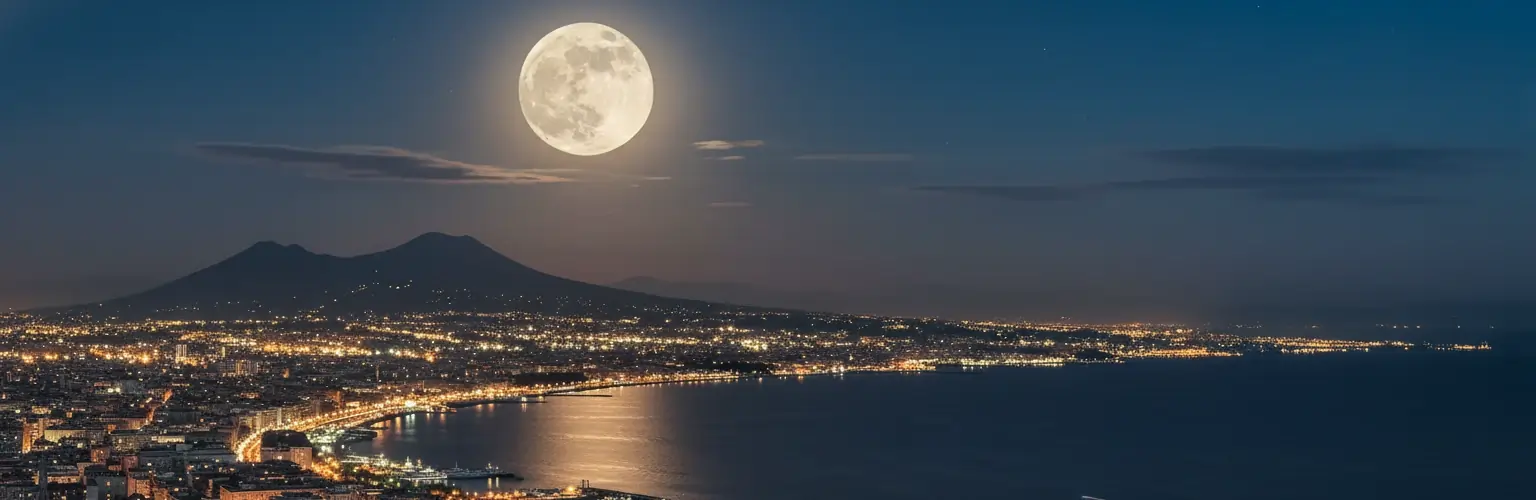
Naples is built like a grand amphitheater carved from volcanic tuff, rising from the Tyrrhenian Sea toward the heights of Vomero and Posillipo. Situated at 40.8° North latitude, the city's geography provides a dramatic eastern horizon dominated by the brooding silhouette of Mount Vesuvius (1,281m). Moon photography here is a study in contrast: the moon rises over the volcano's crater, tracks across the dense urban sprawl of the historic center, and reflects in the deep blue waters of the Gulf. Whether it is the humid summer haze creating the legendary Luna Rossa (Red Moon) or the crisp winter Tramontana clearing the air, Naples offers a celestial theater unlike any other in Italy.
Via Petrarca & Via Orazio
The absolute #1 viewpoint for the "Naples Postcard" shot. From the overlook near the church of Sant'Antonio a Posillipo (known locally for the "13 ramps"), the moon rises directly over Vesuvius. The winding road provides dynamic leading lines for long-exposure car trails that guide the eye toward the volcano and the harbor below. Accessible via the 140 bus.
Castel Sant'Elmo (Vomero)
Towering above the Belvedere di San Martino, Castel Sant'Elmo is the highest urban point in central Naples. While the interior has closing hours, the star-shaped fortress walls provide an unmatched 360° view. From this "highest urban balcony," the moon rises over the Apennine Mountains, illuminating the church domes and the straight line of Spaccanapoli slicing through the historic core.
Castel dell'Ovo & Lungomare
The pedestrianized seafront promenade. Standing on the stone causeway leading to the "Egg Castle," you look East toward Vesuvius. The moon's reflection on the Gulf is stunning here, silhouetting fishing boats and the seaside hotels. The castle walls provide a dark foreground that isolates the lunar light from the city's glare behind you. Free and open late.
Pedamentina Staircase
Just below the Vomero ridge, this ancient stone staircase begins its steep descent. This spot offers a grittier, more authentic Neapolitan angle where the moon rise is framed by rustic walls and laundry lines. It provides a tighter, more intimate composition than the wide-open squares above, capturing the moon as it clears the rooftops of the Spanish Quarter.
Molo San Vincenzo (Public Walk)
Following recent restorations, this historic pier extending into the harbor is now a spectacular public walk. At roughly 2.5km out (total loop ~4-5km), it puts you "in the center of the sea." You can look back at the city skyline with the moon rising behind Vesuvius from a waterline perspective. Confirm current ANM/Port access hours as they are seasonally updated.
Parco Virgiliano (Posillipo)
Located on the extreme tip of the promontory, this park offers a double horizon. Watch the moon rise over the Bay of Naples and Vesuvius, or turn toward the west to see it set over the volcanic islands of Procida and Ischia. It is significantly darker than center-city spots, offering the best sky clarity for wide-angle night landscapes.
◉ Best Times for Moon Photography
📷 Quick Photography Tips
Naples operates on CET (UTC+1) in winter and CEST (UTC+2) in summer. Funicular Note: The Funicolare Centrale generally runs until 00:30, though the Mergellina and Montesanto lines often close earlier (around 22:00). Check current ANM schedules before heading to Vomero. Stellarium handles the elevation offset for Vesuvius automatically.
The moon phase today in Naples is shown in detail above. For the moon phase today in any other city worldwide, visit our Dynamic Moon Phase Calculator on the home page.
◐ What the Experience Actually Feels Like
There is a specific, chaotic romanticism to moonrise in Naples. Standing on the Posillipo hill as the sun dips behind the Phlegraean Fields, you hear the distant chorus of the city—the hum of scooters, the bells of a hundred churches, and the rhythmic lap of the sea. The air often smells of salt and wood-fired ovens. When the moon finally breaks the horizon over Mount Vesuvius, the entire Bay of Naples seems to fall into a sudden, temporary hush.
In the summer, the experience is defined by the Luna Rossa. The heat haze trapped against the volcanic slopes turns the rising moon into a massive, blood-orange orb. It creates a "silver path" across the water that points directly to the Castel dell'Ovo. It is a sight so iconic it has become a staple of local folklore, a moment where the city's intense energy feels perfectly balanced by the celestial stillness above.
From the heights of Castel Sant'Elmo, the perspective is more architectural. You watch the moon climb above a sea of terracotta roofs and Baroque domes, its light catching the laundry lines and the narrow, straight slice of Spaccanapoli. It is a reminder that Naples is a city of layers—Greek, Roman, Bourbon, and modern—all unified under a silver lunar light that makes the crumbling tuff stone glow like velvet.
"The heat haze turns the rising moon into a massive, blood-orange orb that looks impossibly large. It makes the crumbling tuff stone glow like velvet."
✓ Your Naples Moon Chase Checklist
Before You Go
- Check moonrise times on this page — Mount Vesuvius will delay the visual rise for those in the western districts
- Verify Funicular times; missing the last ride from Vomero means a very long walk down the Pedamentina steps
- Download PhotoPills to track the moon's path relative to the Vesuvius crater or the Castel dell'Ovo towers
- Check the humidity forecast; high humidity in summer is the key to the orange "Luna Rossa" effect
- Prepare for a walk: The Molo San Vincenzo is a 4-5km round trip; ensure you have enough water and time
What to Bring
- A telephoto lens (200mm-400mm) to "compress" the moon against the Vesuvius ridgeline from Posillipo
- A wide-angle lens if shooting from Sant'Elmo to capture the full sweep of the city light-grid
- Extra layers — even in summer, the wind off the Bay can make the Posillipo viewpoints surprisingly cool at night
- A remote shutter release or use a timer to prevent tripod shake in the windy coastal spots
- Spare camera batteries — long night sessions and the coastal damp can drain power quickly
- Comfortable shoes for the steep, uneven cobblestones of the Vomero and Posillipo staircases
On the Night
- Arrive at your viewpoint 45 minutes early; the "Blue Hour" glow over Vesuvius is often as beautiful as the rise itself
- Focus manually on the moon's edge; the flickering lights of the city bowl can confuse autofocus systems
- Bracket your exposures — take one for the bright lunar disc and one for the darker shadows of the volcano
- Stay in populated areas like Via Petrarca or the main Lungomare; safety in numbers is advised for late-night gear use
- Stay 20 minutes after moonrise; the composition sharpens as the moon clears the lower horizon haze
? Naples Moon Phase — Frequently Asked Questions
Q. What is the moon phase today in Naples?
The moon phase today in Naples is a New Moon with 0% illumination. The next full moon is in 17 days, on Oct 26. Moonrise is at 6:57 AM and moonset at 6:14 PM.
Q. Where is the best place to view the moon in Naples?
Via Petrarca and Via Orazio on Posillipo offer the classic "Naples Postcard" shot, with the moon rising directly over Vesuvius from the overlook near Sant'Antonio a Posillipo. Castel Sant'Elmo in Vomero is the highest urban point in central Naples with an unmatched 360° view, Castel dell'Ovo and the Lungomare give a seafront perspective with the moon's reflection on the Gulf, and the Pedamentina Staircase, Molo San Vincenzo pier, or Parco Virgiliano add further intimate or panoramic alternatives.
Q. Do I need to plan around funicular schedules for Vomero?
Yes — the Funicolare Centrale generally runs until 00:30, but the Mergellina and Montesanto lines often close earlier, around 22:00. It's worth checking current ANM schedules before heading up to Castel Sant'Elmo or the Vomero ridge, since missing the last ride down means a long walk via the Pedamentina steps.
Q. Does Naples observe daylight saving time?
Yes. Naples operates on CET (UTC+1) in winter and switches to CEST (UTC+2) during summer, in line with the rest of Italy and the European Union. The times shown on this page are already adjusted for whichever period applies today.
Q. What's the best time of year for moon photography in Naples?
June through August brings "Luna Rossa" season, when summer humidity trapped against the volcanic slopes turns the rising moon a deep, blood-orange color. January and February offer the opposite reward — sharper air and, on rare occasions, a snow-capped Vesuvius aligning with the moon. Whatever the season, the moon is often invisible for its first two degrees above the horizon due to sea mist, so don't pack up early if it doesn't appear on schedule.
Q. Does this page work for cities besides Naples?
This page is set up specifically for Naples, Italy. For the moon phase in any other city or location worldwide, use the Dynamic Moon Phase Calculator on the moonphase.today home page.
✦ Explore Further
World Moon Phase Directory
Browse the moon phase today in hundreds of other cities and locations around the world.
📍Moon Phase Today: Pisa
Check tonight's moon phase and best viewpoints in Pisa, elsewhere on the Italian peninsula.
📐Looney 11 Exposure Calculator
Dial in the exact f-stop, ISO, and shutter speed for a full moon — the same rule used in our Vesuvius tips.
🌆Blue Hour Calculator
Find tonight's exact blue hour window to time your Vesuvius moonrise shots.
NASA Moon Phase & Libration Gallery
NASA's Scientific Visualization Studio's daily renders of the moon's exact phase, libration, and orientation, straight from official mission data.