
Moon Phase Okayama
On Saturday, October 10, 2026, the moon in Okayama is a New Moon with 0% illumination. Moon age: 29.0 days.
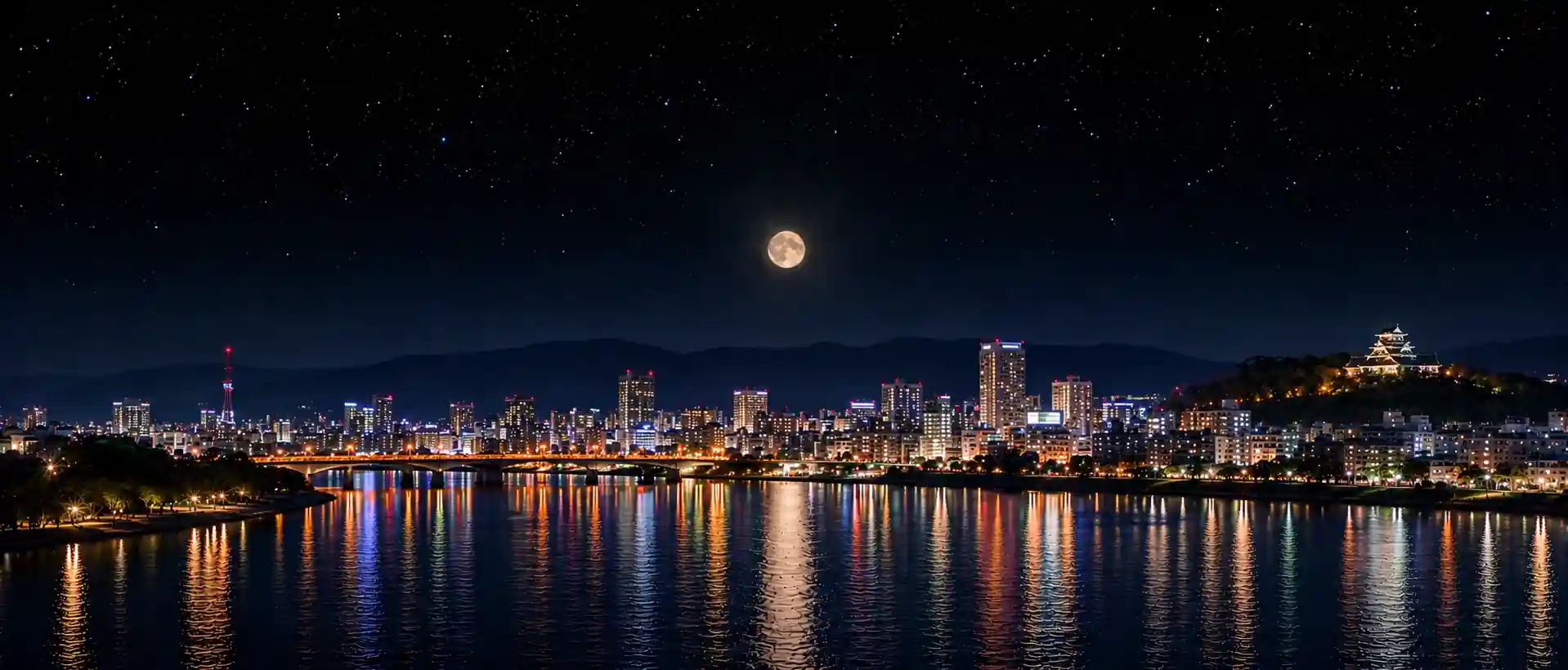
☽ Best Places to View the Moon in Okayama, Japan
Okayama sits at roughly 34.65°N in the Chūgoku region of western Honshu, the capital of Okayama Prefecture with around 705,000 residents. The city is closely associated with the Japanese folk tale Momotarō, "the Peach Boy," and is built around the Asahi River, with one of Japan's Three Great Gardens beside it and a striking black castle across the water. Between the garden, the castle, and a wooded hill within the city itself, Okayama gives a genuinely calm, historic set of places to watch the moon.
Korakuen Garden
Construction began in 1687, and Korakuen reached its initial completion around 1700 beside the Asahi River. It is one of Japan's Three Great Gardens, alongside Kenrokuen in Kanazawa and Kairakuen in Mito. Its 13 hectares of ponds, lawns, and teahouses are about a 25-minute walk from Okayama Station, with red-crowned cranes kept in one corner of the grounds — though normal hours close before nightfall (7:30–18:00 in the warmer months, 8:00–17:00 in winter), aside from occasional seasonal illumination events.
Okayama Castle ("Crow Castle")
A striking black-walled castle, one of Japan's distinctive black-walled keeps, sitting across the river from Korakuen. The original dates to the 16th century, but the current keep is a concrete reconstruction built in 1966 after the wartime original was destroyed; a museum inside gives access to elevated views from the tower, with the design incorporating views toward the river and garden.
Asahi River
The river running between the castle and Korakuen, its open, low banks giving a straightforward view over the water without needing to enter either the garden or the castle grounds.
Kibitsu Shrine
A historic shrine closely associated with the Momotarō legend — Kibitsuhiko-no-Mikoto is traditionally identified as the model for Momotarō, and the shrine's traditions preserve the story of the demon Ura. Published hours run 6:00 to 18:00, so it's best treated as a daytime or early-evening visit rather than a late-night stop.
Momotaro Street & Central Okayama
The main street leading from Okayama Station, decorated with statues and references to the city's Peach Boy mascot. It's Okayama's easiest option for an ordinary evening, with plenty of streetlife around the station area.
Misaoyama Hill
A wooded hill and satoyama landscape within the city, rising to around 130–170 metres, with walking and hiking trails and views over Okayama toward Kojima Bay and the surrounding mountains. It's one of the quieter options in the city for a tree-covered evening away from the river district.
◉ Best Times for Moon Photography
📷 Quick Photography Tips
Okayama runs on Japan Standard Time (UTC+9) year-round — Japan does not observe daylight saving time, so the offset from UTC stays the same in every season.
For the moon phase in any other city worldwide, visit our Dynamic Moon Phase Calculator for instant lunar data tailored to wherever you are.
The moon phase today in Okayama, Japan is shown in detail above — complete with exact illumination percentage, moonrise/set times, and the best viewpoints to see it. For the moon phase today in any other city or location worldwide, visit our Dynamic Moon Phase Calculator on the home page.
◐ While Actually There
Okayama's centre is really one composition split across a river. Korakuen was built beside the castle as the daimyō's own garden, and its design deliberately incorporates views both within its own grounds and out toward the surrounding landscape — the black castle walls across the water are part of that view, even though the garden itself closes its gates well before dark most nights.
The Momotarō legend runs quietly underneath all of it. Kibitsu Shrine, whose traditions are closely tied to the story, sits a little apart from the river district, and the city has folded the tale into its own identity everywhere from Momotaro Street's statues to its mascot branding — a legend doing double duty as civic personality.
The riverbank, the castle exterior, and Momotaro Street are all straightforward for an ordinary evening, while Misaoyama's hillside offers a genuinely different, quieter option if you'd rather trade the castle view for some trees — just check current trail conditions, since not every path is well suited to walking after dark.
"Korakuen was built to look out at the castle across the water — and even after the garden gates close for the night, that view across the river is still there."
✓ Your Okayama Moon Chase Checklist
Before You Go
- Check the moonrise time and phase on this page for each night of your stay
- Check current opening hours for Okayama Castle's museum and keep if you want to go inside, not just view the illuminated exterior
- Check Korakuen Garden's current hours and any seasonal evening illumination events before planning a visit — normal hours close well before nightfall
- Check current access and trail conditions at Misaoyama Hill before an evening walk
- Check the forecast for typhoon activity if visiting in late summer or early autumn
What to Bring
- A light jacket for winter evenings — generally mild rather than severely cold, though a warm layer is still worth having
- A tripod, useful at open spots along the Asahi River
- Comfortable shoes for a walk through Misaoyama's trails
- A light rain layer, especially during the June rainy season
- Spare camera batteries and a lens cloth for humid summer evenings
On the Night
- Arrive 20–30 minutes before moonrise at open spots like the Asahi riverbank
- Shoot RAW and bracket exposures, especially where the illuminated castle mixes with moonlight
- Stick to familiar or well-marked routes at Misaoyama Hill after dark
- Confirm your return transport if visiting Kibitsu Shrine or Misaoyama in the evening, since both sit a little further from the centre
- Watch for typhoon-related weather changes if visiting between summer and early autumn
? Okayama Moon Phase — Frequently Asked Questions
Q. What is the moon phase today in Okayama?
The moon phase today in Okayama is a New Moon with 0% illumination. The next full moon is in 17 days, on Oct 26. Moonrise is at 5:33 AM and moonset at 5:14 PM.
Q. Where is the best place to view the moon in Okayama?
The Asahi River banks give an open, low sightline over the water without needing to enter Korakuen Garden or the castle grounds, and the black-walled Okayama Castle across the river makes a distinctive foreground when its evening illumination is operating. Misaoyama Hill, a wooded hill of roughly 130–170 m within the city, looks over Okayama toward Kojima Bay and the surrounding mountains, though unfamiliar trails are best avoided after dark. Korakuen normally closes before nightfall, at 18:00 in the warmer months and 17:00 in winter, except during occasional seasonal illumination events, so check current hours before planning around it.
Q. Where does the moon rise and set in Okayama, and how high does it climb?
At about 34.7°N, the Moon's rising point swings between roughly east-northeast (azimuth near 54°) and east-southeast (near 126°) over a month at the widest point of its 18.6-year declination cycle, with the setting point mirrored in the west. That cycle peaked with the major lunar standstill of 2024–2025, so the monthly swing is still near its widest. At this latitude the Moon always culminates in the south, ranging from about 27° above the southern horizon at its southern extreme to about 84° at its northern extreme. A December full moon typically culminates near 79°, while a June full moon peaks near 32°.
Q. How do Okayama's climate and seasons affect moon viewing?
Okayama is nicknamed the "Land of Sunshine" and has the most rain-free days, with less than 1 mm of precipitation, of any city in Japan, so its odds of an observable evening are better than in much of the country. Rain-free is not the same as cloud-free, though, so still check the cloud forecast. Summers are warm and humid, with a rainy season in June and typhoon risk from summer into early autumn. Winters are generally mild, with freezing temperatures possible on colder nights.
Q. Is light pollution a problem for moon observing in Okayama?
The Moon is bright enough to observe and photograph from almost anywhere in the city, so light pollution rarely limits the lunar disc itself. With around 705,000 residents, Okayama does wash out earthshine on a thin crescent and faint stars or planets near the Moon. Open riverbanks and an elevated position such as Misaoyama Hill keep nearby buildings out of your foreground and help with a clear horizon. Okayama remains a light-polluted urban location rather than a dark-sky site.
Q. What camera settings and phases work best for moon photography in Okayama?
For a full moon, start with Looney 11 (f/11, ISO 100, 1/100 s) and refine using your histogram, since it is a baseline rather than a guarantee. Okayama Castle's black walls reflect little light, so bracket exposures where the illuminated castle shares the frame with the Moon, and shoot RAW to blend them. A waxing gibbous is useful for blue hour while the foreground is still lit, and a full moon rises around sunset. In humid summers, let your gear acclimate after leaving an air-conditioned space and carry a cloth to wipe condensation from the lens.
Q. What is tsukimi, and when can I see the traditional harvest moon in Okayama?
Tsukimi is Japan's tradition of moon viewing in autumn. Chūshū no Meigetsu, the mid-autumn moon, falls on the 15th night of the eighth month of the traditional lunisolar calendar, which lands between early September and early October, and it is not always exactly full. Around the September equinox the Moon rises only a little later each night, so several evenings in a row offer a bright moon rising near sunset. Check the moonrise time and phase on this page for the nights you plan to go.
Q. Does this page work for cities besides Okayama?
This page is set up specifically for Okayama, Japan. For the moon phase in any other city or location worldwide, use the Dynamic Moon Phase Calculator on the moonphase.today home page.
✦ Explore Further
Moon Phase Today: Himeji
Check tonight's moon phase in Himeji, about 70 km east of Okayama.
🏙️Moon Phase Today: Hiroshima
See the moon over Hiroshima, roughly 140 km west of Okayama along the Seto Inland Sea.
🇯🇵Moon Phase in Japan
Browse moon phase pages for cities across Japan, from Sapporo to Kagoshima.
🌍World Moon Phase Directory
Find the moon phase, rise and set times for cities in every region of the world.
Lunar Terminator Line Calculator
Explore the lunar terminator, the line where crater and mountain relief looks most dramatic.