
Moon Phase Himeji
On Saturday, October 10, 2026, the moon in Himeji is a New Moon with 0% illumination. Moon age: 29.1 days.
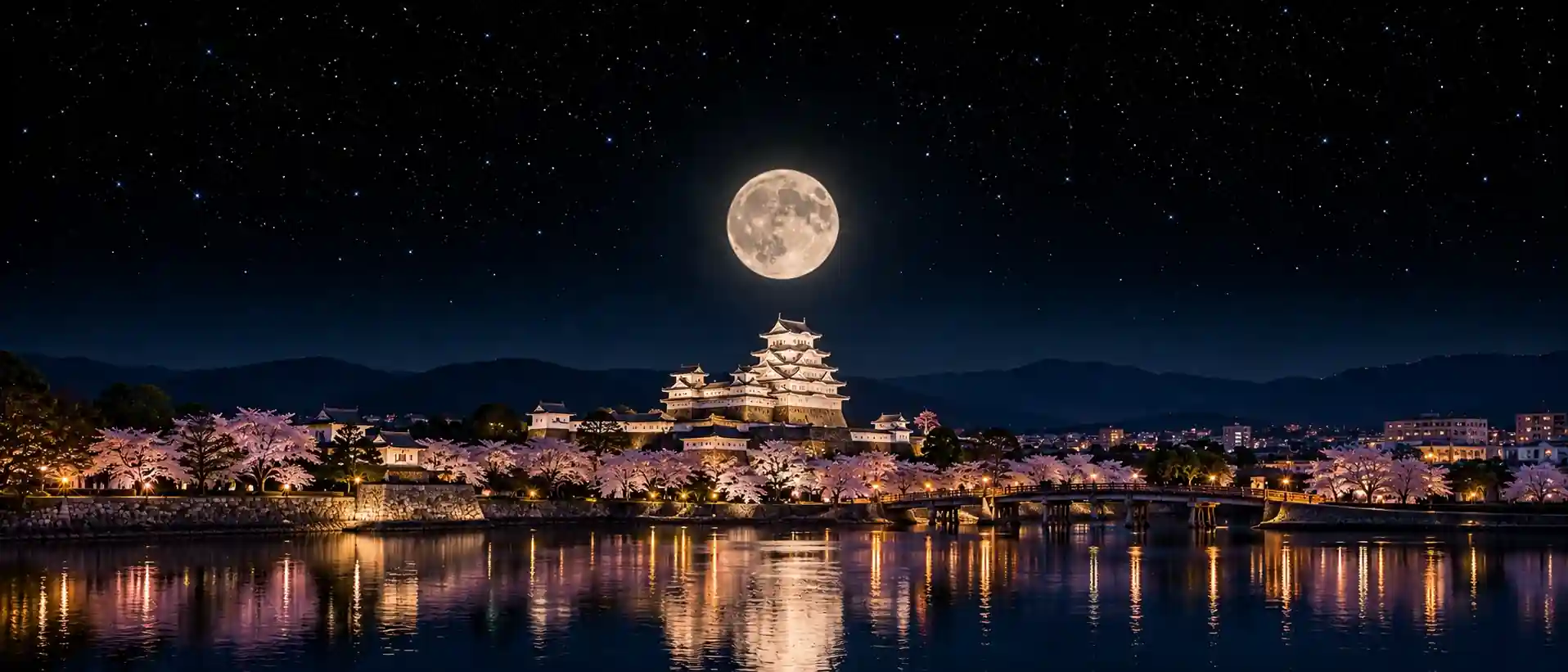
☽ Best Places to View the Moon in Himeji, Japan
Himeji sits at roughly 34.83°N in Hyogo Prefecture in the Kansai region, a castle town west of Kobe with an estimated population of around 516,000 residents as of Sept. 1, 2026 (530,495 in the 2020 census). First fortified in 1333 and expanded under Toyotomi Hideyoshi, Ikeda Terumasa, Honda Tadamasa and others, its present overall form was completed in 1617/1618. Himeji Castle — the White Heron — was inscribed as a UNESCO World Heritage Site in 1993, among Japan's first World Heritage properties, and UNESCO describes it as the finest surviving example of early-17th-century Japanese castle architecture. Between a world-famous castle illuminated at night and a sacred mountain monastery above the city, Himeji gives a classic set of places for tsukimi, moon viewing.
Himeji Castle – Sannomaru Square
One of Japan's best-preserved historic castles and UNESCO's finest surviving example of early-17th-century Japanese castle architecture. Sannomaru Square and the Otemae approach provide broad, head-on sightlines toward the main keep that work well for moon-over-castle compositions — check moonrise azimuth for your date, as direction changes through the month. Castle grounds have closing times and illumination varies.
Mount Shosha – Engyo-ji Temple
A sacred mountain north of the city crowned by Engyo-ji, founded in 966, and identified by official Himeji tourism as a filming location for The Last Samurai. Reached by ropeway and mountain paths, its precincts offer panoramic views over Himeji and the Harima Plain. Ropeway and temple have published hours and last departures — plan as a sunset into early-evening trip.
Shirotopia Memorial Park
Developed from the site of the 1989 event commemorating the city's 100th anniversary, per Himeji City. Broad open park directly north of the moat with lawns, an outdoor stage and castle views — openness varies by exact position and vegetation. Public park with no ticket required for ordinary park use, but the outdoor stage area is currently subject to construction restrictions through the planned March 31, 2027 period.
Tegarayama Central Park
Himeji officially includes Tegarayama among its designated Himeji Castle viewpoints. The central park contains multiple facilities including an aquarium and hillside park areas, with terraces looking north toward the castle and city center. Good higher vantage for moonrise over the urban grid — check facility hours if you plan to use observatory or gardens.
Mount Hiromine – Hiromine Shrine
A forested hill north of the castle with Hiromine Shrine along its approach, a historic shrine with long steps and clearings. Provides a quieter evening walk with moonlight filtering through trees and forested foregrounds. Check current shrine and trail access.
Koko-en Garden & Senhime Tenmangu
Koko-en is a nine-garden complex beside the castle moat, built on the former West Residence site where archaeological excavations confirmed former samurai residences. Its ponds can reflect the moon and illuminated keep. Senhime Shrine is located northwest of Himeji Castle on Otokoyama and is associated with Princess Senhime. Evening access is event-based rather than nightly — e.g. autumn nighttime illumination scheduled November–December 2026 and Sakura Night Viewing as a specific March/April event — so check current light-up schedule.
◉ Best Times for Moon Photography
📷 Quick Photography Tips
Himeji runs on Japan Standard Time (UTC+9) year-round, with no daylight saving time. Sunsets are early in winter and late in summer.
For the moon phase in any other city worldwide, visit our Dynamic Moon Phase Calculator for instant lunar data tailored to wherever you are.
The moon phase today in Himeji, Japan is shown in detail above — complete with exact illumination percentage, moonrise/set times, and the best viewpoints to see it. For the moon phase today in any other city or location worldwide, visit our Dynamic Moon Phase Calculator on the home page.
◐ While Actually There
Himeji's identity is inseparable from its castle. Unlike many Japanese castles lost to war or fire, Himeji-jō survived intact, its white plastered walls and layered roofs earning it the name Shirasagi-jō, the White Heron Castle. Himeji City describes Otemae-dori as a symbolic road from the station with a direct castle view — the broad avenue leading straight to the main gate provides the head-on sightline that works well for moonrise compositions when azimuth aligns.
Mount Shosha tells an older story. Engyo-ji, founded in 966 by Shoku Shonin, has been a place of mountain religious practice for over a thousand years, its wooden halls set among tall trees. In autumn, the mountain's foliage frames the city below, and in the Japanese tradition of tsukimi, the full moon seen from a temple veranda has long been a moment for contemplation.
Himeji Castle's interior has closing times and Koko-en Garden is primarily a daytime garden with event-based evening illuminations such as the autumn illumination and Sakura Night Viewing, so both are best planned around current schedules. Tegarayama and Shirotopia, by contrast, are straightforward for an ordinary evening without much advance planning, aside from the current construction restrictions around Shirotopia's outdoor stage through March 31, 2027.
"The site has been fortified since 1333, but the castle you see today is principally early 17th-century — completed in 1617/1618 and inscribed among Japan's first World Heritage properties in 1993."
✓ Your Himeji Moon Chase Checklist
Before You Go
- Check the moonrise time, azimuth and phase on this page for each night of your stay
- Check current opening hours and illumination schedule for Himeji Castle and Koko-en Garden — evening access is event-based, e.g. Nov–Dec 2026 autumn illumination
- Check current ropeway hours and last departure for Mount Shosha if you plan Engyo-ji for sunset
- Check forecast — winter is generally drier although actual visibility depends on weather, summer is hot and humid with wetter conditions
- Check Shirotopia Memorial Park notices — outdoor stage area under construction restrictions through planned March 31, 2027
What to Bring
- A tripod for Sannomaru Square and Tegarayama terraces where you will want longer exposures
- Comfortable shoes for the climb at Shosha and Hiromine Shrine
- A warm layer for winter evenings on exposed hilltops — freezing uncommon but wind can make it feel colder
- A cloth for humidity in summer and a lens hood for castle illumination glare
On the Night
- Arrive 20–30 minutes before moonrise at open spots like Sannomaru Square or Shirotopia Park
- Shoot RAW and bracket — the illuminated castle is much brighter than surrounding sky early in the evening
- Use Otemae-dori for a centered composition toward the main keep when azimuth aligns
- Confirm your return ropeway time if you stay on Mount Shosha after sunset
? Moon Phase Himeji — Frequently Asked Questions
Q. What is the moon phase today in Himeji?
The moon phase today in Himeji is a New Moon with 0% illumination. The next full moon is in 17 days, on Oct 26. Moonrise is at 5:29 AM and moonset at 5:11 PM.
Q. Where is the best place to view the moon in Himeji?
Himeji Castle's Sannomaru Square and the Otemae-dori approach give broad, head-on views of the illuminated keep, though the castle grounds close in the evening. Mount Shosha, a sacred mountain north of the city crowned by Engyo-ji temple, offers panoramic views over the city and the Harima Plain, reached by ropeway with published last departures. Tegarayama Central Park is an official Himeji Castle viewpoint with terraces looking north across the city, and Shirotopia Memorial Park gives open lawns north of the moat. Koko-en Garden's ponds can reflect the moon and the illuminated keep, but evening access there is event-based rather than nightly.
Q. Where does the moon rise and set in Himeji, and can I frame it behind the castle?
At about 35°N, Himeji's moon rises between roughly northeast and southeast and sets between roughly northwest and southwest over each month, depending on its declination. A winter full moon culminates high, at roughly 80° above the southern horizon, while a summer full moon stays low, peaking at about 25–30°. From Sannomaru Square and Otemae-dori, the keep lies to the north, and from Himeji's latitude the moon never rises or sets in that direction, so a moon-over-keep composition needs a viewpoint east or west of the castle instead. Check the rise or set azimuth for your date and viewpoint with a planning app before committing to a location.
Q. How do Himeji's seasons affect moon viewing?
Winter in Harima is generally drier, with January and February precipitation normals of about 36.9 mm and 48.6 mm compared with about 160.4 mm in June and 184.3 mm in July, though actual visibility still depends on the weather. Summer is hot and humid with wetter conditions, with mean temperatures around 26.4°C in July and 27.8°C in August. A warm layer is useful on exposed hilltops in winter, since freezing is uncommon but wind can make it feel colder, and a cloth helps with humidity in summer.
Q. What camera settings work best for moon photography in Himeji?
For a bright full moon, start with the Looney 11 rule (f/11, ISO 100, 1/100 s) and adjust from your histogram. The illuminated castle is much brighter than the surrounding sky early in the evening, so shoot RAW and bracket exposures to keep both the keep and the moon's detail, and use a lens hood to manage illumination glare. A tripod helps at open, elevated spots such as Tegarayama and Mount Shosha, which are more exposed to wind than the streets near the station, and Koko-en's ponds offer reflections on light-up evenings.
Q. Is Himeji a good place for tsukimi, Japan's moon-viewing tradition?
Yes. Tsukimi is Japan's autumn moon-viewing custom, and Himeji offers classic settings for it. Engyo-ji on Mount Shosha, founded in 966, has been a place of mountain religious practice for over a thousand years, and the full moon seen from a temple veranda there has long been a moment for contemplation. Plan it as a sunset into early-evening trip, since the ropeway and temple have published hours and last departures.
Q. Can I photograph the moon at Himeji Castle and Koko-en after dark?
Access varies by site. Himeji Castle's grounds have closing times and illumination varies, so check current hours before planning around the keep. Koko-en's evening access is event-based rather than nightly, such as the autumn nighttime illumination scheduled for November–December 2026 and Sakura Night Viewing in March or April, so check the current light-up schedule. The Mount Shosha ropeway has a last departure, so confirm your return time if you stay after sunset. Shirotopia Memorial Park's outdoor stage area is under construction restrictions through the planned date of 31 March 2027, and current shrine and trail access should be checked at Mount Hiromine.
Q. Does this page work for cities besides Himeji?
This page is set up specifically for Himeji, Japan. For the moon phase in any other city or location worldwide, use the Dynamic Moon Phase Calculator on the moonphase.today home page.
✦ Explore Further
Moon Phase Today: Kobe
Check tonight's moon phase in Kobe, east of Himeji in the same Hyogo Prefecture.
📍Moon Phase Today: Okayama
See the moon over Okayama, west of Himeji across the prefectural border.
🇯🇵Moon Phase in Japan
Browse moon phase pages for cities across Japan, from Sapporo to Kagoshima.
🌍World Moon Phase Directory
Find the moon phase, rise and set times for cities in every region of the world.
NASA Moon Phase & Libration Gallery
NASA's Scientific Visualization Studio's daily renders of the moon's exact phase, libration, and orientation, straight from official mission data.