
Moon Phase Nagoya
On Saturday, October 10, 2026, the moon in Nagoya is a New Moon with 0% illumination. Moon age: 29.0 days.
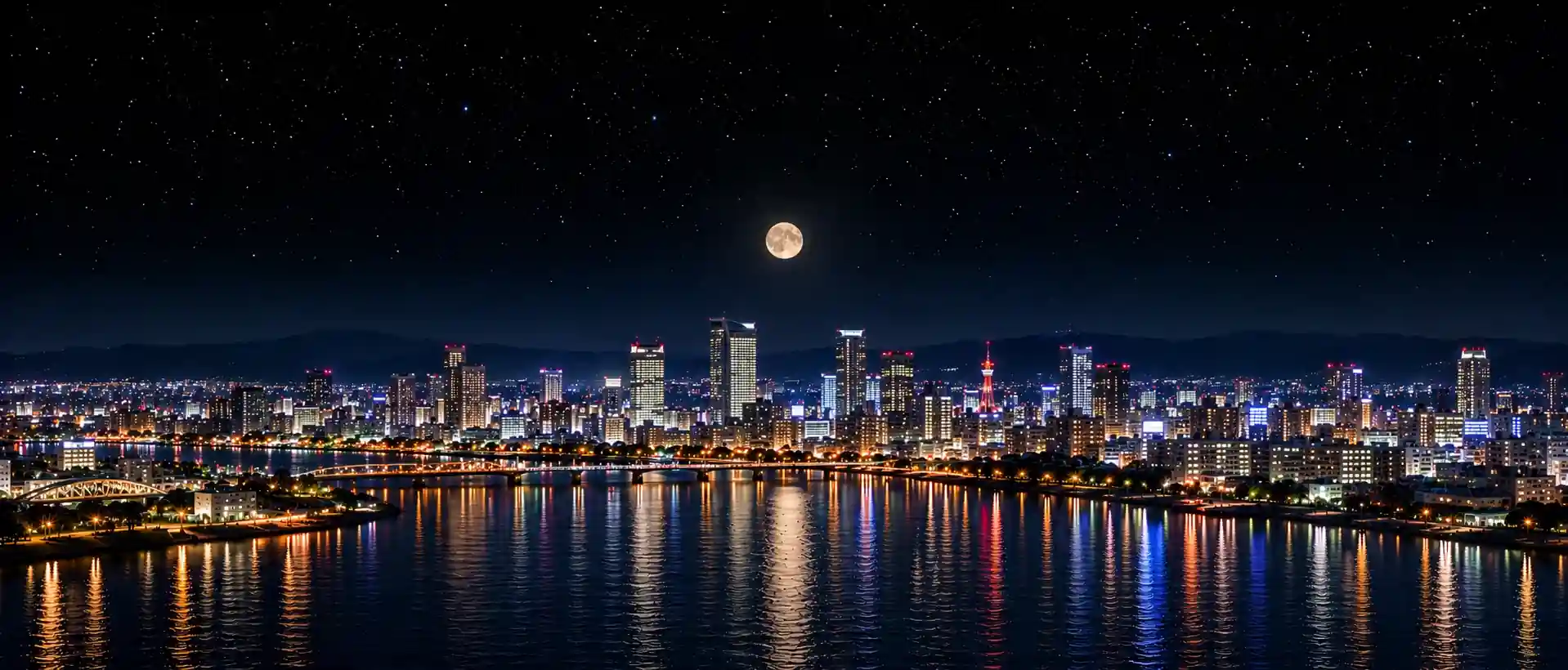
☽ Best Places to View the Moon in Nagoya, Japan
Nagoya sits at roughly 35.18°N on the Pacific coast of central Honshu, one of Japan's largest cities, with around 2.35 million residents and the centre of the Chūkyō metropolitan area. Few cities on this site put astronomy quite so literally at their centre: a giant silver sphere in the middle of downtown Sakae houses what's billed as the world's largest planetarium dome by diameter. Between that, a historic castle, a shrine forest more than a thousand years in the making, and a scattering of observation towers, Nagoya gives plenty of ways to look up.
Nagoya City Science Museum & "Brother Earth" Planetarium
A science museum in central Sakae built around a distinctive silver globe, home to "Brother Earth," a 35-metre planetarium dome opened in March 2011 and recognized as the world's largest by diameter. Its shows run on a set daily schedule rather than staying open into the evening, so it's best treated as a daytime stop before heading out to watch the real sky later.
Nagoya TV Tower (Mirai Tower)
Japan's oldest TV tower, standing 180 metres in Hisaya-Ōdori Park in the heart of Sakae, with observation areas at 90 and 100 metres. Terrestrial broadcasting from the tower ended after the switch to digital broadcasting in 2011, but it remains illuminated nightly, with evening hours that extend later in summer, giving a central, elevated view over the city without leaving downtown.
Higashiyama Sky Tower & Zoo/Botanical Gardens
An observation tower rising from a hill in the Higashiyama Zoo and Botanical Gardens on Nagoya's eastern side, with a deck roughly 100 metres above ground and recognized as one of Japan's "100 Best Night Views." It's open until 9:30pm (last entry 9pm) and closed Mondays, giving one of the wider, less built-up views over the city.
Nagoya Castle
A historic castle completed in 1615 under Tokugawa Ieyasu, with golden shachihoko ornaments on its roofline. Its main keep cannot currently be entered due to a long-term timber reconstruction project, and the surrounding park keeps daytime hours rather than staying open at night — a good sunset or early-evening stop rather than a late one.
Atsuta Shrine
One of Japan's most significant Shinto shrines, marking its 1,900th anniversary and set within the forested Atsuta Grove. The shrine grounds are open 24 hours and free to enter (the Treasure Hall keeps separate, limited hours), making this one of the few tree-covered spots in the city available for a late walk under the moon.
Oasis 21, Sakae
A glass-and-water rooftop structure nicknamed the "Water's Spaceship," right in the middle of Sakae, free to visit and with evening operating hours (though individual areas within it keep their own schedules). It's Nagoya's easiest option for an ordinary night out, with the moon rising over the illuminated structure and surrounding skyline.
◉ Best Times for Moon Photography
📷 Quick Photography Tips
Nagoya runs on Japan Standard Time (UTC+9) year-round — Japan does not observe daylight saving time, so the offset from UTC stays the same in every season.
For the moon phase in any other city worldwide, visit our Dynamic Moon Phase Calculator for instant lunar data tailored to wherever you are.
The moon phase today in Nagoya, Japan is shown in detail above — complete with exact illumination percentage, moonrise/set times, and the best viewpoints to see it. For the moon phase today in any other city or location worldwide, visit our Dynamic Moon Phase Calculator on the home page.
◐ While Actually There
Nagoya's relationship with the sky is unusually literal for a city its size. Walk through Sakae and the Science Museum's silver globe is hard to miss — inside it, "Brother Earth" projects the night sky onto the world's largest planetarium dome by diameter, a fitting centrepiece for a city that also keeps two illuminated observation towers within a short subway ride of each other.
The real moon, when you go looking for it, has a different set of options. Higashiyama Sky Tower and the Nagoya TV Tower both put you above the rooftops, one from a hill on the city's eastern side, the other right in the middle of downtown. Atsuta Shrine offers something different again: no height at all, just genuinely old forested grounds, open around the clock, that feel a world away from the towers a few kilometres north.
None of it asks much planning beyond a few opening hours. Nagoya Castle's grounds and the planetarium operate on daytime schedules, while the towers and Oasis 21 extend into the evening and Atsuta Shrine's grounds remain open around the clock — any of them makes a reasonable base for an evening built around the moon.
"Nagoya put the world's largest planetarium dome in the middle of its downtown — and left a 1,900-year-old shrine grove open all night just a few stops away."
✓ Your Nagoya Moon Chase Checklist
Before You Go
- Check the moonrise time and phase on this page for each night of your stay
- Check current planetarium showtimes at the Science Museum if you want to combine a show with your visit — it isn't open into the evening
- Check Nagoya Castle's current hours and reconstruction status, since the main keep cannot currently be entered
- Confirm Higashiyama Sky Tower's current closing day and last entry time before planning an evening around it
- Check the forecast for typhoon activity if visiting in late summer or early autumn
What to Bring
- A warm layer for winter evenings — generally cool rather than severely cold, though temperatures can approach freezing
- A tripod, useful at open, elevated spots like Higashiyama Sky Tower
- Comfortable shoes for the walk through Atsuta Shrine's grounds
- A light rain layer, especially during the June rainy season
- Spare camera batteries and a lens cloth for humid summer evenings
On the Night
- Arrive 20–30 minutes before moonrise at open spots like Oasis 21 or Atsuta Shrine's grounds
- Confirm last entry times at Higashiyama Sky Tower or the TV Tower before planning a visit around moonrise
- Shoot RAW and bracket exposures, especially where illuminated towers or the castle mix with moonlight
- Mind wind at exposed, elevated spots, particularly in winter
- Watch for typhoon-related weather changes if visiting between summer and early autumn
? Nagoya Moon Phase — Frequently Asked Questions
Q. What is the moon phase today in Nagoya?
The moon phase today in Nagoya is a New Moon with 0% illumination. The next full moon is in 17 days, on Oct 26. Moonrise is at 5:20 AM and moonset at 5:03 PM.
Q. Where is the best place to view the moon in Nagoya?
Higashiyama Sky Tower, an observation tower rising from a hill in the Higashiyama Zoo and Botanical Gardens on the city's eastern side, has a deck roughly 100 metres above ground and is recognised as one of Japan's "100 Best Night Views". Nagoya TV Tower in Hisaya-Ōdori Park, 180 metres tall with observation areas at 90 and 100 metres, is illuminated nightly and gives a central elevated view over Sakae. Oasis 21, the glass-and-water rooftop structure in Sakae, is the easiest option for an ordinary night out, and Atsuta Shrine's forested grounds, open 24 hours, are one of the few tree-covered spots in the city for a late walk under the moon.
Q. Where does the moon rise and set in Nagoya, and how high does it climb?
At about 35°N, Nagoya's moon rises between roughly northeast and southeast and sets between roughly northwest and southwest over each month, depending on its declination. A winter full moon culminates high, at roughly 80° above the southern horizon, while a summer full moon stays low, peaking at about 25–30°. Elevated spots such as Higashiyama Sky Tower and Nagoya TV Tower put you above the rooftops for a clearer horizon, and where the moon lines up with a tower or the castle depends on the date and your position.
Q. Can I see the night sky in a planetarium in Nagoya?
Yes. The Nagoya City Science Museum in central Sakae is built around a distinctive silver globe and houses "Brother Earth", a 35-metre planetarium dome opened in March 2011 and recognised as the world's largest by diameter. Its shows run on a set daily schedule rather than into the evening, so treat it as a daytime stop and check current showtimes before you go, then head out to watch the real sky later.
Q. How do Nagoya's seasons and typhoons affect moon viewing?
Winter is generally drier, with cool nights that can approach freezing, while June brings a rainy season and summer evenings are warm and humid, with typhoon risk from summer into early autumn. Check the forecast for typhoon activity if visiting in late summer or early autumn, and remember that humidity can fog lenses if you come from an air-conditioned space, so carry a cloth and let gear acclimate. Elevated, exposed spots are windier than the streets of Sakae, particularly in winter.
Q. What camera settings work best for moon photography in Nagoya?
For a bright full moon, start with the Looney 11 rule (f/11, ISO 100, 1/100 s) and adjust from your histogram. The moon is much brighter than a night-time foreground, so shoot RAW and bracket exposures, especially where illuminated towers or the castle mix with moonlight. A tripod helps at open, elevated spots such as Higashiyama Sky Tower, and Nagoya Castle's grounds close in the evening, so plan around sunset rather than a late moonrise if you want the castle in frame.
Q. Can I photograph the moon in Nagoya after dark?
Access varies by site. Higashiyama Sky Tower is open until 9:30 pm with last entry at 9 pm and is closed on Mondays. Nagoya TV Tower remains illuminated nightly, with evening hours that extend later in summer, and Oasis 21 has evening operating hours, though individual areas within it keep their own schedules. Atsuta Shrine's grounds are open 24 hours and free to enter, while the Treasure Hall keeps limited hours. Nagoya Castle's grounds keep daytime hours and its main keep cannot currently be entered due to a long-term timber reconstruction project.
Q. Does this page work for cities besides Nagoya?
This page is set up specifically for Nagoya, Japan. For the moon phase in any other city or location worldwide, use the Dynamic Moon Phase Calculator on the moonphase.today home page.
✦ Explore Further
Moon Phase Today: Hamamatsu
Check tonight's moon phase in Hamamatsu, east of Nagoya along the Pacific coast.
⛩️Moon Phase Today: Kyoto
See the moon over Kyoto, west of Nagoya in the Kansai region.
🇯🇵Moon Phase in Japan
Browse moon phase pages for cities across Japan, from Sapporo to Kagoshima.
🌍World Moon Phase Directory
Find the moon phase, rise and set times for cities in every region of the world.
NASA Moon Phase & Libration Gallery
NASA's Scientific Visualization Studio's daily renders of the moon's exact phase, libration, and orientation, straight from official mission data.