
Moon Phase Today Kyoto
On Saturday, October 10, 2026, the moon in Kyoto is a New Moon with 0% illumination. Moon age: 28.9 days.
☽ Best Places to View the Moon in Kyoto
Kyoto is the historical heart of Tsukimi (moon viewing) in Japan. The city sits in a basin ringed by mountains on three sides, and the moon often rises over the Higashiyama range when viewed from central Kyoto. Unlike most modern cities, Kyoto restricts building heights across much of its core, which keeps sightlines between the moon and its centuries-old temples largely intact. Here are the top spots.
Togetsukyo Bridge, Arashiyama
The name means "Moon Crossing Bridge," said to come from Emperor Kameyama remarking that the moon appeared to cross it while he was boating below. From the banks of the Katsura River, the moon rises over the dark silhouette of Arashiyama and can reflect on the water. Busy by day, quiet and peaceful after dark.
Daikaku-ji Temple, Osawa Pond
One of Japan's most important historic moon-viewing sites, home to Osawa Pond — one of Japan's oldest surviving artificial ponds, long associated with imperial moon viewing. The temple normally closes in the late afternoon but opens at night for Kangetsusai around the Harvest Moon (Sept/Oct), with dragon boats on the water. Outside festival dates, check current hours and entrance fees before visiting.
Yasaka Pagoda from Ninenzaka
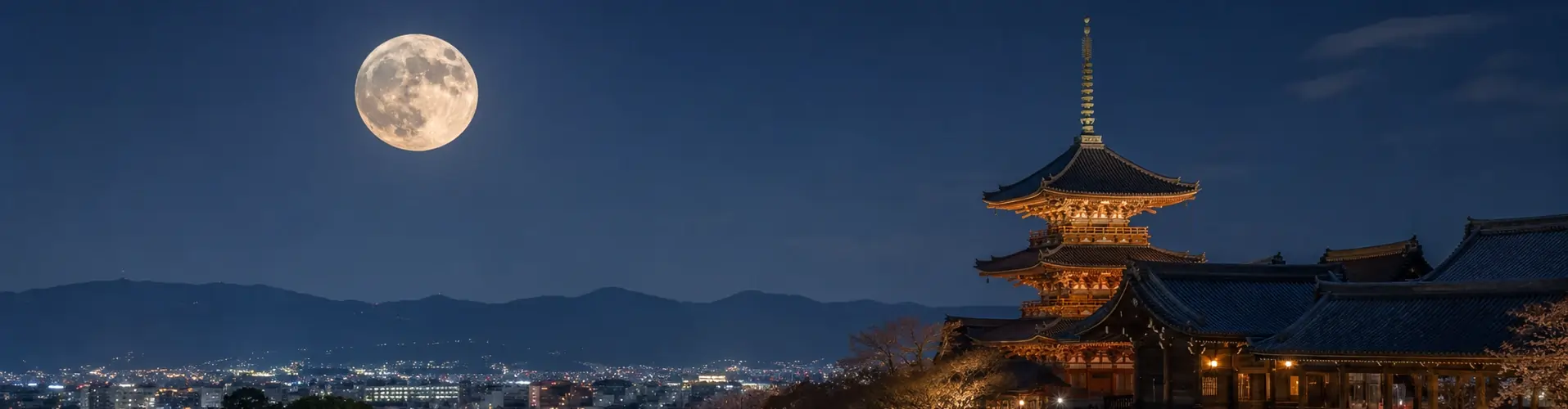
The classic postcard view: the five-story Hokan-ji pagoda rising over the preserved wooden streets of Higashiyama. On a clear night the moon can be framed rising behind the illuminated pagoda from the slopes of Ninenzaka or Sannenzaka. Go after 9 PM once the shops close and the day-trippers thin out.
Kamogawa River Banks
The "living room" of Kyoto — free, grassy riverbanks near Sanjo or Shijo Bridge where locals gather in the evening. The moon often appears above the Higashiyama skyline to the east, near Kiyomizu-dera, while the lit-up Pontocho restaurants add their own reflections to the water.
Shogunzuka Seiryuden
A relatively new observation deck at the summit of the eastern mountains, giving an eagle-eye view over the whole Kyoto basin instead of looking up at it from below — Kyoto Tower and the surrounding hills all visible at once. Reachable by taxi or a winding drive; check current evening hours before you go.
Maruyama Park
Kyoto's oldest public park, tucked beside Yasaka Shrine at the foot of Higashiyama. Best known for its spring "Light Up" cherry blossom nights, when a rising moon over the illuminated trees is one of the city's most photographed scenes — but it's a pleasant, open-sky spot for moon viewing year-round.
◉ Best Times for Moon Photography
📷 Quick Photography Tips
Timezone: Kyoto operates on Japan Standard Time (JST, UTC+9) year-round, with no daylight saving adjustment.
Direction: The moon rises in the east. From central Kyoto, that means looking toward the Higashiyama range, home to Kiyomizu-dera, Yasaka Shrine, and Ginkaku-ji.
◐ What the Experience Actually Feels Like
Tsukimi in Kyoto is a quiet activity, and the city seems built to encourage that. Along the Kamogawa in the evening, couples and small groups sit spaced out along the grassy bank, the murmur of the river underneath the occasional burst of laughter from a restaurant terrace. As the sky over Higashiyama darkens, the moon comes up slowly behind the mountain's silhouette, and conversation tends to drop rather than rise to meet it.
Up in Higashiyama itself, after the day-trippers clear out of Ninenzaka and Sannenzaka, the wooden storefronts go dark except for the paper lanterns still lit along the street. Yasaka Pagoda stands lit up above the rooftops, and on a clear night the moon rising behind it turns an already cinematic street into something that feels almost staged — even with far fewer people around, it's rarely completely empty.
Out at Arashiyama, the mood shifts to something more solitary. By day the Togetsukyo Bridge is one of the most photographed spots in Japan; by night, with the crowds gone, it's just the sound of the Katsura River and the mountain across from it. Watching the moon "cross the bridge," the way Emperor Kameyama is said to have described it centuries ago, it's easy to understand why the image stuck.
"Tsukimi isn't really about watching the moon appear — it's about the quiet that settles over the city while everyone else is doing the same thing."
✓ Your Kyoto Moon Chase Checklist
Before You Go
- Check the moonrise time on this page, and confirm it against Higashiyama's silhouette from your chosen viewpoint
- Confirm temple hours and tripod policy in advance — both change, and Daikaku-ji's night access is limited to Kangetsusai
- Download PhotoPills or Stellarium to check whether the moonrise will line up with a specific pagoda or temple on your date
- Have a taxi app (like GO) installed if you're heading to Arashiyama or Shogunzuka late — late-night public transport is more limited than in Tokyo
- Check the season — sakura light-ups and Tsukimi festival dates both shift the calendar for special night access
What to Bring
- A fast lens and the willingness to shoot handheld at high ISO, since most temple grounds don't allow tripods
- A small bean bag as a tripod substitute, for bracing a camera on a railing where that's permitted
- A compact tripod anyway, for the tripod-friendly spots along the Kamogawa and Arashiyama riverbanks
- Warm layers for winter viewing — Kyoto's basin traps cold air and nights can feel colder than the daytime suggests
- Comfortable shoes for the slopes of Ninenzaka and Sannenzaka, which are stone-paved and can be uneven in low light
On the Night
- Arrive at Higashiyama or Arashiyama after 9 PM if you want the streets quiet and free of daytime crowds
- Keep noise down near temple grounds — moon viewing is treated as a contemplative activity in Japan
- Focus manually on the moon's edge if temple lanterns or streetlights are throwing off autofocus
- Bracket exposures — one for the bright lunar disc, one for the darker temple silhouette or mountain backdrop
- Confirm your route home before you settle in — quiet, remote viewpoints can mean a longer wait for a taxi afterward
? Kyoto Moon Phase — Frequently Asked Questions
Q. What is the moon phase today in Kyoto?
The moon phase today in Kyoto is a New Moon with 0% illumination. The next full moon is in 17 days, on Oct 26. Moonrise is at 5:25 AM and moonset at 5:07 PM.
Q. Where is the best place to view the moon in Kyoto?
Togetsukyo Bridge in Arashiyama — its name means "Moon Crossing Bridge" — is a standout spot, with the moon rising over the mountain and reflecting on the Katsura River. Daikaku-ji's Osawa Pond is one of Japan's most historic moon-viewing sites, Yasaka Pagoda seen from Ninenzaka gives the classic postcard framing, and the Kamogawa riverbanks, Shogunzuka Seiryuden, or Maruyama Park add further free-and-social, eagle-eye, or open-park alternatives.
Q. Can I bring a tripod to Kyoto's temples?
Not generally — many major temples in Kyoto ban tripods and monopods, so it's worth confirming the current policy before you go and being ready to shoot handheld with a fast lens and high ISO. The Kamogawa riverbanks and Arashiyama riverside are public land where longer tripod exposures are generally fine.
Q. Does Kyoto observe daylight saving time?
No. Kyoto operates on Japan Standard Time (JST, UTC+9) year-round, with no daylight saving adjustment. The times shown on this page never need a seasonal adjustment.
Q. What's the best time of year for moon photography in Kyoto?
Tsukimi and Kangetsusai in September/October are the classic Harvest Moon window, with special night openings at temples across the city. Late March through early April brings sakura "Light Up" events, when a full moon over illuminated cherry blossoms is one of the city's most photographed scenes.
Q. Does this page work for cities besides Kyoto?
This page is set up specifically for Kyoto, Japan. For the moon phase in any other city or location worldwide, use the Dynamic Moon Phase Calculator on the moonphase.today home page.
✦ Explore Further
Moon Phase Today: Osaka
Check tonight's moon phase and best viewpoints just down the rail line in Osaka.
📷Moon Photography Guide
Camera settings, lenses, and techniques for shooting sharp, well-exposed moon shots.
📐Looney 11 Exposure Calculator
Dial in the exact f-stop, ISO, and shutter speed for a full moon — a useful starting point for handheld temple shots.
🌆Blue Hour Calculator
Find tonight's exact blue hour window to time your Togetsukyo Bridge moonrise shots.
NASA Moon Phase & Libration Gallery
NASA's Scientific Visualization Studio's daily renders of the moon's exact phase, libration, and orientation, straight from official mission data.