
L98 Imbrium Lava Flows
Among the Moon’s best-preserved lava-flow fronts, a diagonal system of overlapping lobes tracing three distinct eruptions across half a billion years — visible only when the terminator throws long shadows across this stretch of the mare.
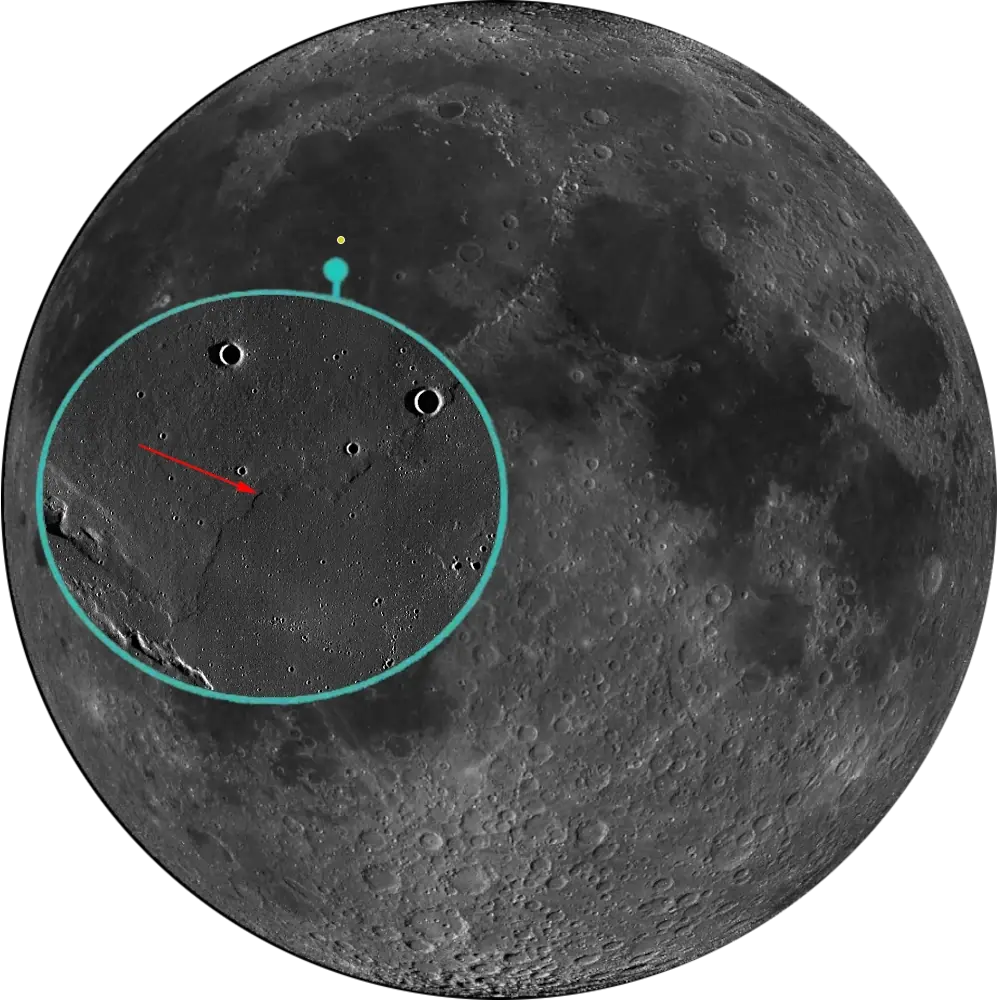
L98 Imbrium Lava Flows
Mare Imbrium · Volcanic Flow Boundaries📉 Vital Statistics
🔭 Field Notes
Most lunar maria appear relatively uniform at ordinary observing scales — whatever individual eruptions built them, many flow boundaries are difficult to distinguish. Mare Imbrium is the exception. Under a low sun angle, subtle scarps and albedo boundaries mark where one flow lobe overrode the next, running diagonally across the basin’s south-central floor toward the Euler region. Many flow margins have modest relief rather than dramatic cliffs, so timing your observation for early lunar morning or late lunar afternoon, when shadows are long, makes the difference between seeing nothing and seeing genuine stratigraphy.
- ▶ Among the Moon’s Best-Preserved Flow Fronts: Few places on the Moon let you trace individual lava-flow systems so clearly from source region toward their distant termini. Most mare surfaces are made of compound flows that merged into a uniform sheet; Imbrium’s flows kept their distinct margins, levees, and channels intact.
- ▶ Three Eruptive Phases Across Half a Billion Years: Mapping from Apollo-era photography identified three major eruptive phases, decreasing in reach each time — roughly 1,200 km, 600 km, and 400 km from their source. The oldest and longest-reaching phase is also the most extensive; the youngest is the smallest and most recent.
- ▶ A Source Toward Euler: The flows trace back toward a source region in the southwestern basin, with the vent area often discussed in connection with the Euler region; the youngest phase has been linked to a roughly 20 km long fissure vent. Much farther north, China’s Chang’e 3 lander touched down on Eratosthenian basaltic terrain associated with this same flow sequence.
📍 Nearby L100 Targets
- L14 Sinus Iridum: The dramatic bay-shaped remnant of an older impact basin roughly 410 km northwest, its arc of mountains forming the northwestern rim of Mare Imbrium itself — a much older structural feature than the lava flows sitting on the basin floor below it.
- L69 Copernicus Secondary Craters: The chains and clusters of secondary impact craters roughly 705 km south-southeast, radiating outward from Copernicus — a much younger, impact-driven overprint on terrain that in places overlies these same Imbrium lava flows.
- L78 Lambert R: A small, subdued crater roughly 215 km south-southeast, its softened rim a useful marker for how much later resurfacing and micrometeorite gardening have altered features sitting directly on these flows.
🚀 Mission Log
Target Acquisition
Aim for the south-central floor of Mare Imbrium, toward Euler
Center your view on Mare Imbrium around 32.8°N, 22.0°W, on the basin floor southeast of the crater Euler. You are not hunting a single point feature here — you’re tracing a system of flow fronts that runs diagonally across the mare toward the northwest, with the source region lying west and south of Euler. Get your bearings on Euler first, then scan outward along the flow trend rather than trying to pin one exact spot.
This one needs a low sun, not a high one
Unlike targets that reveal themselves at any illumination, these flow margins have only modest relief and stay essentially invisible under a high sun. You need early lunar morning or late lunar afternoon, when the terminator is nearby and shadows run long across the mare. Time your session for when this stretch of Imbrium is close to the terminator — that’s often the difference between seeing nothing and picking out the flow boundaries.
Go wide, not high — this is a scan, not a zoom
Drop your magnification and widen your field of view. The flow phases stretch as far as 1,200 km from their source, so a high-power eyepiece will only ever show you a small, disconnected piece of the system. Low-to-moderate power makes it easier to scan across successive flow margins and recognize the broad pattern of lobes and overlapping boundaries, rather than fixating on a single tiny detail.
From the flows to Sinus Iridum, Copernicus Secondaries, and Lambert R
Roughly 410 km northwest, Sinus Iridum (L14) is the dramatic bay-shaped remnant of an older impact basin, forming Imbrium’s northwestern rim — a much older structural feature than the lava sitting on the floor below it. About 705 km south-southeast, the Copernicus Secondary Craters (L69) are chains of impact debris radiating out from Copernicus, in places overprinting these same flows. And roughly 215 km south-southeast, Lambert R (L78) is a partially buried “ghost” crater whose subdued outline shows how later mare resurfacing can nearly erase an older impact feature.
📝 Observation Log — L98 Imbrium Lava Flows
0/4 CompleteAre the Imbrium lava flows visible tonight?
The Imbrium flow fronts run diagonally across the basin’s south-central floor near 32.8°N, 22.0°W, radiating out from a source region by the crater Euler. These flow margins have only modest relief and lose much of their contrast under a high Sun, so you’ll want early lunar morning or late lunar afternoon, when the terminator sits nearby and long shadows pick out the flow boundaries.
Check Moon Phase TodayReturn to the List
Ready to find the next target? Go back to the full map to see what else is visible tonight.
← Back to Lunar 100 Map
When to Observe the Imbrium Lava Flows
Most mare surfaces blur their eruptive history into a uniform sheet. This stretch of Mare Imbrium didn’t, but seeing that history takes the opposite approach from a target like Ina: here, low light is essential and high magnification actively works against you.
- This One Needs a Low Sun, Not a High One: The flow margins have only modest relief and stay essentially invisible under a high sun. You need early lunar morning or late lunar afternoon, when the terminator is nearby and shadows run long across the mare — often the difference between seeing nothing and picking out the flow boundaries.
- Go Wide, Not High: The flow phases stretch as far as 1,200 km from their source, so a high-power eyepiece only ever shows a small, disconnected piece of the system. Low-to-moderate power and a wide field make it easier to scan across successive flow margins and recognize the broad pattern of lobes and overlapping boundaries.
- For Orientation: Center your view around 32.8°N, 22.0°W, on the basin floor southeast of the crater Euler. You aren’t hunting a single point feature — you’re tracing a system of flow fronts running diagonally across the mare toward the northeast, with the source region lying southwest of Euler.
What to Look For
Most mare surfaces are made of compound flows that merged into a single uniform sheet, erasing their individual boundaries. Imbrium’s flows are the exception — their margins, levees, and channels stayed distinct, letting you trace individual lava-flow systems from source region toward their distant termini.
Mapping from Apollo-era photography identified three major eruptive phases, decreasing in reach each time — roughly 1,200 km, 600 km, and 400 km from their source. The oldest phase reached the farthest, while the youngest phase is the shortest and most recent of the three.
The flows trace back to a source region in the southwestern Mare Imbrium, southwest of Euler; the youngest phase has been linked to a roughly 20 km long fissure vent in that source region. Much farther northeast, China’s Chang’e 3 lander touched down on Eratosthenian basaltic terrain associated with this same flow sequence.
The Science: Reading Stratigraphy Without a Shovel
Most Lunar 100 lava features are studied as single eruptive events. This one is valuable precisely because it isn’t — it’s a layered record of three separate eruptions that stayed legible enough to map from Earth-based telescopes and orbital imagery alike.
Vital Statistics
Centered around 32.8°N, 22.0°W, on Rükl chart 10, this is a linear flow-front system rather than a point feature, with three mapped flow phases extending up to roughly 1,200 km from the source region. It’s a system of distinct, traceable mare lava-flow fronts within Mare Imbrium, Latin for “Sea of Showers.” The flows are Eratosthenian in age, erupted in three phases roughly between 3.0 ± 0.4 and 2.5 ± 0.3 billion years ago — model-based age estimates with substantial uncertainty rather than precisely dated eruptions. Its L100 distinction: among the Moon’s best-preserved and most completely traceable lava-flow systems.
A Rare Window Into Flow Stratigraphy
At ordinary observing scales, most lunar maria appear relatively uniform — whatever individual eruptions built them, the flow boundaries are difficult to distinguish. Mare Imbrium’s south-central floor is the exception: under a low sun angle, subtle scarps and albedo boundaries mark where one flow lobe overrode the next, running diagonally across the basin toward the Euler region. Because the margins have only modest relief rather than dramatic cliffs, this stratigraphy is only legible near the terminator — which is exactly what makes it valuable, since it preserves flow-by-flow structure that’s been erased almost everywhere else on the Moon.
Mission Record
Apollo 15’s metric camera photography from lunar orbit, taken under low-Sun illumination in 1971, provided the first clear views of the flow fronts, enabling early geologic mapping of the source region and flow margins. China’s Chang’e 3 lander touched down in 2013 on Eratosthenian basaltic terrain associated with the Imbrium flow sequence, providing ground-truth geologic context for the flow field’s northern extent. Lunar Reconnaissance Orbiter, in orbit since 2009, has since provided far higher-resolution imagery and topographic data, allowing researchers to refine the morphology, boundaries, and thickness estimates of individual Imbrium lava flows first recognized in Apollo-era photography.
Most Lunar 100 targets are chosen for a single moment frozen in the landscape. This one was chosen for a sequence — three eruptions, half a billion years apart, still readable as separate events if you catch them at the right angle of light.