
L78 Lambert R
An ancient crater rim drowned so completely in lava that it’s invisible under normal light — only a knife-edge sunrise or sunset teases its ghostly outline back out of the mare.
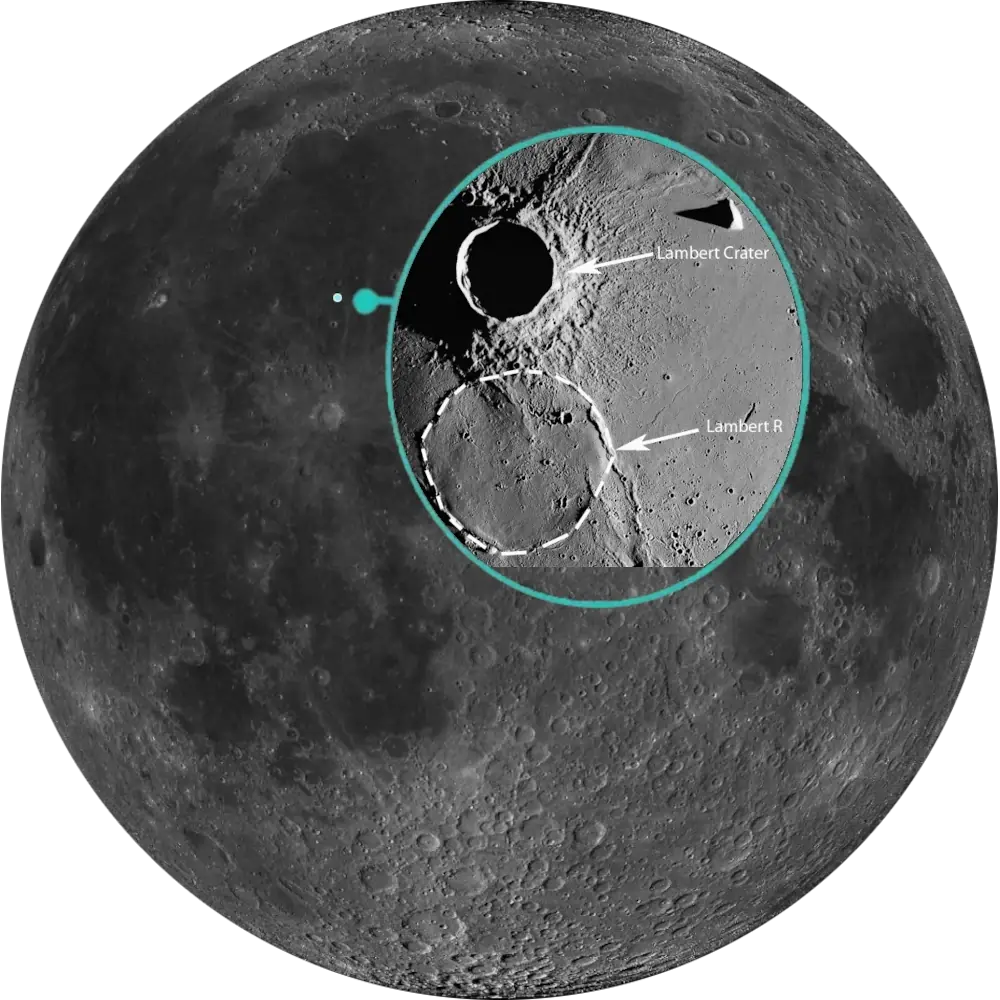
L78 Lambert R
Southern Mare Imbrium · Buried Ghost Crater📉 Vital Statistics
🔭 Field Notes
Unlike a libration-limited target, Lambert R is a lighting-limited one: it sits well inside the visible disc, just south of the sharp, easy-to-spot crater Lambert, but its rim has been so thoroughly drowned in lava that it is essentially invisible under normal illumination. Wait for a very low sun angle, near sunrise or sunset over this part of Mare Imbrium, and the ghostly ring of the buried rim resolves out of the mare as a subtle, shadow-casting wrinkle ridge — a genuine “aha” moment once it snaps into view.
- ▶ A Rim Written in Wrinkle Ridges: Lambert R isn’t a crater in the usual sense anymore — it’s an old impact structure that was almost completely buried as Mare Imbrium was flooded by mare basalt over multiple episodes of volcanic activity. As the lava cooled and compacted, it settled slightly more over the buried crater’s rim than over the surrounding flat mare, gently telegraphing the shape of the hidden rim to the surface as a subtle ring of relief.
- ▶ A Fault Line, Maybe: Close study of the buried rim under different lighting has raised the possibility of a strike-slip offset between its northern and southern halves — an idea first floated from lunar imagery analysis, though on closer inspection the apparent break may simply be early slumping of the crater’s western rim rather than true lateral faulting. It remains an open, debated detail rather than a settled one.
- ▶ A Natural Basalt Gauge: Lambert R is one of the “flooded crater” data points used in published research estimating mare basalt thickness across the Imbrium basin — by comparing a buried crater’s diameter against unburied craters of similar size, researchers can work backward to estimate how much lava was needed to submerge its original relief.
📍 Nearby L100 Targets
- L5 Copernicus: The Moon’s archetypal large complex crater, 93 km across, roughly 430 km almost due south — young, sharp-rimmed, and terraced, a striking contrast to Lambert R’s smothered, barely-there profile.
- L69 Copernicus Secondary Craters: A field of rays and small secondary craterlets near Pytheas, roughly 135 km south-southeast — debris chains blasted out by the Copernicus impact, crossing the same stretch of southern Mare Imbrium as Lambert R.
- L98 Imbrium Lava Flows: Mappable mare lava-flow boundaries roughly 275 km north-northwest — visible evidence of the same multi-stage lava emplacement that, closer to Lambert R, ran deep enough to swallow an entire crater.
🚀 Mission Log
Target Acquisition
Start at Lambert, then look just south
Find the crater Lambert in southern Mare Imbrium, on Rükl chart 20 — sharp-rimmed and easy to spot under almost any lighting. Lambert R, at 23.8°N, 20.6°W, sits just to its south: a 55 km “ghost” crater so thoroughly drowned in mare basalt that, unlike its neighbor, it’s essentially invisible under normal illumination. You’re not hunting for a crater here so much as a rumor of one.
This is a lighting problem, not a libration problem
Lambert R sits well inside the visible disc, so there’s no libration to wait on — the main challenge is sun angle. Time your session for very low sun, near local sunrise or sunset over this stretch of Mare Imbrium, and be patient: the buried rim gives essentially nothing away under normal lighting and can look like a total non-event until the shadows finally line up.
Watch for the ring to resolve out of the mare
At the right sun angle, the ghostly ring of low ridges marking the buried rim should resolve as a subtle, shadow-casting circular structure across the flat basalt — a genuine “aha” moment once it snaps into view rather than a gradual reveal. Take your time scanning the full circumference; the relief is uneven, so parts of the ring will show shadow relief well before others do.
From Lambert R to Copernicus, its secondaries, and the Imbrium lava flows
South, roughly 430 km away, Copernicus (L5) is the Moon’s archetypal large complex crater — young, sharp-rimmed, and terraced, a striking contrast to Lambert R’s smothered, barely-there profile. South-southeast, about 135 km off, the Copernicus Secondary Craters (L69) near Pytheas are debris chains blasted out by that same impact, crossing the same stretch of southern Mare Imbrium as Lambert R. And north-northwest, roughly 275 km distant, the Imbrium Lava Flows (L98) are mappable lava-flow boundaries — visible evidence of the same multi-stage volcanic emplacement that, closer to Lambert R, ran deep enough to swallow an entire crater.
📝 Observation Log — L78 Lambert R
0/4 CompleteIs Lambert R visible tonight?
Lambert R sits well inside the visible disc at 23.8°N, 20.6°W, just south of the crater Lambert — so there’s no libration to wait on here, only lighting. Its buried rim gives nothing away under normal illumination; you need a very low sun angle, near local sunrise or sunset over this stretch of Mare Imbrium, for the ghostly ring to resolve out of the mare as a subtle, shadow-casting wrinkle ridge.
Check Moon Phase TodayReturn to the List
Ready to find the next target? Go back to the full map to see what else is visible tonight.
← Back to Lunar 100 Map
When to Observe Lambert R
Most limb-hugging L100 targets are a libration problem. Lambert R is the opposite case — it sits well inside the visible disc, so there’s nothing to wait for except the right angle of sunlight. Get that wrong and the buried rim gives away nothing at all.
- No Libration to Wait On: Lambert R sits well inside the visible disc, so the main challenge here is sun angle, not limb geometry. This is a lighting problem from start to finish.
- Time It for Very Low Sun: Wait for very low sun, near local sunrise or sunset over this stretch of Mare Imbrium. The buried rim gives away very little under normal illumination and can look like a total non-event until the shadows finally line up.
- For Orientation: Find the crater Lambert first — sharp-rimmed and prominent enough to use as a reliable anchor point — then look just to its south for Lambert R at 23.8°N, 20.6°W.
What to Look For
At the right sun angle, the ghostly ring of low ridges marking the buried rim should resolve as a subtle, shadow-casting circular structure across the flat basalt — a genuine “aha” moment once it snaps into view rather than a gradual reveal.
Look for blocky debris scattered across the floor, interpreted as ejecta thrown here from the Imbrium impact hundreds of kilometers away — a reminder that the basalt didn’t completely erase evidence of the older crater’s surroundings.
Close study of the buried rim under different lighting has raised the possibility of a strike-slip offset between its northern and southern halves — though the apparent break may simply be early slumping of the western rim rather than true lateral faulting. It remains an open, debated detail rather than a settled one.
Ghost craters like Lambert R preserve evidence of older topography beneath the mare basalt. Comparing a buried crater’s diameter against unburied craters of similar size is one way researchers work backward to estimate how much lava it took to submerge terrain like this.
The Science: A Crater Written in Wrinkle Ridges
Lambert R isn’t really a crater anymore in the visual sense — it’s a rumor of one, preserved only in how the overlying lava settled around a shape that’s no longer there.
Vital Statistics
Located at 23.8°N, 20.6°W on Rükl chart 20, Lambert R is a 55 km flooded “ghost” crater — an older impact structure almost entirely buried beneath Mare Imbrium basalt, its rim expressed at the surface only as a subtle ring of relief and wrinkle-ridge deformation. It’s older than the mare basalts that buried it. Its L100 distinction: one of the Moon’s best examples of a buried ghost crater.
A Rim Written in Wrinkle Ridges
Lambert R isn’t a crater in the usual sense anymore — it’s an old impact structure that was almost completely buried as Mare Imbrium was flooded by basalt over multiple episodes of volcanic activity. As the lava cooled and compacted, it settled slightly more over the buried crater’s rim than over the surrounding flat mare, gently telegraphing the shape of the hidden rim to the surface as a subtle ring of relief.
Mission Record
Lunar Orbiter’s 1966–1967 photographic surveys of Mare Imbrium captured the broader Lambert region as part of the mapping effort ahead of the Apollo landings. Modern Lunar Reconnaissance Orbiter imagery has since made it possible to study buried terrain like Lambert R in much greater detail, comparing buried and unburied crater profiles to understand how mare basalt modified the older landscape.
Most Lunar 100 targets show you something that’s still there. Lambert R shows you the outline of something that isn’t — a crater’s ghost, readable for a few minutes of raking light before the mare swallows it back into flatness.