
L88 Peary Crater
The closest major crater to the Moon’s north pole, foreshortened into a ridge by extreme limb geometry — home to permanently shadowed terrain that may hide billions of years of water ice.
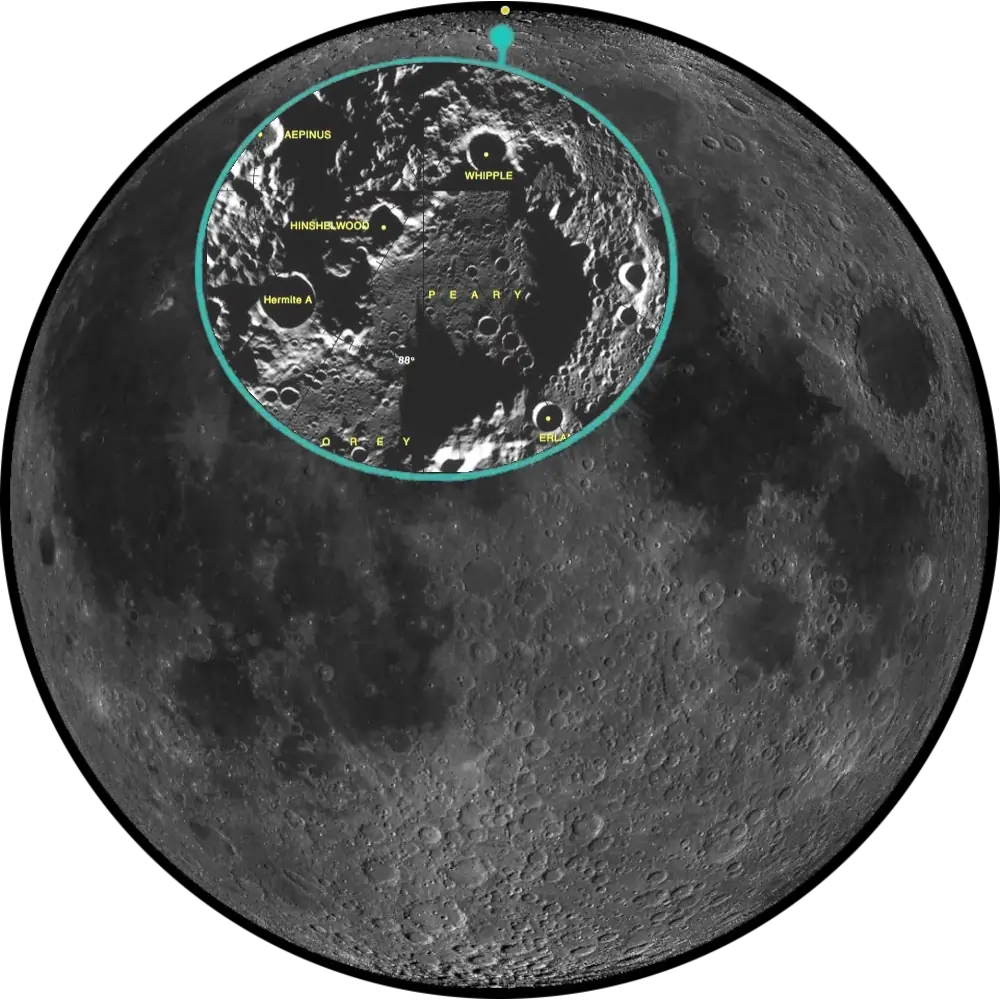
L88 Peary Crater
Lunar North Pole · Permanently Shadowed📉 Vital Statistics
🔭 Field Notes
Peary is the nearest major crater to the Moon’s north pole, with the pole itself lying just outside its worn, roughly circular rim. Because it sits almost exactly on the limb as seen from Earth, telescopic views from the ground were extremely limited until spacecraft began photographing the Moon — Lunar Orbiter 4 provided the first high-quality images. The crater’s extreme latitude means sunlight only ever grazes across it at a very low angle, and significant portions of its interior remain permanently shadowed, never directly illuminated by the Sun and studied instead through laser altimetry, radar, and other remote-sensing techniques rather than ordinary photography. The name itself has an unusual history: originally proposed for a different crater by Wilkins and Moore, it was reassigned to this one in the 1963 Rectified Lunar Atlas and formally approved by the IAU in 1964.
- ▶ The Permanent Shadow: Parts of Peary’s southern floor never receive direct sunlight, making it one of the Moon’s best-known permanently shadowed regions and a candidate site for trapped water ice — its terrain has been mapped primarily through LOLA laser altimetry alongside radar, thermal, and other remote-sensing data rather than optical cameras alone.
- ▶ Near-Eternal Light Nearby: The extreme polar geometry that darkens Peary’s floor also means some high points on its rim and the surrounding terrain receive sunlight for an unusually large fraction of the lunar cycle, part of the broader search for so-called “peaks of eternal light” near both poles.
- ▶ A Crowded Corner: Peary’s rim nearly touches the larger crater Byrd to the south, with the smaller Florey joining along a gap in the southwestern wall — a dense cluster of named craters reflecting how much scientific attention this small stretch of terrain near the pole has attracted.
Because permanently shadowed polar craters can preserve water ice and other volatile compounds for billions of years, Peary remains an important target in planning future robotic and human exploration.
📍 Nearby L100 Targets
- L26 Mare Frigoris: The long, narrow “Sea of Cold” arcing across the northern near side well south of Peary — a useful orientation point for working your way up toward the pole, and itself an unusual mare that isn’t ponded in any obvious circular basin.
- L76 W. Bond: A 156 km ancient, heavily eroded walled plain north of Mare Frigoris, its rim worn down to little more than an outline of hills — a good staging point on the route north toward Peary and the pole itself.
- L19 Alpine Valley (Vallis Alpes): A 166 km straight-walled graben connecting Mare Imbrium to Mare Frigoris’s southwestern shore — a much lower-latitude target that makes a useful anchor point before working your way up the disc toward Peary’s difficult polar position.
🚀 Mission Log
Target Acquisition
Work your way north from Mare Frigoris
Start at Mare Frigoris, the long “Sea of Cold” arcing across the northern near side, and head poleward. Continue north past the flat-floored twins Challis and Main, then Gioja and Byrd, before making the final push toward Peary itself — the closest major crater to the lunar north pole, with the pole lying just outside its worn rim. This isn’t a clean, single-file chain; the polar craters sit in more of a curving, offset cluster, so use each landmark to confirm you’re still headed the right way rather than expecting one straight line to the limb.
This target runs on libration, not lunar phase
Ordinary terminator timing won’t get you here — Peary sits so close to the pole that you need a genuinely favorable northern libration, ideally toward the top of the Moon’s roughly 6°–7° north-south librational range, tipping the pole toward Earth. Check an app like Virtual Moon Atlas for the current libration in latitude before you plan a session; the best libration events don’t always land on a convenient Moon phase, so be ready to observe at an awkward hour or a thin crescent if that’s when the geometry cooperates.
Expect a ridge, not a circle
At 150x–200x or more, don’t look for a normal-looking round crater — extreme foreshortening this close to the limb compresses Peary’s circular rim into a severely foreshortened, ridge-like profile, with long shadows cast across the floor by its worn, rugged walls. Even under a favorable libration, seasoned observers describe this stretch of terrain as consistently difficult to identify with confidence; cross-check what you’re seeing against a lunar atlas or software that models libration and illumination for the date, rather than trusting the view alone.
From Peary to Mare Frigoris, W. Bond, and the Alpine Valley
Well south of Peary, Mare Frigoris (L26) is the unusual, non-circular “Sea of Cold” that makes a good orientation point on the way up toward the pole. North of Frigoris, W. Bond (L76) is a 156 km ancient, heavily eroded walled plain — a useful staging point on the same route north. And well to the south, the Alpine Valley (L19) is a 166 km straight-walled graben connecting Mare Imbrium to Frigoris’s shore — a much lower-latitude, easier target worth anchoring on before you commit a session to Peary’s difficult polar position.
📝 Observation Log — L88 Peary Crater
0/4 CompleteIs Peary visible tonight?
Peary sits almost exactly on the Moon’s north pole near 88.6°N, 33.0°E, and this one breaks the usual terminator rule entirely. Ordinary phase timing won’t help — what matters is a genuinely favorable northern libration, ideally toward the top of the Moon’s roughly 6°–7° librational range. Check a libration table before planning a session, and expect a foreshortened ridge rather than a round crater even under good conditions.
Check Moon Phase TodayReturn to the List
Ready to find the next target? Go back to the full map to see what else is visible tonight.
← Back to Lunar 100 Map
When to Observe Peary
Ordinary terminator timing won’t get you here. Peary sits so close to the lunar north pole that the usual rules of lunar phase barely apply — what matters instead is the Moon’s slow monthly rocking motion, libration, tipping the pole toward or away from Earth.
- Check Libration, Not Phase: You need a genuinely favorable northern libration, ideally toward the top of the Moon’s roughly 6°–7° north-south librational range. Check an app like Virtual Moon Atlas for the current libration in latitude before planning a session.
- Be Ready for Odd Hours: The best libration events don’t always land on a convenient Moon phase, so be ready to observe at an awkward hour or under a thin crescent if that’s when the geometry cooperates.
- For Orientation: Start at Mare Frigoris, the long “Sea of Cold” arcing across the northern near side, and work north past Challis, Main, Gioja, and Byrd before the final push to Peary.
What to Look For
At 150x–200x or more, don’t expect a normal-looking round crater. This close to the limb, extreme foreshortening compresses Peary’s 74 km circular rim into a severely flattened, ridge-like profile, with long shadows cast across the floor by its worn, rugged walls.
Peary’s rim nearly touches the larger crater Byrd to the south, with the smaller Florey joining along a gap in the southwestern wall — a dense cluster of named craters reflecting how much scientific attention this small stretch of terrain near the pole has attracted.
Parts of Peary’s southern floor never receive direct sunlight, making it one of the Moon’s best-known permanently shadowed regions and a candidate site for trapped water ice. Don’t expect to see the shadowed floor itself through the eyepiece — what you’ll actually observe is the crater’s unusual lighting geometry and compressed outline, mapped in detail through laser altimetry, illumination modeling, and specialized spacecraft observations rather than ordinary optical imaging.
The same extreme polar geometry that darkens Peary’s floor also means some high points on its rim and the surrounding terrain receive sunlight for an unusually large fraction of the lunar cycle, part of the broader search for so-called “peaks of eternal light” near both poles.
The Science: Ice at the Edge of Light
Peary’s real interest isn’t its shape but what it might be hiding — permanently shadowed terrain that could preserve water ice for billions of years, right next to some of the most sunlit ground on the Moon.
Vital Statistics
Located at 88.6°N, 33.0°E, on Rükl chart 4 / II (polar chart), Peary spans 74 km and is classified as a Pre-Nectarian, near-polar crater named for Robert Edwin Peary. Its L100 distinction: a difficult-to-observe polar crater.
A Name Reassigned
The name has an unusual history: originally proposed for a different crater entirely by Wilkins and Moore, it was reassigned to this one in the 1963 Rectified Lunar Atlas and formally approved by the IAU in 1964.
Mission Record
Lunar Orbiter 4 provided the first high-quality images of Peary in 1967, since its near-polar, limb-hugging position made ground-based telescopic observation from Earth extremely limited before the spacecraft era. Clementine imaged the crater during the northern hemisphere’s lunar summer in 1994, contributing to early efforts to characterize illumination conditions near the pole. Lunar Reconnaissance Orbiter, in orbit since 2009, has used LOLA, LROC, and Diviner together to map the topography, thermal environment, and illumination history of Peary’s permanently shadowed floor in detail, revealing conditions that visible-light cameras alone cannot directly capture.
Because permanently shadowed polar craters can preserve water ice and other volatile compounds for billions of years, Peary remains an important target in planning future robotic and human exploration — a crater whose real significance lies entirely in what no telescope will ever let you see.