
L87 Humboldt Crater
A 207-kilometer giant stuck on the southeastern limb, its fractured floor hiding volcanic activity that may have continued for over a billion years after impact.
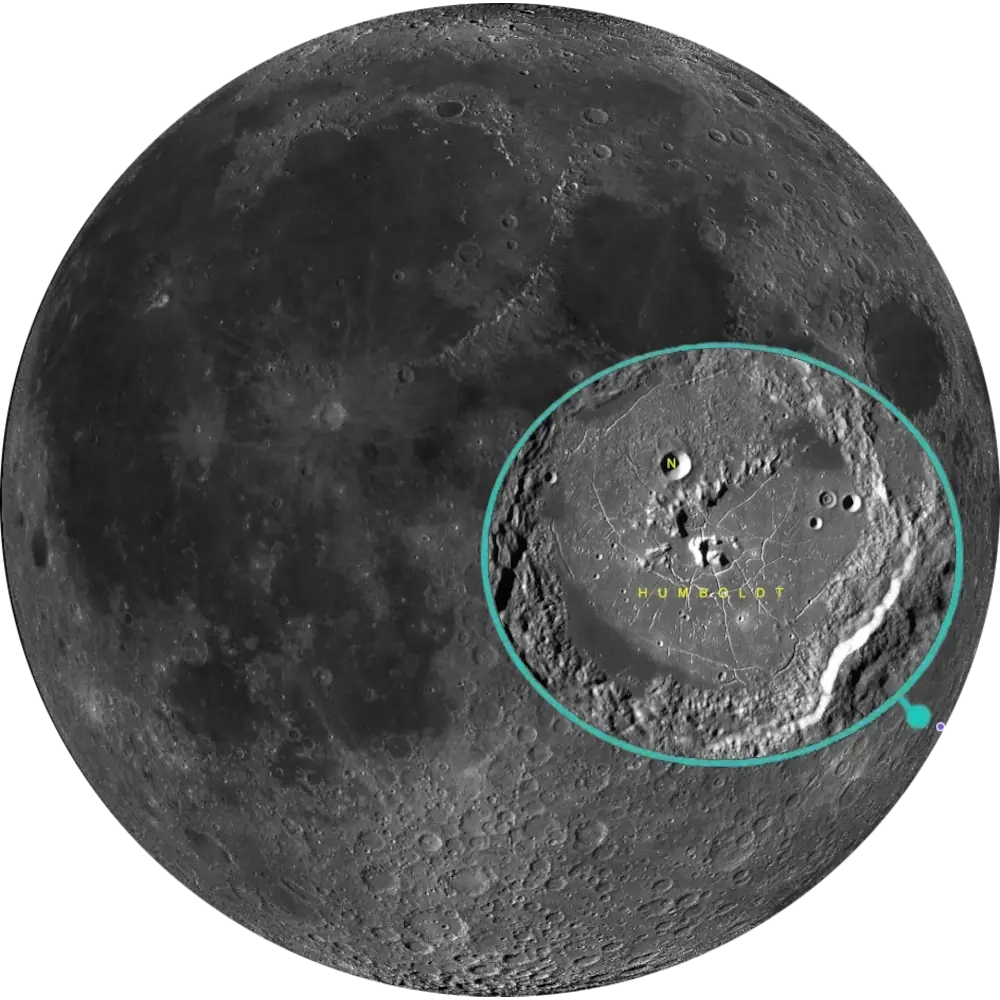
L87 Humboldt Crater
Southeastern Limb · Floor-Fractured Crater📉 Vital Statistics
🔭 Field Notes
Humboldt sits just inside the southeastern limb, east of the prominent floor-fractured crater Petavius, and shows off a surprising amount of interior detail for a feature this close to the edge of the visible disk. Foreshortening stretches it into an exaggerated north-south oval, and a genuinely favorable libration is what puts its “best face” on view — on an average night, there’s simply less to see. Named for Wilhelm von Humboldt, the German statesman, linguist, and university founder (and the more stay-at-home brother of naturalist Alexander von Humboldt), the crater has long been recognized for its central peaks, dark floor patches, and network of fractures, and modern spacecraft data indicates that volcanic activity within the crater may have continued over a span exceeding one billion years.
- ▶ The Dark Spots: Classic visual descriptions note two dark patches near the north and south ends of the floor; modern spectroscopic mapping has resolved these into four separate pyroclastic deposits, comparable to the dark volcanic pits inside Alphonsus and hinting at explosive fire-fountain eruptions long after the impact itself.
- ▶ Central Peak Complex: The central peaks contain crystalline plagioclase pointing to a deep crustal origin, and a distinct row of mounds runs southwest-to-northeast from the peak complex toward one of the pyroclastic deposits — cut across by fractures that show the peaks and this alignment both predate the floor’s later fracturing.
- ▶ A Limb Challenge: Because it sits so close to the edge of the disk, Humboldt is rarely put on amateur observing lists despite rewarding a careful look — a small rayed crater partway between center and the south rim, terraced walls, and a subtle rille slicing roughly east-west across the floor can all be glimpsed in a 6-inch telescope under excellent seeing and favorable libration.
📍 Nearby L100 Targets
- L16 Petavius: A 177 km floor-fractured crater just to the west, near the eastern limb — a close cousin in structure and setting, and a natural target for the same observing session since both reward a well-timed, low-sun approach.
- L56 Australe Basin: A nearly 1,000 km degraded ancient basin further south along the same limb, visible only under favorable libration — a good pairing for a libration-focused night, even though the two targets are geologically unrelated.
- L73 Smythii Basin: A multi-ring basin straddling the near and far side further north along the eastern limb, another target that needs favorable libration to show much at all — Humboldt’s confirmed post-impact volcanism makes an instructive contrast with Smythii’s more ambiguous volcanic history.
🚀 Mission Log
Target Acquisition
Start at Petavius, then push toward the limb
Find Petavius, the well-known 177 km floor-fractured crater near the southeastern limb. Humboldt is its less-visited counterpart, roughly 560 km farther east along the eastern limb — at 207 km, it would rival Copernicus or Clavius for attention if it weren’t stuck on the edge of the disc. Because it’s so rarely on observing lists, it rewards exactly the kind of deliberate, planned session that a limb target like this needs.
Wait for favorable libration and the right illumination to align
Foreshortening ordinarily stretches Humboldt into an exaggerated north-south oval, so an average night simply won’t show you much. What you’re waiting for is favorable libration combined with useful illumination, bringing more of the crater’s interior into view — check a libration table or planetarium app in advance, since the best observing windows depend on the geometry of both the Moon’s apparent rocking and the Sun’s angle across the crater, not on phase alone.
Trace the spiderweb, then hunt for the extras
In a 6-inch or larger scope under excellent seeing, look past the oval outline for a spiderweb of radial and concentric rilles cutting the floor, a linear range of hills stretching across the center, and a small “bull’s-eye” concentric crater in the interior. The four dark mare patches nestle in where the floor meets the rim — watch for them at the north and south ends especially. If conditions are unusually good, look further for a long crater chain extending off the northeast rim, a bonus catch beyond the crater’s standard highlights.
From Humboldt to Petavius, the Australe Basin, and Smythii
Just west, Petavius (L16) is a 177 km floor-fractured crater and close cousin in both structure and setting — a natural target for the same session, since both reward a well-timed, low-sun approach. Further south along the same limb, the Australe Basin (L56) is a roughly 1,000 km degraded ancient basin visible only under favorable libration — a good pairing for a libration-focused night, even though the two targets are geologically unrelated. And further north along the eastern limb, the Smythii Basin (L73) is another libration-dependent target — Humboldt’s well-documented volcanic history makes an instructive contrast with Smythii’s less clearly resolved one.
📝 Observation Log — L87 Humboldt Crater
0/4 CompleteIs Humboldt visible tonight?
Humboldt sits on the southeastern limb near 27.0°S, 80.9°E, and this one needs two things to line up at once. Foreshortening ordinarily stretches it into an exaggerated oval, so an average night won’t show much — you need favorable libration combined with useful illumination, not phase alone. Check a libration table or planetarium app in advance, then look for the rille network and dark floor patches in a 6-inch or larger scope.
Check Moon Phase TodayReturn to the List
Ready to find the next target? Go back to the full map to see what else is visible tonight.
← Back to Lunar 100 Map
When to Observe Humboldt
At 207 km across, Humboldt would rival Copernicus or Clavius for attention if it weren’t stuck on the southeastern limb. Foreshortening ordinarily stretches it into an exaggerated north-south oval, so this is a target that rewards a deliberate, planned session rather than a casual look.
- Wait for Favorable Libration: An average night simply won’t show you much. What you’re waiting for is favorable libration combined with useful illumination, bringing more of the crater’s interior into view.
- Check Geometry, Not Just Phase: Check a libration table or planetarium app in advance — the best observing windows depend on the geometry of both the Moon’s apparent rocking and the Sun’s angle across the crater, not on phase alone.
- For Orientation: Find Petavius, the well-known 177 km floor-fractured crater near the southeastern limb. Humboldt is its less-visited counterpart, farther east along the same limb.
What to Look For
In a 6-inch or larger scope under excellent seeing, look past the oval outline for an intricate network of radial and concentric rilles crossing the floor, a linear range of hills stretching across the center, and a small concentric crater (“bull’s-eye”) in the interior.
Classic visual descriptions note two dark patches near the north and south ends of the floor. Modern spectroscopic mapping has interpreted these as four separate pyroclastic deposits, comparable to the dark volcanic pits inside Alphonsus and hinting at explosive fire-fountain eruptions long after the impact itself.
The central peaks contain crystalline plagioclase pointing to a deep crustal origin, and a distinct row of mounds runs southwest-to-northeast from the peak complex toward one of the pyroclastic deposits — cut across by fractures that show the peaks and this alignment both predate the floor’s later fracturing.
Because it sits so close to the edge of the disk, Humboldt is rarely put on amateur observing lists despite rewarding a careful look — a small rayed crater partway between center and the south rim, terraced walls, and a subtle rille slicing roughly east-west across the floor can all be glimpsed under excellent seeing and favorable libration.
The Science: Volcanism Long After the Impact
Humboldt’s real interest isn’t just its size but its interior — evidence for volcanic activity that, by some estimates, continued for over a billion years after the impact that formed the crater itself.
Vital Statistics
Located at 27.0°S, 80.9°E, on Rükl chart 60, Humboldt spans 207 km with a central peak altitude of −2,212 m. It’s named for Wilhelm von Humboldt, the German statesman, linguist, and university founder — and the more stay-at-home brother of naturalist Alexander von Humboldt. Its L100 distinction: a crater with central peaks and dark spots.
A Billion Years of Volcanism
Spectroscopic mapping from Chandrayaan-1’s Moon Mineralogy Mapper identified crystalline plagioclase in the central peak complex and high-calcium pyroxenes associated with the floor’s volcanic deposits, supporting the interpretation that volcanic activity within Humboldt occurred over a span exceeding one billion years — a striking case of post-impact volcanism persisting long after the crater itself formed.
Mission Record
Lunar Orbiter 4 provided detailed imagery of Humboldt’s floor fractures, central peaks, and dark patches in 1967, offering the first close look at a crater too close to the limb for detailed Earth-based study. Apollo 15’s mapping camera and Hasselblad photography captured numerous regional and oblique views from orbit in 1971, adding to the photographic record used in later geologic studies. Chandrayaan-1’s Moon Mineralogy Mapper conducted spectroscopic mapping in 2008–2009 that identified the mineralogy behind the crater’s volcanic interpretation.
Victorian observer T. W. Webb described Humboldt simply as one of several huge rings on the limb, and even today it stays largely off amateur observing lists purely because of its location — not because there’s little to see.