
L16 Petavius Crater
The Petavius Crater is a 177 km floor-fractured giant near the Moon’s eastern limb — remarkable not for a smooth floor, but for a domed, cracked one: volcanic pressure uplifted the crust from below, splitting the central peaks and carving one of the most dramatic rilles visible in a small telescope.
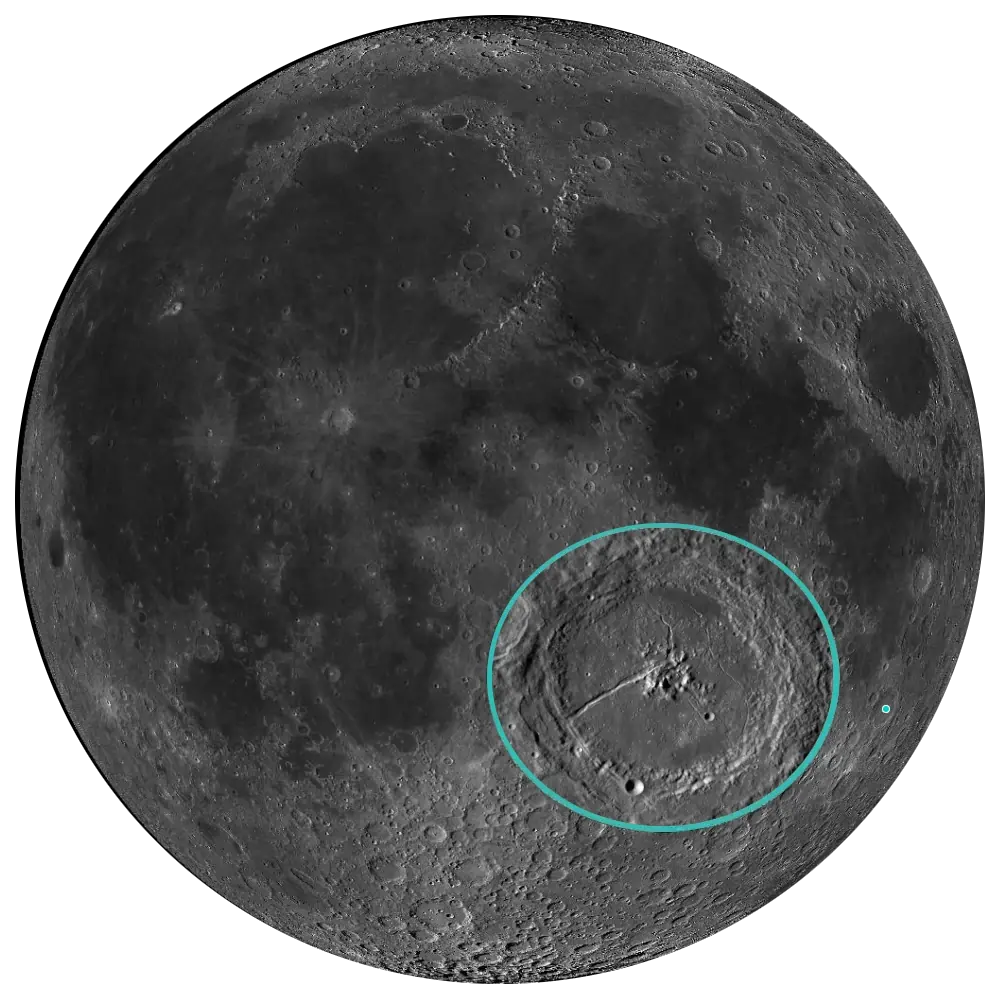
L16 Petavius
Mare Fecunditatis SE📉 Vital Statistics
🔭 Field Notes
Petavius is one of the finest craters on the Moon — a floor-fractured complex modified by post-impact volcanism. Its convex, domed floor sits nearly 1,000 ft higher at center than at the edges, suggesting magma intruded beneath the surface and uplifted the crust without fully flooding it.
- ▶ Rima Petavius: A prominent graben slicing from the central peak to the SW wall — visible in a 60mm refractor at the right phase.
- ▶ Central Massif: A massive multi-peaked mountain complex rising ~1.7 km above the floor, split by the rille system.
- ▶ Best at Day 3: Catch it just after new Moon — shadows retreat fast and by Day 4 most relief is lost.
📍 Nearby L100 Targets
- L87 Humboldt: ~550 km due east, near the lunar limb. A massive floor-fractured plain with a central peak chain, concentric rilles, and four dark pyroclastic patches — requires favorable libration to see well.
- L21 Fracastorius: ~700 km WNW at the southern edge of Mare Nectaris. Its entire northern wall was swallowed by lava, leaving a perfect open bay — a textbook example of crater subsidence.
- L8 Theophilus–Cyrillus–Catharina: The famous degradation trio arcing along Mare Nectaris’ western shore, roughly 900 km to the west.
🚀 Mission Log
Target Acquisition
The Visual Anchor
Look to the southeastern limb of the Moon and locate the dark, tadpole-shaped tail of Mare Fecunditatis (the Sea of Fertility) tapering southward. Petavius sits just off its southeastern tip — a massive walled enclosure that is unmistakable on Day 3.
Identify the Chain
You will notice a conspicuous north-south chain of large craters hugging the eastern limb — Langrenus, Vendelinus, and then Petavius further south. Petavius is the one with the dramatically convex, domed floor and the bold dark scar cutting across it.
The Optics Challenge
Push to 150x – 200x and look for two things simultaneously: the Rima Petavius graben slashing from the central peak to the southwest wall, and the convex dome of the floor itself — the center visibly bows upward about 300 m higher than the edges, an eerie effect on a crater floor.
📝 Observation Log
0/4 CompleteIs the Petavius Crater visible tonight?
Petavius is best on Day 3 after New Moon — catch it before Day 4 when the shadows disappear. Check the current phase to plan your session.
Check Moon Phase Today
When to Observe the Petavius Crater
Petavius sits just southeast of Mare Fecunditatis (“Sea of Fertility”), near the Moon’s eastern limb. It is a floor-fractured crater, meaning its floor was uplifted by volcanic pressure from below rather than simply flooded flat — and that subtle convex dome is only visible under a low, raking Sun. Miss the narrow window and the entire floor washes out.
- Best Viewing: Day 3 after New Moon (Waxing Crescent), or the equivalent waning phase when the terminator returns from the east. By Day 4 the shadows on the floor are nearly gone.
- The Eastern Chain: Petavius anchors the southern end of the Great Eastern Chain alongside Langrenus and Vendelinus. Comparing all three in a single eyepiece view is a great lesson in crater age and preservation — Langrenus is sharper and more intact, while Vendelinus is heavily worn and degraded.
What to Look For
1. The Convex Floor
Unlike a simple flooded crater, the floor of Petavius bows upward — the center sits nearly 1,000 feet (300 m) higher than the edges. Under the right Sun angle this dome effect is genuinely visible as a gentle curve across the floor rather than a flat plain.
- Challenge: Can you detect the floor’s curvature? Compare it to the flat lava plains of Mare Fecunditatis just to the north — the contrast makes the dome easier to perceive.
2. Rima Petavius
The most dramatic feature on the floor is a bold graben rille — Rima Petavius — slicing from the central peak complex all the way to the southwest inner wall. It is one of the few rilles on the Moon visible in a 60mm refractor, appearing as a sharp dark crack cutting across the uplifted floor.
- Challenge: Rima Petavius is actually a system of rilles, not a single crack. Under steady seeing at 150x or higher, can you resolve any of the secondary fractures branching away from the main graben?
3. The Central Massif
Petavius has no single central peak — instead it has a massive, multi-peaked mountain complex rising roughly 1.7 km above the floor. Volcanic and tectonic stress split this massif apart, and Rima Petavius runs directly through it. Look for the jagged, irregular silhouette compared to the clean single cone you would see in a simpler crater like Tycho.
4. The Double Rampart
The outer wall of Petavius is unusually wide and displays a double rim along the south and west sides — a rare feature. The rim height varies by as much as 50% between its highest and lowest points, and ridges radiate outward from the rim onto the surrounding terrain.
The Science: Floor-Fractured Craters
Petavius is one of the Moon’s finest examples of a floor-fractured crater (FFC) — a class of craters modified long after their formation by volcanic intrusion from below.
- Oldest: The Petavius impact occurred during the Lower Imbrian epoch, roughly 3.8 billion years ago, punching a deep bowl into the lunar crust.
- Middle: Magma rising from below intruded beneath the crater floor, inflating it upward like a blister. This uplift cracked the floor and split the central peak, forming the rille system.
- Youngest: Small amounts of lava seeped through the fractures and partially resurfaced the floor — but unlike a fully flooded crater, the volcanic activity stopped before it could bury the central peaks or erase the rilles.
This frozen-in-progress state is exactly what makes Petavius scientifically valuable. It sits between a pristine impact crater and a fully lava-flooded one, preserving evidence of the volcanic forces that reshaped much of the early Moon.