
Moon Phase Turku
On Sunday, October 4, 2026, the moon in Turku is a Last Quarter with 45% illumination. Moon age: 22.6 days.
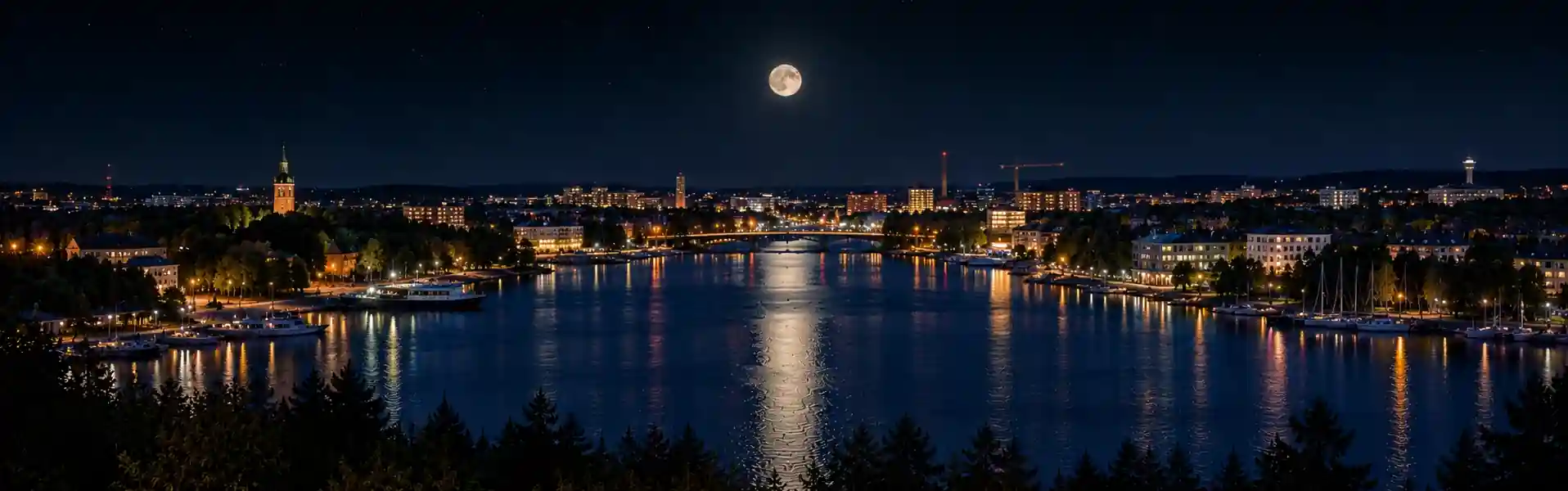
☽ Best Places to View the Moon in Turku, Finland
Turku sits at roughly 60.45°N at the mouth of the Aura River, on Finland's south-western coast. Its history as a city traces back to 1229, making it Finland's oldest city and its former capital, and today it's the mainland gateway to the Archipelago Sea, often described as one of the largest archipelagos in the world, with tens of thousands of islands and islets. Turku has also watched the sky for a long time: Finland's first observatory stood on Vartiovuori Hill, and an astronomical society has held public star shows here for a century. Between the river running through the city centre, a scatter of bridge-connected islands to the south, and the open archipelago beyond them, Turku has an unusually wide range of places to watch the Moon from. At this latitude the Moon rises between north-east and south-east, and a summer full Moon stays very low, near 6°, while a winter one climbs to about 53°. Exact rise and set times and azimuth depend on the date and your observing position, so check both before planning a specific composition.
Vartiovuori Observatory Hill
A 46-metre hill in the city centre, topped by the neoclassical Vartiovuori Observatory, designed by Carl Ludvig Engel and completed in 1819 for the Royal Academy of Turku, Finland's first observatory. It went out of use after the Great Fire of Turku in 1827; the academy's astronomical instruments were transferred to Helsinki by 1831. The surrounding park and hilltop views over the city have long been open to anyone, but if you want to go inside the building rather than just view the hill, check its current opening hours and events before relying on it.
Iso-Heikkilä Tower – Turun Ursa Star Shows
The astronomical society Turun Ursa, formed in 1926, is based at the Iso-Heikkilä tower in Turku. According to a 2024 presentation by the society, it holds public star shows on clear Friday evenings from October to March, from 7 to 9 p.m., solar shows in June, and club evenings on Fridays. Entry has been ticketed, with members free. Turku's first public star show was held in 1924. The shows run only in clear weather, so check Turun Ursa's current programme.
Tuorla Observatory – Avaruuspuisto Väisälä
The University of Turku's Tuorla Observatory, in Kaarina just east of Turku, has a public planetarium at Avaruuspuisto Väisälä, which hosts a monthly "Kuukauden tähtitaivas" show on the first Saturday of the month at 1 p.m., except from May to July. It shows a projected sky, not the real Moon, so treat it as an astronomy stop rather than a viewing spot, and check the current schedule.
Turku Castle & the Aura River Waterfront
A medieval castle at the mouth of the Aura River, among Finland's oldest and largest surviving medieval buildings. Its setting near the river mouth and harbour gives more open maritime views than the narrower stretch of river further upstream. The riverside promenade through the city centre, past the cathedral, the market square and cafés along both banks, is one of Turku's most-used public spaces and its easiest option for an ordinary evening. It won't give you a dark sky, but it puts the Moon directly over the water in the middle of the city's oldest streets.
Ruissalo & Kakskerta – Bridge-Connected Islands
Ruissalo is a large island connected to the mainland by bridge, home to what's described as Finland's largest and most valuable area of oak forest, along with the University of Turku's Botanical Garden. Saaronniemi beach, on the island's outer edge, is locally rated among Turku's best and faces open water toward the archipelago rather than back at the city. Kakskerta, reached by bridge via Hirvensalo and Satava, is a rural former municipality, part of Turku since 1968, with Lake Kakskerranjärvi at its centre and beaches such as Brinkhall; its southern and western edges open onto the Archipelago Sea. Both have unlit stretches, and Kakskerta is rural enough that services and lighting thin out after dark, so plan your route back in advance.
Samppalinnanvuori
A hilltop park just south of the Aura River, close to the city centre, known for its wide views and home to an open-air summer theatre. It's a quick, central alternative to Vartiovuori on the opposite side of the river. Mind the slopes and stairs in icy conditions.
◉ Best Times for Moon Photography in Turku
📷 Quick Photography Tips for Turku
🕐 Timezone: Turku runs on EET (UTC+2), shifting to EEST (UTC+3) for daylight saving time, from the last Sunday in March to the last Sunday in October. Double-check your moonrise app is set to Turku and not carrying over a stale offset across the DST switch.
🔭 Telescope Option: Turun Ursa runs public star shows from the Iso-Heikkilä tower on clear Friday evenings from October to March, with solar shows in June, and a monthly planetarium show at Tuorla's Avaruuspuisto Väisälä. Check the society's current programme for dates. For the moon phase in any other city, use the calculator on our home page.
The moon phase today in Turku, Finland is shown in detail above — complete with exact illumination percentage, moonrise/set times, and the best viewpoints to see it. For the moon phase today in any other city or location worldwide, visit our Dynamic Moon Phase Calculator on the home page.
◐ What the Experience Actually Feels Like
Turku has been looking at the sky for a long time. Vartiovuori Hill carried Finland's first observatory for about twelve years before fire and politics moved the whole enterprise to Helsinki, but the hill itself never stopped being one of the more prominent vantage points in the old town — it just went back to being a park with a very good view, rather than a working instrument. The tradition of public star shows never stopped either: Turku's first was held in 1924, and the local astronomical society still points its telescopes at the Moon on clear winter Friday evenings.
Downstream, the city's relationship with water does something similar. The Aura runs straight through the centre past the castle and cathedral, but a few kilometres south it opens out into the start of the Archipelago Sea — tens of thousands of islands, most of them barely more than rock, stretching out toward Åland. Ruissalo and Kakskerta are close enough to reach by bridge without a boat, but they already feel like a different, quieter register than the river in the old town.
What ties it together is how little effort any of it takes. Nowhere on this page requires a ferry timetable or a wilderness permit — just a bridge, or a walk up a hill that used to have a telescope on it.
"Turku watched the sky before it was really a country's business to do so — a hill with an observatory on it, a river that opens into tens of thousands of islands, and neither one very far from the other."
✓ Your Turku Moon Chase Checklist
Before You Go
- Check the moonrise time and phase on this page for each night of your stay
- Check Turun Ursa's programme for its next public star show — Friday evenings from October to March, when the sky is clear
- If you want to go inside the Vartiovuori Observatory building rather than just view the hill, check its current opening hours and events
- For Kakskerta or Ruissalo's outer beaches, check current road and trail conditions, especially in winter
- Between late March and late October, remember Finland shifts to EEST — re-verify your moonrise app's offset
- In autumn or winter, check the aurora forecast alongside the moon phase
What to Bring
- Proper winter layers — nights can occasionally fall well below −15°C
- A headlamp for unlit stretches on Ruissalo and Kakskerta
- A tripod, useful at the open hilltops and coastal beaches
- Sturdy footwear for icy paths on Vartiovuori's and Samppalinnanvuori's slopes
- Spare camera batteries kept warm in an inner pocket
On the Night
- Arrive 20–30 minutes before moonrise at open spots like Ruissalo's outer coast or the water off Turku Castle
- At Vartiovuori and Samppalinnanvuori, mind the slopes and stairs, especially in icy conditions
- On Kakskerta, plan your route back in advance — it's rural enough that services and lighting thin out after dark
- Shoot RAW and bracket exposures, particularly along the open coast
- Watch the northern sky as well as the Moon on clear winter nights — you may get both in the same frame
? Turku Moon Phase — Frequently Asked Questions
Q. What is the moon phase today in Turku?
The moon phase today in Turku is a Last Quarter with 45% illumination. The next full moon is in 23 days, on 26 Oct. Moonrise is at 11:24 PM and moonset at 6:02 PM.
Q. Where is the best place to view the moon in Turku?
Turku, Finland's oldest city and its former capital, sits at the mouth of the Aura River on the south-west coast, at the edge of the Archipelago Sea. Vartiovuori Hill in the city centre carried Finland's first observatory and still gives wide views over the old town. Turku Castle, near the river mouth, has more open maritime views, while Samppalinnanvuori is a quick hilltop park south of the river. Ruissalo and Kakskerta, two islands reached by bridge, are quieter, and the Aura riverside promenade puts the moon over the water in the middle of town.
Q. Can I look at the moon through a telescope in Turku?
Yes. The astronomical society Turun Ursa runs public star shows from its Iso-Heikkilä tower on clear Friday evenings from October to March, from 7 to 9 p.m. according to a 2024 presentation, with solar shows in June. Entry has been ticketed, with members free. The society was formed in 1926, and Turku's first public star show was in 1924. Separately, a monthly "Kuukauden tähtitaivas" planetarium show runs at Avaruuspuisto Väisälä at the University of Turku's Tuorla Observatory in Kaarina, east of Turku, on the first Saturday of the month at 1 p.m., except from May to July. The planetarium shows a projected sky, not the real moon. Check Turun Ursa's current programme, since observing depends on the weather.
Q. Where does the moon rise and set in Turku, and how high does it climb?
At about 60.5°N, Turku's moonrise and moonset points swing widely across the horizon each month, from roughly north-east to south-east for rising and north-west to south-west for setting, a wider swing than further south, and wider still in years near a major lunar standstill. A full moon near the winter solstice climbs to roughly 53° in the south, while a full moon near the summer solstice stays very low, peaking near 6°. The coast and the Archipelago Sea give a wide horizon, wider than in the more forested inland areas. Check the azimuth for your date and exact spot.
Q. Is light pollution a problem for moon observing in Turku?
The moon is bright enough to observe and photograph from almost anywhere in Turku, so light pollution rarely limits the lunar disc itself. It does wash out earthshine on a thin crescent and any faint sky detail. Turku is a sizeable city, so stars are faint around the river and the old town. Ruissalo and Kakskerta are quieter, and Turun Ursa's rural observatory at Kevola in Paimio is described by the society as outside the light pollution of the towns. Around midsummer the sun stays within about 6° of the horizon all night, so there is little true darkness.
Q. What camera settings and phases work best for moon photography in Turku?
For a full moon, start with Looney 11 (f/11, ISO 100, 1/100 s) and refine using your histogram, since it is a baseline rather than a guarantee. Shoot RAW and bracket exposures, particularly along the open coast, where a bright moon over dark water needs different handling than over snow. A tripod helps at open, exposed spots such as Vartiovuori and Samppalinnanvuori, and even more on Ruissalo's outer coast. Arrive 20 to 30 minutes before moonrise at open spots like Ruissalo's outer coast or the water off Turku Castle.
Q. How do cold, wind and the aurora season affect moon viewing in Turku?
Winter nights in Turku can occasionally fall well below −15 °C, so check the forecast and dress warmly in proper winter layers. Cold drains camera batteries fast, so carry spares in an inner pocket. Coastal and archipelago conditions change with the season, and slopes and stairs on Vartiovuori and Samppalinnanvuori can be icy. On clear autumn and winter nights it is worth watching the northern sky for the aurora as well as the moon, and checking the aurora forecast. Check the Finnish Meteorological Institute for cloud and wind.
Q. What time zone are Turku's moonrise and moonset times shown in?
Turku runs on Eastern European Time, EET, UTC+2, in winter and Eastern European Summer Time, EEST, UTC+3, in summer. Clocks go forward on the last Sunday in March and back on the last Sunday in October, and moonrise and moonset times on this page follow the local clock in effect on each date, so re-check any moonrise app's offset across the change. Turku lies at about 22.3°E, west of the 30°E meridian on which Eastern European Time is based, so the sun and moon cross the sky about 31 minutes later on the clock than they would on that meridian.
Q. Can I shoot the moon at Turku's viewpoints after dark?
Mostly, with care, but check each place. The hills and the riverside are public, but if you want to go inside the Vartiovuori Observatory building rather than just view the hill, check its current opening hours and events. Ruissalo and Kakskerta have unlit stretches, so bring a headlamp, and Kakskerta is rural enough that services and lighting thin out after dark, so plan your route back in advance. Check current road and trail conditions for the outer beaches, especially in winter.
✦ Explore Further
Moon Phase Today: Espoo
Check tonight's moon phase in Espoo, roughly 135 km east of Turku beside Nuuksio National Park.
🏙️Moon Phase Today: Tampere
See the moon over Tampere, roughly 140 km north-east of Turku between two great lakes.
🌍World Moon Phase Directory
Find the moon phase, rise and set times for cities in every region of the world.
Blue Hour Calculator
Work out when blue hour falls, ideal for waxing gibbous shots over the Aura River.