
Moon Phase Oulu
On Sunday, October 4, 2026, the moon in Oulu is a Last Quarter with 45% illumination. Moon age: 22.6 days.
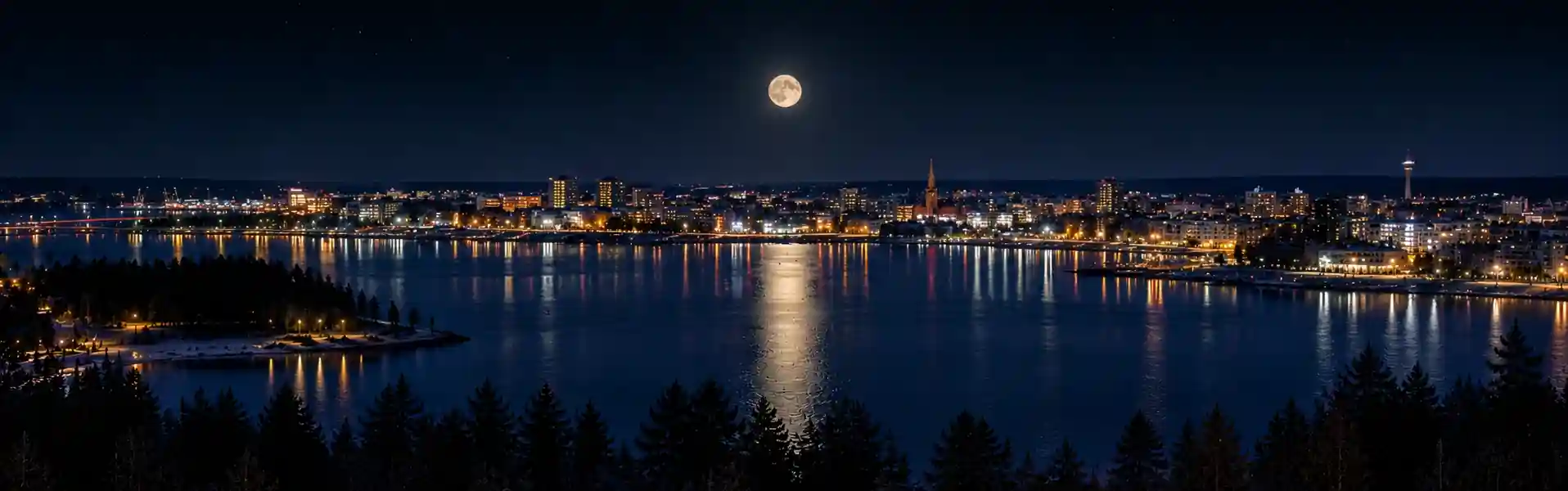
☽ Best Places to View the Moon in Oulu, Finland
Oulu sits at roughly 65°N on the coast of the Bay of Bothnia, at the mouth of the Oulujoki river, Finland's fifth-largest city. The Moon here behaves quite differently than further south: around midsummer the Sun does set, but the sky stays in bright twilight through the night, while the winter solstice brings only around 3.5 hours of daylight. A winter full Moon climbs to about 48°, but a summer full Moon barely clears the horizon, near 1.5°, and in some years does not rise at all. The river delta, the open Bay of Bothnia coastline, and a rural offshore island all give genuinely different ways to watch it. Exact rise and set times and azimuth depend on the date and your observing position, so check both before planning a specific composition.
Hupisaaret Park & Tuira Riverside
Hupisaaret is a scatter of small islands across the Oulujoki estuary right in the middle of the city, linked by white wooden bridges over quiet channels. It became a public park after the 1850s, following a history as watermills, cattle pasture, and formal gardens. It's an easy, central option, though it sits inside the well-lit city core rather than away from it. The residential district of Tuira sits directly across the river, with a riverside path giving open views back across the water toward Linnansaari and the castle ruins, a quieter vantage point on the same stretch of river. Bring a headlamp for the Tuira path.
Linnansaari Island & Oulu Castle
An island in the Oulujoki delta that has held a fortress since at least the 1590s; the castle was destroyed in 1793 when its gunpowder storage exploded, and its renovated foundations survive. In 1875 the Oulu Maritime School built a tower there to a design by Wolmar Westling, and the building has served as a summer café since 1912. It is called the Tähtitorni, which means "star tower," but it is an observation tower, not a working observatory. Check the café's opening hours if you want to visit rather than just view the island from outside.
Nallikari Beach, Hietasaari
An approximately one-kilometre stretch of sandy beach on Hietasaari island, a short bus ride from the centre, facing open water on the Bay of Bothnia. It's Oulu's best-known beach and a popular spot for watching the Sun barely dip below the horizon around midsummer; the same open sea horizon works for the Moon through the rest of the year. It is exposed to wind, so bring a tripod and dress for it.
Merikoski Rapids & Koskikeskus
The Merikoski hydroelectric plant, completed in 1948 in the lower Oulujoki in central Oulu, sits within a district shaped by Alvar Aalto's 1940s plan for the river delta, with bridges, islands, and open water tying central Oulu to the Tuira district across the river. A fish pass added in 2003 lets migrating salmon and trout past the dam. The open water around the rapids and Toivoniemi creates a distinctive foreground for lunar photography.
Hailuoto Island
The largest island in the Bay of Bothnia, now connected to the mainland by a fixed road link of 8.4 km, a causeway and bridges from Oulunsalo, which opened on 29 June 2026 and replaced the ferry. With about 1,000 residents and a noticeably lower level of development than Oulu, it's promoted for its darkness and lack of light pollution, with the Marjaniemi lighthouse, dating to 1871, at its western tip. Check current road and weather conditions before you go, and bring a headlamp for unlit stretches.
Arktos Observatory – Puolivälinkangas Water Tower
Oulu's astronomical society Arktos has an observatory in the Puolivälinkangas water tower, but local press reports that public star shows have not been held there for years, first because of the pandemic and an elevator renovation, and later because visitors could no longer be allowed to use their own keys. Treat it as closed to the public unless the society announces otherwise, and check its announcements before relying on a telescope night in Oulu.
◉ Best Times for Moon Photography in Oulu
📷 Quick Photography Tips for Oulu
🕐 Timezone: Oulu runs on EET (UTC+2), shifting to EEST (UTC+3) for daylight saving time, from the last Sunday in March to the last Sunday in October. Its latitude makes the swing far more extreme than further south: around 21 hours of daylight near the June solstice against roughly 3.5 hours near the December one.
🔭 Telescope Option: No regular public telescope night is advertised in Oulu. The Arktos society's observatory in the Puolivälinkangas water tower has not held public star shows for years, and the Tähtitorni on Linnansaari is an observation tower, not an observatory. Check Arktos for announcements. For the moon phase in any other city, use the calculator on our home page.
The moon phase today in Oulu, Finland is shown in detail above — complete with exact illumination percentage, moonrise/set times, and the best viewpoints to see it. For the moon phase today in any other city or location worldwide, visit our Dynamic Moon Phase Calculator on the home page.
◐ What the Experience Actually Feels Like
Oulu is a modern tech city — university, hospital, a long electronics and telecoms industry legacy — that combines that with a latitude where the Moon behaves quite differently through the year. In June, it barely matters where you stand: the twilight glow around midsummer washes out everything but the brightest objects, night after night, and a full Moon hugs the horizon. By December, the equation flips entirely, and a city that gets barely three and a half hours of daylight has plenty of dark hours left to fill.
What's unusual about Oulu specifically is Linnansaari — a small island in the river delta that has carried a fortress since the 1500s, and which the Maritime School topped with a tower in 1875. It's a café now, called the Tähtitorni, the "star tower," a name that outlasted whatever the tower was first used for.
Out in the bay, Hailuoto is the other end of the spectrum: a real island, still rising out of the sea from post-glacial rebound, now reachable over a fixed road link rather than a ferry, but with a fraction of the city's population and a landscape explicitly promoted for its darkness. It's a short drive rather than an expedition, but it's the clearest contrast between the city's own river islands and something genuinely apart from it.
"Oulu is far enough north that the sky itself becomes part of the story — a summer that barely goes dark, a winter that barely gets light, and, in between, a castle ruin with a tower called the star tower."
✓ Your Oulu Moon Chase Checklist
Before You Go
- Check the moonrise time and phase on this page for each night of your stay
- If visiting around the summer solstice, set expectations for the trip rather than for the sky — real darkness is largely off the table until late summer
- For Hailuoto, check current road and weather conditions before travelling across the fixed connection
- Between late March and late October, remember Finland shifts to EEST — re-verify your moonrise app's offset
- In autumn or winter, check the aurora forecast alongside the moon phase — Oulu sits close enough to the auroral zone for a chance on a clear, active night
What to Bring
- Serious winter layers — winter nights can be around −6°C or colder, with substantially colder periods possible
- A headlamp for unlit stretches on Hailuoto and along the Tuira riverside
- A tripod for the open, wind-exposed ground at Nallikari and on Hailuoto
- Sturdy, grippy footwear — icy paths and bridges are routine through the winter
- Spare camera batteries kept warm in an inner pocket
On the Night
- Arrive 20–30 minutes before moonrise at open spots like Nallikari or Hailuoto's shoreline
- At Linnansaari, check the Tähtitorni café's opening hours if you want to visit rather than just view the island from outside
- Check your return travel time from Hailuoto before heading out
- Shoot RAW and bracket exposures, especially against open water or snow
- Watch the northern sky as well as the Moon on clear autumn or winter nights — you may get both in the same frame
? Oulu Moon Phase — Frequently Asked Questions
Q. What is the moon phase today in Oulu?
The moon phase today in Oulu is a Last Quarter with 45% illumination. The next full moon is in 23 days, on 26 Oct. Moonrise is at 9:44 PM and moonset at 7:16 PM.
Q. Where is the best place to view the moon in Oulu?
Oulu sits at about 65°N on the coast of the Bay of Bothnia, at the mouth of the Oulujoki. Nallikari Beach on Hietasaari island faces the open sea, so it has the broadest horizon. Hupisaaret Park, a cluster of small islands in the river delta linked by wooden bridges, is an easy central option, and Linnansaari, an island with the ruins of Oulu Castle and the Tähtitorni observation tower, looks out over the delta. The Merikoski rapids and the Tuira riverside path give open water in the foreground. Hailuoto, the largest island in the Bothnian Bay, is promoted for its darkness and has been joined to the mainland by a fixed road link since 29 June 2026.
Q. Can I look at the moon through a telescope in Oulu?
Not at a regular public night that is advertised. Oulu's astronomical society Arktos has an observatory in the Puolivälinkangas water tower, but local press reports that public star shows have not been held there for years, first because of the pandemic and an elevator renovation, and later because visitors could no longer be allowed to use their own keys. The Tähtitorni on Linnansaari, a café in a former Maritime School tower built in 1875, is an observation tower and not a working observatory. Check Arktos for any announcements, since observing depends on the weather.
Q. Where does the moon rise and set in Oulu, and how high does it climb?
At about 65°N, Oulu's moonrise and moonset points swing very widely across the horizon each month, from roughly north-north-east to south-south-east for rising and the mirror image for setting, and wider still in years near a major lunar standstill, when the moon can stay above the horizon for most of a day. A full moon near the winter solstice climbs to roughly 48° in the south, while a full moon near the summer solstice barely clears the horizon, peaking near 1.5°, and in some years does not rise at all. The open water of the Bay of Bothnia gives a broad horizon at Nallikari. Check the azimuth for your date and exact spot.
Q. Is light pollution a problem for moon observing in Oulu?
The moon is bright enough to observe and photograph from almost anywhere in Oulu, so light pollution rarely limits the lunar disc itself. It does wash out earthshine on a thin crescent and any faint sky detail, and local press has reported that light pollution over the city has grown over the decades, with complaints about overly bright advertising lights. Hailuoto, with about 1,000 residents and a lower level of development, is promoted for its darkness and is one of the more useful places for the aurora and other faint-sky photography. Around midsummer the sun sets only briefly, to within about 1.5° of the horizon, so twilight never fully fades.
Q. What camera settings and phases work best for moon photography in Oulu?
For a full moon, start with Looney 11 (f/11, ISO 100, 1/100 s) and refine using your histogram, since it is a baseline rather than a guarantee. Shoot RAW and bracket exposures, especially against open water or snow, because a bright winter moon over snow needs different handling than the same moon over dark water. A tripod helps against the open, exposed wind at Nallikari and on Hailuoto. Around the June solstice, don't expect a genuinely dark sky at all: even a bright moon competes with a twilight glow that never fully fades at this latitude.
Q. How do the extreme seasons, cold and the aurora affect moon viewing in Oulu?
Oulu's daylight swings from around 21 hours near the June solstice to only around 3.5 hours near the December one, so check twilight times for your dates as well as the moon phase. Winter nights can be around −6 °C or colder, with substantially colder periods possible, and cold drains camera batteries fast, so carry spares in an inner pocket. Icy paths and bridges are routine through the winter, so wear grippy footwear. Oulu sits close enough to the auroral zone for a chance of aurora on a clear, active night in autumn and winter, so check the aurora forecast alongside the moon phase.
Q. What time zone are Oulu's moonrise and moonset times shown in?
Oulu runs on Eastern European Time, EET, UTC+2, in winter and Eastern European Summer Time, EEST, UTC+3, in summer. Clocks go forward on the last Sunday in March and back on the last Sunday in October, and moonrise and moonset times on this page follow the local clock in effect on each date, so re-check any moonrise app's offset across the change. Oulu lies at about 25.5°E, west of the 30°E meridian on which Eastern European Time is based, so the sun and moon cross the sky about 18 minutes later on the clock than they would on that meridian.
Q. Can I shoot the moon at Oulu's viewpoints after dark?
Mostly, with care, but check each place. The Tähtitorni café on Linnansaari is a summer café, so check its opening hours if you want to visit rather than just view the island. Hailuoto is reached over the fixed road link from Oulunsalo, so check current road and weather conditions and your return travel time, and bring a headlamp for unlit stretches on the island and along the Tuira riverside. Nallikari and Hailuoto's shoreline are exposed to wind, so dress for it.
✦ Explore Further
Moon Phase Today: Tampere
Check tonight's moon phase in Tampere, roughly 400 km south-south-west of Oulu between two great lakes.
✈️Moon Phase Today: Vantaa
See the moon over Vantaa, roughly 525 km south of Oulu in the Helsinki region.
🌍World Moon Phase Directory
Find the moon phase, rise and set times for cities in every region of the world.
Blue Hour Calculator
Work out when blue hour falls, ideal for waxing gibbous shots over the Bay of Bothnia.