
Moon Phase Bremen
On Sunday, October 4, 2026, the moon in Bremen is a Last Quarter with 45% illumination. Moon age: 22.6 days.
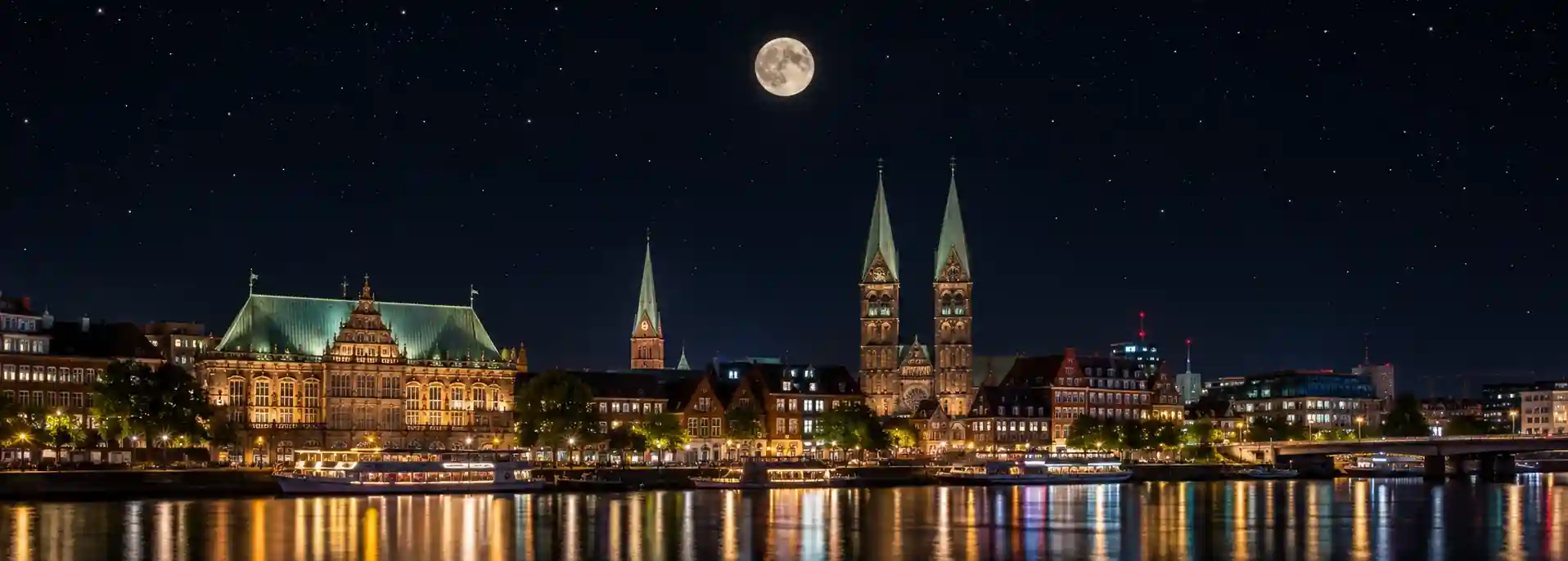
☽ Best Places to View the Moon in Bremen, Germany
Bremen has an unusual advantage for moon-watchers: several of its best viewpoints combine open horizons, water, elevated ground, and deliberately astronomical landmarks. The standout is Metalhenge, an art installation at about 40 metres on the first reclaimed section of the Blockland landfill, whose steel elements were designed with astronomical alignments in mind, including selected rising and setting points of the Sun and Moon. Along the Weser, the riverfront provides reflections and open sightlines, while the Bürgerpark and Stadtwald offer quieter green spaces away from the busiest parts of the city. For a more formal astronomical experience, the Walter-Stein-Sternwarte on the roof of the Hochschule Bremen, above the Olbers Planetarium, offers views of the Moon through telescopes on selected days when conditions permit. Bremen is flat, and the Moon rises in the east and sets in the west, so a raised viewpoint matters: Metalhenge lies north-west of the city centre, so the city lies to the south-east, inside the range of directions where the Moon rises. As always, the Moon's exact rise time and direction change with the date and your observing location, so check both before planning a specific composition. Here are six useful moon-viewing options around Bremen, each suited to a different kind of visit.
Metalhenge
Bremen's most distinctive astronomical viewpoint, an art installation by Thomas Roth, created with Die Bremer Stadtreinigung and Dieter Vornholz of the Olbers Planetarium. It stands at about 40 metres on the first reclaimed section of the Blockland landfill, which is Bremen's highest hill, opened in July 2021. The installation is designed around astronomical alignments, with elements indicating selected rising points of stars and setting points of the Sun and Moon. It is free and listed as open around the clock. The city lies to the south-east, where the Moon rises, but a newly raised landfill section can block part of the western horizon, so check the view before relying on a Moonset. Address: Fahrwiesendamm 100, 28219 Bremen-Walle.
Stephanibrücke & Weser
A strong urban location for moon photography, with the Weser directly below and views toward the illuminated riverfront and Schlachte. The combination of water, skyline and an unobstructed section of sky can work especially well when the Moon is low on the horizon, and a calm river can give a reflection. Best suited to photographers looking for a city-and-Moon composition rather than a dark-sky setting.
Beobachtungsturm am Hollerdeich
An observation tower in Oberneuland that provides a more open view away from Bremen's central streets. The elevated position makes it useful when you want a broader horizon rather than buildings immediately surrounding the Moon. It is particularly interesting for landscape-style lunar photography and for watching the Moon rise over the more open eastern side of the city. Check current access before an evening visit.
Bürgerpark
One of Bremen's major historic landscape parks, with mature trees, open areas, paths and ponds that provide plenty of foreground options. It can produce a very different Moon photograph from the riverfront, especially when the lunar disc is framed between trees or reflected on water. The park is governed by its own visitor regulations, listed as restricting staying in the grounds after 22:30, so check current access rules before planning a late-night session.
Stadtwald & Unisee
The Stadtwald forms a large green area alongside the Bürgerpark, with long paths, wooded sections and the Unisee providing an open waterside setting. It offers a quieter alternative to the central Weser viewpoints, although the surrounding city means this is still an urban observing environment rather than a true dark-sky site. Visitor rules for the Bürgerpark and Stadtwald apply, including restrictions on remaining in the grounds late at night.
Walter-Stein-Sternwarte
Bremen's working observatory, operated by the Olbers-Gesellschaft, founded in 1920, on the roof of the Hochschule Bremen in the Neustadt, above the Olbers Planetarium. On selected days, visitors can look through the large fixed telescopes and the smaller mobile telescopes set up on the terrace. When weather permits, the observatory can be used to observe the Moon, planets and other bright astronomical objects despite the city skyglow. The Olbers Planetarium below is said to be Germany's most-visited small planetarium. Check the Olbers-Gesellschaft's schedule for current dates. Address: Werderstraße 73, 28199 Bremen.
◉ Best Times for Moon Photography
📷 Quick Photography Tips
🕐 Timezone: Bremen uses Central European Time — CET (UTC+1) in winter and CEST (UTC+2) during daylight saving time. Germany observes daylight saving time, with the clock moving forward in spring and back in autumn. PhotoPills or Stellarium will handle the Moon's exact rise azimuth and altitude for your chosen Bremen location automatically.
🔭 Observatory: The Walter-Stein-Sternwarte is on the roof of the Hochschule Bremen at Werderstraße 73, 28199 Bremen, run by the Olbers-Gesellschaft above the Olbers Planetarium. On selected days visitors can look through its telescopes in clear weather, and the planetarium shows the night sky when it is cloudy. Check the Olbers-Gesellschaft's schedule for current dates.
The moon phase today in Bremen is shown in detail above — complete with exact illumination percentage, moonrise/set times, and the best local spots to see it. For the moon phase today in any other city worldwide, visit our Dynamic Moon Phase Calculator on the home page.
◐ What the Experience Actually Feels Like
Metalhenge is unlike the other locations on this list because the astronomy is built into the place itself. From the elevated summit, Bremen spreads out below while the installation's steel forms create deliberate references to astronomical directions. The city's own tourism service describes it as an astronomical viewpoint, including markers associated with selected rising and setting points of stars, the Sun and Moon. It is therefore one of the most natural places in Bremen to combine a Moonrise with the landscape rather than simply finding an empty patch of sky.
Along the Weser, the experience becomes much more urban. From Stephanibrücke, the river provides a broad reflective surface while the illuminated waterfront and Schlachte create a distinctly Bremen foreground. A low Moon can work particularly well here because you can include the river, buildings and lunar disc in the same frame without needing to leave the city centre.
Bürgerpark and Stadtwald offer a quieter alternative, with trees, paths, ponds and the Unisee replacing the hard lines of the city skyline. They are still urban environments, and the park regulations are listed as restricting staying in the grounds after 22:30 except for specified purposes, so these locations are better suited to evening observing within the permitted hours than to an all-night observing session.
For a more traditional astronomical experience, the Walter-Stein-Sternwarte provides something the outdoor locations cannot: access to an actual observatory. On selected days, when weather conditions cooperate, visitors can look through its telescopes and observe the Moon and planets even under Bremen's relatively bright city sky.
"Bremen's Moon-viewing experience ranges from deliberate astronomical alignments at Metalhenge to river reflections, historic parkland and an actual working observatory."
✓ Your Bremen Moon Chase Checklist
Before You Go
- Check the Moon's rise time, altitude and azimuth for your date and exact observing location — the direction can change substantially from one date to another
- If you're photographing Metalhenge, use PhotoPills or Stellarium to check whether the Moon will line up with the installation or the Bremen skyline, and check the western horizon, which a newly raised landfill section can partly block
- Verify Site Access: Bürgerpark and Stadtwald have specific visitor regulations, listed as restricting staying in the grounds after 22:30
- Check the Olbers-Gesellschaft's schedule for the Walter-Stein-Sternwarte if you want to observe through the telescope rather than simply viewing the Moon outdoors
- Check cloud cover and visibility before leaving, particularly if you're planning a precise Moonrise composition
- Allow extra time at Metalhenge if you want to photograph the Moon with the astronomical structures and Bremen's skyline rather than simply observe the Moon
What to Bring
- A telephoto lens — 200mm or longer can be useful when you want a relatively large Moon beside a distant Bremen landmark, depending on your shooting distance
- A warm layer, particularly outside the summer months — an exposed viewpoint such as Metalhenge can feel considerably cooler than a sheltered city street
- A remote shutter release or a 2-second timer to reduce camera shake on tripod shots
- A small flashlight with a red-light mode can be useful when walking darker paths without unnecessarily brightening your surroundings
- A backup viewing location in case cloud, crowds, access restrictions or changing conditions spoil your original composition
On the Night
- Arrive at least 30–45 minutes early when photographing a planned Moonrise composition so you can establish the foreground and camera position
- If autofocus struggles in low light, switch to manual focus and focus carefully on the Moon's edge or another distant subject
- Bracket your exposures — one for the bright lunar disc and another for the darker river, park or skyline below
- If the Moon looks soft or hazy right at Moonrise, consider waiting until it climbs higher above the horizon; the longer atmospheric path at low altitude can increase scattering and distortion
- At Bürgerpark and Stadtwald, plan around the current posted park regulations rather than assuming that late-night access is permitted
Use the tools on this page, pick your vantage point, and catch a Bremen moonrise for yourself.
? Bremen Moon Phase — Frequently Asked Questions
Q. What is the moon phase today in Bremen?
The moon phase today in Bremen is a Last Quarter with 45% illumination. The next full moon is in 23 days, on 26 Oct. Moonrise is at — and moonset at 4:52 PM.
Q. Where is the best place to view the moon in Bremen?
Bremen is flat, so the best places are its few raised viewpoints and open water. Metalhenge, an art installation by Thomas Roth designed with the Olbers Planetarium, stands at about 40 m on the first reclaimed section of the Blockland landfill, Bremen's highest hill, and gives a wide view over the city. The Weser riverfront around Stephanibrücke and the Schlachte gives reflections, the observation tower at Hollerdeich in Oberneuland looks over the open eastern side of the city, and the Bürgerpark, Stadtwald and Unisee have trees and water. The Walter-Stein-Sternwarte is the place to see the moon through a telescope.
Q. Can I look at the moon through a telescope in Bremen?
Yes. The Walter-Stein-Sternwarte is on the roof of the Hochschule Bremen at Werderstraße 73, above the Olbers-Planetarium, and is run by the Olbers-Gesellschaft, founded in 1920. On selected days visitors can look through its large fixed telescopes and smaller mobile telescopes set up on the terrace, and when the weather allows, the moon and planets can be observed even under Bremen's city sky. The Olbers-Planetarium, said to be Germany's most-visited small planetarium, shows the night sky on a dome in cloudy weather. Check the Olbers-Gesellschaft's schedule for current dates.
Q. Where does the moon rise and set in Bremen, and how high does it climb?
At about 53.1°N, Bremen's moonrise and moonset points swing widely across the horizon each month, from roughly north-east to south-east for rising and north-west to south-west for setting, with an even wider swing in years near a major lunar standstill. A full moon near the winter solstice climbs to roughly 60° in the south, while a full moon near the summer solstice stays low, peaking near 14°. Metalhenge lies north-west of the city centre, so the city lies to the south-east, inside the range of directions where the moon rises, and its steel markers are designed around selected rising and setting points of the sun and moon. A newly raised landfill section can block part of the western horizon from the hill, so check the view before relying on a moonset. Check the azimuth for your date and exact spot.
Q. Is light pollution a problem for moon observing in Bremen?
The moon is bright enough to observe and photograph from almost anywhere in Bremen, so light pollution rarely limits the lunar disc itself. It does wash out earthshine on a thin crescent and any faint sky detail. Bremen is a large city and port, so stars are faint at most viewpoints, including Metalhenge and the parks. The moon and the bright planets remain easy telescope targets even under a city sky.
Q. What camera settings and phases work best for moon photography in Bremen?
For a full moon, start with Looney 11 (f/11, ISO 100, 1/100 s) and refine using your histogram, since it is a baseline rather than a guarantee. The moon is much brighter than the city, the river and the parks, so shoot RAW and bracket or blend exposures to keep both crater detail and the foreground. A full moon is not always the best phase for showing surface relief. For a moon-and-landmark shot, move farther back and use a longer focal length of 200 mm or more, with a sturdy tripod where allowed and manual focus on the moon's edge using magnified live view. The moon illusion makes a low moon look huge, but it is perceptual, not a change in size. A calm Weser can give a reflection.
Q. How do cloud, wind and fog affect moon viewing in Bremen?
Bremen has a maritime climate with changeable cloud, so a planned moonrise can disappear quickly even when the wider forecast looks favourable. Exposed viewpoints such as Metalhenge and the riverfront can be windier and colder than sheltered streets, and fog and haze can form over the Weser and the low, flat surroundings in cool, calm weather. Check cloud cover and visibility as well as the general forecast, and bring a warm layer.
Q. What time zone are Bremen's moonrise and moonset times shown in?
Bremen runs on Central European Time, CET, UTC+1, in winter and Central European Summer Time, CEST, UTC+2, in summer. Clocks go forward on the last Sunday in March and back on the last Sunday in October, and moonrise and moonset times on this page follow the local clock in effect on each date. Bremen lies at about 8.8°E, west of the 15°E meridian on which Central European Time is based, so the sun and moon cross the sky about 25 minutes later on the clock than they would on that meridian.
Q. Can I shoot the moon at Bremen's viewpoints after dark?
Mostly yes, with care. Metalhenge is listed as open to the public around the clock, but it is on a hill with an unlit approach, so take a torch and care on the path. Bürgerpark and Stadtwald have their own visitor regulations, listed as restricting staying in the grounds late at night, after 22:30, so check them before a late session. The Walter-Stein-Sternwarte opens only on selected days, and the riverfront promenades are public spaces. Check access at the Hollerdeich tower before an evening visit.
✦ Explore Further
Moon Phase Today: Hamburg
Check tonight's moon phase in Hamburg, roughly 95 km east-north-east of Bremen on the Elbe.
🏙Moon Phase Today: Dortmund
See the moon over Dortmund, roughly 195 km south-south-west of Bremen in the Ruhr region.
🌍World Moon Phase Directory
Find the moon phase, rise and set times for cities in every region of the world.
Blue Hour Calculator
Work out when blue hour falls, ideal for waxing gibbous shots over the Weser.