
Moon Phase Today Sunshine Coast Australia
On Saturday, October 10, 2026, the moon in Sunshine Coast is a New Moon with 0% illumination. Moon age: 28.9 days.
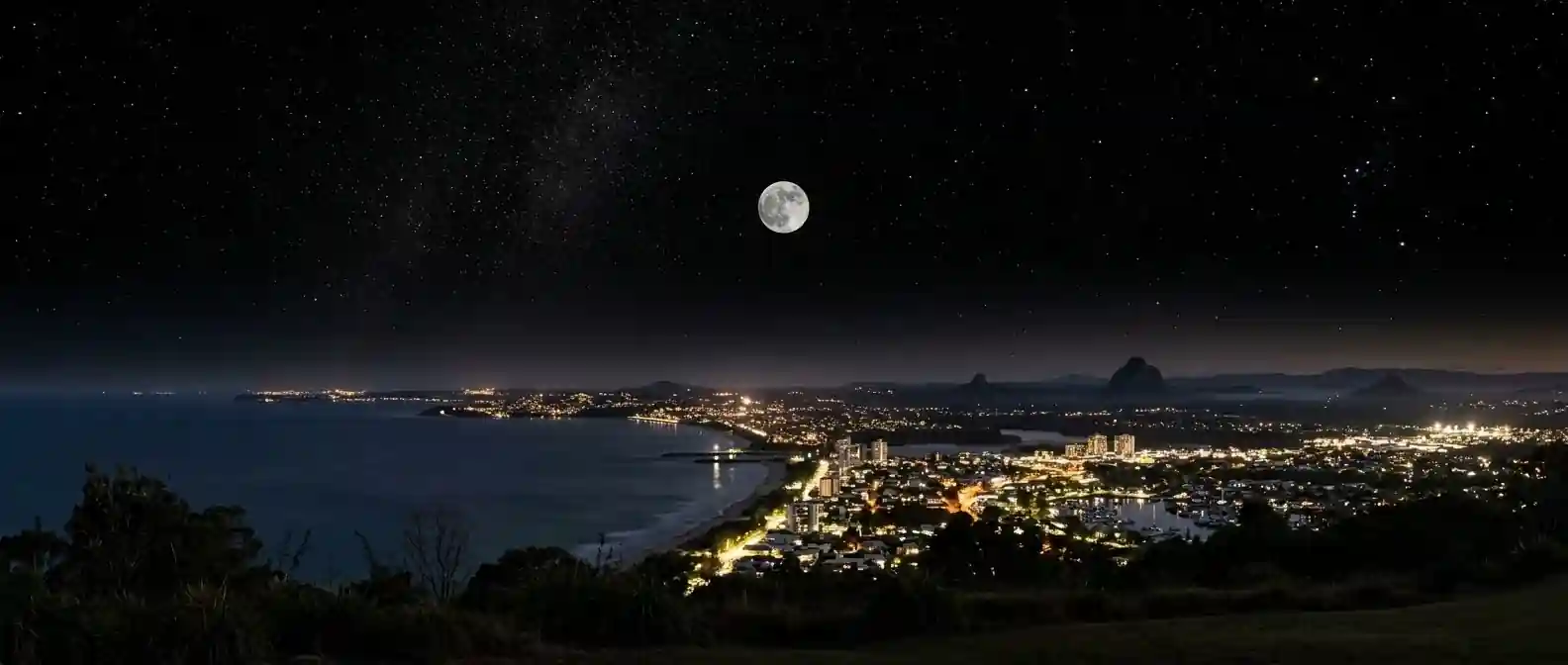
☽ Best Places to View the Moon in Sunshine Coast, Australia
The Sunshine Coast has about 60 km of beaches facing east over the ocean, with a hinterland of volcanic peaks and rainforest behind it. In the southern hemisphere the moon rises in the east, climbs to its highest point in the northern sky, and sets in the west, so every moonrise from the headlands comes up over open sea, and a full moon in June passes almost overhead, at about 87°. The hinterland is also Queensland's first International Dark Sky Reserve, designated in June 2026, with public observatories at Maleny and Mapleton. One caution: dark skies and a bright moon work against each other, so use the reserve's stars at new moon and its telescopes for the moon.
Noosa National Park Coastal Walk – Listed 24 Hours, Walk in Daylight
A coastal walk and day-use area on Noosa Headland with sweeping coastal views, and headlands that face the ocean to the east. Queensland Parks lists the Coastal Walk and the day-use area as open 24 hours a day, but it also says to walk in the park in daylight hours only, stay on marked tracks, and keep domestic animals out. The beaches are not patrolled, and Alexandria Bay is subject to storm surges. Use it for a moonrise near dusk, not a night walk.
Point Cartwright – Lighthouse Headland at Mooloolaba
A headland reserve with an active lighthouse and a viewing platform over the mouth of the Mooloolah River, with extensive coastal views. It faces east over open ocean, so a rising moon comes up out of the sea, with a beach foreground. Check current local access rules before an evening visit.
Mount Coolum National Park – Coastal Summit, Daylight Walking Only
A coastal summit with panoramic ocean and hinterland views, on a short, steep track. Queensland Parks says to walk in daylight hours only. The ocean lies to the east, so use it for a moonrise near dusk, and leave before dark.
Maleny and Mapleton Observatories – Telescopes in the Dark Sky Reserve
Maleny Observatory, designated an observatory by the Astronomical Society of Australia in 2021, hosts public viewing nights through the year run by the Brisbane Astronomical Society. Mapleton Observatory, at Mapleton State School, offers open nights including private viewing nights. Both lie in the hinterland, inside the Dark Sky Reserve, and are the best places to see the moon through a telescope. Check the Sunshine Coast Astronomy - Qld Facebook page for dates.
Glass House Mountains Lookout – Volcanic Peaks, 24-Hour Day-Use Area
An iconic group of volcanic peaks, with a lookout day-use area listed as open 24 hours. Queensland Parks says walking in the surrounding forest should be in daylight hours only, and Mount Ngungun is a steep, exposed Grade 4 climb, not a casual night hike. The peaks give a dramatic foreground for a moonrise or twilight shot from the lookout.
Kondalilla and Mary Cairncross – Daytime Hinterland Rainforest
Kondalilla National Park has a waterfall circuit with over 300 stairs, and Queensland Parks says to walk in daylight hours only. Tracks can close in severe wet weather because of flooding, and the rock pools are not for swimming. Mary Cairncross Scenic Reserve has a viewing deck toward the Glass House Mountains, with rainforest walks listed from 7am to 6pm daily. Both are daytime sites, so use them for scouting, not for night sessions.
◉ Best Times for Moon Photography in Sunshine Coast
📷 Quick Tips for Sunshine Coast
🕐 Timezone: The Sunshine Coast runs on Australian Eastern Standard Time (AEST, UTC+10) all year, because Queensland does not observe daylight saving. From the first Sunday in October to the first Sunday in April, Sydney and Melbourne are an hour ahead. Australia/Brisbane.
Horizons: The beaches face east over the ocean, so every moonrise is over open sea. The moon sets in the west, over the hinterland. Check the azimuth for your particular date.
Light: The coastal strip is lit. The hinterland, over 870 square kilometres of the Blackall Range, became Queensland's first International Dark Sky Reserve in June 2026.
Access: A 24-hour listing is not permission to walk at night. Queensland Parks asks for daylight-only walking in Noosa, Mount Coolum, Kondalilla and the Glass House Mountains forests, and rainforest tracks can close for flooding.
◐ What It Feels Like
At Noosa and Point Cartwright, the Sunshine Coast feels open and warm: headlands, surf and a lighthouse, and the moon lifting out of the ocean with a bright path across the water.
At the Glass House Mountains lookout, it feels ancient and strange. The volcanic peaks rise out of flat country, and the moon comes up behind them against the last of the light.
At Maleny Observatory, it feels like a hill town that looks up: members of the Astronomical Society at their telescopes under a very dark sky, with the moon filling the eyepiece.
"A moonrise out of the ocean, a telescope in a Dark Sky Reserve, and a coast where a 24-hour listing still means daylight walking."
✓ Checklist for Lunar Observers
Before You Go
- Check moonrise and moonset times and azimuth for your date — the moon rises in the east and sets in the west, and its direction shifts through the month
- Check access — Noosa is listed 24 hours but with daylight-only walking, Mount Coolum and Kondalilla are daylight only, and Mary Cairncross walks run 7am to 6pm
- Check Maleny and Mapleton Observatory dates, and flooding closures on rainforest tracks
What to Bring
- Telephoto and wide lenses for headland and mountain compositions
- Tripod with a tilting head for bracketing, reflections and a high moon
- Lens cloth for coastal humidity
- Insect repellent and a red-light torch for evenings in the rainforest
On the Night
- Check exact azimuth and elevation — they vary nightly
- Bracket for lunar detail and coastal lights during the twilight window
- Stay on marked tracks and lookouts, respect daylight-only walking, and keep clear of unpatrolled beaches and cliff edges
? Sunshine Coast Moon Phase — Frequently Asked Questions
Q. What is the moon phase today in Sunshine Coast?
The moon phase today in Sunshine Coast is a New Moon with 0% illumination. The next full moon is in 17 days, on Oct 26. Moonrise is at 4:46 AM and moonset at 5:39 PM.
Q. Where is the best place to view the moon on the Sunshine Coast?
Face the ocean for moonrise. The Sunshine Coast's beaches face east, so the headlands give an open sea horizon where the moon comes up. Noosa National Park's Coastal Walk and Noosa Headland day-use area have sweeping coastal views, Point Cartwright at Mooloolaba has a lighthouse and a viewing platform over the mouth of the Mooloolah River, and Mount Coolum is a coastal summit with panoramic views. Inland, the Glass House Mountains Lookout looks across the volcanic peaks, and the hinterland observatories at Maleny and Mapleton are the places to see the moon through a telescope.
Q. Can I look at the moon through a telescope on the Sunshine Coast?
Yes, in the hinterland. Maleny Observatory, designated an observatory by the Astronomical Society of Australia in 2021, hosts public viewing nights through the year run by the Brisbane Astronomical Society, and Mapleton Observatory, at Mapleton State School, offers open nights including private viewing nights. The Sunshine Coast Astronomy - Qld Facebook page lists public events. Check the current listings for dates and booking, since observing depends on the weather, and a bright moon is the easiest first target.
Q. Where does the moon rise and set on the Sunshine Coast, and does it look different from the northern hemisphere?
Yes. At about 26.7°S, the moon rises in the east, over the ocean, climbs to its highest point in the north, and sets in the west, over the hinterland, the reverse of northern cities where it crosses the south. Its rising point swings each month from roughly east-north-east to east-south-east, with a wider swing in years near a major lunar standstill. A full moon near the June winter solstice climbs to roughly 87° in the northern sky, almost directly overhead, while one near the December summer solstice peaks near 40°. The moon also looks inverted compared with the north: a waxing crescent is lit on its left and a waning crescent on its right. Because the beaches face east, every moonrise comes up over open sea. Check the azimuth for your date and exact spot.
Q. Is light pollution a problem for moon observing on the Sunshine Coast?
The moon is bright enough to observe and photograph from almost anywhere on the Sunshine Coast, so light pollution rarely limits the lunar disc itself. It does wash out earthshine on a thin crescent and any faint sky detail. The coastal strip is lit, but in June 2026 the Sunshine Coast hinterland was designated Queensland's first International Dark Sky Reserve, covering more than 870 square kilometres of the Blackall Range, including Maleny, Mapleton, Montville, Witta, Flaxton, Kenilworth and Conondale. A bright moon works against the stars, and Sunshine Coast Council advises that you will see the most stars within a week of the new moon, so choose a full or gibbous moon if you want the moon itself.
Q. What camera settings and phases work best for moon photography on the Sunshine Coast?
For a full moon, start with Looney 11 (f/11, ISO 100, 1/100 s) and refine using your histogram, since it is a baseline rather than a guarantee. The moon is much brighter than the sea, headlands and town lights, so shoot RAW and bracket or blend exposures to keep both crater detail and the foreground. A waxing gibbous is useful for twilight over the ocean while some daylight remains. To isolate the moon over a distant headland or the Glass House Mountains, use a 200 to 400 mm lens on a sturdy tripod, with manual focus on the moon's edge using magnified live view. A moonrise over the sea can lay a bright path on the water, and a tilting tripod head helps when the moon is high in the north. Bring insect repellent for evenings in the rainforest.
Q. How do cloud, humidity and storms affect moon viewing on the Sunshine Coast?
The Sunshine Coast has a humid subtropical climate, and summer evenings can bring thunderstorms and heavy cloud, while haze over the sea can hide a rising moon near the horizon. Winter and early spring are generally clearer, and the hinterland is cooler and can be misty. Headlands are exposed to wind, and humidity fogs lenses, so bring a lens cloth. Rainforest tracks can close in severe wet weather because of flooding. Check cloud, haze and storm forecasts before heading out.
Q. What time zone are the Sunshine Coast's moonrise and moonset times shown in?
The Sunshine Coast runs on Australian Eastern Standard Time, AEST, UTC+10, all year, because Queensland does not observe daylight saving. From the first Sunday in October to the first Sunday in April, New South Wales and Victoria move an hour ahead, so the Sunshine Coast is an hour behind Sydney and Melbourne during that period. Moonrise and moonset times on this page follow Queensland's clock. The Sunshine Coast lies at about 153.1°E, east of the 150°E meridian on which AEST is based, so the sun and moon cross the sky about 12 minutes earlier on the clock than they would on that meridian.
Q. Can I shoot the moon at the Sunshine Coast's viewpoints after dark?
With care. Queensland Parks lists Noosa National Park's Coastal Walk and Noosa Headland day-use area as open 24 hours a day, but it also says to walk in the park in daylight hours only, stay on marked tracks, and keep domestic animals out, and the beaches around the park are not patrolled. Mount Coolum and Kondalilla are daylight walking only, the Glass House Mountains Lookout day-use area is listed as open 24 hours but walking in the surrounding forest is daylight only, and Mary Cairncross's rainforest walks run from 7am to 6pm. Check current alerts and local rules, including at Point Cartwright, before an evening visit.
✦ Explore Further
Moon Phase Today: Sydney
Check tonight's moon phase in Sydney, roughly 820 km south-south-west of the Sunshine Coast down the east coast.
🦘Moon Phase in Australia
Browse moon phase pages for cities across Australia, from the Sunshine Coast to Darwin.
🌍World Moon Phase Directory
Find the moon phase, rise and set times for cities in every region of the world.
Blue Hour Calculator
Work out when blue hour falls, ideal for waxing gibbous shots over the Pacific Ocean.