
Moon Phase Today Newcastle Australia
On Saturday, October 10, 2026, the moon in Newcastle is a New Moon with 0% illumination. Moon age: 28.9 days.
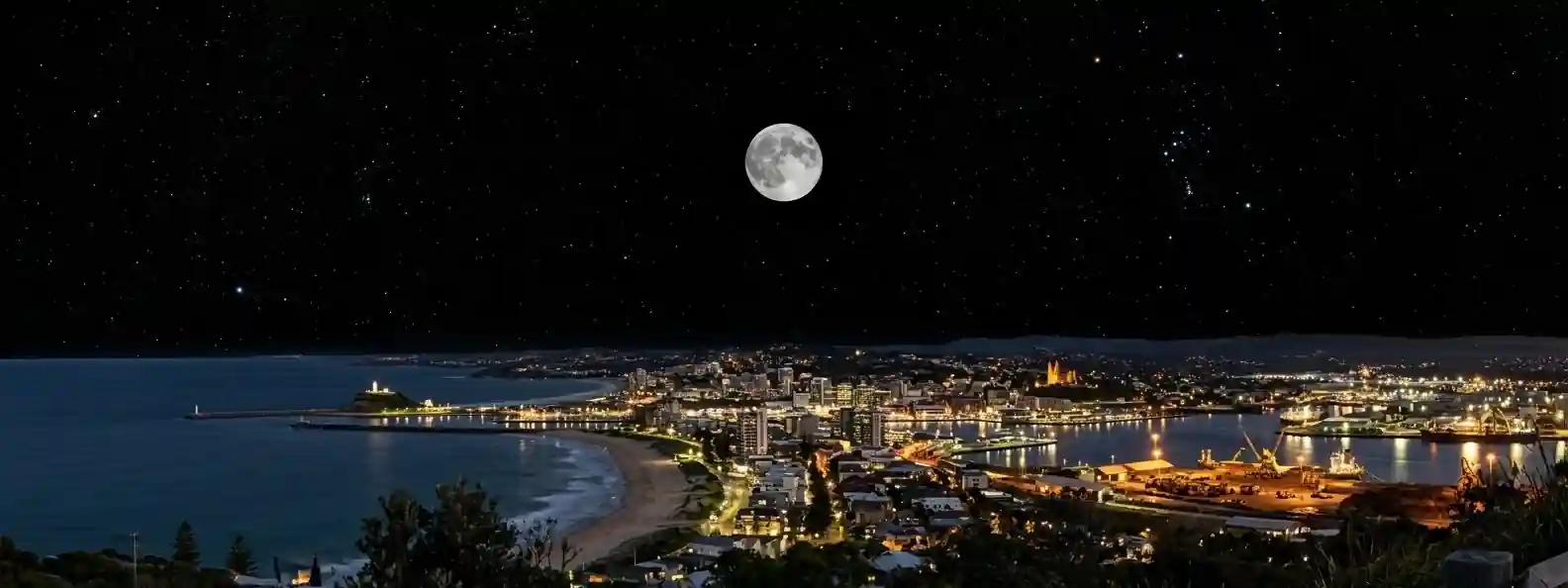
☽ Best Places to View the Moon in Newcastle, Australia
Newcastle sits where the Hunter River meets the Pacific, and its city-side coast faces east. In the southern hemisphere the moon rises in the east, climbs to its highest point in the northern sky, and sets in the west, so every moonrise from the clifftops and headlands comes up over open sea, and a full moon in June passes close to overhead, at about 81°. A setting moon drops behind the land to the west. The best spots are east-facing and elevated, and many of them have daytime hours, so check access before an evening visit.
King Edward Park – Cliff-Top Moonrise Over the Pacific
A coastal park with Norfolk Island pines, a Victorian rotunda and Garside Gardens, on an elevated clifftop that is part of the Bathers Way coastal route. It faces east over open ocean, so a rising moon comes up straight out of the sea. Check current park hours before an evening visit.
Newcastle Memorial Walk – Cliff-Top Bridge and Coastline Views
A 450 m coastal walkway with a 160 m cliff-top bridge, with extensive coastline, city and Hunter Valley views. The elevation and the ocean to the east make it a strong moonrise and twilight spot. It is a public walkway, but check current access and conditions, and do not assume permitted late-night observing. Take care on the bridge and clifftop in the dark.
Fort Scratchley – Harbour Entrance Headland, Daytime Hours
A historic fort on the headland at the entrance to Newcastle Harbour, near Nobbys, with elevated views over the harbour, the beaches and the open Pacific. It is listed as open Wednesday to Monday from 10am to 4pm, last entry 3:30pm, and closed Tuesdays, so the fort itself is not an evening option unless there is a special event. The views are best scouted by day.
Foreshore Park and Nobbys Beach – River Mouth
A harbour foreshore park with playgrounds, open and event spaces and amenities near Nobbys Beach, at the river mouth opposite Stockton, linked to the city centre by ferry. Sandy shores and open horizons give a moonrise over the water. The ocean baths are separate facilities. Check current hours and event closures.
Merewether Ocean Baths and Dixon Park – Southern Beaches
The southern stretch of the Bathers Way, which runs about 6 km from Merewether Ocean Baths north to Nobbys Beach, with ocean baths, beaches and rocky headlands facing east. Newcastle Beach lies north of Dixon Park, not among the southern beaches. Lifeguard patrol periods are seasonal and are not the same as access hours. Reflections depend on sea conditions and the moon's height.
Newcastle Astronomical Association – Telescope Nights
The Newcastle Astronomical Association has run public astronomy nights with members' telescopes, including a National Science Week night on the University of Newcastle's Callaghan campus in 2019. That event is old, so check the Association's current listings for dates and booking. Many online results for a Newcastle astronomical society are for Newcastle upon Tyne in England, not here.
◉ Best Times for Moon Photography in Newcastle
📷 Quick Tips for Newcastle
🕐 Timezone: Newcastle runs on Australian Eastern Standard Time (AEST, UTC+10) and Australian Eastern Daylight Time (AEDT, UTC+11), with daylight saving from the first Sunday in October to the first Sunday in April. Australia/Sydney.
Horizons: The city-side coast faces east over the Pacific, so every moonrise is over open sea. The moon sets in the west, behind the land. Check the azimuth for your particular date.
Light: Newcastle is a city and working port with continuous lighting along the coast. The sky over the ocean is darker, and the Hunter Valley inland is darker still.
Access: Fort Scratchley is open Wednesday to Monday, 10am to 4pm. Many parks are generally dawn to dusk, and beach patrol hours are not access hours. Confirm current access for the Memorial Walk and the Bathers Way before an evening visit.
◐ What It Feels Like
At King Edward Park, Newcastle feels like a city with its back to the land: Norfolk Island pines, a rotunda, and a wide ocean opening in front of you as the moon lifts out of the sea.
On the Memorial Walk, it feels high and windy. The cliff-top bridge carries you out over the water, the coastline curves away, and the harbour lights come on behind you.
At Nobbys and the river mouth, it feels like a working harbour on the edge of the ocean: ships at anchor, the ferry to Stockton, and a bright path across the water from the rising moon.
"A city that faces the moonrise, with clifftops over the Pacific and a harbour at its feet."
✓ Checklist for Lunar Observers
Before You Go
- Check moonrise and moonset times and azimuth for your date — the moon rises in the east and sets in the west, and its direction shifts through the month
- Check access — Fort Scratchley is daytime only and closed Tuesdays, many parks are dawn to dusk, and beach patrols are not access hours
- Confirm current conditions on the Memorial Walk and the Bathers Way, and check the Newcastle Astronomical Association for telescope nights
What to Bring
- Telephoto and wide lenses for harbour and ocean compositions
- Tripod with a tilting head for bracketing, reflections and a high moon
- Lens cloth for coastal humidity and spray
- Warm layers for evening coastal winds
On the Night
- Check exact azimuth and elevation — they vary nightly
- Bracket for lunar detail and harbour lights during the twilight window — Looney 11 is a starting point
- Stay on marked trails, boardwalks and headland paths, and respect posted closing times, because several excellent photographic locations are not late-night observing locations
? Newcastle Moon Phase — Frequently Asked Questions
Q. What is the moon phase today in Newcastle?
The moon phase today in Newcastle is a New Moon with 0% illumination. The next full moon is in 17 days, on Oct 26. Moonrise is at 5:48 AM and moonset at 6:50 PM.
Q. Where is the best place to view the moon in Newcastle?
Face the ocean for moonrise. Newcastle's coast faces east over the Pacific, so the cliff-top and headland viewpoints on the city side of the harbour give open sea horizons where the moon comes up. King Edward Park is an elevated coastal park on the Bathers Way route, the Newcastle Memorial Walk is a 450 m coastal walkway with a 160 m cliff-top bridge and coastline views, and Fort Scratchley stands on the headland at the harbour entrance near Nobbys. Foreshore Park and Nobbys Beach sit at the river mouth opposite Stockton, and Merewether Ocean Baths and Dixon Park give southern beach and headland views.
Q. Can I look at the moon through a telescope in Newcastle?
Possibly, through the local astronomy groups. The Newcastle Astronomical Association has run public astronomy nights with members' telescopes, including a National Science Week night on the University of Newcastle's Callaghan campus in 2019, with Saturn and Jupiter as the targets, and a bright moon is the easiest first target for any beginner. That event is old, so check the Association's current listings for dates, venues and booking, since observing depends on the weather. Many online listings for a Newcastle astronomical society refer to Newcastle upon Tyne in England, not New South Wales.
Q. Where does the moon rise and set in Newcastle, and does it look different from the northern hemisphere?
Yes. At about 32.9°S, the moon rises in the east, over the Pacific, climbs to its highest point in the north, and sets in the west, the reverse of northern cities where it crosses the south. Its rising point swings each month from roughly east-north-east to east-south-east, with a wider swing in years near a major lunar standstill. A full moon near the June winter solstice climbs to roughly 81° in the northern sky, close to overhead, while one near the December summer solstice peaks near 34°. The moon also looks inverted compared with the north: a waxing crescent is lit on its left and a waning crescent on its right. Because the city-side coast faces east, every moonrise comes up over open sea, while a setting moon drops behind the land to the west. Check the azimuth for your date and exact spot.
Q. Is light pollution a problem for moon observing in Newcastle?
The moon is bright enough to observe and photograph from almost anywhere in Newcastle, so light pollution rarely limits the lunar disc itself. It does wash out earthshine on a thin crescent and any faint sky detail. Newcastle is a city and working port with continuous lighting along the coast, so stars will be faint near the harbour and the beaches, but the sky over the ocean to the east is darker, which suits a moonrise. For darker skies, head inland toward the Hunter Valley.
Q. What camera settings and phases work best for moon photography in Newcastle?
For a full moon, start with Looney 11 (f/11, ISO 100, 1/100 s) and refine using your histogram, since it is a baseline rather than a guarantee. The moon is much brighter than the sea, headlands and harbour lights, so shoot RAW and bracket or blend exposures to keep both crater detail and the foreground. A waxing gibbous is useful for twilight over the harbour and the beaches while some daylight remains. To isolate the moon over a distant foreground such as the harbour heads or an ocean bath, use a 200 to 400 mm lens on a sturdy tripod, with manual focus on the moon's edge using magnified live view. A moonrise over the sea can lay a bright path on the water, and longer exposures smooth the waves.
Q. How do cloud, sea haze and wind affect moon viewing in Newcastle?
Newcastle has a mild coastal climate, but cloud and sea haze can build over the Pacific, so a rising moon can be hidden near the horizon even on a mostly clear night. Headlands and cliff-top walkways are exposed to coastal winds, especially in the evening, which can shake a tripod, and spray and humidity can fog lenses. Check cloud, haze and wind forecasts before heading out, and bring warm layers.
Q. What time zone are Newcastle's moonrise and moonset times shown in?
Newcastle runs on Australian Eastern Standard Time, AEST, UTC+10, and Australian Eastern Daylight Time, AEDT, UTC+11, with daylight saving running from the first Sunday in October to the first Sunday in April. Moonrise and moonset times on this page follow the local clock in effect on each date. Newcastle lies at about 151.8°E, east of the 150°E meridian on which AEST is based, so the sun and moon cross the sky about seven minutes earlier on the clock than they would on that meridian.
Q. Can I shoot the moon at Newcastle's viewpoints after dark?
Check each site. Fort Scratchley is listed as open Wednesday to Monday from 10am to 4pm, with last entry at 3.30pm and closed Tuesdays, so the fort itself is not an evening option unless there is a special event. Many of Newcastle's parks are generally open from dawn to dusk, and lifeguard patrol periods on the beaches are seasonal and are not the same as access hours. The Bathers Way and the Memorial Walk are public coastal routes, but confirm current access and conditions rather than assuming night-time access, and take care on cliff-top paths and bridges in the dark.
✦ Explore Further
Moon Phase Today: Sydney
Check tonight's moon phase in Sydney, roughly 115 km south-south-west of Newcastle down the Central Coast.
🦘Moon Phase in Australia
Browse moon phase pages for cities across Australia, from Newcastle to Darwin.
🌍World Moon Phase Directory
Find the moon phase, rise and set times for cities in every region of the world.
Blue Hour Calculator
Work out when blue hour falls, ideal for waxing gibbous shots over the Hunter River mouth and the Pacific Ocean.