
Moon Phase Today Melbourne
On Saturday, October 10, 2026, the moon in Melbourne is a New Moon with 0% illumination. Moon age: 28.9 days.
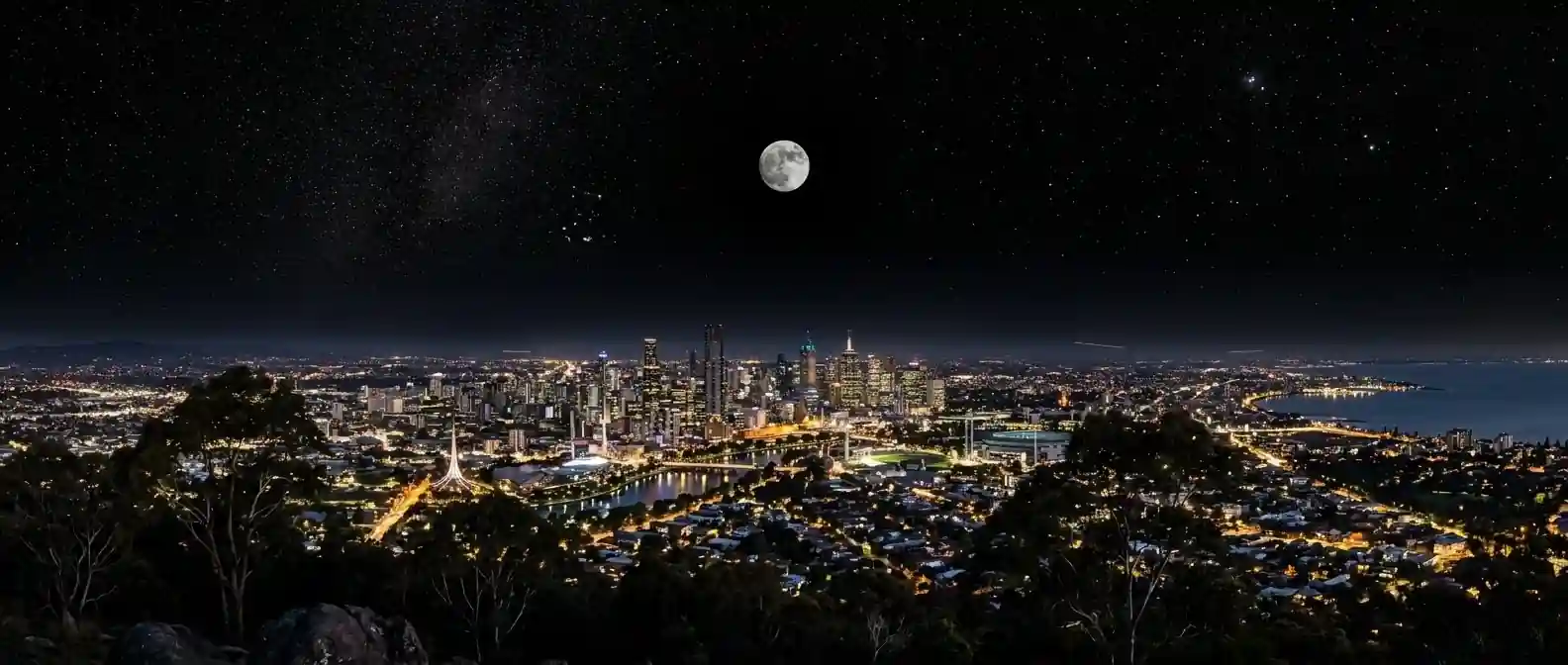
☽ Best Places to View the Moon in Melbourne, Australia
Melbourne's moon geometry is set by one fact: the CBD lies north of the Yarra, and the moon never rises or sets in the north. In the southern hemisphere the moon rises in the east, climbs to its highest point in the northern sky, and sets in the west, so from the city's gardens and the bay's eastern shore it passes high above the skyline, to about 76° in June and 29° in December. Port Phillip Bay lies south-west of the CBD, so the bay's eastern shore, including St Kilda, faces the setting moon, while its western shore faces east. Most of the gardens close before dark, so the observatory nights matter.
Royal Botanic Gardens and Melbourne Observatory – Gardens Close Before Dark, Observatory Runs Night Tours
About two kilometres from the city centre beside the Yarra, with lawns, the Ornamental Lake and the skyline beyond the trees to the north. The Gardens are open every day from 7:30am to 5:30pm, extending to 7:30pm from 1 October to the end of March, and hours are subject to change. The Old Melbourne Observatory stands inside them, and the Astronomical Society of Victoria runs ticketed Stellar Nights tours there with heritage telescopes, including views of the moon. Places are limited, so book ahead.
St Kilda Pier and Catani Gardens – Moonset Over the Bay
A historic boardwalk and gardens on the east side of Port Phillip Bay, looking west over open water, the direction of moonset, with the Melbourne skyline to the north. It is not where the Yarra enters Hobsons Bay, which is several kilometres further north-west. St Kilda Pier has undergone major redevelopment, with works ongoing in 2026, so check current hours and pier access before you go.
Albert Park Lake – Lake Horizon Near the CBD
A flat lake circuit close to the CBD, described by Parks Victoria as a picturesque lake with sailing and rowing, lakeside trails and skyline views. The skyline lies to the north, so the moon passes high above it, but the open water can hold a reflection on a calm night. Parks Victoria lists restricted opening hours for the lake precinct, so check access before an evening visit.
Birrarung Marr and Alexandra Gardens – Yarra Riverfront
Urban parks beside the Yarra, with Birrarung Marr directly opposite Federation Square and Alexandra Gardens along the river toward the sports precinct. The CBD towers lie to the west and north-west of Birrarung Marr, which is the direction of moonset, so a setting moon can drop behind the skyline. That is my reading of the coordinates, so check the azimuth for your date. Open lawns and riverside trails give foreground, but check current hours.
Mount Burnett Observatory – Dandenong Ranges
A community observatory at 420 Paternoster Road, east of the city in the Dandenong Ranges, run by Mount Burnett Observatory Inc. It holds public viewing nights, including bookable sessions with a tour of the night sky and a look through its 18-inch telescope. It is the best place near Melbourne to see the moon through a large telescope. Check the current listing and booking.
Scienceworks Planetarium – Spotswood
The Planetarium at Scienceworks, 2 Booker Street, Spotswood, shows the live night sky on a dome, in shows of 30 to 45 minutes, and is a dependable indoor option when Melbourne's weather turns cloudy. Check the current show times and booking.
◉ Best Times for Moon Photography in Melbourne
📷 Quick Tips for Melbourne
🕐 Timezone: Melbourne runs on Australian Eastern Standard Time (AEST, UTC+10) and Australian Eastern Daylight Time (AEDT, UTC+11), with daylight saving from the first Sunday in October to the first Sunday in April. Australia/Melbourne.
Horizons: The CBD lies north of the Yarra, so the moon passes high above it. Port Phillip Bay lies south-west, so the bay's eastern shore faces moonset and its western shore faces moonrise. Check the azimuth for your particular date.
Light: Melbourne is a large city with continuous lighting around the bay. Parks give more open sky, not darker skies. The Dandenong Ranges to the east are darker, and the Astronomical Society of Victoria's Leon Mow Dark Sky Site at Heathcote is about an hour and three-quarters away.
Access: The Royal Botanic Gardens close at 5:30pm, or 7:30pm from 1 October to the end of March, and hours are subject to change. Albert Park Lake has restricted hours, and St Kilda Pier has redevelopment works. Do not stay in a park after closing time.
◐ What It Feels Like
At the Royal Botanic Gardens, Melbourne feels green and unhurried: the Ornamental Lake, old trees, the skyline rising beyond them, and a pale moon climbing in the north before the gates close.
At St Kilda Pier, it feels like the edge of the city: a long wooden boardwalk out into Port Phillip Bay, the wind off the water, and the moon dropping toward the western horizon.
On a Melbourne Observatory night, it feels like a hidden city. The roof of a nineteenth-century observatory rolls back, a guide swings a heritage telescope onto the moon, and the lit towers stand a couple of kilometres away.
"A moon that passes high above the skyline, a moonset over the bay, and a nineteenth-century observatory in the middle of the Gardens."
✓ Checklist for Lunar Observers
Before You Go
- Check moonrise and moonset times and azimuth for your date — the moon rises in the east and sets in the west, and its direction shifts through the month
- Check park hours — the Royal Botanic Gardens 7:30am to 5:30pm, or 7:30pm from 1 October to the end of March, Albert Park Lake restricted hours, and St Kilda Pier redevelopment works
- Book Melbourne Observatory, Mount Burnett or Scienceworks sessions ahead, since places are limited
What to Bring
- Telephoto and wide lenses for bay, lake and garden compositions
- Tripod with a tilting head for bracketing, reflections and a high moon
- Lens cloth for coastal humidity
- Warm layers for evening bay winds
On the Night
- Check exact azimuth and elevation — they vary nightly
- Bracket for lunar detail and city lights during the twilight window — Looney 11 is a starting point, not a fixed exposure
- Stay on marked trails and respect posted closing times, because several scenic daytime locations are not places where you can stay after dark
? Melbourne Moon Phase — Frequently Asked Questions
Q. What is the moon phase today in Melbourne?
The moon phase today in Melbourne is a New Moon with 0% illumination. The next full moon is in 17 days, on Oct 26. Moonrise is at 6:12 AM and moonset at 7:23 PM.
Q. Where is the best place to view the moon in Melbourne?
It depends which way you want to face. St Kilda Pier and Catani Gardens, on the east side of Port Phillip Bay, look west over open water, which suits a moonset, with the city skyline to the north. The Royal Botanic Gardens, about two kilometres from the city centre beside the Yarra, have lawns and the Ornamental Lake with the skyline rising beyond the trees, and the Old Melbourne Observatory stands inside them. Albert Park Lake gives a lake horizon close to the CBD, and Birrarung Marr and Alexandra Gardens give Yarra riverfront foregrounds. The bay's western shore, around Williamstown and Altona, faces east for a moonrise over the water.
Q. Can I look at the moon through a telescope in Melbourne?
Yes. The Astronomical Society of Victoria runs Stellar Nights guided night tours at the Melbourne Observatory in the Royal Botanic Gardens, where visitors look through heritage telescopes, including lunar landscapes, and learn to use a telescope on the Observatory Viewing Lawn. Places are limited and sessions have sold out, so book ahead. Mount Burnett Observatory, at 420 Paternoster Road in the Dandenong Ranges, runs public viewing nights, including bookable sessions with its 18-inch telescope, and the Scienceworks Planetarium in Spotswood shows the live night sky on a dome. Check each organiser's listings for dates and booking, since observing depends on the weather.
Q. Where does the moon rise and set in Melbourne, and does it look different from the northern hemisphere?
Yes. At about 37.8°S, the moon rises in the east, climbs to its highest point in the north, and sets in the west, the reverse of northern cities where it crosses the south. Its rising point swings each month from roughly east-north-east to east-south-east, and its setting point from west-south-west to west-north-west, with a wider swing in years near a major lunar standstill. A full moon near the June winter solstice climbs to roughly 76° in the northern sky, while one near the December summer solstice peaks near 29°. The moon also looks inverted compared with the north: a waxing crescent is lit on its left and a waning crescent on its right. The CBD lies north of the Royal Botanic Gardens and St Kilda, where the moon never rises or sets, so from those spots it passes high above the skyline rather than behind it. Port Phillip Bay lies south-west of the CBD, so the bay's eastern shore faces the setting moon. Check the azimuth for your date and exact spot.
Q. Is light pollution a problem for moon observing in Melbourne?
The moon is bright enough to observe and photograph from almost anywhere in Melbourne, so light pollution rarely limits the lunar disc itself. It does wash out earthshine on a thin crescent and any faint sky detail. Melbourne is a large city with continuous lighting around the bay, and even Royal Park and Albert Park are inside the metropolitan glow, so stars will be faint across the inner city. For darker skies, the Dandenong Ranges, where Mount Burnett Observatory sits, are east of the city, and the Astronomical Society of Victoria's Leon Mow Dark Sky Site at Heathcote is about an hour and three-quarters away.
Q. What camera settings and phases work best for moon photography in Melbourne?
For a full moon, start with Looney 11 (f/11, ISO 100, 1/100 s) and refine using your histogram, since it is a baseline rather than a guarantee. The moon is much brighter than the bay, gardens and city lights, so shoot RAW and bracket or blend exposures to keep both crater detail and the foreground. A waxing gibbous is useful for twilight over the bay or the lake while some daylight remains. For a moon-and-landmark shot, move farther back and use a 200 to 400 mm lens on a sturdy tripod, with manual focus on the moon's edge using magnified live view. When the moon is high in the northern sky, a tilting tripod head helps, and calm evenings can give a reflection on Albert Park Lake or the Ornamental Lake.
Q. How do cloud, wind and cool changes affect moon viewing in Melbourne?
Melbourne's weather is changeable, and cloud can arrive quickly from the Southern Ocean and Bass Strait, so clear lunar windows can be short. The bay and the piers are exposed to evening breezes, which can shake a tripod, and cold fronts are often followed by clear, cool nights that suit moon viewing. Haze and smoke can soften the moon near the horizon at times. Check cloud, haze and wind forecasts before heading out, and bring warm layers for the bay.
Q. What time zone are Melbourne's moonrise and moonset times shown in?
Melbourne runs on Australian Eastern Standard Time, AEST, UTC+10, and Australian Eastern Daylight Time, AEDT, UTC+11, with daylight saving running from the first Sunday in October to the first Sunday in April. Moonrise and moonset times on this page follow the local clock in effect on each date. Melbourne lies at about 145.0°E, roughly 5° west of the 150°E meridian on which AEST is based, so the sun and moon cross the sky about 20 minutes later on the clock than they would on that meridian.
Q. Can I shoot the moon at Melbourne's viewpoints after dark?
Mostly not in the gardens. The Royal Botanic Gardens are open every day of the year from 7.30am to 5.30pm, with hours extended to 7.30pm from 1 October to the end of March, and hours are subject to change, so the Gardens close before dark for much of the year. Evening access to the Melbourne Observatory is through the Astronomical Society of Victoria's ticketed night tours. Parks Victoria lists restricted opening hours for the Albert Park Lake precinct, and St Kilda Pier is affected by redevelopment works, so check current hours and pier access. Do not stay in a park after closing time.
✦ Explore Further
Moon Phase Today: Sydney
Check tonight's moon phase in Sydney, roughly 700 km north-east of Melbourne across the Victorian border.
🦘Moon Phase in Australia
Browse moon phase pages for cities across Australia, from Melbourne to Darwin.
🌍World Moon Phase Directory
Find the moon phase, rise and set times for cities in every region of the world.
Blue Hour Calculator
Work out when blue hour falls, ideal for waxing gibbous shots over Port Phillip Bay and the Yarra.