
Moon Phase Today Hobart
On Saturday, October 10, 2026, the moon in Hobart is a New Moon with 0% illumination. Moon age: 28.9 days.
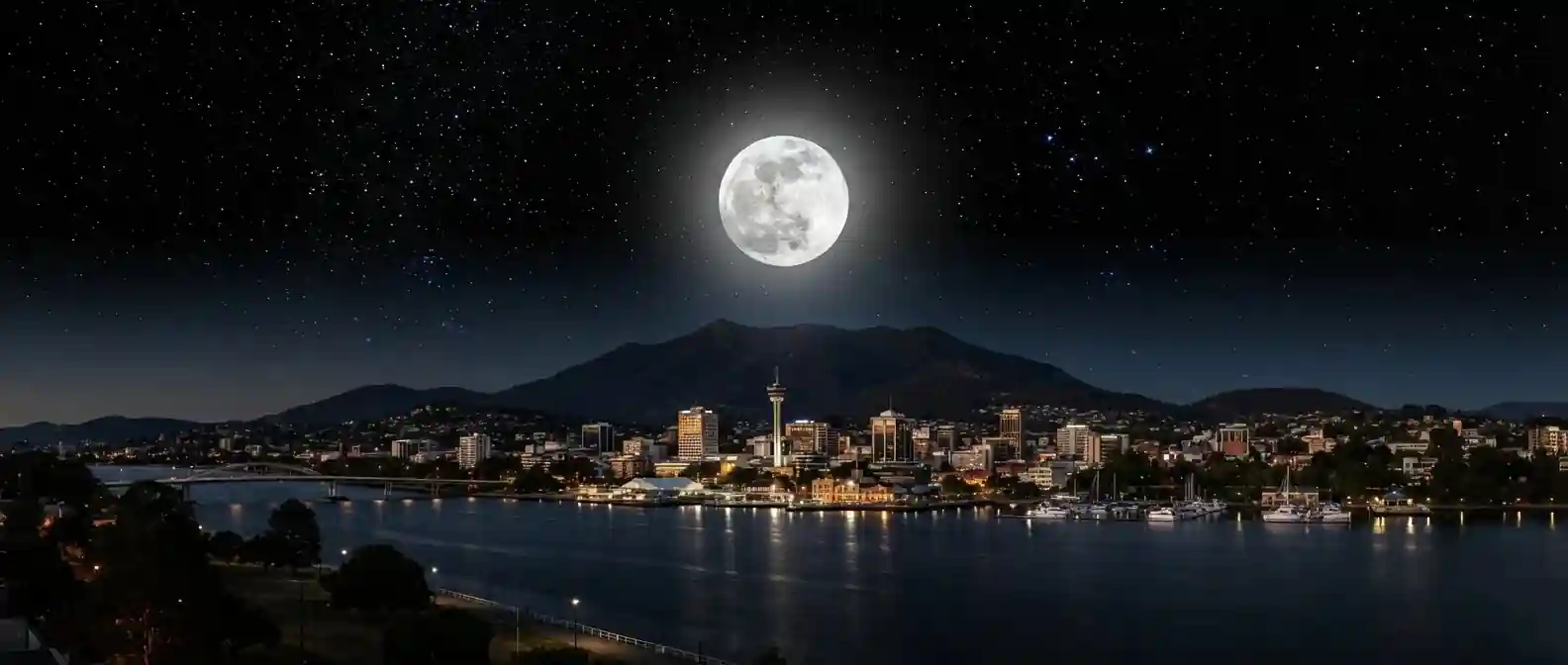
☽ Best Places to View the Moon in Hobart, Australia
Hobart is Australia's most southerly capital, set between kunanyi / Mount Wellington and the River Derwent. In the southern hemisphere the moon rises in the east, climbs to its highest point in the northern sky, and sets in the west, and the Derwent splits the viewpoints neatly: the west bank looks east for moonrise, and the Eastern Shore looks west toward the mountain for moonset. The mountain is a real alpine summit, with snow, ice and a road that often closes overnight, so check conditions before you plan a night session.
kunanyi / Mount Wellington Pinnacle – Highest Horizon, Road Often Shut at Night
At 1,271 m, the Pinnacle's lookouts and observation decks view over Hobart toward the east coast, the direction of moonrise, with the Derwent and city lights below. Wellington Park has no opening hours and no entry fee, and closes only on Extreme or Catastrophic fire danger days. The only road, Pinnacle Road, is run by the City of Hobart and closes for snow and ice, often pre-emptively, and overnight closures are common: a City of Hobart report counted 130 in 2019 and 95 in 2020. The enclosed observation shelter keeps daytime hours. Temperatures below 0°C and high winds are common, and the summit can be 12 degrees or more colder than the waterfront.
Rosny Hill Lookout – Eastern Shore, Moonset Over the Mountain
Lookout on the Eastern Shore with views of Kangaroo Bay, the Derwent, Mount Wellington and Tasman Bridge. It faces west, so it suits a moonset: the mountain lies west-south-west and Tasman Bridge west-north-west, both inside the range where the moon sets, and a setting moon can drop behind the summit before its calculated time. A moonrise comes up behind you, over the Eastern Shore, so do not plan a moonrise-over-the-city shot here. Check current local access.
Mount Nelson Lookout and Signal Station – Derwent and Storm Bay
About a 10-minute drive from central Hobart, overlooking the Derwent and Storm Bay, in a skyline reserve reached via Bicentennial Park or Truganini Conservation Area. The water lies to the east and south-east, the direction of moonrise, so it gives an elevated moonrise over the estuary. Check current access and wind.
Battery Point and Sullivans Cove – West Bank, Moonrise Over the Water
On the west bank, facing east across the Derwent, so a rising moon comes up over the water and the Eastern Shore hills. The Battery Point Sculpture Trail runs between Salamanca Place and Marieville Esplanade, with sections down to the waterfront. These are public streets and foreshore, so check current conditions.
Bellerive Foreshore and Kangaroo Bay – Eastern Shore Waterfront
Bellerive Public Pier extends into the mouth of Kangaroo Bay with a walkway, seating and lighting, and the Clarence Foreshore Trail follows the Derwent with views across toward Mount Wellington. It faces west, so it is another moonset spot, and the pier lighting makes it easier to reach in the dark. The area is subject to development and planning work, so check current access.
Mount Pleasant Observatory – Public Night Sky Evenings
The Astronomical Society of Tasmania holds Public Night Sky Viewing Evenings at its observatory on Denholms Road, between Cambridge and Richmond, on the University of Tasmania's radio observatory site, in relatively dark skies. Dates are normally set for later summer, autumn or early spring, and often to give a good view of a first quarter moon. Registration is essential, and the night is cancelled in cloud, haze or rain.
◉ Best Times for Moon Photography in Hobart
📷 Quick Tips for Hobart
🕐 Timezone: Hobart runs on Australian Eastern Standard Time (AEST, UTC+10) and Australian Eastern Daylight Time (AEDT, UTC+11), with daylight saving from the first Sunday in October to the first Sunday in April. Australia/Hobart.
Horizons: The Derwent runs through the middle of the city. The west bank faces east for moonrise, and the Eastern Shore faces west, where Mount Wellington (1,271 m) can hide a low setting moon. Check the azimuth for your particular date.
Light: Hobart is a small capital, so the city glow is modest. The Astronomical Society of Tasmania describes its Mount Pleasant Observatory as having relatively dark skies.
Access: Wellington Park is open at all times except Extreme or Catastrophic fire danger days, with no Parks Pass needed. Pinnacle Road is not: it closes for ice, snow, fire danger and events, and often overnight. The summit is not a casual night walk, with temperatures below 0°C and severe wind chill common. Do not assume 24-hour access at Rosny Hill or the foreshores.
◐ What It Feels Like
On kunanyi / Mount Wellington, Hobart feels like another climate. The wind is sharp, the Derwent and the city lights are far below, and the moon comes up out of the east over the coast.
From Rosny Hill and Bellerive, it feels like a front-row view of the mountain: the whole city and the Tasman Bridge laid out to the west, and a full moon sliding down toward the summit at dawn.
From Battery Point, it feels historic and calm: sandstone cottages, the cove, and a moon rising out of the water to the east.
"A moonrise over the Derwent from the west bank, a moonset behind the mountain from the east, and a road that is often closed at night."
✓ Checklist for Lunar Observers
Before You Go
- Check moonrise and moonset times and azimuth for your date — the moon rises in the east and sets in the west, and its direction shifts through the month
- Check Pinnacle Road status before driving up, because it closes for ice, snow, fire danger and events, often overnight, and check the fire danger rating for Wellington Park
- Confirm current access at Rosny Hill, Mount Nelson and the foreshores, including Bellerive's development work
What to Bring
- Telephoto and wide lenses for harbour and mountain compositions
- Tripod for bracketing and longer exposures, which also gives smooth-water effects
- Lens cloth for coastal and summit conditions
- Warm layers and windproof gear for the summit, where temperatures below 0°C and wind chill are common
On the Night
- Check exact azimuth and elevation — they vary nightly, and a low setting moon can disappear behind the mountain early
- Bracket for lunar detail and city lights during the twilight window
- Stay on marked tracks and lookouts, and respect road restrictions and fire closures
? Hobart Moon Phase — Frequently Asked Questions
Q. What is the moon phase today in Hobart?
The moon phase today in Hobart is a New Moon with 0% illumination. The next full moon is in 17 days, on Oct 26. Moonrise is at 5:58 AM and moonset at 7:19 PM.
Q. Where is the best place to view the moon in Hobart?
It depends which way you want to face. The Pinnacle of kunanyi / Mount Wellington, at 1,271 m, has lookouts with views over Hobart toward the east coast, so it gives the widest horizon for moonrise. Battery Point and Sullivans Cove on the west bank face east across the River Derwent, which suits a moonrise over the water. Rosny Hill Lookout and the Bellerive foreshore on the Eastern Shore face west toward Mount Wellington, the city and Tasman Bridge, which suits a moonset. Mount Nelson Signal Station overlooks the Derwent and Storm Bay.
Q. Can I look at the moon through a telescope in Hobart?
Yes. The Astronomical Society of Tasmania, founded in 1934, holds Public Night Sky Viewing Evenings at its Mount Pleasant Observatory on Denholms Road, between Cambridge and Richmond, on the University of Tasmania's radio observatory site, where the skies are relatively dark. Dates are normally set for later summer, autumn or early spring, and often chosen to give a good view of a first quarter moon, which sits in the north-west in the evening. Registration is essential, entry has been $10 per car at the gate, and the night is cancelled if cloud, haze or rain stops observing. The Society has also run Sidewalk Astronomy on the Hobart waterfront during the annual Off Season festival in August.
Q. Where does the moon rise and set in Hobart, and does it look different from the northern hemisphere?
Yes. At about 42.9°S, the moon rises in the east, climbs to its highest point in the north, and sets in the west, the reverse of northern cities where it crosses the south. Its rising point swings each month from roughly east-north-east to east-south-east, and its setting point from west-south-west to west-north-west, with a wider swing in years near a major lunar standstill. A full moon near the June winter solstice climbs to roughly 70° in the northern sky, while one near the December summer solstice peaks near 24°. The moon also looks inverted compared with the north: a waxing crescent is lit on its left and a waning crescent on its right. From the Eastern Shore, Mount Wellington lies west-south-west, so a setting moon can vanish behind the summit before its calculated moonset time. Check the azimuth for your date and exact spot.
Q. Is light pollution a problem for moon observing in Hobart?
The moon is bright enough to observe and photograph from almost anywhere in Hobart, so light pollution rarely limits the lunar disc itself. It does wash out earthshine on a thin crescent and any faint sky detail. Hobart is a small capital, so the city glow is modest and mostly confined to the Derwent valley and the waterfront, and the hills and the mountain block some of it. The Astronomical Society of Tasmania describes its Mount Pleasant Observatory, east of the city, as having relatively dark skies, and Tasmania's skies as still largely pristine.
Q. What camera settings and phases work best for moon photography in Hobart?
For a full moon, start with Looney 11 (f/11, ISO 100, 1/100 s) and refine using your histogram, since it is a baseline rather than a guarantee. The moon is much brighter than the harbour, hills and city lights, so shoot RAW and bracket or blend exposures to keep both crater detail and the foreground. A waxing gibbous is useful for blue hour over the Derwent while some daylight remains. To isolate the moon over a distant foreground such as Mount Wellington from the Eastern Shore, use a 200 to 400 mm lens on a sturdy tripod, with manual focus on the moon's edge using magnified live view. The Derwent can give a reflection when the water is calm.
Q. How do cloud, wind and snow affect moon viewing in Hobart?
Hobart's weather is changeable, and cloud can arrive quickly off the Southern Ocean, so clear lunar windows can be short. Kunanyi / Mount Wellington is a true alpine environment, where snow, black ice, high winds and temperatures below 0°C are common at the summit even when the city is mild, and the Wellington Park Management Trust says the Pinnacle can be 12 degrees or more colder than the waterfront. Snow can fall at any time of year. Check the forecast for the mountain as well as the city, and the Pinnacle Road status, before heading up.
Q. What time zone are Hobart's moonrise and moonset times shown in?
Hobart runs on Australian Eastern Standard Time, AEST, UTC+10, and Australian Eastern Daylight Time, AEDT, UTC+11, with Tasmania's daylight saving running from the first Sunday in October to the first Sunday in April. Moonrise and moonset times on this page follow the local clock in effect on each date. Hobart lies at about 147.3°E, roughly 2.7° west of the 150°E meridian on which AEST is based, so the sun and moon cross the sky about 11 minutes later on the clock than they would on that meridian.
Q. Can I shoot the moon at Hobart's viewpoints after dark?
Wellington Park is an open-access reserve with no opening or closing hours and no entry fee, closed only on days of Extreme or Catastrophic fire danger. The catch is the road: Pinnacle Road is managed by the City of Hobart and closes for snow and ice, sometimes pre-emptively, and for fire danger and events. A City of Hobart report counted 130 overnight closures in 2019 and 95 in 2020, when the road reopened by 9am, so a night drive to the summit is often not possible. The enclosed observation shelter at the Pinnacle keeps daytime hours, so plan for the open-air lookouts. Check current access for Rosny Hill, Mount Nelson and the foreshores.
✦ Explore Further
Moon Phase Today: Sydney
Check tonight's moon phase in Sydney, roughly 1,050 km north-north-east of Hobart across Bass Strait.
🦘Moon Phase in Australia
Browse moon phase pages for cities across Australia, from Hobart to Darwin.
🌍World Moon Phase Directory
Find the moon phase, rise and set times for cities in every region of the world.
Blue Hour Calculator
Work out when blue hour falls, ideal for waxing gibbous shots over the River Derwent.