
Moon Phase Today Central Coast Australia
On Saturday, October 10, 2026, the moon in Central Coast is a New Moon with 0% illumination. Moon age: 28.9 days.
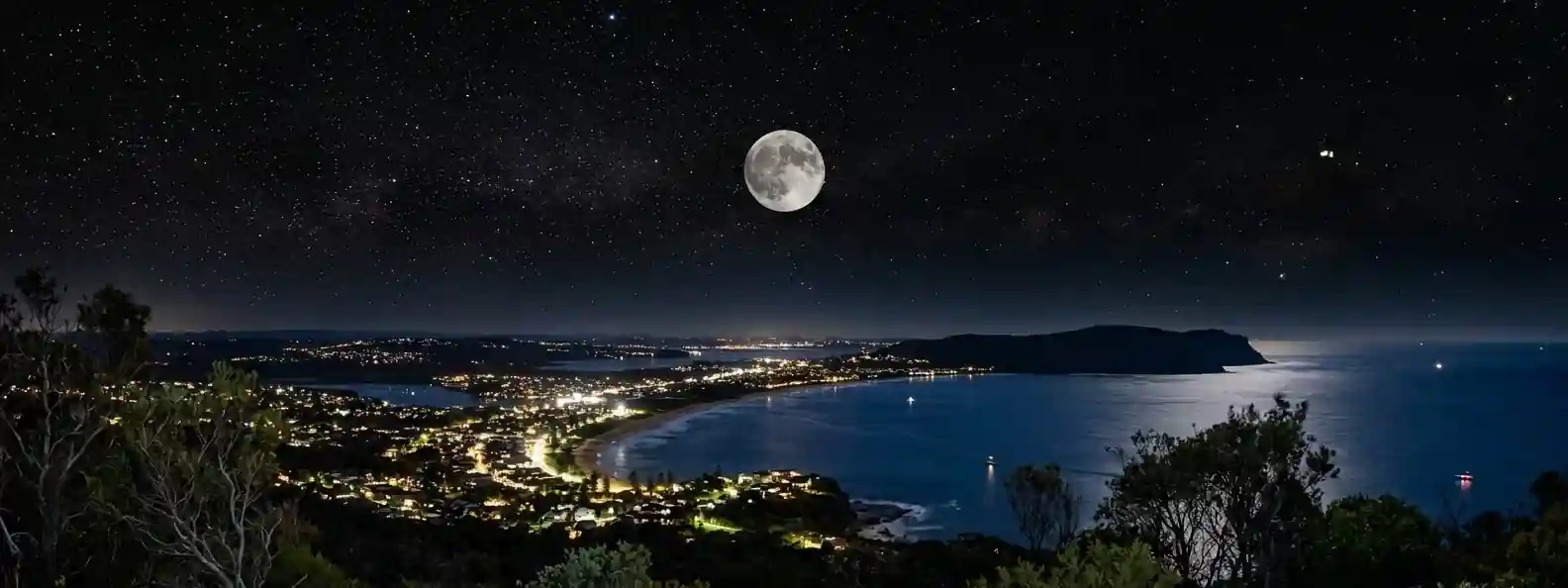
☽ Best Places to View the Moon in Central Coast, Australia
The Central Coast is a strip of beaches, headlands and lakes between Sydney and Newcastle, and its coast faces east over the Pacific. In the southern hemisphere the moon rises in the east, climbs to its highest point in the northern sky, and sets in the west, so every moonrise from the headlands comes up over open sea, and a full moon in June passes close to overhead, at about 80°. That makes the coast a moonrise region. The catch is access: the national park lookouts close at dusk, so a moonrise at a lookout depends on the season and the closing time.
Terrigal and The Skillion – Headland Over the Pacific
A coastal town with The Skillion headland, giving panoramic views over Terrigal Beach and the open Pacific. It faces east, so a rising moon comes up straight out of the sea. The headland is exposed, so check the wind before you set up a tripod.
Crackneck Point Lookout, Wyrrabalong National Park – Closes at Dusk
A headland lookout over Shelly Beach, with panoramic views along the coast past Norah Head, Tuggerah Lake and The Entrance. NSW National Parks lists Wyrrabalong as open 5:30am to 8pm during daylight saving and 5:30am to 6pm the rest of the year, so it is not a night site. The beaches here are not patrolled and can have strong rip currents. In summer, a full moon rising near sunset can be caught before closing.
Norah Head Lighthouse – Elevated Ocean Views
A historic lighthouse precinct on the northern Central Coast, with elevated views over the ocean, which lies to the east, the direction of moonrise. Check the lighthouse tour hours and the reserve's access before you plan an evening visit.
Bouddi National Park – Coastal Headlands
Secluded beaches and coastal headlands with Aboriginal sites, facing the open ocean to the east. NSW National Parks says it is always open, but it may close for poor weather or fire danger, and pets are prohibited. Cliff-top tracks are hazardous in the dark, so scout by day and check current alerts.
The Entrance and Tuggerah Lake – Lake Meets the Ocean
A lakeside town where Tuggerah Lake meets the ocean through The Entrance Channel. The lake can give a reflection on a calm evening, and the ocean beach faces east for moonrise. The channel is dynamic and was dredged in early 2026, so check current conditions.
Brisbane Water National Park – Inland Sandstone Country
Sandstone country with Somersby Falls, Girrakool and views over the Hawkesbury River. It lies inland, so the west is where the moon sets. Somersby Falls and Girrakool picnic areas close in the evening, from 8pm in daylight saving and 6pm otherwise, and other areas are open at all times subject to closures.
◉ Best Times for Moon Photography in Central Coast
📷 Quick Tips for Central Coast
🕐 Timezone: The Central Coast runs on Australian Eastern Standard Time (AEST, UTC+10) and Australian Eastern Daylight Time (AEDT, UTC+11), with daylight saving from the first Sunday in October to the first Sunday in April. Australia/Sydney.
Horizons: The coast faces east over the Pacific, so every moonrise is over open sea. The moon sets in the west, over the hinterland. Check the azimuth for your particular date.
Light: The coast is a long strip of towns with continuous lighting, and Sydney's glow lies to the south. The sky over the ocean is darker.
Access: Wyrrabalong is open 5:30am to 8pm in daylight saving and 5:30am to 6pm otherwise. Bouddi is always open but can close for weather or fire. The Somersby Falls and Girrakool picnic areas close in the evening. Check NSW National Parks alerts before an evening visit.
◐ What It Feels Like
At The Skillion, the Central Coast feels like a town facing the ocean: the headland above Terrigal Beach, the wind off the water, and the moon rising out of the sea with a bright path across the waves.
At Crackneck Point, it feels wide and open. The lookout runs along the coast to Norah Head and The Entrance, and a summer full moon lifts out of the Pacific just before the gates close.
At Bouddi, it feels remote: secluded bays and cliff-top tracks, best scouted by day and left before dark.
"A coast that faces the moonrise, and lookouts that close at dusk."
✓ Checklist for Lunar Observers
Before You Go
- Check moonrise and moonset times and azimuth for your date — the moon rises in the east and sets in the west, and its direction shifts through the month
- Check hours — Wyrrabalong 5:30am to 8pm in daylight saving or 6pm otherwise, Bouddi always open but can close, and Somersby Falls and Girrakool picnic areas close in the evening
- Confirm current trail and beach access and fire danger, and check The Entrance Channel conditions
What to Bring
- Telephoto and wide lenses for headland and lake compositions
- Tripod with a tilting head for bracketing, reflections and a high moon
- Lens cloth for coastal humidity and spray
- Warm layers for evening coastal winds
On the Night
- Check exact azimuth and elevation — they vary nightly
- Bracket for lunar detail and coastal lights during the twilight window
- Stay on marked trails, respect posted closing times, and keep clear of unpatrolled beaches and cliff edges
? Central Coast Moon Phase — Frequently Asked Questions
Q. What is the moon phase today in Central Coast?
The moon phase today in Central Coast is a New Moon with 0% illumination. The next full moon is in 17 days, on Oct 26. Moonrise is at 5:49 AM and moonset at 6:53 PM.
Q. Where is the best place to view the moon on the Central Coast?
Face the ocean for moonrise. The Central Coast's coast faces east over the Pacific, so the headlands and lookouts give an open sea horizon where the moon comes up. The Skillion at Terrigal is a headland with panoramic views over Terrigal Beach, and Crackneck Point lookout in Wyrrabalong National Park looks over Shelly Beach and along the coast toward Norah Head, Tuggerah Lake and The Entrance. Norah Head Lighthouse has elevated ocean views, Bouddi National Park has coastal headlands and secluded beaches, and Tuggerah Lake meets the ocean at The Entrance.
Q. Can I watch the moon rise over the sea on the Central Coast?
Yes, and it is the region's main lunar draw. Because the coast faces east, every moonrise comes up over open water, with a rising point that swings between roughly east-north-east and east-south-east through the month. A full moon rises near sunset, so catch it from a headland such as the Skillion or Crackneck Point, but check the park's closing time first, because Wyrrabalong National Park closes at 8pm in daylight saving and 6pm the rest of the year. Check the azimuth for your date to see where along the horizon it will appear.
Q. Where does the moon rise and set on the Central Coast, and does it look different from the northern hemisphere?
Yes. At about 33.4°S, the moon rises in the east, over the Pacific, climbs to its highest point in the north, and sets in the west, over the hinterland, the reverse of northern cities where it crosses the south. Its rising point swings each month from roughly east-north-east to east-south-east, with a wider swing in years near a major lunar standstill. A full moon near the June winter solstice climbs to roughly 80° in the northern sky, close to overhead, while one near the December summer solstice peaks near 33°. The moon also looks inverted compared with the north: a waxing crescent is lit on its left and a waning crescent on its right. Check the azimuth for your date and exact spot.
Q. Is light pollution a problem for moon observing on the Central Coast?
The moon is bright enough to observe and photograph from almost anywhere on the Central Coast, so light pollution rarely limits the lunar disc itself. It does wash out earthshine on a thin crescent and any faint sky detail. The coast is a long strip of towns with continuous lighting, and Sydney's glow lies to the south, so stars are faint near the beaches, but the sky over the ocean to the east is darker. Amateur astronomers have gathered at higher, darker ground inland at Mangrove Mountain around the new moon, though that was an informal group, so check local listings for any public telescope night.
Q. What camera settings and phases work best for moon photography on the Central Coast?
For a full moon, start with Looney 11 (f/11, ISO 100, 1/100 s) and refine using your histogram, since it is a baseline rather than a guarantee. The moon is much brighter than the sea, headlands and town lights, so shoot RAW and bracket or blend exposures to keep both crater detail and the foreground. A waxing gibbous is useful for twilight over the ocean and the lake while some daylight remains. To isolate the moon over a distant headland, use a 200 to 400 mm lens on a sturdy tripod, with manual focus on the moon's edge using magnified live view. A moonrise over the sea can lay a bright path on the water, and longer exposures smooth the waves.
Q. How do cloud, sea haze and wind affect moon viewing on the Central Coast?
The Central Coast has a mild coastal climate, but cloud and sea haze can build over the Pacific, so a rising moon can be hidden near the horizon even on a mostly clear night. Exposed headlands such as the Skillion are windy, especially in the evening, which can shake a tripod, and spray and humidity can fog lenses. Check cloud, haze and wind forecasts before heading out, and bring warm layers.
Q. What time zone are the Central Coast's moonrise and moonset times shown in?
The Central Coast runs on Australian Eastern Standard Time, AEST, UTC+10, and Australian Eastern Daylight Time, AEDT, UTC+11, with daylight saving running from the first Sunday in October to the first Sunday in April. Moonrise and moonset times on this page follow the local clock in effect on each date. The Central Coast lies at about 151.3°E, east of the 150°E meridian on which AEST is based, so the sun and moon cross the sky about five minutes earlier on the clock than they would on that meridian.
Q. Can I shoot the moon at the Central Coast's viewpoints after dark?
Not at Wyrrabalong National Park, which NSW National Parks lists as open from 5.30am to 8pm during daylight saving and 5.30am to 6pm the rest of the year, and where the beaches are not patrolled by lifeguards and can have strong rip currents. Bouddi National Park is always open but may close for poor weather or fire danger, and pets are prohibited. In Brisbane Water National Park, the Somersby Falls and Girrakool picnic areas close in the evening, from 8pm in daylight saving and 6pm otherwise. Check current alerts and access before an evening visit.
✦ Explore Further
Moon Phase Today: Sydney
Check tonight's moon phase in Sydney, roughly 50 km south-south-west of the Central Coast across the Hawkesbury River.
🦘Moon Phase in Australia
Browse moon phase pages for cities across Australia, from the Central Coast to Darwin.
🌍World Moon Phase Directory
Find the moon phase, rise and set times for cities in every region of the world.
Blue Hour Calculator
Work out when blue hour falls, ideal for waxing gibbous shots over the Pacific Ocean.