
Moon Phase Today Canberra
On Saturday, October 10, 2026, the moon in Canberra is a New Moon with 0% illumination. Moon age: 28.9 days.
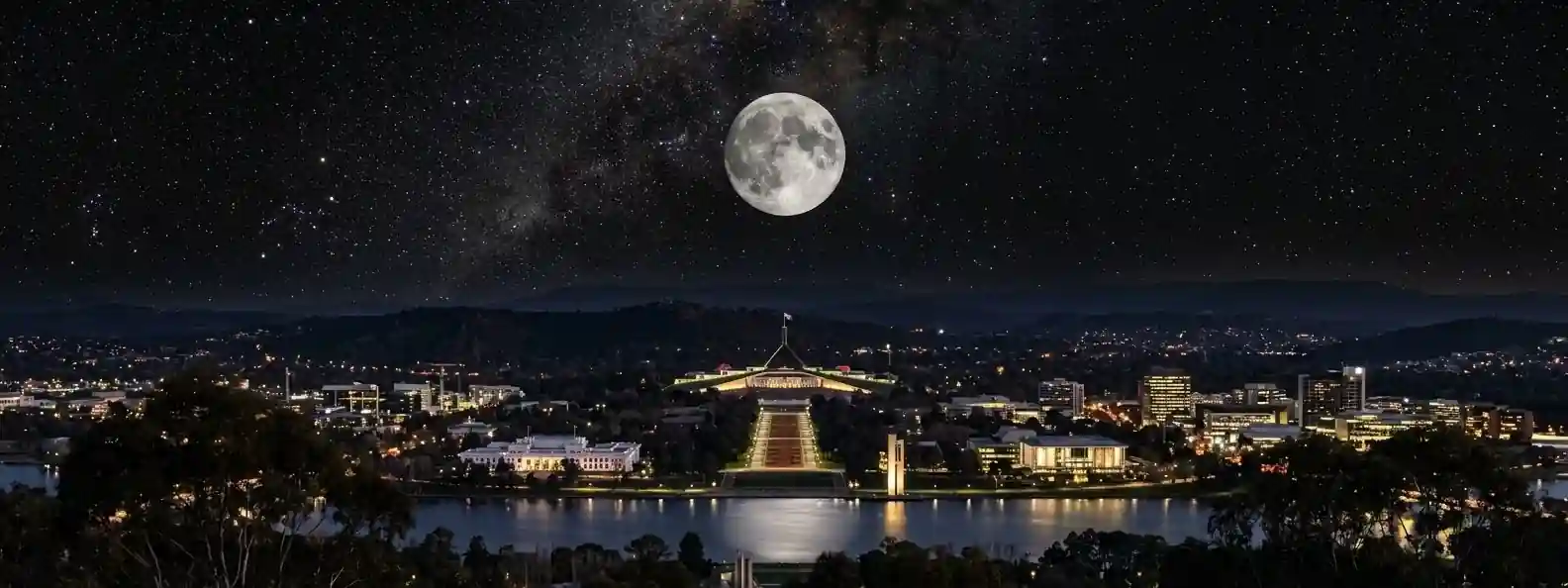
☽ Best Places to View the Moon in Canberra, Australia
Canberra is an inland capital built around Lake Burley Griffin and ringed by wooded hills, with the Brindabella Range to the west. In the southern hemisphere the moon rises in the east, climbs to its highest point in the northern sky, and sets in the west, and a full moon in June passes at about 78°. The hills that frame the city are the viewpoints: Mount Stromlo to the west looks east over the city, where the moon rises, while the lookouts on the east and north side look toward the western ranges, where it sets. Many of the best sites close at dusk, so the public stargazing nights at Mount Stromlo matter.
Mount Stromlo Observatory – Public Stargazing Nights, Moonrise Over the City
The observatory sits on a hill west of the city and looks east over Canberra and the lake, which lie east-north-east, inside the range of directions where the moon rises. With the Canberra Astronomical Society and the Australian National University it runs free public stargazing nights and lectures, with telescopes set up for visitors, weather permitting. Warm clothing is recommended. Paid private stargazing sessions can be booked, and the day visitor centre has daytime hours. Check current dates.
Mount Ainslie Lookout – Land Axis View, Moonset Toward the Ranges
A paved lookout with information plaques over Lake Burley Griffin and the national attractions, reached by walking, cycling or driving to the summit car park. It looks south-south-west along the Land Axis toward Parliament House, where the moon never sets, but the Brindabella Range to the west-south-west is in the right direction for a moonset. Tourism listings show 24 hours, but Parks ACT does not publish an explicit 24-hour schedule, so check current road and track access.
National Arboretum Canberra – Hilltop City Views, Seasonal Hours
Hilltop forests with sweeping city views. The grounds are open 7am to 5:30pm in standard time and 6am to 8:30pm in daylight saving, with closures possible for fire danger or events, so a dusk moonrise is realistic in summer. Pedestrians, cyclists and horse riders can use some parts after front-gate hours via Forest Drive and fire trails at their own risk, so check current conditions.
Lake Burley Griffin Central Basin – Reflections
The artificial lake at the heart of the city, formed by damming the Molonglo River, with the Central Basin and Captain Cook Jet looking toward the National Library and Parliament House. Calm evenings can give a moon reflection on the open water. Check current lake access and any event closures.
Black Mountain Nature Reserve – Woodland Above the City
A nature reserve on the northern side of the lake, with woodland, walking tracks and birdlife, reached on foot via the Australian National Botanic Gardens and topped by Telstra Tower. The city and lake lie to the east, the direction of moonrise. The Botanic Gardens are open 8:30am to 5pm daily, with the gates locked outside those hours, so this is a dusk and twilight option, not a night walk.
Canberra Deep Space Communication Complex – Apollo 11 Connection
The NASA-linked tracking complex at Tidbinbilla, with a daytime visitor centre. Canberra's Honeysuckle Creek tracking station provided the first pictures of the Apollo 11 moonwalk, and the complex tells that story. It is a daytime visit, not a night viewpoint, but it is the best place to connect the moon in the sky to Canberra's role in reaching it. Check current opening times.
◉ Best Times for Moon Photography in Canberra
📷 Quick Tips for Canberra
🕐 Timezone: Canberra runs on Australian Eastern Standard Time (AEST, UTC+10) and Australian Eastern Daylight Time (AEDT, UTC+11), with daylight saving from the first Sunday in October to the first Sunday in April. Australia/Sydney.
Horizons: Canberra is ringed by hills. Mount Stromlo to the west looks east over the city for moonrise, and the Brindabella Range to the west is in the right direction for moonset. Check the azimuth for your particular date.
Light: Canberra is a planned city with a clear glow over the central lake basin. Stars are better on the western and southern edges, such as Mount Stromlo.
Access: The Botanic Gardens are open 8:30am to 5pm, with gates locked outside. The Arboretum is open 7am to 5:30pm in standard time and 6am to 8:30pm in daylight saving. Mount Ainslie is listed as 24 hours by tourism sources, but not explicitly by Parks ACT. Fire danger can close reserves.
◐ What It Feels Like
At Mount Stromlo, Canberra feels like a small city under a big sky. Telescopes line up outside the observatory, members of the Astronomical Society point them at the moon, and the city lights spread out below to the east.
At Mount Ainslie, it feels formal and planned: the Land Axis runs straight down to Parliament House, the lake glitters beyond it, and the ranges go dark to the west as the moon sets.
At the Arboretum and the lake, it feels calm and cool: forest on the hilltop, still water below, and an early moon in the northern sky.
"A moonrise over the city from Mount Stromlo, and a moonset toward the ranges from Mount Ainslie."
✓ Checklist for Lunar Observers
Before You Go
- Check moonrise and moonset times and azimuth for your date — the moon rises in the east and sets in the west, and its direction shifts through the month
- Check hours — Mount Ainslie is 24 hours in tourism listings but not explicitly from Parks ACT, the Botanic Gardens close at 5pm, and the Arboretum has seasonal hours
- Check Mount Stromlo's public night dates, and fire danger and event closures
What to Bring
- Telephoto and wide lenses for lake and hill lookout compositions
- Tripod with a tilting head for bracketing, reflections and a high moon
- Lens cloth for cool evening air
- Warm layers and gloves for cold evening hilltop winds
On the Night
- Check exact azimuth and elevation — they vary nightly
- Bracket for lunar detail and city lights during the twilight window
- Stay on marked trails and observation decks, and respect reserve protections and posted closing times
? Canberra Moon Phase — Frequently Asked Questions
Q. What is the moon phase today in Canberra?
The moon phase today in Canberra is a New Moon with 0% illumination. The next full moon is in 17 days, on Oct 26. Moonrise is at 5:56 AM and moonset at 7:04 PM.
Q. Where is the best place to view the moon in Canberra?
It depends which way you want to face. Mount Stromlo, west of the city, looks east over Canberra and Lake Burley Griffin, the direction of moonrise, and it is also the site of Mount Stromlo Observatory. Mount Ainslie Lookout, north-east of the city centre, looks south-west over the city and the Land Axis toward Parliament House, with the ranges beyond, which suits a moonset. The National Arboretum has hilltop forests with sweeping city views, and Lake Burley Griffin's Central Basin gives open water for reflections. Black Mountain Nature Reserve has woodland trails north of the lake.
Q. Can I look at the moon through a telescope in Canberra?
Yes. Mount Stromlo Observatory runs free public stargazing nights and lectures with the Canberra Astronomical Society and the Australian National University, with telescopes set up for visitors. Warm clothing is recommended, and observing is weather dependent. The Observatory also offers paid private stargazing sessions with after-hours access and its outreach telescopes, which need booking. Check the Observatory's and the Society's current listings for dates, since a bright moon is the easiest first target. Canberra's Honeysuckle Creek tracking station provided the first pictures of the Apollo 11 moonwalk, and the Canberra Deep Space Communication Complex at Tidbinbilla, which has a daytime visitor centre, tells that story.
Q. Where does the moon rise and set in Canberra, and does it look different from the northern hemisphere?
Yes. At about 35.3°S, the moon rises in the east, climbs to its highest point in the north, and sets in the west, the reverse of northern cities where it crosses the south. Its rising point swings each month from roughly east-north-east to east-south-east, and its setting point from west-south-west to west-north-west, with a wider swing in years near a major lunar standstill. A full moon near the June winter solstice climbs to roughly 78° in the northern sky, while one near the December summer solstice peaks near 31°. The moon also looks inverted compared with the north: a waxing crescent is lit on its left and a waning crescent on its right. From Mount Stromlo, Canberra lies to the east-north-east, inside the range where the moon rises, so a rising moon can appear over the city. From Mount Ainslie, Parliament House lies to the south-south-west, where the moon never sets, but the Brindabella Range to the west-south-west is in the right direction for moonset. Check the azimuth for your date and exact spot.
Q. Is light pollution a problem for moon observing in Canberra?
The moon is bright enough to observe and photograph from almost anywhere in Canberra, so light pollution rarely limits the lunar disc itself. It does wash out earthshine on a thin crescent and any faint sky detail. Canberra is a planned city of lit suburbs and parkland, with a clear glow over the central lake basin, so stars are faint near the centre but better on the western and southern edges, such as Mount Stromlo. The Canberra Astronomical Society has run dark-sky nights out of town for members.
Q. What camera settings and phases work best for moon photography in Canberra?
For a full moon, start with Looney 11 (f/11, ISO 100, 1/100 s) and refine using your histogram, since it is a baseline rather than a guarantee. The moon is much brighter than the lake, hills and city lights, so shoot RAW and bracket or blend exposures to keep both crater detail and the foreground. A waxing gibbous is useful for twilight over Lake Burley Griffin while some daylight remains. To isolate the moon over a distant foreground such as Parliament House or the lake from a hill lookout, use a 200 to 400 mm lens on a sturdy tripod, with manual focus on the moon's edge using magnified live view. A calm evening can give a reflection on the lake, and a tilting tripod head helps when the moon is high in the north.
Q. How do cold, fog and smoke affect moon viewing in Canberra?
Canberra is inland, so it is less exposed to the sea haze that affects coastal cities, but its winter nights can be very cold and frosty, and fog can settle over the lake and low ground, especially on still mornings. Hilltop lookouts such as Mount Ainslie and the Arboretum can be windy in the evening. In summer, bushfire smoke can dim and redden the moon, and fire danger can close reserves. Check cloud, fog, wind and fire-danger forecasts before heading out, and bring warm layers.
Q. What time zone are Canberra's moonrise and moonset times shown in?
Canberra runs on Australian Eastern Standard Time, AEST, UTC+10, and Australian Eastern Daylight Time, AEDT, UTC+11, with daylight saving running from the first Sunday in October to the first Sunday in April. Moonrise and moonset times on this page follow the local clock in effect on each date. Canberra lies at about 149.1°E, slightly west of the 150°E meridian on which AEST is based, so the sun and moon cross the sky about three minutes later on the clock than they would on that meridian.
Q. Can I shoot the moon at Canberra's viewpoints after dark?
Mostly not at the gardens and the Arboretum. The Australian National Botanic Gardens are open from 8.30am to 5pm every day except Christmas Day, with the gates locked outside those hours. The National Arboretum's grounds are open 7am to 5.30pm in standard time and 6am to 8.30pm in daylight saving, with closures possible for fire danger or events, and some after-hours pedestrian and cyclist access via Forest Drive and fire trails at your own risk. Mount Ainslie Lookout appears as 24 hours in tourism listings, but Parks ACT does not publish an explicit 24-hour schedule, so check current road and track access. Mount Stromlo's public stargazing nights are the dependable night option.
✦ Explore Further
Moon Phase Today: Sydney
Check tonight's moon phase in Sydney, roughly 245 km north-east of Canberra across the Southern Tablelands.
🦘Moon Phase in Australia
Browse moon phase pages for cities across Australia, from Canberra to Darwin.
🌍World Moon Phase Directory
Find the moon phase, rise and set times for cities in every region of the world.
Blue Hour Calculator
Work out when blue hour falls, ideal for waxing gibbous shots over Lake Burley Griffin.