
Moon Phase Today Leicester UK
On Friday, October 9, 2026, the moon in Leicester is a New Moon with 0% illumination. Moon age: 28.9 days.
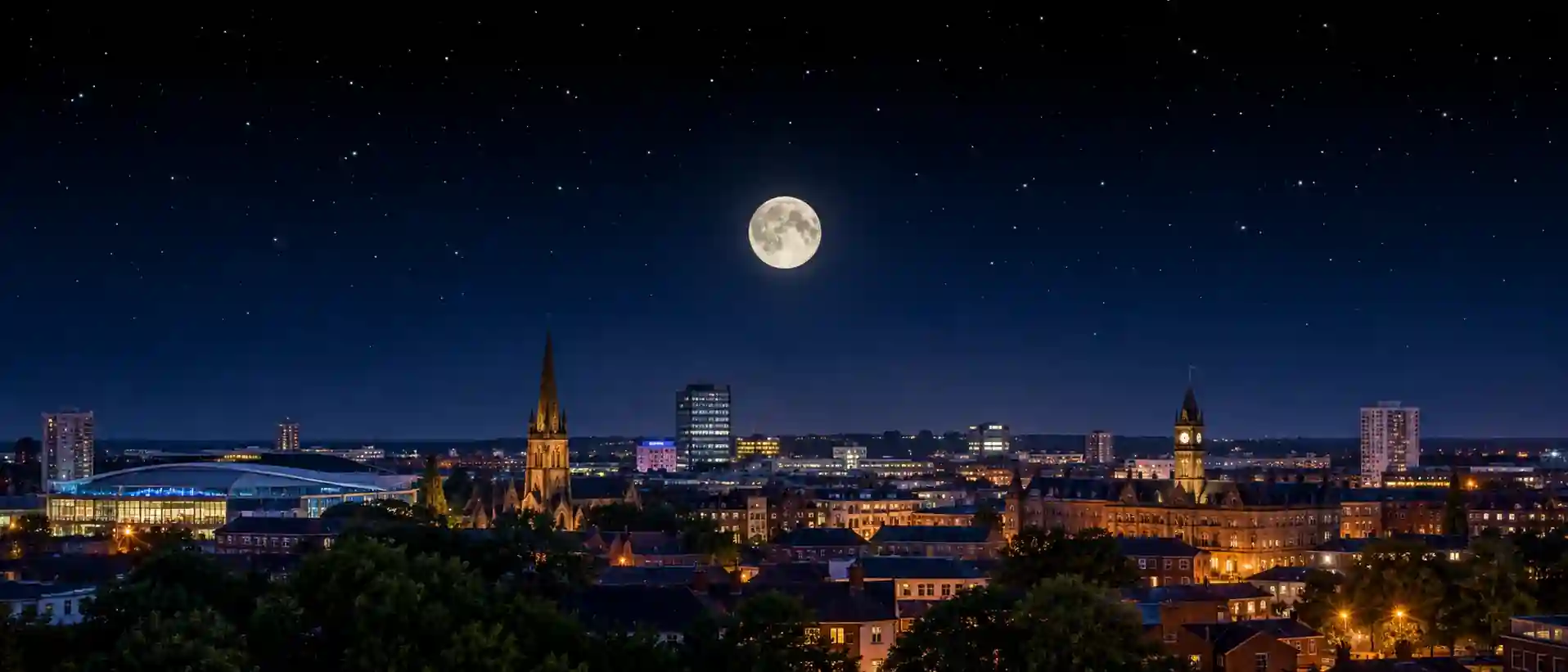
☽ Best Places to View the Moon in Leicester, UK
Leicester is a low-lying city built around the River Soar, and it is the home of the National Space Centre, the largest dome planetarium in the UK and the base of the Leicester Astronomical Society. That makes it one of the best places in the East Midlands to look at the moon through a telescope. The city is bright, so the parks suit moonrises and reflections on water rather than stars.
Abbey Park – Soar Water Meadows
An 89-acre Grade II* registered park, opened in 1882 on former water meadows between the River Soar and the canal, with a lake, open lawns and a bandstand. The ruins of the medieval abbey and Cavendish House lie across the river in the Abbey Grounds. The park is open daily but with set hours, so check the council's current times before an evening visit.
National Space Centre – Space Lates and Telescopes
On Exploration Drive in Belgrave, with the Sir Patrick Moore Planetarium, the largest dome planetarium in the UK. Evening Space Lates include stargazing through telescopes with the Leicester Astronomical Society, and the society meets here on the second and fourth Tuesdays at 7.30pm. It is the easiest place in Leicester to see the moon through a telescope. Check event listings and booking.
Watermead Country Park (North) – Lakes North of the City
Managed by Leicestershire County Council, north-east of Leicester beside the A46 between Syston and Wanlip, with lakes and the River Soar. The open water can hold a reflection when still. The park is open every day, but the car park closes seasonally, from 4pm in winter to 8pm in summer, with no overnight parking.
Victoria Park – Former Racecourse
A 69-acre park south-east of the city centre, backing onto the University of Leicester and close to the railway station. Leicester racecourse ran here from 1806 to 1883, and the wide open grass reflects that history. It gives a broad sky close to the centre. Check council opening times first.
Western Park – West Leicester
One of the city's largest parks, at 72 acres, west of the centre, with open grassland, woodland and sports pitches. The open ground gives a wide view toward the west, the direction of moonset. Check council opening times before an evening visit.
Evington Park – East Leicester
A large Victorian park in the east of the city with formal gardens, lawns and wooded areas. The lawns give an open sky on the eastern side, the direction of moonrise. Check council opening times, and stay on paths in the dark.
◉ Best Times for Moon Photography in Leicester
📷 Quick Photography Tips for Leicester
🕐 Timezone: Leicester runs on Greenwich Mean Time (GMT, UTC+0) in winter and British Summer Time (BST, UTC+1) in summer.
Horizons: Leicester is low-lying, built around the River Soar valley, so buildings and trees hide a low moon at street level. Open water meadows, lakes and wide parkland give the clearest sightlines.
Light: Leicester is a large city, and the National Space Centre is estimated to have urban light levels. Stars are faint across the city, so plan around the moon or join a telescope event.
Access: Abbey Park is open daily with set hours, and Watermead North's car park closes seasonally with no overnight parking. Check the council for the other city parks, and check Space Centre listings for evening events.
The moon phase today in Leicester is shown above. For the moon phase today anywhere else, visit the Dynamic Moon Phase Calculator.
◐ What the Experience Actually Feels Like
At Abbey Park, Leicester feels Victorian and riverside: a lake, a bandstand and old abbey ruins, with an early-evening moon rising over the water meadows.
At Watermead, it feels like open country on the edge of the city. The lakes go quiet, the reeds stand against the sky, and a still evening gives a clear reflection of the moon.
At the National Space Centre, it feels like a city that looks up. Telescopes line up outside, members of the Astronomical Society point them at the moon, and the planetarium dome glows behind.
"Moon over the water meadows at Abbey Park, and through a telescope at the National Space Centre."
✓ Your Leicester Moon Chase Checklist
Before You Go
- Check the moonrise and moonset times and azimuth for your date — a rising moon appears between north-east and south-east
- Check access — Abbey Park has set daily hours, Watermead North's car park closes seasonally, and the Space Centre needs a booking for evening events
- Check the Met Office for cloud, visibility, wind and rain
What to Bring
- A telephoto lens of 200mm or longer for a tight Moon, and a wide lens for the lakes and parkland
- A tripod, and a remote shutter or 2-second timer
- A lens cloth for damp air near the water
- A warm layer and water-resistant footwear for wet paths
On the Night
- Focus manually on the Moon's edge
- Bracket exposures — one for the bright disc, one for the darker land or water
- Stay on paths, and take care by the water in the dark
- A Green Flag award means well maintained, not open at night — check hours before you go
? Leicester Moon Phase — Frequently Asked Questions
Q. What is the moon phase today in Leicester?
The moon phase today in Leicester is a New Moon with 0% illumination. The next full moon is in 17 days, on Oct 26. Moonrise is at 5:57 AM and moonset at 5:47 PM.
Q. Where is the best place to view the moon in Leicester?
Abbey Park, a 89-acre Grade II* registered park beside the River Soar, opened in 1882 and formed from former water meadows, has open lawns and a lake. Watermead Country Park (North), managed by Leicestershire County Council north-east of the city, has lakes for reflections. Victoria Park, a 69-acre park south-east of the centre that was the site of Leicester racecourse until 1883, and Western Park, a 72-acre park in the west, have open grassland. The National Space Centre, in Belgrave, is the place to go for an organised moon-gazing evening.
Q. Can I look at the moon through a telescope in Leicester?
Yes. The National Space Centre on Exploration Drive holds Space Lates, evening events with talks, planetarium shows and stargazing through telescopes with astronomers from the Leicester Astronomical Society. The Space Centre's Sir Patrick Moore Planetarium is the largest dome planetarium in the UK, and it has run shows such as Chasing the Moon. The Leicester Astronomical Society meets at the Space Centre on the second and fourth Tuesday of most months at 7.30pm. Check the Space Centre's event listings for dates and booking, since stargazing depends on the weather.
Q. Where does the moon rise and set in Leicester, and how high does it climb?
At about 52.6°N, Leicester's moonrise and moonset points swing widely across the horizon each month, from roughly north-east to south-east for rising and north-west to south-west for setting, with an even wider swing in years near a major lunar standstill. A full moon near the winter solstice climbs to roughly 61° in the south, while a full moon near the summer solstice stays very low, peaking near 14°, so it needs a clear view south. Leicester is low-lying, built around the River Soar valley, so buildings and trees hide a low moon at street level, and open water meadows and lakes give the clearest sightlines. Check the azimuth for your date and exact spot.
Q. Is light pollution a problem for moon observing in Leicester?
The moon is bright enough to observe and photograph from almost anywhere in Leicester, so light pollution rarely limits the lunar disc itself. It does wash out earthshine on a thin crescent and any faint sky detail. Leicester is a large city, and the National Space Centre itself is estimated to have urban light levels, so stars will be faint across the city, including in its parks. For darker skies you need to leave the city for the Leicestershire countryside, and the Space Centre's events are a better bet for a telescope view than a dark park.
Q. What camera settings and phases work best for moon photography in Leicester?
For a full moon, start with Looney 11 (f/11, ISO 100, 1/100 s) and refine using your histogram, since it is a baseline rather than a guarantee. The moon is much brighter than parkland, lakes and the city, so shoot RAW and bracket or blend exposures to keep both crater detail and the foreground. A waxing gibbous is useful for blue hour over the water while some daylight remains. For a moon-and-landmark shot, move farther back and use a longer focal length of 200 mm or more, with a sturdy tripod and manual focus on the moon's edge using magnified live view. Abbey Park's lake and the Watermead lakes can give a reflection when the water is still.
Q. How do cloud, wind and mist affect moon viewing in Leicester?
Leicester has a mild, changeable East Midlands climate with frequent cloud and rain, so clear lunar windows can be short. Mist can gather over the River Soar water meadows, lakes and low ground on cool, still nights, and open lakeside parks can be windy. Paths can be wet and muddy after rain, so wear water-resistant footwear. Check the Met Office forecast for cloud, visibility, wind and rain before heading out.
Q. What time zone are Leicester's moonrise and moonset times shown in?
Leicester runs on Greenwich Mean Time, UTC+0, in winter and British Summer Time, UTC+1, in summer. Clocks go forward on the last Sunday in March and back on the last Sunday in October, and moonrise and moonset times on this page follow the local clock in effect on each date. Leicester lies at about 1.1°W, close to the Greenwich meridian on which GMT is based, so clock times track the sun and moon closely.
Q. Can I shoot the moon at Leicester's viewpoints after dark?
Mostly not at Abbey Park, which is open daily but with set hours that listings give differently, so check Leicester City Council's current times before an evening visit. Watermead Country Park (North) is open every day, but its car park closes in the evening, from 4pm in December and January to 8pm from May to August, and overnight parking and camping are not allowed. Check the council for Victoria Park, Western Park and the other city parks, and note that a Green Flag award means well maintained, not open at night. The National Space Centre's evening events are the dependable night option.
✦ Explore Further
Moon Phase Today: Birmingham
Check tonight's moon phase in Birmingham, roughly 55 km west-south-west of Leicester in the West Midlands.
🏙Moon Phase Today: Manchester
See the moon over Manchester, roughly 120 km north-west of Leicester across the Peak District.
🇬🇧Moon Phase in the UK
Browse moon phase pages for cities across the United Kingdom, from Edinburgh to Bath.
🌍World Moon Phase Directory
Find the moon phase, rise and set times for cities in every region of the world.
Blue Hour Calculator
Work out when blue hour falls, ideal for waxing gibbous shots over Abbey Park's lake.