
Moon Phase Today Zamboanga
On Monday, October 5, 2026, the moon in Zamboanga is a Waning Crescent with 34% illumination. Moon age: 23.7 days.
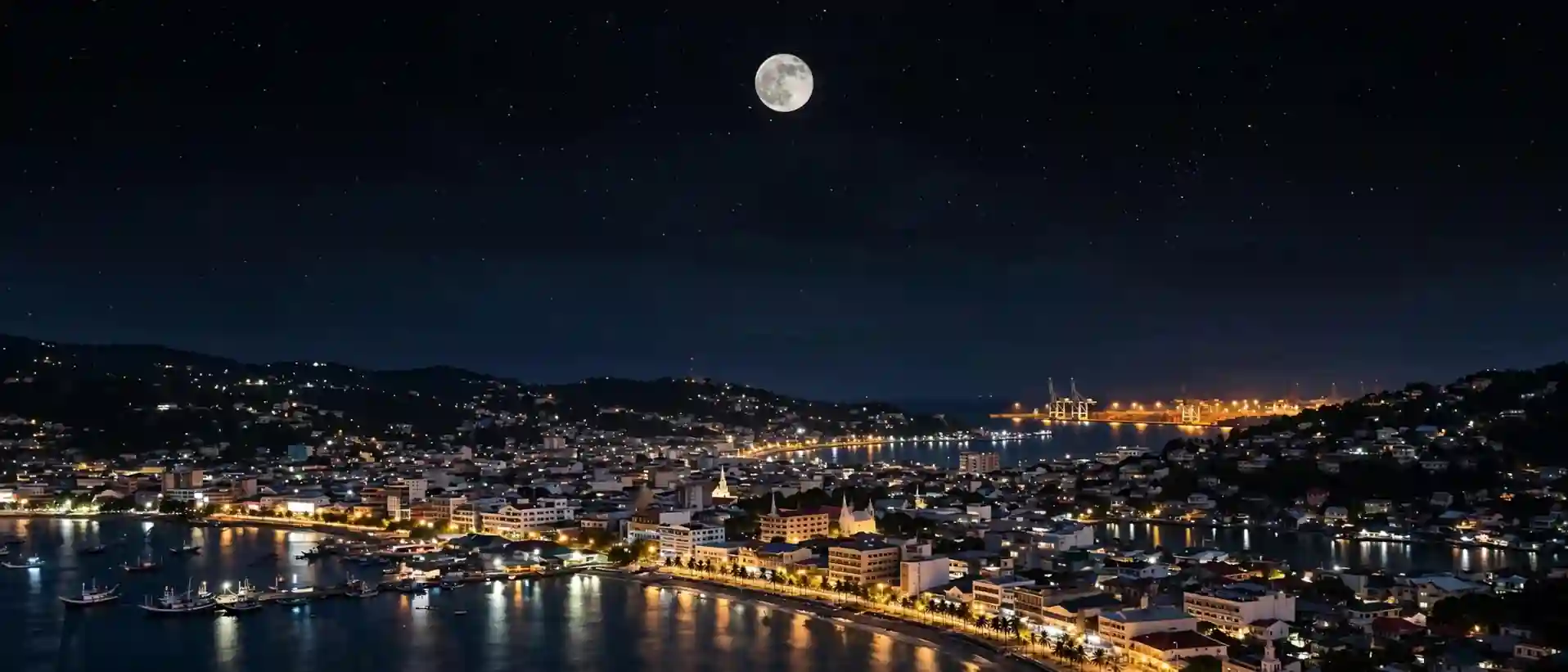
☽ Best Places to View the Moon in Zamboanga City, Philippines
Zamboanga City sits at roughly 6.9°N at the southern tip of the Zamboanga Peninsula, with the Sulu Sea to the west, the Moro Gulf to the east and the Basilan Strait to the south. The west coast faces the Sulu Sea and the east coast faces the Moro Gulf, and narrow coastal plains rise quickly to interior hills, so the downtown waterfront, the Heritage Zone and the upland park of Pasonanca each give a different view. At this latitude the Moon rises and sets fairly close to due east and west and climbs high: a full Moon near the December solstice passes roughly 68° to 79° up, a little north of the zenith, while one near the June solstice crosses the southern sky at roughly 55° to 65°. Moonsets can fall over the Sulu Sea from west-coast spots, and moonrise can fall over the strait or the east-coast hills depending on the date. Exact rise and set times and azimuth depend on the date and your observing position, so check both before planning a specific composition.
Paseo del Mar – Fort Pilar Waterfront
A public park on the waterfront beside Fort Pilar, with a colourful open stage, a children's playground and a skate park, one of the city's newest public spaces. It is listed as open from 6 a.m. until about midnight, which makes it the most practical evening spot in the Heritage Zone, with a broad view of the sea to the south. Crowds and events vary, so check current access and use the public walkways.
R.T. Lim (Cawa-Cawa) Boulevard
The city's seaside path, where locals stroll and jog, with views across the water to the Cruz Islands. It is listed as open around the clock, and it faces the sea, so the Moon can rise or set over the water for a date when the azimuth lines up, with a possible reflection. It is a public promenade, so crowd levels vary; use the designated viewing areas and mind the sea breeze when setting up a tripod.
Heritage Zone – Plaza Pershing, Rizal Park & Fort Pilar
The Heritage Zone groups City Hall, Plaza Pershing, Rizal Park, Pettit Barracks, Fort Pilar Shrine, the National Museum and Paseo del Mar close together in the central business district. The plazas and the fort grounds give open ground among historic buildings for a moon-over-landmark photograph when the Moon's azimuth for your date lines up. City Hall keeps office hours of about 7 a.m. to 6 p.m., and the fort and museum keep their own hours, so check before a late visit and use public areas only.
Pasonanca Park – Daytime Upland Park
The city's main upland park, in Barangay Pasonanca, about 5 to 6 km north of the centre. Construction began in 1912 under General John J. Pershing, governor of the Moro Province. It has the Pasonanca Tree House, an aviary, the Jardin Maria Clara Lobregat and Butterfly Park, three public pools and an amphitheatre, and it is known for a cool, comfortable climate. It is listed as open daily from 6 a.m. to 6:30 p.m., so it closes about when a full Moon rises, which makes it a daytime visit.
West Coast – Limpapa Viewing Deck & the Sulu Sea
The Limpapa Viewing Deck on the Zamboanga West Coastal Road is listed among the city's viewpoints. The west coast faces the Sulu Sea, so from here the Moon can set over open water, between roughly west-north-west and west-south-west. It is outside the central business district, so check current access and conditions, plan your return transport, and avoid private resort grounds along the coast.
Telescopes – PAGASA Regional Centres
Zamboanga has no regular public telescope night that is advertised. PAGASA, the national astronomy agency, lists its regional centres in Davao and Cagayan de Oro, among others, as places where stargazing and telescoping sessions can be arranged, but both are several hundred kilometres away, and Zamboanga is not on its list. Check PAGASA and local schools for one-off events.
◉ Best Times for Moon Photography in Zamboanga City
📷 Quick Photography Tips for Zamboanga City
🕐 Timezone: Zamboanga City runs on Philippine Standard Time (UTC+8) year-round; the Philippines does not observe daylight saving time. Photo-planning apps such as PhotoPills or Stellarium will work out the Moon's exact rise azimuth for any of these spots.
🔭 Telescope Option: Zamboanga has no regular public telescope night. PAGASA lists its regional centres in Davao and Cagayan de Oro as places where stargazing sessions can be arranged, both several hundred kilometres away. For the moon phase in any other city, use the calculator on our home page.
The moon phase today in Zamboanga City is shown in detail above — complete with exact illumination percentage, moonrise/set times, and the best local spots to see it. For the moon phase today in any other city worldwide, visit our Dynamic Moon Phase Calculator on the home page.
◐ What the Experience Actually Feels Like
At Paseo del Mar and R.T. Lim Boulevard, Zamboanga feels coastal and relaxed. The promenade stays open late, families and joggers share it, and the sea opens out to the south, with the Cruz Islands visible across the water. A moonrise there is an easy evening, not an expedition, and the Moon climbs high rather than hugging the horizon.
The Heritage Zone gives the same evening a historic backdrop. City Hall, Plaza Pershing, Rizal Park and Fort Pilar sit within a short walk of each other and of the waterfront, so a moon-over-landmark photograph is only a matter of working out which way the Moon will rise on your date.
Pasonanca Park is the contrast. It is the city's upland park, cooler and greener, with its tree house, aviary and garden, but it closes around the time a full Moon rises, so it is a place for the day. For the Moon setting over open water, the west coast faces the Sulu Sea. The wetter months, roughly May to November, can cover the Moon for days, and the drier months from December make the better bet.
"Zamboanga has a waterfront that stays open late and a heritage zone a short walk behind it — a good place to watch the Moon climb out of the sea air."
✓ Your Zamboanga City Moon Chase Checklist
Before You Go
- Check the moonrise time and phase on this page for your date — some days have no moonrise at all
- Paseo del Mar is listed as open until about midnight and R.T. Lim Boulevard around the clock, but Pasonanca Park only 6 a.m. to 6:30 p.m. and City Hall about 7 a.m. to 6 p.m. — confirm hours before a late setup
- Use PhotoPills or Stellarium to check whether the Moon will rise or set over the water or line up with a landmark on your date
- If you want a telescope, check PAGASA for one-off events, since Zamboanga has no regular public night
- Check the current PAGASA forecast and tropical-cyclone advisories, especially from May to November
What to Bring
- A telephoto lens, often 200 mm or longer, to frame the Moon tightly against Fort Pilar or the plaza monuments, plus a wider lens for sea reflections
- A sturdy tripod and a remote shutter release or 2-second timer to avoid shake
- A lens cloth for humidity, sea breeze and haze, which are common in the evening
- A light rain layer and water-resistant footwear during the wetter months, May to November
- Some Philippine pesos for food or parking near the Heritage Zone and boulevard
On the Night
- Arrive early at the boulevard and Paseo del Mar, which are popular for sunset and evening strolls and can be busy on weekends
- Focus manually on the Moon's edge, since City Hall and boulevard lighting can confuse autofocus at dusk
- Bracket exposures: one for the bright lunar disc and another for the darker promenade or fort grounds below
- Stay in public areas and on the promenade, and avoid private resort grounds and steep interior hills without permission
? Zamboanga City Moon Phase — Frequently Asked Questions
Q. What is the moon phase today in Zamboanga City?
The moon phase today in Zamboanga City is a Waning Crescent with 34% illumination. The next full moon is in 22 days, on Oct 26. Moonrise is at 12:42 AM and moonset at 1:37 PM.
Q. Where is the best place to view the moon in Zamboanga City?
Zamboanga City sits at the southern tip of the Zamboanga Peninsula, with the Sulu Sea to the west, the Moro Gulf to the east and the Basilan Strait to the south, so the best spots are on the waterfront. Paseo del Mar, a public park beside Fort Pilar, is listed as open into the early hours, and R.T. Lim (Cawa-Cawa) Boulevard, the seaside path with a view of the Cruz Islands, is listed as open around the clock. The Heritage Zone around City Hall, Plaza Pershing and Fort Pilar adds a historic setting. Pasonanca Park, the city's upland park, is a daytime visit.
Q. Can I look at the moon through a telescope in Zamboanga City?
Not at a regular public night that is advertised. For a real telescope, PAGASA, the national astronomy agency, lists its regional centres in Davao and Cagayan de Oro, among others, as places where stargazing and telescoping sessions can be arranged, but both are several hundred kilometres away. Zamboanga is not on that list. Check PAGASA and local schools for one-off events, and use the calculator on this page to plan when the Moon is well placed.
Q. Where does the moon rise and set in Zamboanga City, and how high does it climb?
At about 6.9°N, the Moon in Zamboanga City rises and sets fairly close to due east and west. A full moon near the December solstice passes high overhead, roughly 68° to 79° up and a little north of the zenith, while a full moon near the June solstice crosses the southern sky at roughly 55° to 65°. Moonsets, between roughly west-north-west and west-south-west, can fall over the Sulu Sea from west-coast spots such as the Limpapa Viewing Deck, and moonrise can fall over the strait or the east-coast hills depending on the date and your viewpoint. Check the azimuth for your date and exact spot.
Q. Is light pollution a problem for moon observing in Zamboanga City?
The moon is bright enough to observe and photograph from almost anywhere in Zamboanga City, so light pollution rarely limits the lunar disc itself. It does wash out earthshine on a thin crescent and any faint sky detail. The downtown Heritage Zone and the boulevard have moderate artificial lighting, so stars are faint there, and the waterfront is open to the sky over the sea. The interior hills are darker, but they are not a place to go after dark without local knowledge.
Q. What camera settings and phases work best for moon photography in Zamboanga City?
For a full moon, start with Looney 11 (f/11, ISO 100, 1/100 s) and refine using your histogram, since it is a baseline rather than a guarantee. Shoot RAW and expose for the lunar disc, because the boulevard and plaza lighting is far dimmer than the moon. To make the moon look large against Fort Pilar, City Hall or Plaza Pershing, shoot from a substantial distance with a long telephoto lens, often 200 mm or longer. A waxing gibbous moon rises before sunset, giving a useful blue-hour window, and over the water you can bracket exposures for reflections.
Q. How do the rainy season and typhoons affect moon viewing in Zamboanga City?
City climate material describes a wetter period from about May to November and a relatively short dry period from about December to April, with rainfall rising substantially from May through November. This is general climatological guidance, not a forecast. Zamboanga lies south of the Philippines' main typhoon belt, so direct typhoon hits are less frequent than in the north, but heavy rain and cloud still get in the way. Check the current PAGASA forecast and any tropical-cyclone advisories, and bring a lens cloth for humidity and sea breeze.
Q. What time zone are Zamboanga City's moonrise and moonset times shown in?
Zamboanga City uses Philippine Standard Time, UTC+8, all year, and the Philippines does not observe daylight saving time, so there is no clock change to account for. Zamboanga City lies at about 122.1°E, east of the 120°E meridian on which UTC+8 is based, so the sun and moon cross the sky about 8 minutes earlier on the clock than they would on that meridian.
Q. Can I shoot the moon at Zamboanga City's viewpoints after dark?
Mostly, with care, but check each place. Pasonanca Park is listed as open from 6 a.m. to 6:30 p.m., so it closes around the time of a full moonrise. Paseo del Mar is listed as open until about midnight, with a slightly later close from Tuesday to Sunday, and R.T. Lim Boulevard is listed as open around the clock, but crowds vary. Zamboanga City Hall keeps office hours of about 7 a.m. to 6 p.m. Stay on the public promenade, avoid private resort areas, and check current access before a late setup.
✦ Explore Further
Moon Phase Today: Cagayan de Oro
Check tonight's moon phase in Cagayan de Oro, roughly 330 km north-east of Zamboanga City on Macajalar Bay.
🐟Moon Phase Today: General Santos
See the moon over General Santos, roughly 355 km east-south-east of Zamboanga City on Sarangani Bay.
🌍World Moon Phase Directory
Find the moon phase, rise and set times for cities in every region of the world.
Blue Hour Calculator
Work out when blue hour falls, ideal for waxing gibbous shots over the Basilan Strait.