
Moon Phase Today Parañaque
On Monday, October 5, 2026, the moon in Parañaque is a Waning Crescent with 34% illumination. Moon age: 23.7 days.
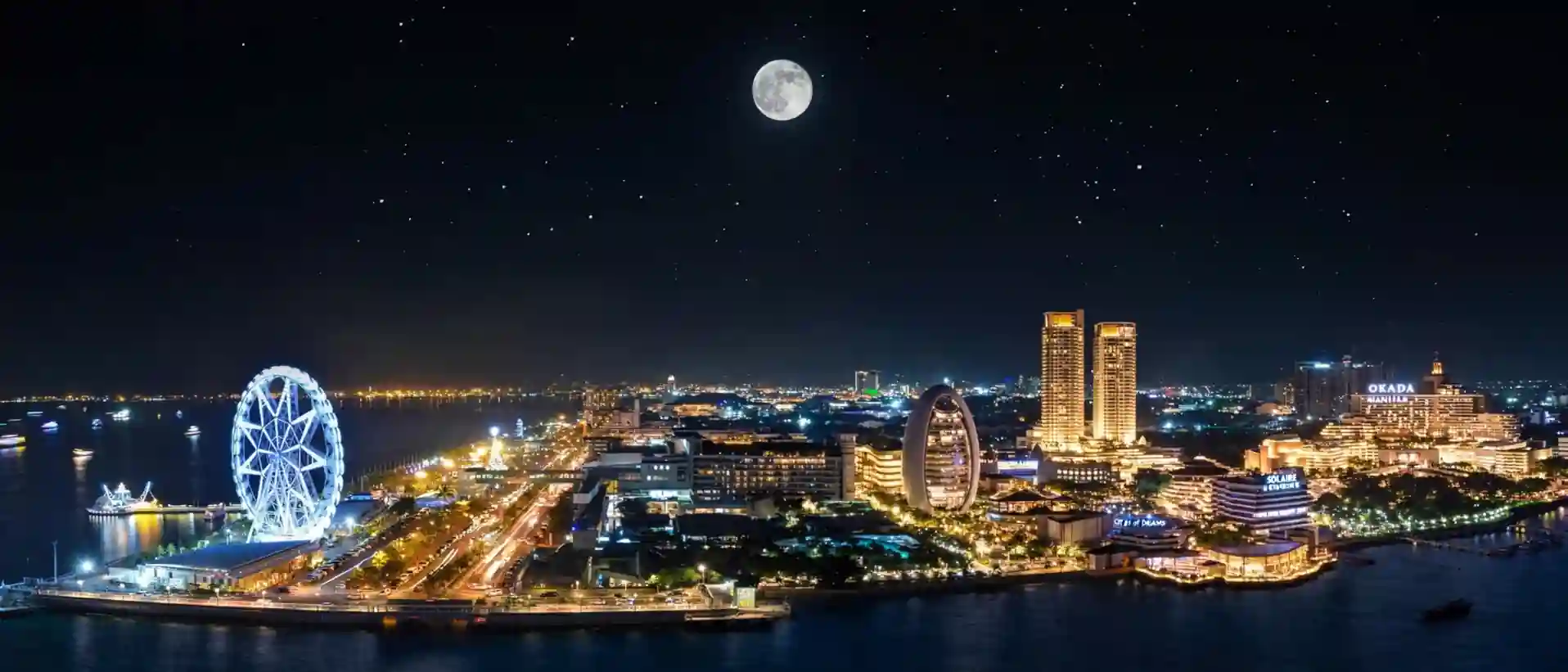
☽ Best Places to View the Moon in Parañaque City, Philippines
Parañaque sits at roughly 14.5°N on the shore of Manila Bay in south-west Metro Manila. The city is generally flat, with low coastal and reclaimed land along the bay and somewhat higher ground to the east, so the views are of the bay to the west and of built-up land inland. It is a bay city in two parts: a protected coastal wetland shared with Las Piñas, and the reclaimed Bay City and Aseana City commercial districts. At this latitude the Moon rises between roughly east-north-east and east-south-east and climbs high: a full Moon near the December solstice passes within about 15° of the zenith, while one near the June solstice crosses the southern sky at roughly 47° to 57°. Manila Bay lies to the west, so a setting Moon can fall over the water on many dates, though the Cavite shore lies to the south-west, so check where it will actually set. Exact rise and set times and azimuth depend on the date and your observing position, so check both before planning a specific composition.
Las Piñas–Parañaque Wetland (LPPCHEA) – Freedom Island
A 175-hectare protected coastal wetland on Manila Bay, made up of Freedom Island in Parañaque and Long Island in Las Piñas, with mangroves, shallow lagoons and coastline. It was declared a critical habitat in 2007 and listed as a Ramsar Wetland of International Importance in March 2013, and it is a sanctuary for resident and migratory birds. The wetland is shared between the two cities, and its open edges give broad western horizons over Manila Bay, where the Sun and, on many dates, the Moon set over the water. It is free to enter but needs prior clearance from the DENR, facilities are minimal, and the visitor center has a second-storey viewing deck, so check current access rules before planning a late visit.
Parqal – Aseana City Linear Park
A five-hectare mixed-use development on Macapagal Boulevard in Aseana City, with retail, offices and al fresco dining around a linear greenway under a 300-metre canopy. The paved promenades and open plazas give sections of sky among the low-rise buildings, not unobstructed horizons. It is privately managed, so access and evening hours vary with management, and you should confirm before a late-night visit.
Aseana City & the Bay City Reclamation District
Aseana City is a mixed-use central business district of about 204 hectares in the Bay City area, and the Ayala Malls Manila Bay area within it has landscaped gardens, lawns and promenades. Bay City is Parañaque's main reclaimed-land setting along Manila Bay, but it is not a continuous public waterfront, and much of Aseana City sits inland from the bay edge. Where a public western edge exists, it can frame a moonset over the bay when the setting azimuth for your date lines up. It is a working commercial district, so use designated public areas only.
Parañaque River Mouth – La Huerta & Don Galo
The Parañaque River reaches Manila Bay near the La Huerta and Don Galo areas, with riverside and roadside viewpoints in low-lying community areas. Not every part of the river mouth is suitable or open for photography, so use only specific accessible public viewpoints, and check the tide and current conditions before visiting. A west-facing viewpoint can show a moonset over the water when the azimuth lines up.
Skywatchers Society of Las Piñas – Nearby Events
Parañaque has no regular public telescope night of its own, but the Skywatchers Society of Las Piñas, a local group in the next city, is active: Space Week 2026 listings included a Moon and Rocket Exhibit at Robinsons Place Las Piñas, run with the Philippine Space Agency. Check the group's announcements for events and telescope viewing.
PAGASA Observatory – Telescopes 20 km North-North-East
The PAGASA Astronomical Observatory at UP Diliman in Quezon City, about 20 km north-north-east, has a 45-cm telescope open for public use that can show the Moon and planets. It holds sessions on request, with a letter to PAGASA at least two weeks ahead, and free walk-in sessions during events such as Philippine Space Week, weather permitting. Check PAGASA for current dates.
◉ Best Times for Moon Photography in Parañaque City
📷 Quick Photography Tips for Parañaque City
🕐 Timezone: Parañaque City runs on Philippine Standard Time (UTC+8) year-round; the Philippines does not observe daylight saving time. Photo-planning apps such as PhotoPills or Stellarium will work out the Moon's exact rise azimuth for any of these spots.
🔭 Telescope Option: Parañaque has no regular public telescope night. The PAGASA Astronomical Observatory at UP Diliman in Quezon City, about 20 km north-north-east, holds sessions on request, with a letter to PAGASA at least two weeks ahead, and free walk-in sessions during Space Week events. For the moon phase in any other city, use the calculator on our home page.
The moon phase today in Parañaque City is shown in detail above — complete with exact illumination percentage, moonrise/set times, and the best local spots to see it. For the moon phase today in any other city worldwide, visit our Dynamic Moon Phase Calculator on the home page.
◐ What the Experience Actually Feels Like
At the Las Piñas–Parañaque Wetland, the Moon shares the evening with Manila Bay. The wetland is one of Metro Manila's last natural coastal areas, a bird sanctuary on the edge of the bay, and its open edges look straight out over the water to the west. When the calm and the azimuth line up, a setting Moon over the bay, with its reflection, is the best Moon-watching in the city, though access is by prior clearance and facilities are limited.
Aseana City is the urban contrast. Parqal and the Ayala Malls Manila Bay gardens are walkable and well lit, with the Moon appearing over low-rise buildings and canopy structures. The sky is bright with commercial glow, but the Moon cuts through it easily, and at this latitude it climbs high rather than hugging the horizon.
For the Moon through a telescope, the nearest options are the PAGASA observatory at UP Diliman and the events of the Skywatchers Society of Las Piñas next door. The rainy season, roughly June to November, can cover the Moon for days, and Manila Bay tides and surge are worth checking in typhoon season. The drier months from December make the better bet.
"Parañaque faces west across Manila Bay — a protected wetland on one side and a lit commercial district on the other, and the Moon can set over the water from either."
✓ Your Parañaque City Moon Chase Checklist
Before You Go
- Check the moonrise time and phase on this page for your date — some days have no moonrise at all
- Seek prior clearance from the DENR for the wetland, which is a protected area with limited facilities
- Use PhotoPills or Stellarium to check whether the Moon will set over the bay or line up with a landmark on your date
- Check access for Parqal, Aseana City and the Ayala Malls Manila Bay area, which are privately managed and can change with management
- Check the current PAGASA forecast, tide levels for Manila Bay and the Parañaque River, and typhoon advisories, especially from June to November
What to Bring
- A telephoto lens, often 200 mm or longer, to frame the Moon tightly against the Parqal canopy or the wetland mangroves, plus a wider lens for bay reflections
- A sturdy tripod and a remote shutter release or 2-second timer to avoid shake
- A lens cloth for humidity, sea spray and haze, which are common on the bay in the evening
- A light rain layer and water-resistant footwear during the rainy season, June to November
- Some Philippine pesos for food or parking in Bay City, where prices change often
On the Night
- Arrive early at Parqal and the Bay City waterfront, which can get busier after sunset, particularly on weekends
- Focus manually on the Moon's edge, since Bay City lighting can confuse autofocus at dusk
- Bracket exposures: one for the bright lunar disc and another for the darker wetland, promenade or river mouth below
- Stay in designated public areas and on protected-area trails, and avoid mangrove restoration zones and private areas without permission
? Parañaque City Moon Phase — Frequently Asked Questions
Q. What is the moon phase today in Parañaque City?
The moon phase today in Parañaque City is a Waning Crescent with 34% illumination. The next full moon is in 22 days, on Oct 26. Moonrise is at 12:32 AM and moonset at 1:55 PM.
Q. Where is the best place to view the moon in Parañaque City?
Parañaque City sits on the shore of Manila Bay in south-west Metro Manila, so the bay lies to the west and the best Moon-over-water spots face that way. The Las Piñas–Parañaque Critical Habitat and Ecotourism Area, a 175-hectare protected coastal wetland shared with Las Piñas, has broad open views over the bay from Freedom Island, though entry needs prior clearance from the DENR. Parqal and the wider Aseana City district give paved promenades and open plazas among low-rise buildings, and the Bay City reclamation district is the city's main reclaimed-land setting.
Q. Can I look at the moon through a telescope in Parañaque City?
Not in Parañaque at a regular public night that is advertised. The nearest is the PAGASA Astronomical Observatory at UP Diliman in Quezon City, about 20 km north-north-east, which has a 45 cm telescope open for public use. PAGASA holds stargazing sessions on request, with a letter at least two weeks ahead, and free walk-in sessions during events such as Philippine Space Week. Next door in Las Piñas, Space Week 2026 listings included a Moon and Rocket Exhibit at Robinsons Place Las Piñas, run by the Skywatchers Society of Las Piñas with the Philippine Space Agency, so watch for that group's events.
Q. Where does the moon rise and set in Parañaque City, and how high does it climb?
At about 14.5°N, the Moon in Parañaque City rises and sets fairly close to due east and west, between roughly east-north-east and east-south-east for moonrise. A full moon near the December solstice passes high overhead, typically within about 15° of the zenith, while a full moon near the June solstice crosses the southern sky at roughly 47° to 57°. Manila Bay lies to the west, so a setting Moon can fall over the water on many dates, though the Cavite shore lies to the south-west, so check where it will actually set. Crescent moons often look tilted, lying on their back like a bowl or a boat.
Q. Is light pollution a problem for moon observing in Parañaque City?
The moon is bright enough to observe and photograph from almost anywhere in Parañaque City, so light pollution rarely limits the lunar disc itself. It does wash out earthshine on a thin crescent and any faint sky detail. Aseana City and the Bay City district are heavily lit commercial areas, so stars are faint there. The wetland and the coastal road may have lower lighting than the commercial areas, depending on your viewpoint, but they are still inside Metro Manila's glow.
Q. What camera settings and phases work best for moon photography in Parañaque City?
For a full moon, start with Looney 11 (f/11, ISO 100, 1/100 s) and refine using your histogram, since it is a baseline rather than a guarantee. Shoot RAW and expose for the lunar disc, because Bay City lighting is far dimmer than the moon. To make the moon look large against the Parqal canopy or the wetland mangroves, shoot from a substantial distance with a long telephoto lens, often 200 mm or longer. A waxing gibbous moon rises before sunset, giving a useful blue-hour window, and over the bay you can bracket exposures for reflections.
Q. How do the rainy season, typhoons and tides affect moon viewing in Parañaque City?
The Philippines has a rainy season from about June to November and a drier season from about December to May, with typhoon activity typically peaking from July to October. This is national climatological guidance, not a Parañaque prediction. Parañaque is low-lying along Manila Bay, so tides and storm surge matter as well as cloud and humidity. Check the current PAGASA forecast, tide levels for Manila Bay and the Parañaque River, and typhoon advisories before going out.
Q. What time zone are Parañaque City's moonrise and moonset times shown in?
Parañaque City uses Philippine Standard Time, UTC+8, all year, and the Philippines does not observe daylight saving time, so there is no clock change to account for. Parañaque City lies at about 121.0°E, just east of the 120°E meridian on which UTC+8 is based, so the sun and moon cross the sky about 4 minutes earlier on the clock than they would on that meridian.
Q. Can I shoot the moon at Parañaque City's viewpoints after dark?
Only some, and with care. The Las Piñas–Parañaque wetland is a protected area that is free to enter but needs prior DENR clearance, and its facilities are limited, so check access rules before planning a late visit. Parqal, Aseana City and the Ayala Malls Manila Bay area are privately managed, so access and evening hours vary with management. For river-mouth and roadside spots on the coast, use only specific accessible viewpoints, and check tide and current conditions.
✦ Explore Further
Moon Phase Today: Las Piñas
Check tonight's moon phase in Las Piñas, roughly 5 km south-west of Parañaque City beside the shared wetland.
🏙️Moon Phase Today: Taguig City
See the moon over Taguig City, roughly 5 km north-east of Parañaque City toward Laguna de Bay.
🌍World Moon Phase Directory
Find the moon phase, rise and set times for cities in every region of the world.
Blue Hour Calculator
Work out when blue hour falls, ideal for waxing gibbous shots over Manila Bay.