
Moon Phase Today Davao
On Monday, October 5, 2026, the moon in Davao is a Waning Crescent with 34% illumination. Moon age: 23.7 days.
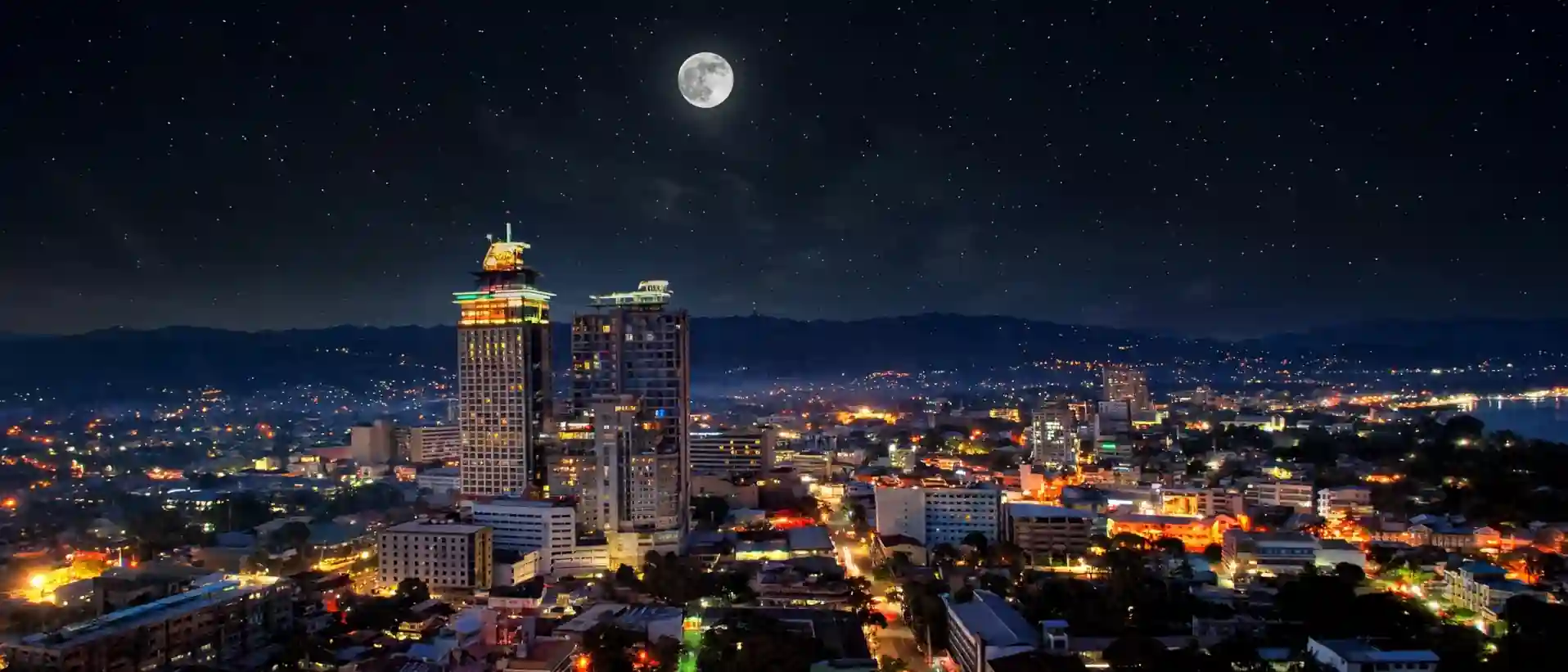
☽ Best Places to View the Moon in Davao City, Philippines
Davao City sits at roughly 7.2°N on the north-western shore of Davao Gulf, near its head, with Samal Island across the water to the east. That puts the gulf roughly east of the urban waterfront, not west, the reverse of the more famous Philippine bay-city arrangement, so many waterfront and hillside viewpoints face broadly toward the part of the sky where the Moon rises. At this latitude the Moon rises and sets fairly close to due east and west, but the rising azimuth swings well north or south of east depending on the date. A full Moon near the December solstice passes high overhead, roughly 69° to 79° up, a little north of the zenith, while one near the June solstice crosses the southern sky at roughly 54° to 65°. On clear evenings Mount Apo, the highest peak in the Philippines, is visible from much of the city and adds its own silhouette to the scene. Exact rise and set times and azimuth depend on the date and your observing position, so check both before planning a specific composition.
Jack's Ridge
A hilltop dining and viewing complex on Shrine Hills in Matina, built on the site of a former Japanese military headquarters, with surviving WWII-era tunnels beside its restaurants and view decks. It is best known for its night view over the city, and it looks out over Davao Gulf and Samal Island, with Mount Apo visible on clear days. Listings show it open into the late evening, so it is one of the more plausible nighttime spots here, but it is a private dining venue, so check current hours and any tripod policy before visiting.
Ramon Magsaysay Park & Sta. Ana Wharf
An open public park beside Sta. Ana Wharf in central Davao, the departure point for passenger ferries to Samal and Talicud islands. It is a workaday waterfront, not a polished promenade, but it is open to the water, and looking east from the seawall puts you facing the part of the sky where the Moon rises, across Davao Gulf. The ferries run on a daytime schedule and generally stop by early evening, so check departure times before planning around them.
Azuela Cove Seaside Esplanade – Lanang
A waterside mixed-use estate in Lanang, developed by Ayala Land and the Alcantara Group, with a public seaside esplanade completed in 2023 that faces Davao Gulf and Samal Island directly, with a vantage toward Mount Apo as well. It is a newer and more clearly public option than the older hotel-fronted stretches of Lanang, with shops and restaurants along the promenade. Check current hours for the esplanade area specifically.
People's Park
A cultural park in the Poblacion District, landscaped with native plants, footbridges, man-made waterfalls and large sculptures representing Davao's identity. It is free and centrally located, and listed as open from 7 a.m. to 10 p.m., though other sources give different hours, so check before visiting at night. As an inland downtown park its view of the horizon is limited by the surrounding buildings, so you catch the Moon between rooflines more than watching it rise clear.
Samal & Talicud Islands
Samal and the smaller Talicud Island sit across Davao Gulf from the city, reached by passenger ferry from Sta. Ana Wharf or the vehicle ferry from Sasa Wharf. Isla Reta, a well-known beach, is on Talicud, not on Samal itself. Some west-facing beaches look back across the gulf toward the Davao skyline, though not every beach faces that way. The public ferries run on a daytime schedule and stop in the late afternoon or early evening, so this works best as a day trip, or with an overnight stay at a resort on the island.
PAGASA Davao Regional Centre – Telescope on Request
Davao has no regular public telescope night that is advertised, but PAGASA's regional field station in the city is one of four, with Cagayan de Oro, Cebu and Legazpi, that has a 25 cm telescope available for stargazing and telescoping sessions for local residents. Sessions are arranged on request, so contact PAGASA in advance, and observing depends on the weather. Check PAGASA and local schools for one-off events.
◉ Best Times for Moon Photography in Davao City
📷 Quick Photography Tips for Davao City
🕐 Timezone: Davao City runs on Philippine Standard Time (PhST, UTC+8) year-round; the Philippines does not observe daylight saving time. PAGASA uses PhST rather than PST to avoid confusion with Pacific Standard Time. Photo-planning apps such as PhotoPills or Stellarium will work out the Moon's exact rise azimuth for any of these spots.
🔭 Telescope Option: PAGASA's Davao regional centre has a 25 cm telescope for stargazing sessions for local residents, arranged on request. Contact PAGASA in advance, and check for one-off events. For the moon phase in any other city, use the calculator on our home page.
The moon phase today in Davao City is shown in detail above — complete with exact illumination percentage, moonrise/set times, and the best local spots to see it. For the moon phase today in any other city worldwide, visit our Dynamic Moon Phase Calculator on the home page.
◐ What the Experience Actually Feels Like
At Jack's Ridge, dinner crowds come mainly for the city lights and the cool hilltop breeze, not a literal sunset, since much of the main view is inland toward the city. But on a given night a Moon rising somewhere across the eastern sky, with the city or Samal Island forming the foreground, can hold the whole table's attention just as easily.
Down at Magsaysay Park, the mood is more workaday, with passengers and activity around the ferry terminal and a scatter of people out for an evening walk. It is not a polished promenade, but it is open to the water, and looking east from the seawall puts you facing the part of the sky where the Moon rises. The Azuela Cove esplanade in Lanang is the tidier version of the same view.
People's Park feels contained, with its sculptures and shaded paths, a pleasant green space when its evening hours allow, even though the surrounding buildings mean you catch the Moon between rooflines. For the Moon through a telescope, the nearest option is PAGASA's regional centre, by arrangement, and since Davao's rain falls across the year, the forecast matters more than the season.
"At Magsaysay Park, looking east from the seawall puts you facing where the Moon rises — a small reversal of how most Philippine bay cities are arranged."
✓ Your Davao City Moon Chase Checklist
Before You Go
- Check the moonrise time and rise azimuth for your date — the date and your location determine the Moon's rise time and direction, while your viewpoint determines how much of that horizon is unobstructed
- Remember Davao Gulf lies roughly east of the urban waterfront, so most east-facing water viewpoints look toward where moonrise occurs, the opposite of the usual bay-city layout
- Check that public ferries to Samal generally stop by early evening, and that Eden Nature Park is listed as open about 9 a.m. to 5 p.m., before building an evening around either
- Check current opening hours at People's Park and Jack's Ridge directly, since posted hours vary between sources
- Use PhotoPills or Stellarium to check whether the Moon will line up with Samal Island or a landmark on your date, and check the forecast for cloud cover and rain
What to Bring
- A telephoto lens, often 200 mm or longer, to frame the Moon tightly against the skyline from Jack's Ridge or across the gulf from Magsaysay Park
- Philippine pesos for ferry fares, food and venue purchases, since People's Park and Magsaysay Park are free to enter but ferries and Jack's Ridge dining are not
- A sturdy tripod and a remote shutter release or 2-second timer to avoid shake
- A lens cloth, since humidity can fog a lens quickly when moving between air-conditioned malls and the outside air
- A light rain layer, since a shower can arrive with little warning at any time of year
On the Night
- Arrive at your viewpoint at least 30 to 45 minutes early, especially at Jack's Ridge on weekend evenings
- Focus manually on the Moon's edge, since restaurant lighting and city glow can confuse autofocus at dusk
- Bracket exposures: one for the bright lunar disc and another for the darker gulf, skyline or park below
- If the Moon looks soft or hazy right at moonrise, consider waiting until it climbs higher, when atmospheric effects are often less pronounced
- Confirm current closing times before you go, and plan to be back with time to spare rather than counting on staying past posted hours
? Davao City Moon Phase — Frequently Asked Questions
Q. What is the moon phase today in Davao City?
The moon phase today in Davao City is a Waning Crescent with 34% illumination. The next full moon is in 22 days, on Oct 26. Moonrise is at 12:27 AM and moonset at 1:23 PM.
Q. Where is the best place to view the moon in Davao City?
Davao City sits on the north-western shore of Davao Gulf, with Samal Island across the water to the east, so the urban waterfront faces broadly toward the part of the sky where the Moon rises, the reverse of the usual Philippine bay-city layout. Ramon Magsaysay Park beside Sta. Ana Wharf looks out across the gulf, and the Azuela Cove esplanade in Lanang faces Samal Island directly. Jack's Ridge, a hilltop dining complex on Shrine Hills, has night views over the city and the gulf. On clear evenings Mount Apo, the highest peak in the Philippines, is visible from much of the city.
Q. Can I look at the moon through a telescope in Davao City?
Yes, by arrangement. PAGASA lists Davao as one of four cities, with Cagayan de Oro, Cebu and Legazpi, where its regional centre has a 25 cm telescope available for stargazing and telescoping sessions for local residents. Sessions are arranged on request, so contact PAGASA in advance, and observing depends on the weather. There is no regular public night that is advertised, so check PAGASA and local schools for one-off events.
Q. Where does the moon rise and set in Davao City, and how high does it climb?
At about 7.2°N, the Moon in Davao City rises and sets fairly close to due east and west, but the rising azimuth swings well north or south of east depending on the date. A full moon near the December solstice passes high overhead, roughly 69° to 79° up and a little north of the zenith, while a full moon near the June solstice crosses the southern sky at roughly 54° to 65°. From the waterfront, moonrise is over the gulf side, with Samal Island or open water as the horizon depending on the date and your viewpoint. Check the azimuth for your date and exact spot.
Q. Is light pollution a problem for moon observing in Davao City?
The moon is bright enough to observe and photograph from almost anywhere in Davao City, so light pollution rarely limits the lunar disc itself. It does wash out earthshine on a thin crescent and any faint sky detail. The downtown, the restaurants of Jack's Ridge and the city glow add skyglow, so stars are faint in the city, while the gulf side is darker. Moving up into the hills gives a wider view but not a dark sky.
Q. What camera settings and phases work best for moon photography in Davao City?
For a full moon, start with Looney 11 (f/11, ISO 100, 1/100 s) and refine using your histogram, since it is a baseline rather than a guarantee. Shoot RAW and expose for the lunar disc, because restaurant, gulf-side and park lighting is far dimmer than the moon. A telephoto lens does not enlarge the moon relative to the foreground on its own, but shooting from farther away from a distant landmark, with a longer focal length of 200 mm or more, lets you frame the composition tightly. A waxing gibbous moon rises before sunset, giving a useful blue-hour window.
Q. How do the rainy season and typhoons affect moon viewing in Davao City?
Unlike much of the Philippines, Davao's rainfall is spread fairly evenly across the year and does not follow a sharply defined wet and dry season, so check the forecast for cloud cover and afternoon showers in any month. Davao is also hit directly by tropical cyclones far less often than Luzon or the Visayas, though it is not completely exempt. A light rain layer is a good idea at any time of year, since a shower can arrive with little warning. Check the current PAGASA forecast before going out.
Q. What time zone are Davao City's moonrise and moonset times shown in?
Davao City uses Philippine Standard Time, UTC+8, all year, and the Philippines does not observe daylight saving time, so there is no clock change to account for. PAGASA uses the abbreviation PhST for it to avoid confusion with Pacific Standard Time. Davao City lies at about 125.5°E, well east of the 120°E meridian on which UTC+8 is based, so the sun and moon cross the sky about 22 minutes earlier on the clock than they would on that meridian.
Q. Can I shoot the moon at Davao City's viewpoints after dark?
Some, with care. Jack's Ridge is a private dining venue that is listed as open into the late evening, so check current hours and any tripod policy. People's Park is free and listed as open from 7 a.m. to 10 p.m., though its view of the horizon is limited by the surrounding buildings. Passenger ferries to Samal run on a daytime schedule and stop by early evening, and Eden Nature Park, about an hour's drive away, is listed as open 9 a.m. to 5 p.m., so neither suits a night visit.
✦ Explore Further
Moon Phase Today: General Santos
Check tonight's moon phase in General Santos, roughly 125 km south-south-west of Davao City on Sarangani Bay.
🌊Moon Phase Today: Cagayan de Oro
See the moon over Cagayan de Oro, roughly 165 km north-west of Davao City on Macajalar Bay.
🌍World Moon Phase Directory
Find the moon phase, rise and set times for cities in every region of the world.
Blue Hour Calculator
Work out when blue hour falls, ideal for waxing gibbous shots over Davao Gulf.